
Notarized Translation
Get compliant notarized translation—also spelt notarised translation in the UK—completed by expert legal linguists and coordinated with a UK notary. Optional apostille/legalisation available for overseas submission. Upload your file and we’ll confirm the exact steps your case needs.
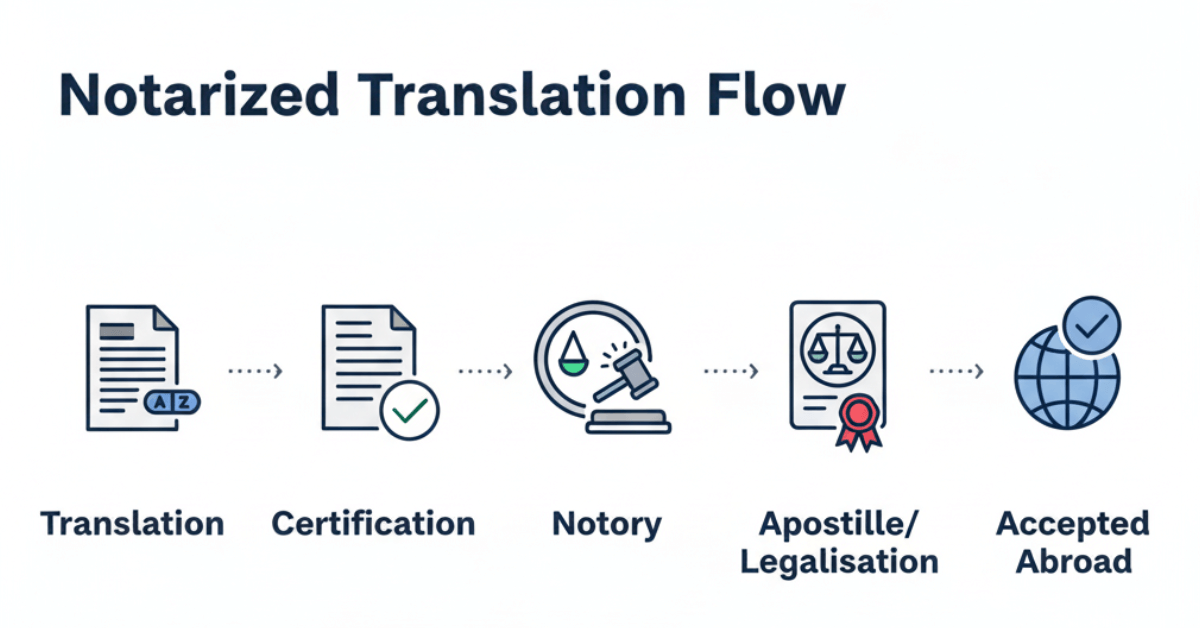
What is a Notarized (Notarised) Translation?
A notarised translation is a certified translation that is signed and witnessed by a UK notary. The notary’s role is to verify identity, capacity and understanding of the signer (typically the translator/authorised representative) and formally attest the signature. The notary’s attestation is what makes the certification recognised abroad.
In many cross-border filings, authorities also ask for an apostille from the UK Legalisation Office to recognise the notary’s signature internationally.
Get a Notarized Translation
When do you need a notarised translation?
-
Consular filings (marriage, birth, visa, sponsorship)
-
Company registrations and corporate records for use overseas
-
Powers of attorney and notarial acts referring to a translation
-
Academic/immigration submissions where a notary is required by the receiving body
-
Court bundles for foreign jurisdictions
-
Documents bound for apostille under the Hague Convention (often required after notarisation)

Translate in every language
Notarised vs Certified vs Apostille vs Legalised
Certified Translation (UK)
A translated document accompanied by a translator’s certificate of accuracy (signed, dated, with credentials). Often sufficient for UK authorities, banks and solicitors.
Notarised Translation
A certified translation whose certificate is signed in front of a notary, who verifies the signer’s identity and executes a notarial act. Required when an overseas authority demands a notary public’s involvement.
Apostille (Legalisation)
An apostille from the UK Legalisation Office confirms the authenticity of the notary’s signature/seal so the document is accepted in other Hague member states. You can apply for a paper apostille or e-Apostille.
Consular Legalisation
For non-Hague states, additional consular legalisation may be required after notarisation.
Our 5-Step Process (fast and clear)
- Upload your files – secure portal; we confirm needs (certified only vs notarised; apostille if required).
- Human legal translation – assigned to a vetted specialist; QA check.
- Certification pack – translator’s statement prepared to UK standards.
- Notary appointment – we coordinate identity checks and signing with a UK notary (remote/e-notary may be possible where permitted).
- Apostille/legalisation (optional) – we arrange Legalisation Office submission and return.
Deliverables: secure PDF + optional hard-copy bundle with notarial seal; tracked delivery.
Why Transcribe Lingo?
-
Legal-grade accuracy: specialist linguists for law, immigration, corporate and public sector.
-
End-to-end compliance: certification → notarisation → apostille in one managed flow.
-
Speed without shortcuts: same-day/next-day options where feasible.
-
Security & GDPR: encrypted file handling, UK/EU-aligned data standards.
-
Transparent pricing: itemised quotes with all disbursements before you approve.
Turnaround & Pricing
Project times depend on language pair, length, notary availability, and (if needed) Legalisation Office processing. We’ll confirm:
-
translation time,
-
notary scheduling,
-
apostille timeline (paper or e-Apostille), and
-
courier/return options.
Compliance notes (UK)
-
UK notaries verify identity, capacity and understanding before attesting signatures.
-
Notarial acts are internationally recognised; the Faculty Office regulates the profession.
-
Overseas recipients frequently request apostille after notarisation.
FAQs
Q1. Do I need a notarised translation or will certified be enough?
If your recipient explicitly asks for a notary or apostille, choose notarised translation; otherwise UK bodies often accept certified translations. When in doubt, share their instructions and we’ll advise the minimal compliant route.
Q2. What exactly does the notary do?
A UK notary verifies identity, capacity and understanding, then witnesses/attests the signature on the translator’s certification. This creates a notarial act recognised abroad.
Q3. Will I also need an apostille after notarisation?
Many foreign authorities require an apostille to recognise the notary’s signature. We can arrange paper or e-Apostille with the UK Legalisation Office. (Keywords: apostille for notarised translation UK)
Q4. Can notarisation be done online?
Q5. How fast can I get a notarised translation?
Often 1–3 working days for translation + notary scheduling, with expedited paths where feasible. Apostille timings depend on the Legalisation Office service chosen.
Q6. Which documents most commonly need notarisation?
Powers of attorney, corporate records, civil status documents, academic certificates and immigration packs destined for overseas use.
Ready to get started?
Prefer to talk? +44 121 295 8707 (UK) · +1 213 669 6381 (US)
★★★★★ Average client rating (internal NPS data)
NDA on request | UK GDPR aligned | Secure file upload
Experienced post-editors across legal, healthcare, finance, and tech