

Medical transcription pricing in 2026 sits at the intersection of accuracy, speed, and risk. Clients want fast turnaround and clean, structured notes. You want pricing that protects your time, covers compliance overhead, and still feels fair.
Here’s the simplest way to think about it:
You’re not charging for “minutes of audio.” You’re charging for the time, skill, and responsibility required to turn sensitive clinical speech into usable, accurate documentation.
This guide gives you how to charge realistic rate ranges for medical transcription, explains the most common pricing models, and includes a plug-and-play calculator so you can decide exactly what to charge.
The going rate in 2026 (quick answer)
Most medical transcription work in 2026 falls into one of these real-world pricing bands:
- Per 65-character line: $0.09–$0.18 per line (higher for complex specialties, rush jobs, poor audio, heavy formatting)
- Per audio minute: $1.75–$4.50 per minute (higher for STAT turnaround, multiple speakers, messy dictation)
- Per hour of audio (project fee): $105–$270+ per recorded hour (useful for client budgeting, but quote it as a project total)
If you’re UK-based (or quoting UK clients), professional human transcription often starts around £2.20 per audio minute and scales up based on complexity and turnaround.
Why medical transcription costs more than “normal” transcription
If someone asks “how much do transcription services cost?” they often think of podcasts, meetings, or interviews.
Medical transcription is different because:
- Clinical terminology can’t be “close enough.”
- Formatting matters (SOAP notes, H&P, discharge summaries, referral letters, templates).
- Privacy expectations are higher (health data is sensitive, and mishandling it can be costly).
- Accuracy has consequences (misheard dosages, diagnoses, or procedures can create real risk).
That’s why “how much for transcription services” is always the wrong question in healthcare.
The right question is:
How should I charge for medical transcription services when accuracy is mission-critical?
You charge based on:
- how long it takes to produce a reliable transcript, and
- how much liability you absorb by handling sensitive medical content.
The 4 pricing models clients expect (and how to use each)
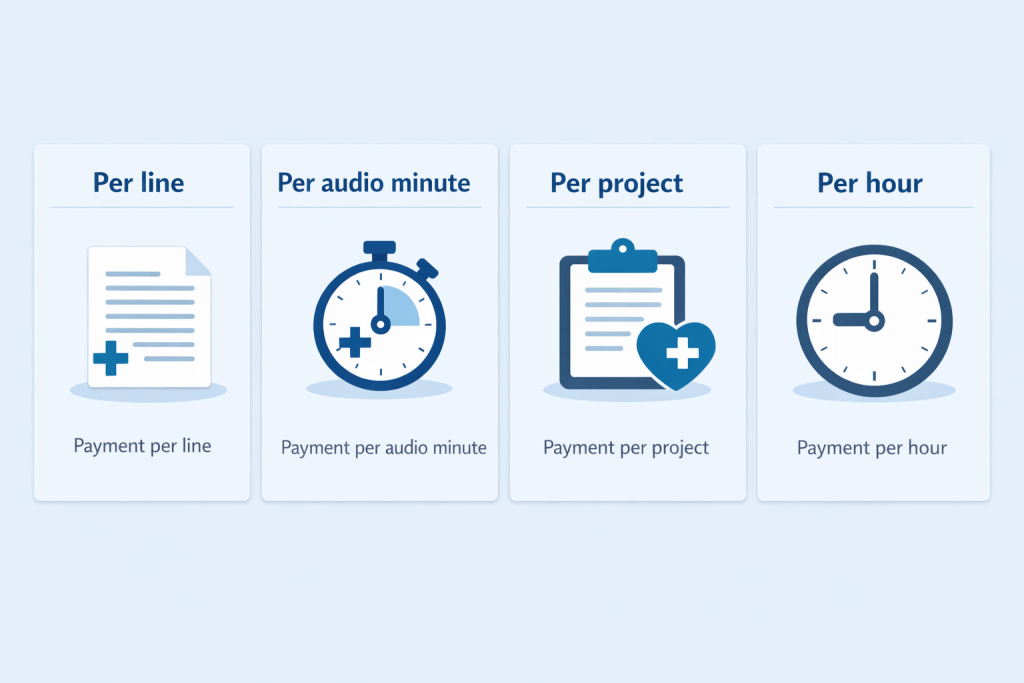
1) Per line (the classic medical model)
This is the most traditional approach in medical transcription.
Standard medical line definition: 65 characters, including spaces.
Best for: provider dictation, structured clinical notes, medical letters, consistent templates
Watch-outs: clients may ask what counts as a “line” (headers/footers/macros). Be explicit.
Typical 2026 rate: $0.09–$0.18 per line
When to use the higher end:
- STAT turnaround
- Heavy accents / low audio quality
- Highly technical specialties (cardiology, ortho, neuro, oncology)
- Lots of formatting or template compliance
2) Per audio minute (the easiest to sell)
This is the simplest for clients to understand.
Best for: clinics, private practices, telehealth recordings, short dictations
Watch-outs: audio minutes don’t reflect transcription effort (a “5-minute” file can take 30–60+ minutes).
Typical 2026 rate: $1.75–$4.50 per audio minute
3) Per project (flat fee)
You quote a total price for the file(s), usually based on length + complexity + turnaround.
Best for: agencies, hospitals, recurring clients, large batches
Watch-outs: you need a consistent method behind the scenes so you don’t underquote.
4) Per hour (avoid this unless you’re careful)
Charging “$X per hour” sounds fair… until the client asks why the bill doubled.
Best for: internal teams, long-term partnerships with clear scope
If you use it: translate it into an expected per-minute equivalent so everyone understands the final cost.
A fast way to convert line rate ↔ audio-minute rate
Clients compare quotes across providers, so you’ll often need conversions.
A practical estimate used for budgeting:
- 1 audio minute ≈ 12–16 standard 65-character lines (varies by speaker speed + formatting)
So:
- $0.12/line × 14 lines/min ≈ $1.68 per audio minute
- $0.16/line × 14 lines/min ≈ $2.24 per audio minute
Use 14 lines per minute as a baseline unless you have file-specific data.
The pricing calculator that prevents undercharging
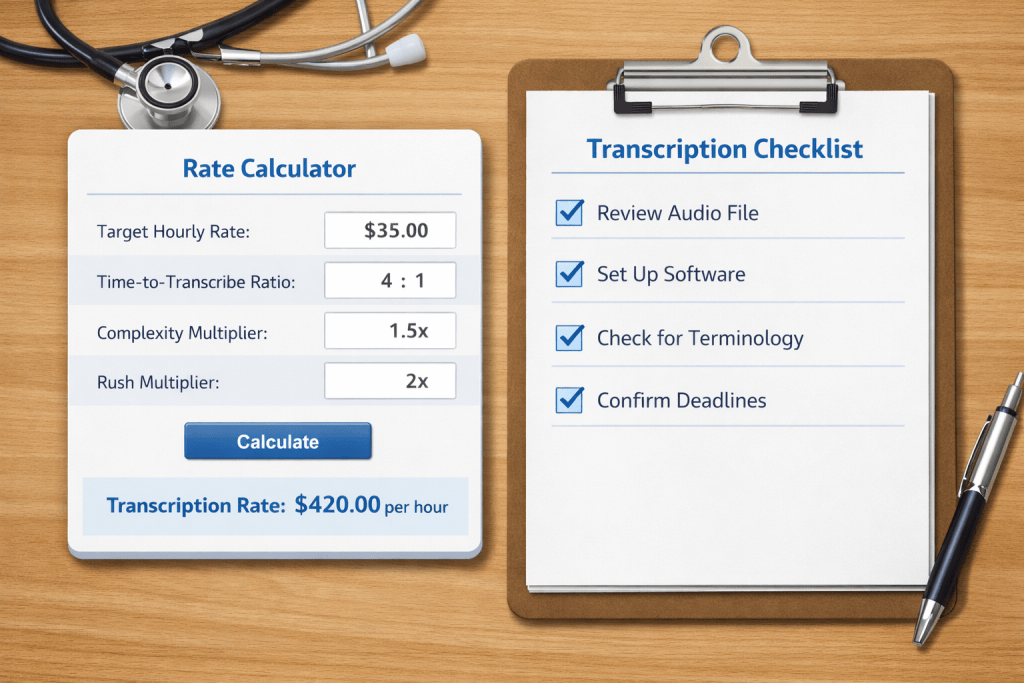
If you only take one thing from this guide, take this:
Your minimum sustainable price is driven by your target hourly rate and your time-to-transcribe ratio.
Step 1: Pick your target hourly earnings
Include everything: admin time, software, QA, insurance, taxes.
Example targets:
- Entry/intermediate: $25–$35/hr
- Experienced medical transcriptionist: $40–$60/hr
- Specialist + tight turnaround: $65+/hr
Step 2: Estimate your time-to-transcribe ratio (TTR)
TTR is how many minutes of work it takes to transcribe one minute of audio.
Typical ranges:
- Clean dictation, familiar specialty: 4×–6×
- Mixed audio, multiple speakers, heavy formatting: 6×–9×
- Poor audio, complex specialty, urgent: 9×–12×
Step 3: Use this formula (audio-minute rate)
Audio-minute rate = (Hourly target × TTR) ÷ 60 × Complexity multiplier × Rush multiplier
Suggested multipliers:
- Complexity: 1.0 (standard) / 1.25 (technical) / 1.5 (highly technical)
- Rush: 1.0 (standard) / 1.25 (24–48h) / 1.5 (same-day) / 2.0 (STAT)
Quick example
- Target: $45/hr
- TTR: 7×
- Complexity: 1.25
- Rush: 1.0
Audio-minute rate = (45 × 7) ÷ 60 × 1.25
= 315 ÷ 60 × 1.25
= 5.25 × 1.25
= $6.56 per audio minute
That’s not what most clients will pay for routine work, which tells you something important:
✅ Either reduce TTR (workflow + tools)
✅ Or narrow scope (cleaner audio, less formatting)
✅ Or choose clients who value premium accuracy
✅ Or price per line/project with clear inclusions (often easier to defend)
This is why “cheap rates” burn people out.
Medical transcription rate table (use this as a 2026 baseline)
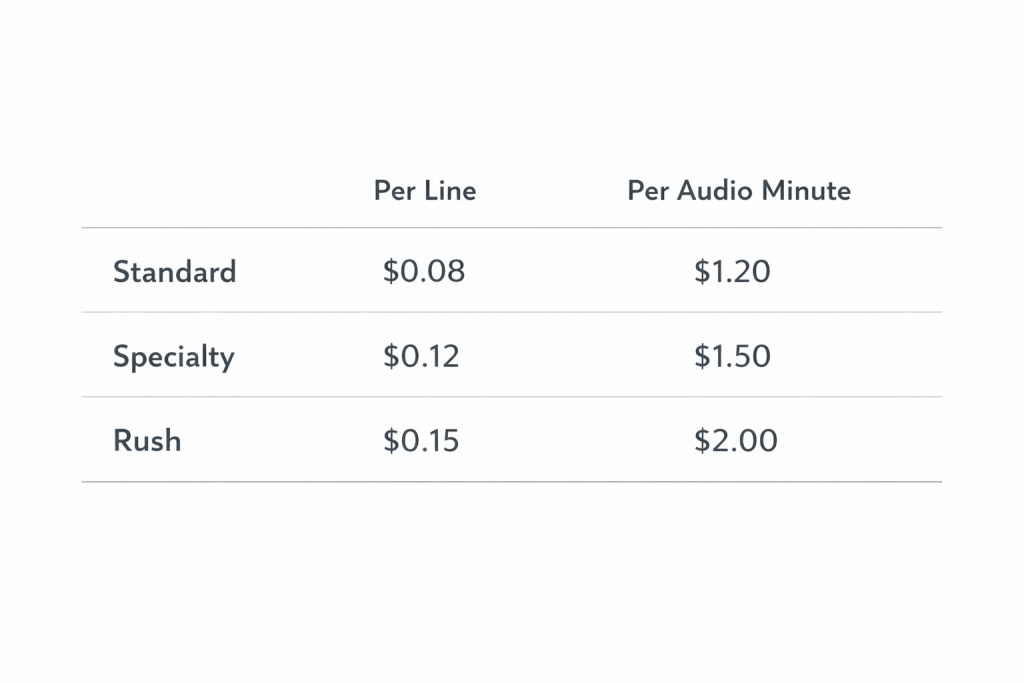
Standard turnaround, clear audio, single speaker
- Per line: $0.09–$0.13
- Per audio minute: $1.75–$2.50
Technical specialty, structured templates, careful QA
- Per line: $0.12–$0.16
- Per audio minute: $2.25–$3.50
Rush / poor audio / heavy accents / multiple speakers
- Per line: $0.15–$0.18+
- Per audio minute: $3.50–$4.50+ (sometimes higher for true STAT)
What drives the charges up (and what to list on your quote)
When clients ask “how much is transcription service?”, they’re really asking what affects the cost.
Use this checklist on your quote form (and in your scope):
Audio factors
- Background noise / low volume / cross-talk
- Strong accents or fast speech
- Number of speakers
- Phone recordings vs studio-quality
Medical complexity
- Specialty terminology (cardiology, neurology, oncology, orthopaedics)
- Heavy medication lists
- Lab values, imaging findings, procedure descriptions
Deliverable requirements
- SOAP/H&P/discharge summary formatting
- Templates/macros or EHR-ready structure
- Speaker labels, timestamps, strict formatting rules
- Proofreading level (basic vs double-pass QA)
Turnaround time
A fair rush ladder many clients accept:
- Standard: included
- 24–48h: +25%
- Same-day: +50%
- STAT: +100% (when truly urgent)
How to charge for medical transcription services without constant negotiation
Here’s the structure that keeps your pricing clean and defensible:
1) Offer 3 tiers clients can choose without a back-and-forth
- Essential: standard formatting, standard turnaround
- Clinical-ready: templates + terminology QA
- STAT: priority queue + fastest turnaround
2) Use minimums so small jobs don’t lose money
Examples:
- Minimum charge per file (even if it’s 2 minutes)
- Minimum batch total for discounted volume rates
3) Put the “line definition” and inclusions in writing
If you charge per line, define:
- What counts (headers, footers, templates)
- How rounding works
- What add-ons cost (timestamps, strict formatting, extra QA)
Real quote examples (copy this structure)
Example A: GP dictation, clear audio
- 18 minutes audio, standard turnaround
- Edited medical transcript, basic formatting
Quote: $2.25/min × 18 = $40.50
Example B: Specialist referral letter, heavy terminology
- 12 minutes audio, structured letter format, double-pass QA
Quote: $3.25/min × 12 = $39.00
Example C: Rush discharge summary, messy audio
- 22 minutes audio, same-day required, template compliance
Quote: $3.50/min × 22 = $77.00
Rush +50% = $115.50
This makes pricing feel predictable to clients and protects your margins.
Where can I transcribe audio for free (and when you shouldn’t)
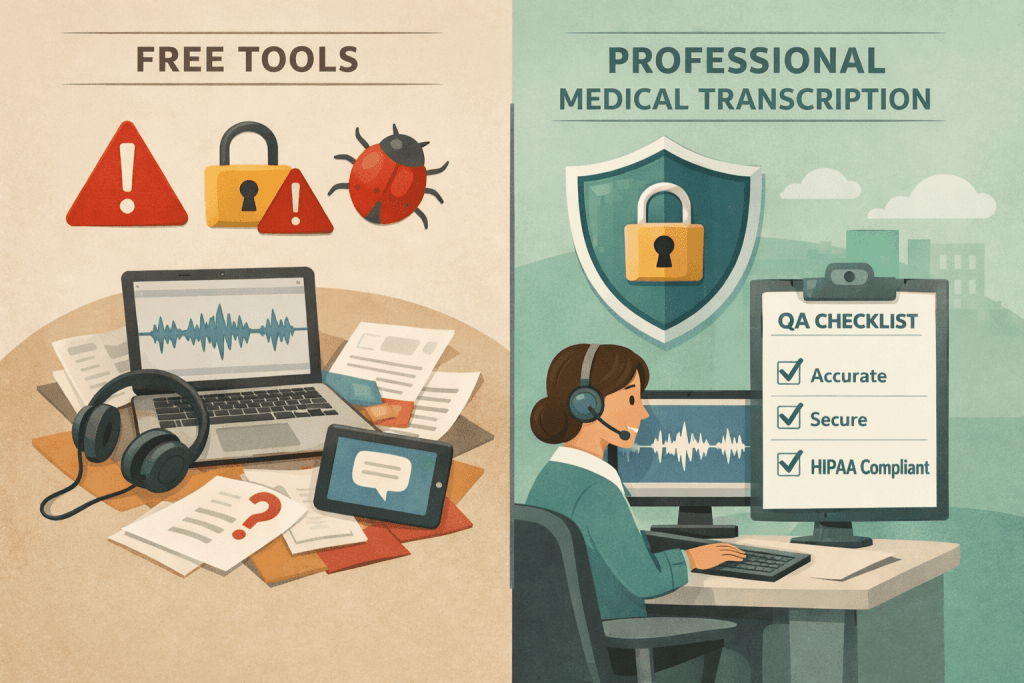
Yes, you can transcribe audio for free — but “free” usually means you pay with time, accuracy, or privacy.
Common free or low-cost options
- Voice typing tools (good for live dictation, not recorded audio)
- Free trials of transcription apps
- Open-source speech recognition you run locally
The medical reality check
If the recording contains patient-identifiable information, “free” tools can become risky fast unless you have explicit permissions, the right controls, and the right processing agreements.
A safer approach for healthcare workflows is:
- Use automation only for a first draft, and
- Have a trained human edit to clinical accuracy.
If you need a dependable medical transcript you can use clinically, it’s usually faster (and cheaper in total time) to send the file to a specialist team.
If you’d like, you can upload a short sample and we’ll return a no-obligation quote with the best-fit pricing model.
How much do medical transcription services cost if you choose AI vs human in 2026?
In 2026, many clients compare:
- AI-only (cheap, fast, inconsistent)
- Human-only (highest accuracy, higher cost)
- Hybrid (best balance for many medical use cases)
A useful way to position it:
- AI gets you speed
- Humans deliver reliability
- Hybrid delivers predictable accuracy at a controlled cost
If the output is going into a clinical workflow, “predictable accuracy” is usually the deciding factor.
A simple rate card you can publish (and update quarterly)
Use this language to reduce client confusion:
- Standard medical transcription: from $X per audio minute / $Y per line
- Specialty dictation: from $X per audio minute / $Y per line
- Rush (same-day): +50%
- STAT: +100%
- Add-ons: timestamps, speaker labels, strict templates, extra QA
Want to see a transparent example rate card? You can download ours here: Price rate card
Ready to charge a medical transcription job in minutes?
If you want a quote that accounts for audio quality, terminology, turnaround, and formatting, start here:
- Transcription services
- UK transcription rates
- Verbatim & intelligent verbatim options
- Contact the team
Upload a file, tell us your turnaround, and we’ll return a clear price with the right model (per minute, per line, or per project) — no guessing.
FAQs
What is the going rate or how should I charge for medical transcription services in 2026?
For general transcription, rates often cluster around per-minute pricing for human work, with higher ranges for technical subject matter. Medical transcription typically commands a premium because accuracy and formatting requirements are stricter.
How much should I charge for medical transcription per line?
Many medical transcription projects price using a 65-character line. In 2026, a common band is roughly $0.09–$0.18 per line, depending on specialty, audio quality, and turnaround.
How much to charge for medical transcription services per audio minute?
A practical medical range in 2026 is $1.75–$4.50 per audio minute, with rush work and complex specialties exceeding that when the scope requires.
How much do transcription services cost for one hour of audio?
One recorded hour can cost anywhere from low hundreds to more for medical work, depending on complexity and deadlines. The best way to avoid surprises is to quote per project or per minute with clear inclusions.
Where can I transcribe audio for free?
You can use voice typing tools, free trials, or open-source speech recognition. For medical recordings containing sensitive data, always confirm privacy protections and whether the tool is appropriate for handling health information.
