

Applying for a UK Student visa can feel simple on paper, then suddenly turn into a folder full of bank statements, sponsor letters, consent forms, transcripts and “one last document” your university asks for at the final moment. If any of those documents are not in English or Welsh, the translation needs to be clear, verifiable, and presented in a way that avoids delays.
This guide walks you through what typically needs translating for a Student visa (formerly Tier 4), how certified translations work in the UK, and how to prepare CAS packs, financial evidence translation, and academic documents translation so your application stays smooth.
If you’re ready to move, upload your files and get a quick quote with a confirmed turnaround time.
What “certified translation” means for a uk student visa document translation
For UK visa submissions, “certified translation” usually means:
- A complete and faithful translation of the original document (including stamps, seals, headers, handwritten notes, and official remarks)
- A signed certificate (sometimes called a Certificate of Accuracy) attached to the translation
- Clear contact details so the translation can be verified if needed
What your certification page should include (practical checklist)
Most requesting bodies look for these essentials:
- A statement confirming the translation is accurate and complete
- The date of translation
- The translator’s full name and signature (or the agency name and authorised signature)
- Contact details (email/phone/address) for verification
If you’re applying from inside the UK, some institutions may also expect the translator’s qualifications to be stated. If you’re unsure, we’ll format it to cover both scenarios.
Documents that commonly need translation for a UK Student visa
Your exact list depends on your nationality, course, and whether you’re applying from outside or inside the UK. As a rule, translate anything you submit that isn’t in English or Welsh.
Identity and civil status documents
Common examples:
- Birth certificate (often required for under-18s or where parents are funding)
- National ID card (if used as supporting identity evidence)
- Marriage certificate / divorce documents (if your circumstances require them)
- Legal guardianship paperwork (for under-18s)
Education and academic documents translation
Universities and visa submissions often involve:
- Degree certificate / diploma
- Academic transcript or marksheet
- Medium of instruction letter (where relevant)
- Award letters or scholarship confirmation
- Professional registration letters (if requested)
Financial evidence translation for uk student visa document translation
This is where many applications get slowed down—because the evidence must be readable, consistent, and easy to verify.
Typical documents:
- Bank statements
- Bank letters (balance confirmation, account verification, official statements)
- Fixed deposit certificates
- Scholarship or sponsorship letters
- Education loan sanction letters
- Consent letters from financial sponsor (and evidence of relationship, where required)
Under-18 documents and consent pack
If you’re under 18, you’ll usually need:
- Written consent from parents/legal guardians (covering your visa, travel, and living arrangements)
- Proof of relationship to your parent/guardian (often a birth certificate or official record)
Other supporting documents (case-by-case)
Depending on your situation, you may be asked for:
- Sponsor consent letter (especially if you’ve been sponsored recently)
- Accommodation confirmation (some institutions request it)
- Police certificates (if requested)
- Medical or vaccination records (rare for Student route, but sometimes requested by institutions)
CAS packs explained: what to translate (and what not to)
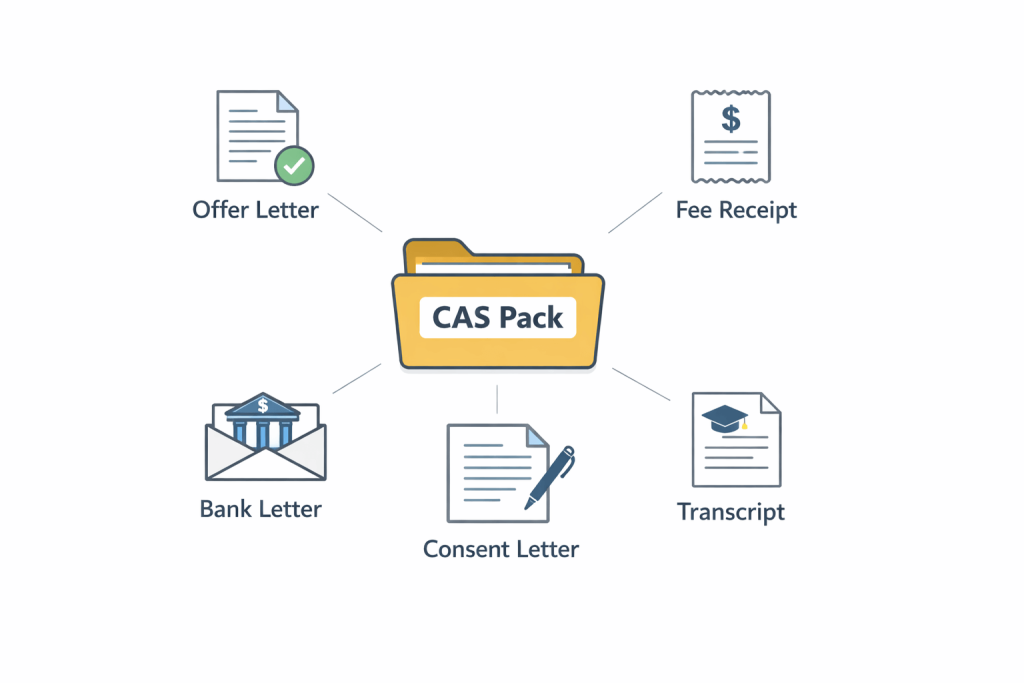
Your CAS (Confirmation of Acceptance for Studies) is issued by your education provider and is typically referenced electronically in your application. However, students often talk about a “CAS pack” meaning the bundle of documents tied to the CAS decision: offer letters, fee/deposit receipts, sponsor letters, and supporting academic documents.
A simple rule for CAS-related documents
Translate the documents you are actually submitting. If you’re not uploading it, you don’t need it translated.
CAS pack translation priorities
If you’re unsure what matters most, prioritise:
- Financial evidence translation (bank statements/letters/loan letters)
- Sponsor letters + relationship evidence (where needed)
- Academic documents translation (transcripts/degree certificates)
- Consent letters (under-18s)
- Any official letters your university specifically tells you to upload
The “name match” check (the most overlooked issue)
Before you translate anything, make sure the details match across:
- Passport name (exact spelling and order)
- CAS details
- Bank account holder name
- Sponsor name (if different)
- Transcripts and certificates
If your documents use different scripts (for example Arabic, Chinese, Cyrillic), a certified translation should standardise spellings carefully and add clarifying notes where needed.
Financial evidence translation: how to avoid bank document problems
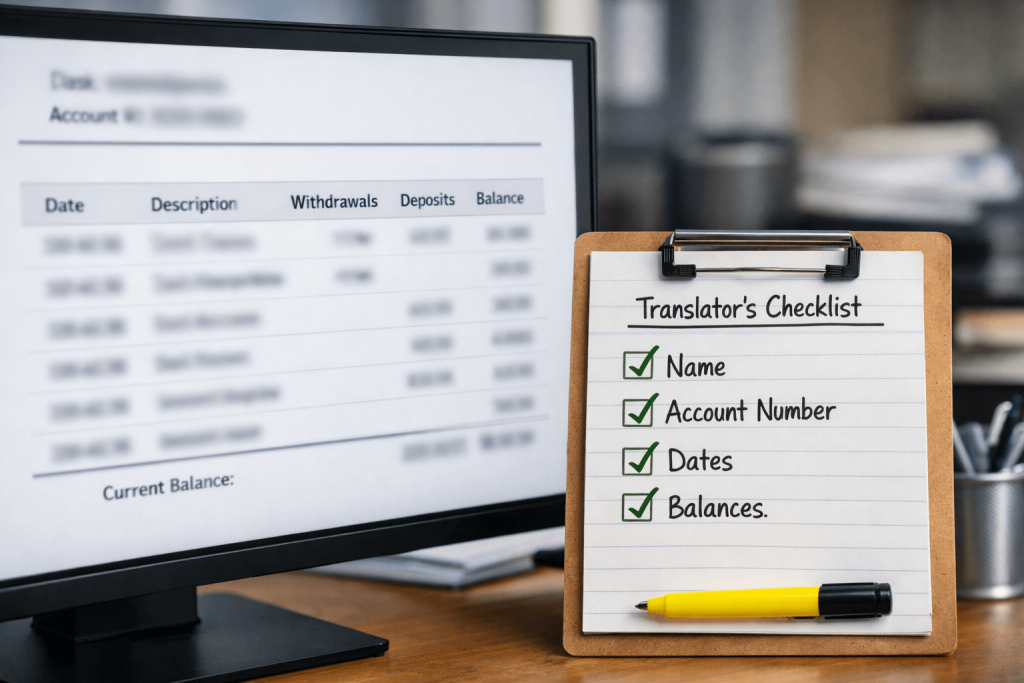
Financial evidence is heavily detail-based. A clean translation is not just about language; it’s about presentation and verification.
Bank statements: what must be obvious in English
Even when the statement is long, the translated version must make it easy to see:
- Account holder name (exactly as shown)
- Account number (or partial masking if appropriate—only if the original is masked too)
- Bank name and identifying details
- Statement date and the period covered
- Balances (especially where rules require funds to be held consistently)
- Currency and key totals
If a statement contains repeated standard text, we can keep formatting consistent while ensuring all meaningful information is translated.
Bank letters: what UKVI-style letters should show
If you’re using a bank letter instead of (or alongside) statements, it typically needs:
- Your name (or parent/guardian name if they hold the funds)
- Account number
- Current balance (and sometimes confirmation on how the balance has been maintained)
- Bank’s contact details
- Official stamp/signature where the bank provides one
Sponsor letters: keep them formal, specific, and consistent
If you have an official sponsor (government, employer, scholarship body), the sponsor letter should clearly state:
- What they are covering (fees, living costs, both)
- The amount and duration
- Their consent for the visa application (and any extension wording if required)
- Official letterhead, stamp, or authorised signature where applicable
Practical tip: sponsor letters often read “clear” in the original language but become vague when translated by non-specialists. A professional translation keeps the structure crisp and “official letter” in tone.
Academic documents translation: transcripts, diplomas, and grading systems
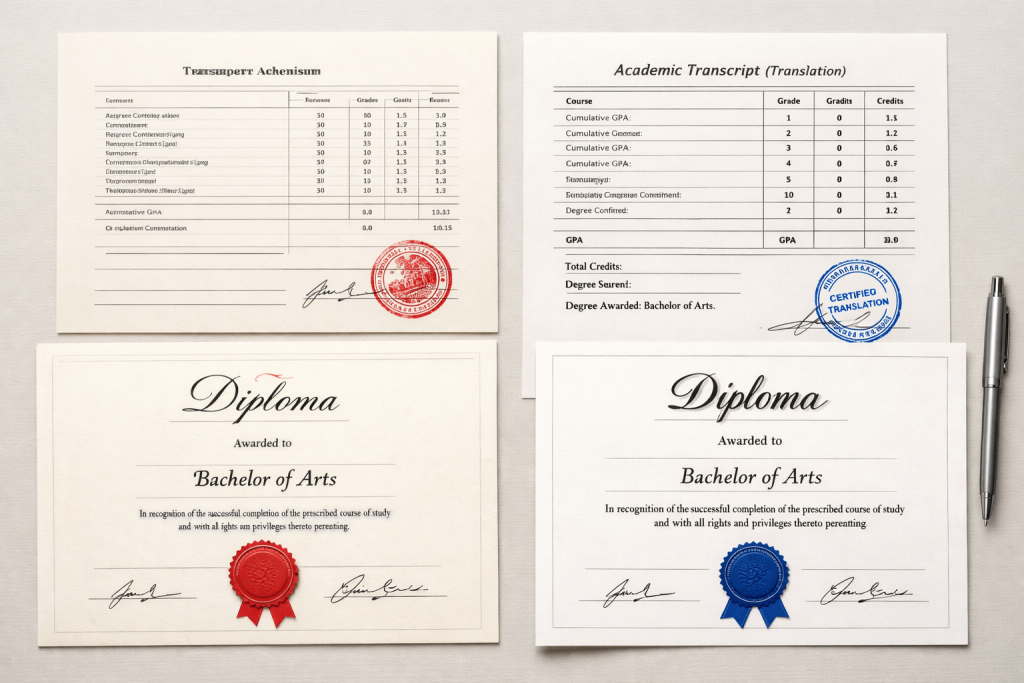
Academic documents aren’t hard to translate—but they are easy to mis-format. Common issues include missing stamps, unclear grading scales, and inconsistent institution names.
What a strong academic translation includes
- The institution name translated consistently across all pages
- Course titles and module names translated clearly (without inventing meaning)
- Grades presented in a legible format
- Notes explaining official terms where needed (for example, grading categories that don’t map neatly to UK terms)
- Stamps, seals, signatures reflected in the layout (even if they’re not translated word-for-word)
When you may need more than just translation
Sometimes your university (or a third-party verifier) asks for:
- A certified translation plus a clear scan of the original
- A translator declaration that references the original language and document type
- Extra clarity for multi-page transcripts (page numbering and consistency checks)
If your transcript is stamped across pages, make sure the scan shows full edges—cropped seals are a common reason documents get questioned.
Tier 4 replacement guidance: what changed and what didn’t
If you see Tier 4 referenced on older university checklists, that’s normal—Student route replaced Tier 4, but many internal documents still use legacy wording.
What changed:
- Terminology and route names (Student route instead of Tier 4)
- Some financial and process details have evolved over time
What didn’t:
- If your supporting evidence is not in English or Welsh, it still needs a properly certified translation
- Financial evidence translation still needs to be precise, readable, and verifiable
- Universities still expect professional translations (self-translation is a common rejection point)
Step-by-step: how to get your uk student visa document translation without delays
1) Gather the right files (before requesting a quote)
- Scan or export PDFs at good quality (avoid shadows and blurred phone photos)
- Include every page (front/back where relevant)
- Keep stamps, margins, and headers visible
- If you have multiple documents, name them clearly (e.g., “BankStatement_Jan–Mar”, “SponsorLetter”, “Transcript”)
2) Decide what you need delivered
Most students choose:
- Certified PDF for upload (fastest)
- Optional hard copy via tracked post (useful if your university wants a physical file)
3) Send your purpose in one line
A simple message helps the translator format everything correctly:
- “UK Student visa submission (UKVI-style certification)”
- “University admissions + visa”
- “Financial evidence translation (bank statements + sponsor letter)”
4) Quality check the finished pack (2 minutes that can save weeks)
Before you submit, confirm:
- Names match your passport spelling
- Dates and numbers are correct
- All pages are included
- Certification statement is attached
- Contact details for verification are present
Common mistakes that slow down k student visa document translation applications
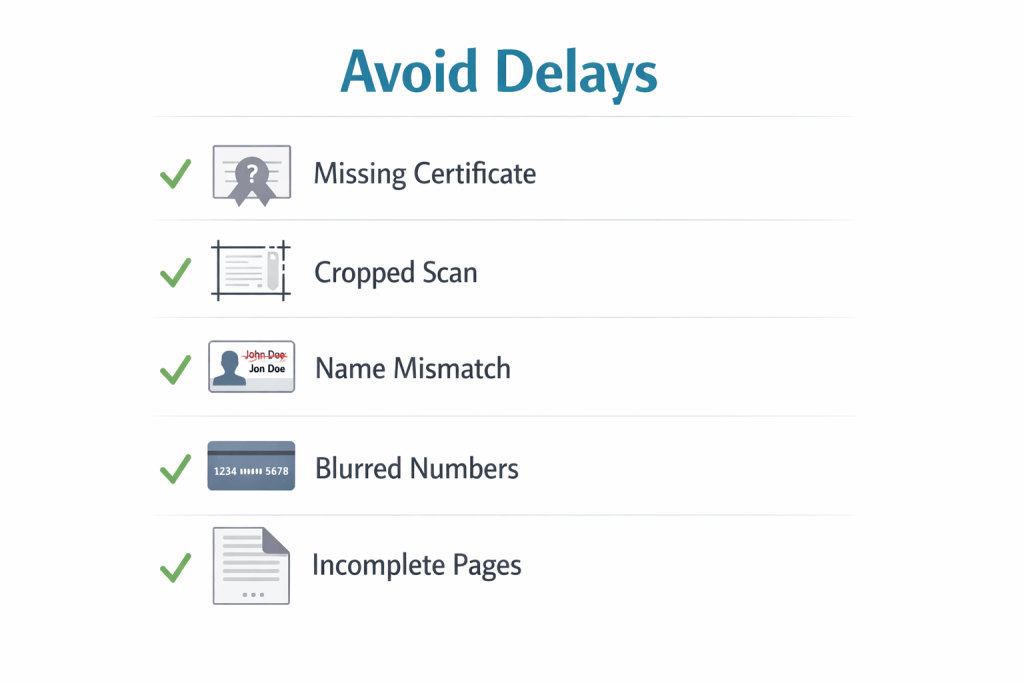
Avoid these and your application is far less likely to be paused for clarification:
- Submitting translations without a certificate page
- Using self-translation or a friend’s translation
- Cropped scans (missing stamps, missing account details, cut-off margins)
- Inconsistent name spellings across bank letters, transcripts, and passports
- Missing pages (especially multi-page statements)
- Translating only part of a document without clarity (high-risk for financial evidence translation)
- Poor image quality (blurred numbers are still “missing numbers”)
- Informal sponsor letters that don’t clearly confirm amounts and consent
- Translating headings but not stamps/notes (official annotations still count)
- Leaving the translation to the last 24 hours before submission
If you’re on a deadline, tell us the date you need to submit and we’ll recommend the safest turnaround option.
Fast turnaround options and London service
Student timelines are real—CAS deadlines, accommodation cut-offs, appointment slots, and airline plans.
For most standard certificates, bank letters, and transcripts, certified delivery is often available quickly, with express options for urgent cases.
Need a London service option?
If you’re based in London (or your documents need to be delivered to a London address), we can support you remotely with fast certified PDFs and arrange hard-copy delivery where required. Many students handle everything online and still meet tight timelines.
Ready to start? Upload your documents for a quick quote and a clear delivery time—so you can plan the rest of your application confidently.
What you’ll receive from Transcribe Lingo
Every Student visa translation pack is prepared for official submission and includes:
- A clear, complete translation that mirrors the original
- A certification page suitable for UK submissions
- A final review focused on names, dates, and numbers
- Secure handling of your documents
Client feedback (recent):
“Quick turnaround and accurate translations, totally worth the price.”
“Thoroughly professional and really supportive throughout the whole process.”
Mini case examples (what “doing it right” looks like)
Case 1: Bank statement in Arabic + sponsor letter
Issue: The sponsor letter named the student one way, the bank statement used another spelling.
Fix: We aligned spellings to passport format and added a clean, consistent translation across both documents.
Case 2: Transcript with stamps and an unusual grading system
Issue: The grades were clear locally but confusing in English.
Fix: We kept the official grade terms, translated course/module names carefully, and formatted the transcript so it reads like an official record.
Case 3: Under-18 consent pack
Issue: Consent letter covered travel but not living arrangements, and the birth certificate scan was cropped.
Fix: We advised what to re-scan and formatted the translated consent pack in a way that matches typical submission expectations.
FAQs
Do I need uk student visa document translation for every document?
If you’re submitting a document that is not in English or Welsh, you should provide a certified translation for it. If you are not uploading the document, you do not need to translate it.
Can I translate my own bank statement for a Student visa?
It’s strongly advised not to. Visa submissions and universities typically expect professional translations that can be verified, with a signed certification statement and contact details.
What documents count as financial evidence translation?
Usually bank statements, bank letters, fixed deposits, loan letters, scholarship letters, and sponsor letters—anything you use to demonstrate funds, funding source, or permission to use those funds.
Do I need notarisation or an apostille for a UK Student visa translation?
In most Student visa situations, a properly certified translation is sufficient. Notarisation or apostille is usually only needed if a separate authority (often outside the UK) specifically asks for it.
How fast can you translate academic documents and bank letters?
Turnaround depends on the number of pages and complexity, but many student documents can be delivered quickly as certified PDFs, with express options available if you’re on a deadline.
Do you offer a London service for student document translation?
Yes—students based in London often handle everything online with certified PDFs, and we can arrange delivery of printed copies to a London address if required.
