

If you’re searching how to code interview transcripts in qualitative research, you probably have the same problem most researchers hit: you’ve got pages of transcript text, a deadline, and no clear path from “raw words” to defensible findings.
This guide gives you a practical, repeatable workflow you can use for thematic analysis, grounded theory, framework analysis, and more—plus copy-paste templates you can reuse across projects.
Want transcripts that are already formatted for coding (speaker labels, timestamps, clean layout)? Upload your files on our Transcription Services page and tell us your preferred transcript style—we’ll return a file you can code immediately.
Table of contents
- A quick answer: the 7-step coding workflow
- What is transcription in qualitative research?
- Verbatim vs clean verbatim vs intelligent verbatim (and what you actually need)
- Prepare transcripts for coding (formatting, anonymising, consistency)
- Build a codebook (with a copy-paste template)
- First-cycle coding: create strong initial codes
- Second-cycle coding: refine codes into categories and themes
- How to analyze interview transcripts in qualitative research (beyond coding)
- Rigor: reliability, reflexivity, audit trail, and common pitfalls
- How to cite a transcript (APA 7th edition)
- FAQs
A quick answer: the 7-step workflow (save this)
- Choose your transcript style (verbatim / clean verbatim / intelligent verbatim) based on your method
- Standardise your transcripts (speaker labels, paragraphs, timestamps, anonymisation)
- Read for context (memo your first impressions, assumptions, surprises)
- Code line-by-line (first cycle) using short, clear labels
- Clean and consolidate codes (merge duplicates, split vague codes, define each code)
- Group codes into categories and themes (second cycle)
- Validate and write-up (negative cases, audit trail, quotes, and a transparent method section)
Keep it simple: code first, interpret second, name themes last.
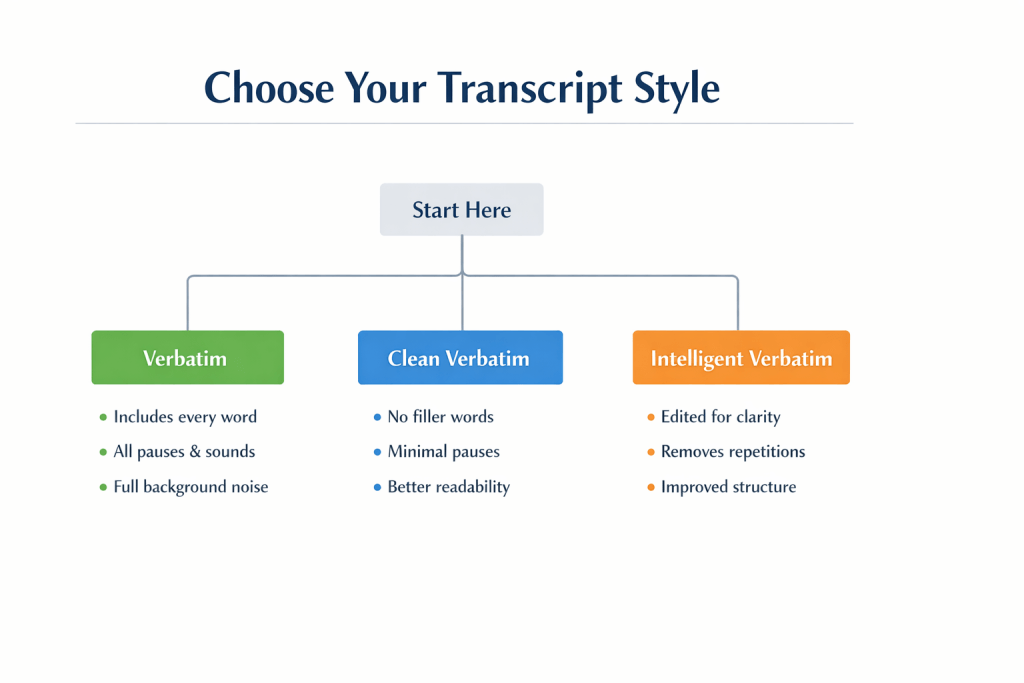
What is transcription in qualitative research?
What is transcription in research? It’s the process of turning recorded speech (interviews, focus groups, observations) into text so you can search, compare, code, and interpret it.
In qualitative research, transcription is not just admin. It’s a methodological step that shapes what you notice:
- What gets included (pauses, laughter, overlaps, filler words)
- What gets cleaned (false starts, repetitions, “um/uh”)
- What gets standardised (dialect spellings, slang, grammar)
- What gets masked (names, locations, identifiers)
That’s why your first decision—transcript style—matters so much.
What is a transcript in research?
A transcript is your interview data in written form. It becomes the core “text dataset” you’ll code, query, compare, and quote.
Most researchers use transcripts to:
- Extract patterns across participants
- Capture nuance in lived experience
- Preserve evidence for claims (supporting quotes)
- Build themes, models, or theory grounded in participant language
Verbatim transcription: what it is (and how to write it)
What does verbatim transcription mean?
Verbatim transcription captures speech word-for-word—including false starts, filler words, repetitions, and often nonverbal markers like [laughs] or [pause].
How to write a verbatim transcript (quick rules)
Use these conventions to keep transcripts consistent:
- Speaker labels: Interviewer: / Participant 01: (or real names if permitted)
- Paragraphing: new paragraph when the speaker changes, or when a topic shifts
- Nonverbal cues: [laughs], [sighs], [pause] (only if meaningful)
- Unclear audio: [inaudible 00:12:31] or [unclear]
- Overtalk: mark overlaps simply: [overlapping speech]
- Timestamps: add every 30–60 seconds, or at key moments you’ll cite later
If you need a professional word-for-word file, our Verbatim Transcription Services team delivers transcripts that are consistent, readable, and ready for analysis.
Clean verbatim vs intelligent verbatim (and when verbatim isn’t necessary)
What does clean verbatim transcription mean?
Clean verbatim keeps the meaning and wording intact, while removing “speech noise” that makes transcripts hard to read (filler clusters, repeated starts, stutters). It does not paraphrase—think: same words, cleaner surface.
What is intelligent verbatim transcription?
Intelligent verbatim transcription goes one step further: it removes non-essentials and lightly standardises language so the transcript reads smoothly (e.g., “gonna” → “going to”)—without changing meaning.
Transcribe Lingo uses intelligent verbatim formats across academic workflows too (see Intelligent Academic Transcription Services) when readability and insight extraction matter.
Is verbatim transcription of interview data always necessary?
No. Verbatim is necessary when “how it’s said” is data. Clean/intelligent formats often work better when you’re analysing meaning rather than micro-speech features.
Use this decision guide:
| Your method / purpose | Best transcript style | Why |
| Conversation analysis, discourse analysis, linguistic work | Full verbatim (+ detailed notation) | Timing, overlaps, and speech features are evidence |
| Thematic analysis, framework analysis, applied research reports | Clean verbatim / intelligent verbatim | You need clarity and consistent coding units |
| Legal, compliance, sensitive HR | Verbatim (often with timestamps) | Exact record and defensible audit trail |
| Publishing quotes publicly | Clean verbatim + careful review | Readability while preserving meaning |
Practical rule: If you plan to code quickly and compare across many interviews, clean/intelligent formats usually reduce friction—as long as you keep a link to audio for verification when needed.
Step 1: Prepare transcripts for coding (this prevents 80% of coding pain)

Before you create a single code, standardise your text.
Transcript “coding-ready” checklist
- One consistent speaker format (e.g., P01: / INT:)
- Stable paragraphs (no giant blocks of text)
- Consistent punctuation (enough to clarify meaning, not “perfect grammar”)
- Names standardised (same spelling every time)
- Sensitive identifiers masked ([Hospital A], [City], [Company])
- Timestamp strategy chosen (none / periodic / key moments only)
- File naming that matches your metadata (e.g., P01_F_34_UAE_2026-01-10.docx)
- A separate metadata sheet (participant attributes, interview context, consent notes)
If you’re cleaning auto-generated transcripts, use a two-pass workflow: accuracy first, readability second. Our practical walkthrough is here: How to Edit an Interview Transcript for Accuracy and Readability.
Step 2: Choose your coding approach (so your codes match your research question)
Coding isn’t one thing. Your question determines your lens.
Common first-cycle coding types (use one as your default)
- Descriptive coding: “What is this about?” (topic labels)
- In vivo coding: participant’s exact phrasing (great for voice and authenticity)
- Process coding: actions and sequences (“coping,” “negotiating,” “avoiding”)
- Emotion coding: feelings and affect (“fear,” “relief,” “frustration”)
- Values coding: beliefs and priorities (“fairness,” “status,” “security”)
Start with descriptive + in vivo if you’re unsure. It keeps you close to the data and avoids premature theory.
Step 3: Build a codebook (copy-paste template)
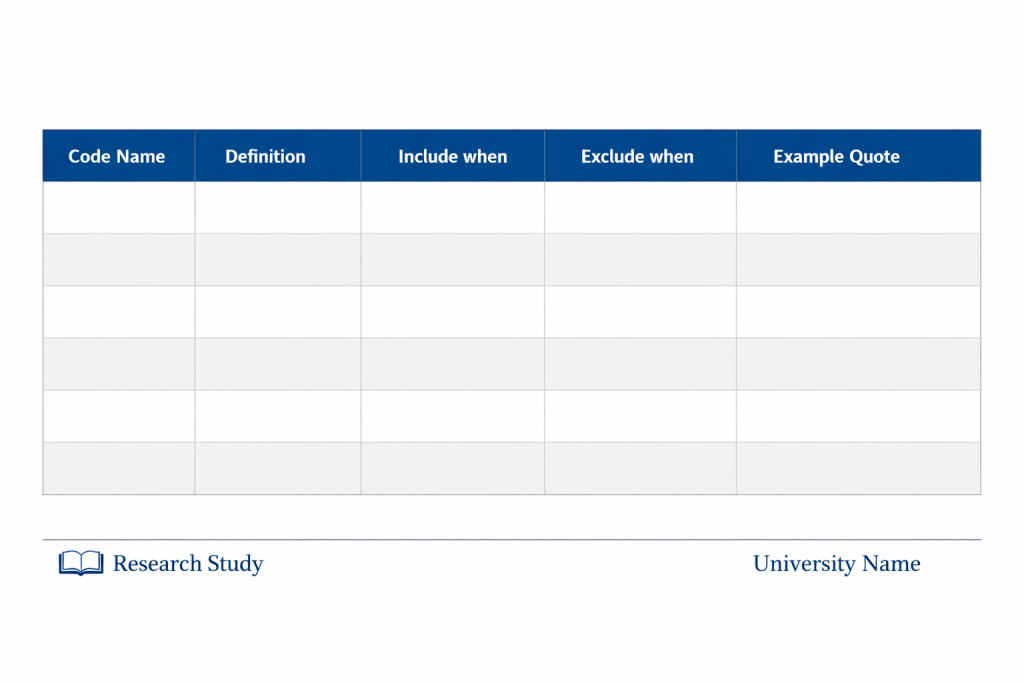
A codebook is your project’s internal dictionary. It stops codes drifting over time and makes your analysis explainable.
Codebook template (copy/paste)
| Code name | Definition | Include when… | Exclude when… | Example quote | Notes |
Code quality rules (simple, strict, effective)
- A code is a label, not a theme. Keep it short.
- One code = one idea. Avoid “everything codes” like “Challenges”.
- Define boundaries. Your “exclude when…” line matters as much as “include when…”
- Write one real example quote for each high-use code.
- Rename boldly. Your first code names are drafts, not decisions.
Step 4: First-cycle coding (how to code interview transcripts in qualitative research, line by line)
The 3-pass method that keeps you moving
Pass A: fast open coding
Code quickly to capture meaning—don’t overthink.
Pass B: refine labels
Merge duplicates, split vague codes, write definitions.
Pass C: consistency sweep
Recode earlier transcripts using your updated codebook.
A practical example (mini transcript + codes)
Transcript excerpt
INT: What changed after the policy rollout?
P03: I stopped speaking up in meetings. It felt pointless. People who raised issues got labelled “difficult.”
P03: After that, I just did what I was told and kept my head down.
Possible first-cycle codes
- silencing in meetings
- fear of negative label
- learned helplessness / futility
- compliance strategy
- psychological safety loss (if this aligns with your framework)
Why this works: these codes are specific enough to compare across participants, but not so interpretive that you’re forcing a conclusion too early.
Step 5: Second-cycle coding (turn codes into categories and themes)
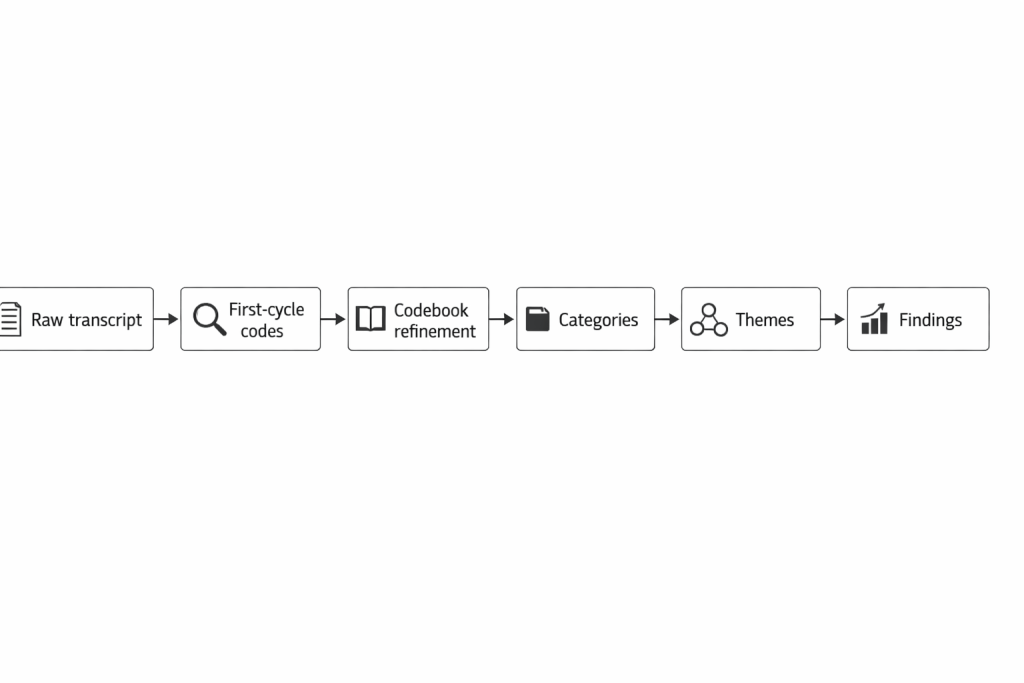
Second-cycle coding is where analysis starts to “tighten.”
What you do in second-cycle coding
- Collapse synonyms (e.g., “staying quiet” + “not speaking up” → silencing)
- Create parent/child structure (workplace risk → fear of label, fear of retaliation)
- Move from fragments to patterns across interviews
A simple theme-building worksheet (copy/paste)
Candidate theme name:
What it explains (one sentence):
Which codes belong here:
What doesn’t belong (boundary):
Best supporting quotes (2–4):
Negative/contradicting cases:
So what (implication):
How to analyze or code interview transcripts in qualitative research (beyond “just coding”)
Coding is the engine, but these steps turn coded text into findings people trust.
1) Write analytic memos as you code
Memos are where insight happens. Keep them short:
- What surprised me?
- What repeats across participants?
- What’s context-specific?
- What assumptions am I bringing in?
2) Compare across cases
Ask:
- Do different participant groups describe the same phenomenon differently?
- Are there “turning points” in narratives?
- What is the sequence of events and decisions?
3) Look for negative cases
A theme is stronger when you can explain exceptions.
4) Build a transparent audit trail
Save versions of:
- Codebook revisions
- Decisions you made (merge/split/rename codes)
- Why you chose transcript style
- How you handled confidentiality
Rigor without paralysis (reliability, reflexivity, transparency)
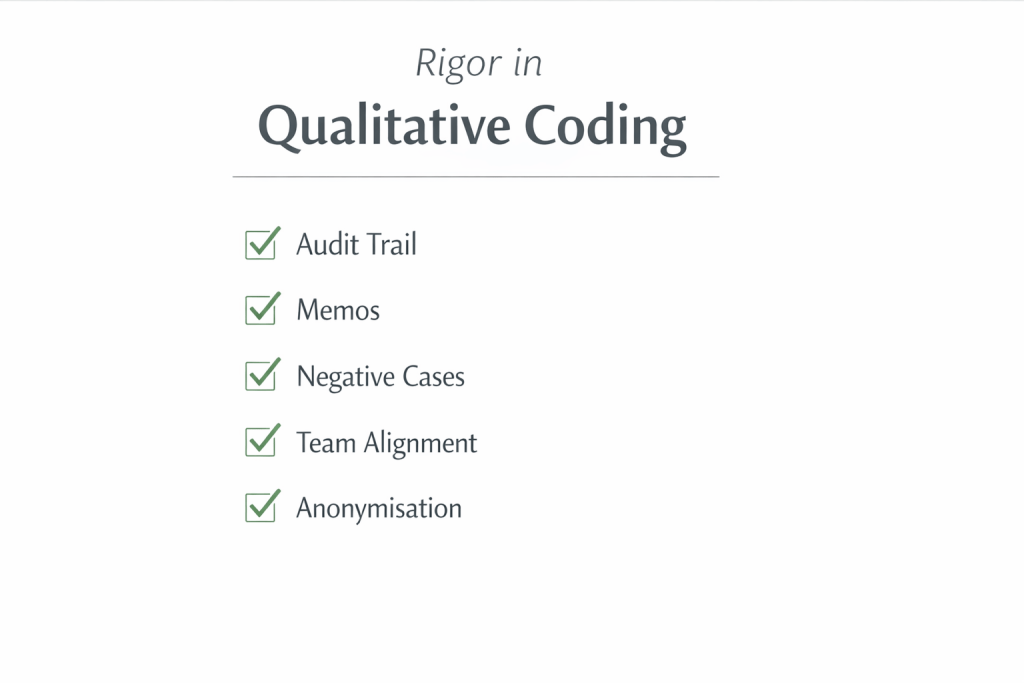
If you’re working with a team, create consistency without turning coding into bureaucracy.
Intercoder agreement (team coding)
A practical approach:
- Code the same 1–2 transcripts independently
- Meet to resolve differences
- Update code definitions
- Repeat once—then code the remaining transcripts using the refined codebook
Reflexivity (solo or team)
Add a short “reflexivity note”:
- Your relationship to the topic
- Your role (insider/outsider)
- How you reduced bias (memos, negative cases, peer debrief)
How to cite a transcript (APA 7th edition)
This is where many researchers get stuck, because interview transcripts are often not retrievable to readers.
Use this practical rule:
If the interview transcript is private (your research data)
- Treat it like a personal communication style citation in text (common in APA 7 guidance), because the reader can’t access it directly.
- Typically do not add it to the reference list unless your institution or publisher requires an archived/retrievable dataset approach.
Example (in-text style):
- Narrative: A. B. Participant (personal communication, January 10, 2026) described…
- Parenthetical: (A. B. Participant, personal communication, January 10, 2026)
If the transcript is publicly available (e.g., published interview transcript)
- Cite it as a retrievable transcript (like other audiovisual/online sources), and include it in the reference list following the format of where it lives (website, archive, etc.).
Quoting interview data ethically
Even when citation rules are clear, confidentiality still comes first:
- Use participant IDs (P01, P02)
- Mask identifiers in quotes where necessary
- Keep a separate secure key file linking IDs to identities
If you want transcripts formatted for quoting and referencing (speaker turns, clean paragraphs, optional timestamps), upload your recording and request your preferred style on our Transcription Services page.
A credibility boost you can include in your methods section (copy/paste)
Interviews were transcribed and standardised for analysis (consistent speaker labels, paragraphing, and anonymisation). Coding followed an iterative process including first-cycle coding, codebook refinement, second-cycle coding, and theme development supported by analytic memos and negative case checks. Decisions and revisions were documented to maintain an audit trail.
FAQ
How to code interview transcripts in qualitative research if I’m a beginner?
Start with descriptive codes (topic labels) plus a few in vivo codes (participant wording). Do one transcript end-to-end, refine your codebook, then code the rest.
How to analyze interview transcripts in qualitative research without software?
Use a consistent method: highlight text in Word/Google Docs, add comments as codes, then copy coded excerpts into a table organised by code. The key is consistency and an audit trail.
What is clean verbatim transcription, and is it acceptable for research?
Clean verbatim removes filler words and false starts while preserving meaning. It’s commonly acceptable when you’re analysing meaning rather than micro-speech features.
What is intelligent verbatim transcription used for?
Intelligent verbatim is used when readability and rapid insight extraction matter (many academic and applied research projects), while still preserving meaning.
Is verbatim transcription of interview data always necessary?
Not always. Use full verbatim when speech features are analytical evidence. Use clean/intelligent formats for most thematic and applied coding projects.
How to cite a transcript APA 7th edition?
If the transcript is private research data, APA 7 guidance commonly treats it as personal communication cited in-text only. If it’s publicly retrievable, cite it as a transcript/online source and include it in references.
