
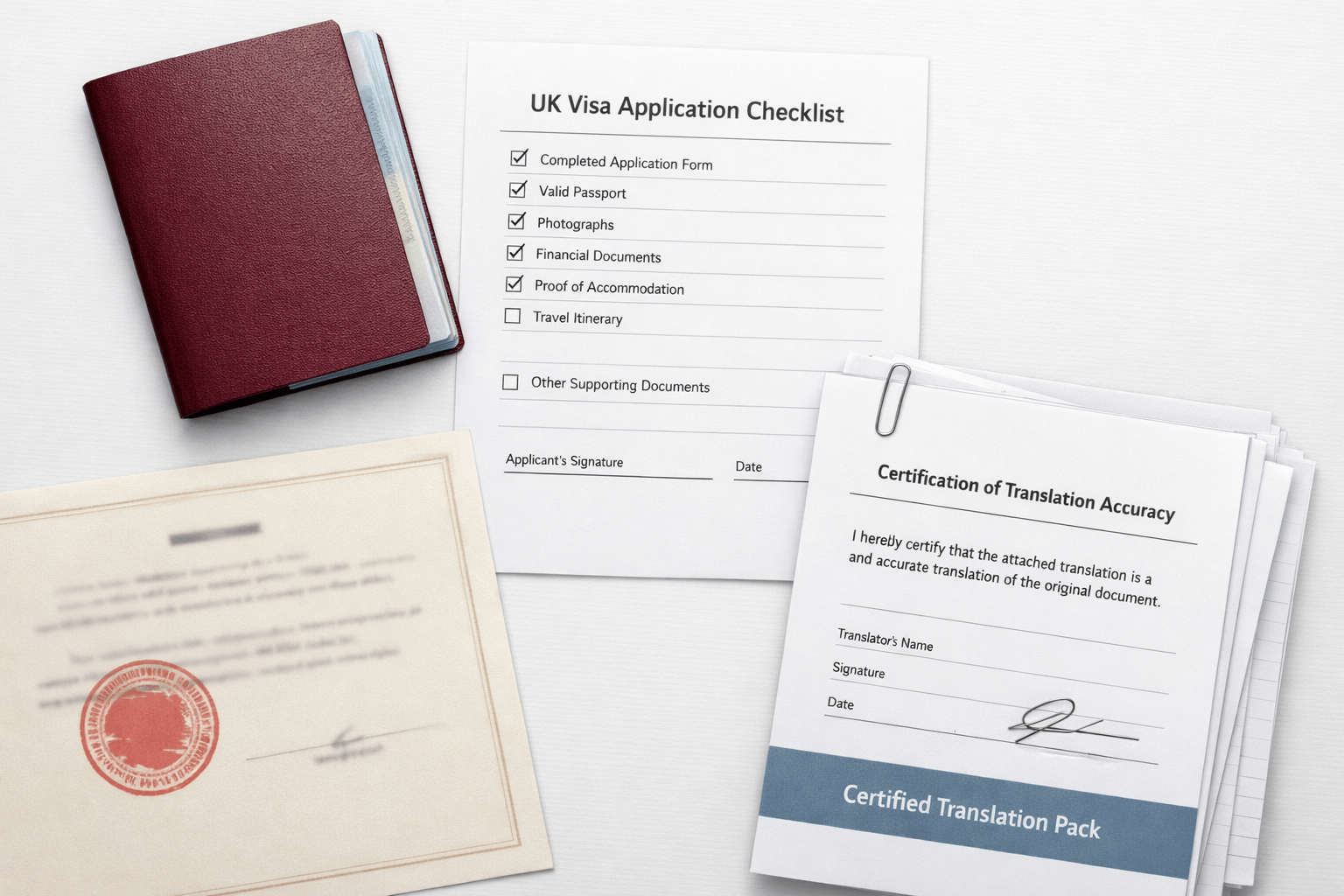
Applying for a Skilled Worker visa is stressful enough without your evidence being delayed because a document wasn’t translated in the right way. If you’re uploading paperwork that isn’t in English (or Welsh), skilled worker visa document translation is not a “nice to have” — it’s part of getting your supporting documents accepted and reviewed smoothly.
This guide explains what Home Office reviewers expect, which Skilled Worker documents most commonly need translation, and how to avoid the formatting and certification mistakes that cause avoidable delays. If you need UK work visa translations urgently, you’ll also find a practical checklist to speed things up without cutting corners.
If you’d like us to review your files and confirm exactly what needs translating, you canupload yur file for a fast quote and we’ll come back with a clear price and turnaround time.
The rule that matters most (and catches people out)
If any supporting document is not in English or Welsh, you should assume you’ll need:
- A complete translation (not a summary)
- A certified translation that is clearly attributable to a translator or translation company
- A format that can be independently verified (someone can check who translated it)
That single point covers most Skilled Worker visa applications where applicants submit overseas documents (civil status, qualifications, police certificates, financial evidence, and previous employment records).
What “certified translation” means for UKVI-style submissions
A certified translation is typically:
- The translated document (including stamps, seals, headings, handwritten notes and annotations)
- A certificate / declaration confirming it’s a true and accurate translation
- Translator or agency details that make the translation verifiable
You can see how Transcribe Lingo structures this on ourcertified translation services page, including fast options for time-sensitive applications.
The 4-point “acceptance checklist” for every translated document
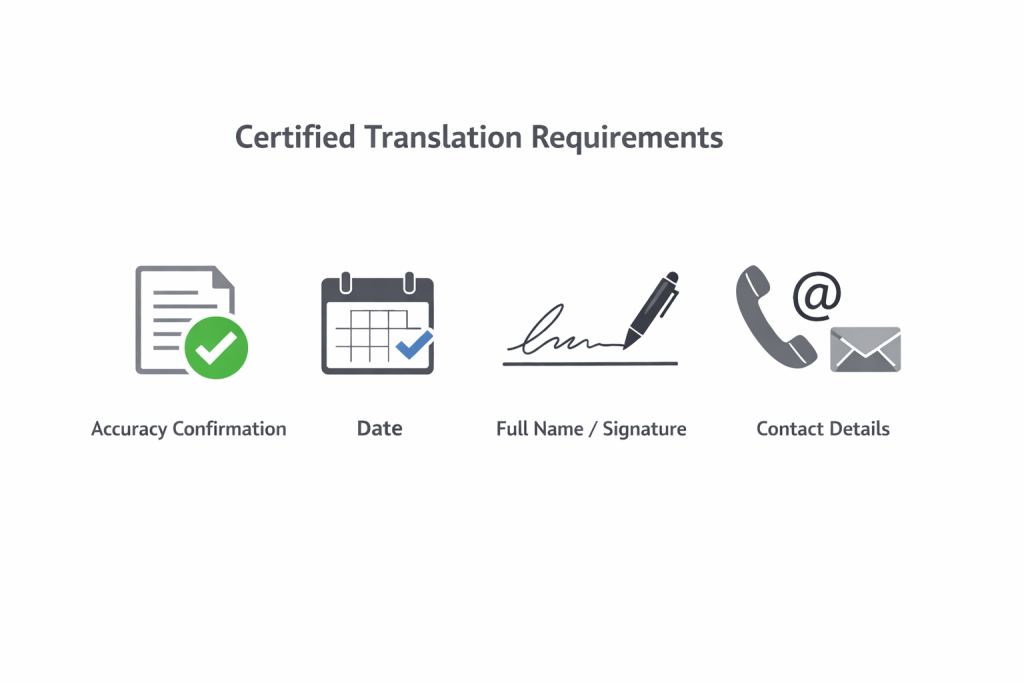
Before you submit, make sure the translation pack includes:
- Accuracy confirmation (a written statement confirming it’s an accurate translation of the original)
- Date of translation
- Translator’s full name and signature
- Translator’s contact details (or the translation company’s verifiable contact details)
If any one of these is missing, you’re relying on luck rather than compliance.
Copy-and-paste certificate wording (UK-friendly)
You can use wording like this (your translator/agency will place it on letterhead or attach it as a certificate page):
Certificate of Accuracy
I, [Full Name], confirm that I am competent to translate from [Source Language] into English and that the attached translation is a true and accurate translation of the original document provided to me.
Translated on: [DD Month YYYY]
Translator/Agency: [Name]
Signature: ___________________
Contact details: [Email, telephone, address / website]
A good provider will also add project identifiers (reference number, page count) to keep multi-document visa bundles tidy.
Skilled Worker Visa supporting documents that commonly need translation
Not every applicant will need every document below. But these are the most common categories people end up translating for a Skilled Worker application or for related steps (Ecctis, criminal record checks, dependants’ evidence, and employer onboarding).
1) Identity and civil status documents
Often required when you’re proving relationship status, dependant eligibility, or matching identity details across systems:
- Birth certificate
- Marriage / civil partnership certificate
- Divorce decree / dissolution certificate
- Name change documents
- Family book extracts (where used)
- National ID cards, household registration documents
If you’re translating civil certificates, it can help to link out by document type for consistency across your bundle, for example:
2) Qualifications and professional registration evidence
Skilled Worker applicants often submit evidence tied to:
- English language route
- Regulated professions (healthcare, education, social care)
- Ecctis verification or qualification comparability checks
Common documents include:
- Degree certificates and transcripts
- Professional licences and registrations
- Training certificates
- Letters from universities or awarding bodies
- Professional standing letters
These are exactly the kinds of documents where accurate formatting matters — tables, grades, module titles, stamps and signatures need to be faithfully represented.
3) Criminal record certificates (and related documents)
If your role requires it, criminal record evidence may be requested. These documents frequently include stamps, handwritten notes, and official formatting that must be carried through correctly in translation.
4) Financial evidence (when it’s requested)
Depending on how maintenance is evidenced, some applicants are asked for documents such as:
- Bank statements
- Savings statements
- Sponsor letters confirming maintenance
- Income evidence in certain scenarios
Bank statements in particular are a “formatting trap” — they’re repetitive, dense, and full of numbers. A professional approach often uses consistent templates so figures, headers, and transaction descriptions remain clear across pages.
If you need the translation to mirror the original layout (tables, alignment, headings), ask for typesetting / layout preservation alongside translation.
5) HR letters translation and overseas employment evidence
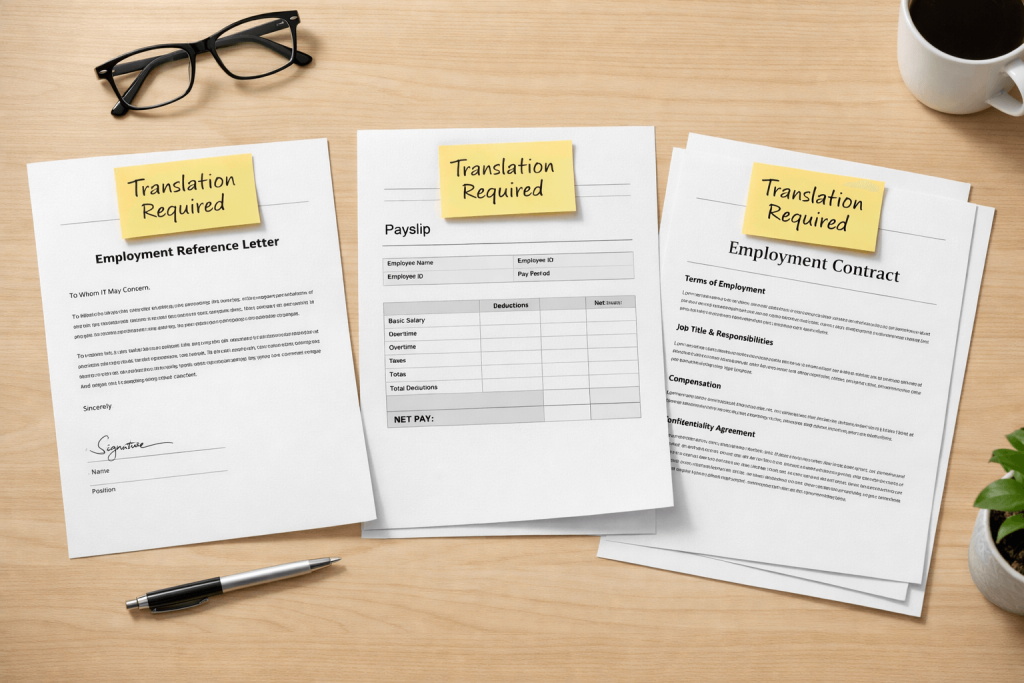
This is a common blind spot: your UK sponsor normally issues documents in English — but your previous employer evidence may be in another language.
Documents that often need HR letters translation include:
- Reference letters
- Employment confirmation letters
- Experience letters (job title, dates, duties)
- Payslips
- Tax documents and social insurance records
- Job contracts from overseas employers
If you’re translating a reference letter or employment confirmation, a dedicated service page can help:reference letter translation.
And if you’re dealing with an overseas contract, make sure your provider can handle contract translation UK standards, especially where legal terminology and defined terms must remain consistent. Our legal team support sits underlegal translation services.
Accurate formatting: how to translate stamps, seals, tables and signatures
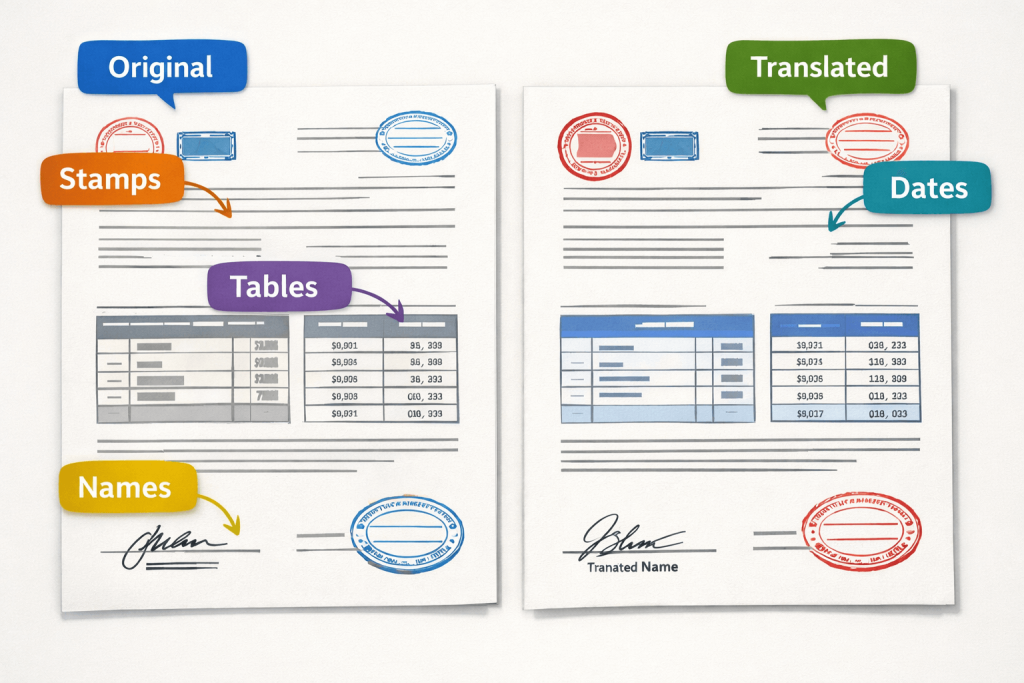
When reviewers can’t match your translation to the original, they slow down. The goal is not to make the English version “look nice” — it’s to make it traceable.
Translating stamps and seals
A proper translation will:
- Indicate the presence of stamps and seals (rather than ignoring them)
- Describe handwritten notes where legible
- Keep the placement clear (e.g., “Stamp: [text]”)
Example formatting inside the translation:
- [Round stamp in blue ink: Ministry of …, date …]
- [Handwritten note: …]
- [Signature: illegible]
Tables and numbers: where most errors happen
Visa submissions and onboarding checks often fail on tiny numeric mismatches. Protect yourself by checking:
- Dates (different national formats are common)
- Decimal separators and thousands separators
- Document numbers and reference codes
- Salary figures (monthly vs annual)
- Job titles (exactly as written, then clarified in brackets if needed)
Names and transliteration: keep identity consistent
If your original documents use a different script (Arabic, Cyrillic, Chinese, etc.), the key is consistency across your whole set:
- Match spellings to your passport whenever possible
- Keep any alternative spellings noted clearly (but don’t invent “corrected” versions)
- Use the same transliteration across every translated document in your bundle
If you’ve ever had a case where one document says “Muhammad” and another says “Mohamed” — you already know how quickly that can become a problem.
Certified vs notarised vs apostilled: what you usually need for a UK skilled worker visa
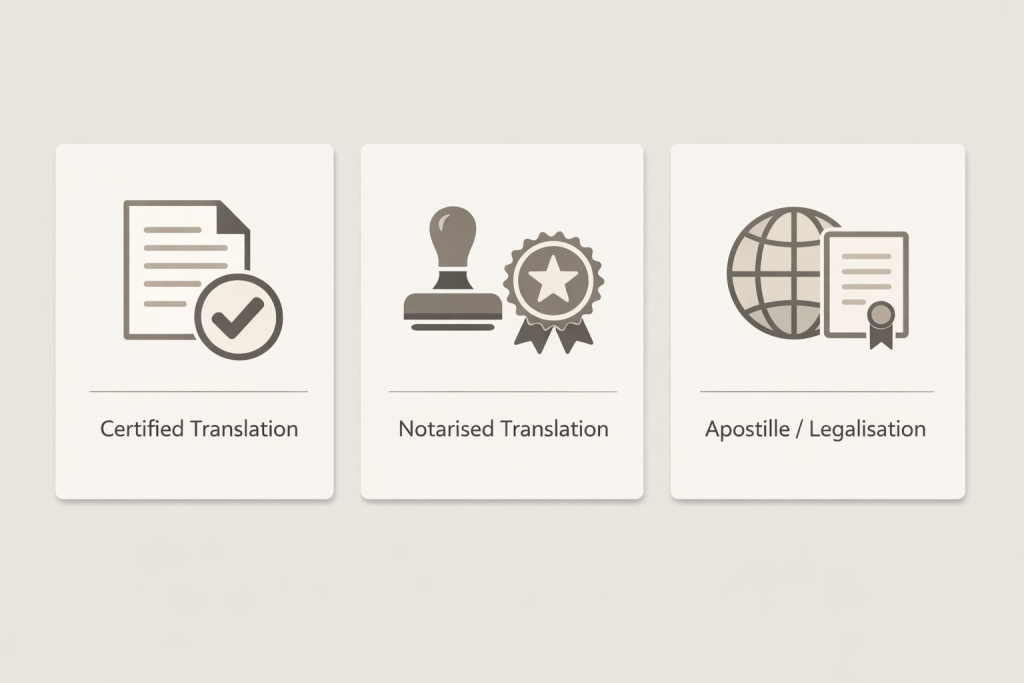
For most Skilled Worker applications, a certified translation is the relevant requirement. Notarisation is a different step and is typically only needed if:
- A specific authority explicitly requests notarisation, or
- The document is being used outside the UK where notarisation/apostille is a local requirement
If someone tells you “you must notarise everything”, ask them to show you where that is stated for your specific use-case.
If you do need those extras (for example, for an overseas authority or a separate process), you can bundle it through services like notarised translation and legalisation — but don’t pay for it unless the receiving body demands it.
The top reasons Skilled Worker translations get questioned or delayed
Here’s what causes friction in real submissions:
- Missing certification elements (no date, no signature, no contact details)
- Partial translation (summaries instead of full translation)
- Ignored stamps/seals (translation doesn’t account for official marks)
- Inconsistent names and dates across documents
- Unreadable scans (blurry stamps, cut-off edges, low resolution photos)
- Formatting that hides key information (tables converted into paragraphs)
- Mixed language packs (some pages translated, others left out)
The “submission-ready” final check (5 minutes)
Before you upload:
- Confirm every translated file has a certificate/declaration
- Check names match your passport spelling
- Check dates and numbers against the original
- Ensure every page of the original is included
- Make sure stamps, signatures and notes are represented
Choosing a provider for urgent document translation (without risking quality)
If you’re under time pressure, speed matters — but so does process.
Look for:
- Clear certification wording and verifiable contact details
- Specialist translators (legal/HR/financial) for the documents you’re submitting
- A review step (second linguist or QA) before certification is issued
- Secure handling of sensitive data
Transcribe Lingo’s approach is designed for official submissions and time-sensitive deadlines. You can start with a quick upload here:get a free quote.
“Highly recommend Transcribe Lingo for being prompt to respond to our last minute request! The service provided was thoroughly professional!”
— Client feedback
“Amazing service. Quick turnaround and accurate translations, totally worth the price…”
— Client feedback
A simple process to get your Skilled Worker translation done correctly
- Collect every page of every non-English/Welsh document (including back pages and attachments).
- Scan clearly (flat, well-lit, no cut edges; 300dpi if possible).
- List your priorities: what’s urgent, what’s needed for dependants, what’s for Ecctis/employer checks.
- Send a single bundle and request consistent spellings across documents.
- Receive your certified translation pack as a PDF set, ready to upload.
Ready to move?Upload your documents here and we’ll confirm what needs translating and the fastest compliant turnaround.
Frequently Asked Questions
Do I need certified translation for Skilled Worker visa documents?
If your supporting documents are not in English or Welsh, you will generally need a certified translation that can be independently verified and includes the required translator details.
Can I translate Skilled Worker documents myself?
Self-translation is risky for official submissions because translations usually need independent verification, certification wording, and clear translator identity and contact details.
Do I need notarised translations for UK work visa translations?
In most cases, a certified translation is the relevant requirement. Notarisation is typically only needed if the receiving authority explicitly asks for it.
What documents most commonly need translation for a Skilled Worker application?
Common examples include degree certificates/transcripts, professional licences, criminal record certificates (where required), bank statements (where requested), and overseas employment letters (HR letters translation).
How fast can urgent document translation be done?
Turnaround depends on language pair, page count, and formatting complexity (especially bank statements, contracts, and stamped certificates). Same-day or 24-hour options are often possible for short, clear documents.
Should the translation copy the original formatting exactly?
It should remain traceable and easy to compare to the original. For tables, stamps and official certificates, accurate formatting prevents confusion and reduces the risk of follow-up queries.
