

English to Welsh conversion can look deceptively simple: paste English in, get Welsh out, publish, done. In reality, the moment your text needs to persuade, reassure, comply, or represent your brand, “conversion” stops being a shortcut and starts being a risk decision.
This guide gives you a practical way to choose the right approach every time, with Welsh-specific pitfalls, a fast decision framework, and a workflow you can copy and use today. If you’re working on anything customer-facing, time-sensitive, or official, you’ll also see exactly where professional Welsh translation services change the outcome.
What “English to Welsh conversion” actually covers
People use english to welsh conversion to describe a few different tasks:
- Translating web pages, landing pages, and app content
- Converting marketing assets (ads, brochures, emails, social posts)
- Translating documents (policies, contracts, letters, certificates)
- Localising UX elements (buttons, menus, error messages)
- Creating bilingual layouts (English + Welsh in the same document)
- Producing Welsh captions/subtitles from English scripts
Each one has a different tolerance for risk. A quick draft for internal understanding is not the same as a public notice, a service agreement, or a homepage headline.
If you’re unsure where your project sits, start with the 60-second test below.
The 60-second test: tool, human, or hybrid?
Answer these three questions:
1) Will anyone outside your team see it?
If yes, lean human or hybrid. Public Welsh is a trust signal. It can also be a compliance requirement for some organisations and contexts in Wales.
2) Could a mistake cause real harm?
Examples:
- A form is misunderstood
- A medical or safety instruction is unclear
- A policy or legal term is wrong
- A price, time, or condition becomes ambiguous
If yes, use a human translator (and a second review if it’s high-stakes).
3) Does tone matter as much as meaning?
If your message needs to sound confident, warm, formal, reassuring, or persuasive, a human translator is the difference between “technically correct” and “actually effective”.
If you answered yes to any of the above, consider professional support through Translation Services rather than relying on a direct tool output.
Why Welsh “conversion” is harder than it looks
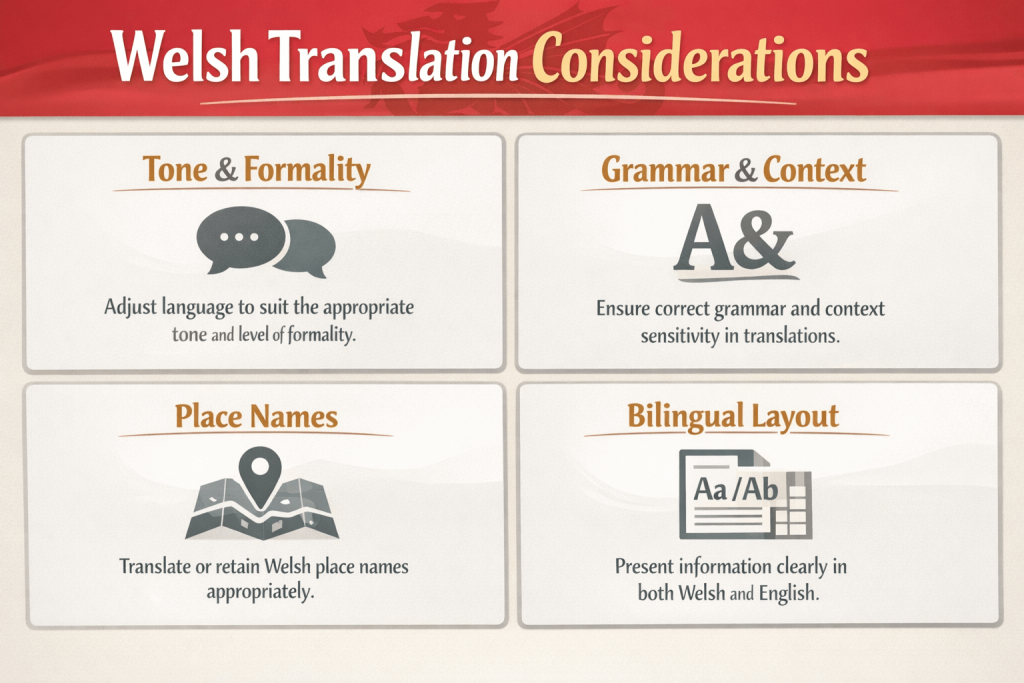
Even when machine translation gets the gist right, Welsh has features that make “literal conversion” feel unnatural fast. That matters because people don’t just read the words, they read what the words suggest about competence, care, and credibility.
Welsh is sensitive to context and grammar triggers
Welsh spelling and word forms can change depending on surrounding words and structure. Tools often produce something that’s understandable but not idiomatic, or they fail to keep the sentence consistent from start to finish.
Formality is not optional in real-world Welsh
A quick conversion might default to a tone that feels too casual or mismatched for your audience. A human translator will align register to the situation: customer service, public information, legal text, education, healthcare, or brand marketing.
Place names and proper nouns need a policy
Wales is rich in place naming conventions. A human approach sets a consistent rule: what stays as English, what uses the Welsh form, and how to handle mixed audiences.
“Bilingual layout” is a design problem, not just a language problem
English and Welsh do not expand/contract at the same rate. Buttons overflow. Titles wrap oddly. Side-by-side documents lose alignment. The best Welsh work considers formatting from the beginning, not after the fact.
If your project is public, brand-facing, or document-based, don’t treat Welsh as a simple output field. Treat it as publishing.
A decision matrix you can reuse
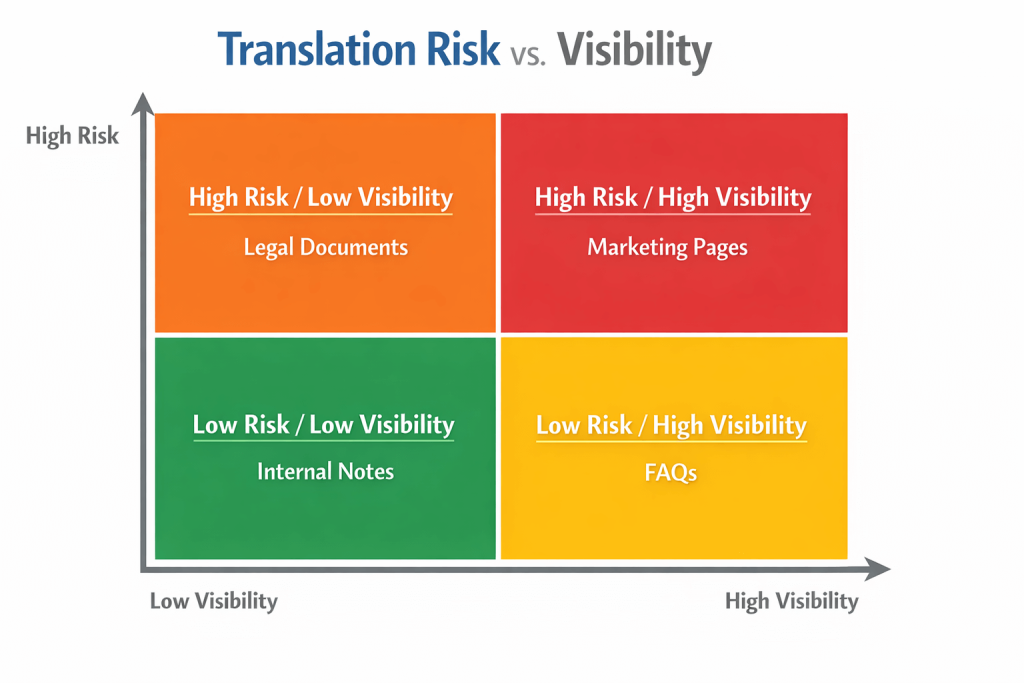
Use this quick table to choose the safest approach without overthinking it.
| Content type | Examples | Recommended approach |
| Internal / low-risk | rough notes, research, “what does this mean?” | Tool is fine |
| Customer service (repeatable) | FAQs, common replies, templates | Hybrid (tool + human edit) |
| Brand or conversion-critical | homepage, landing pages, ads, slogans | Human translator |
| Technical / regulated | medical, financial, safety, legal policies | Human + second review |
| Official submission | immigration, courts, universities, certified documents | Human + certification as required |
| Bilingual public info | signage, notices, public guidance | Human translator |
If you’re in the “human translator” column and the document is for official use, start with Certified Translation Services to avoid rework and rejections.
When a human Welsh translator is non-negotiable
Official or high-accountability documents
If the text will be submitted, reviewed, archived, or relied upon as evidence, you need a translator who treats accuracy, terminology, and formatting as a deliverable, not an afterthought.
Common examples:
- Certificates and official records
- Formal letters to institutions
- Contracts, HR policies, legal correspondence
- Academic documents and application materials
If your content crosses into legal territory, use a service built for it: Legal document translation.
Public-facing content where trust is the product
Welsh isn’t just “another language version.” For many audiences, it signals respect and legitimacy. A stiff or awkward conversion can undermine the exact trust you’re trying to build.
Human translation matters most for:
- About pages and mission statements
- Service pages and pricing explanations
- Complaint handling and sensitive communication
- Anything that represents a brand promise
Marketing and localisation
Marketing isn’t about replacing words. It’s about preserving intent, tone, rhythm, and cultural fit. A human translator will stop a direct conversion from sounding like a translated template.
If you’re translating campaigns, creative, or PR, this is the right lane: Marketing translation and localisation.
UI, UX, and product journeys
Short strings are where tools fail most visibly. A slightly “off” button label or error message creates friction instantly. Human translators think about:
- consistency across screens
- clarity under pressure (“something went wrong” moments)
- accessibility and plain language
- layout constraints
When tools are useful (and how to use them safely)
Tools can be a great starting point if you use them for the right job.
Good use cases
- Understanding the gist of Welsh content quickly
- Early drafts and brainstorming
- Internal notes that won’t be published
- Sorting/triaging large amounts of text before professional review
The safe “hybrid” method
If speed matters, do this instead of publishing raw output:
- Run the first pass with your tool of choice
- Create a terminology list (names, products, place names, key phrases)
- Hand it to a human editor to correct grammar, tone, and consistency
- Lock the approved Welsh and reuse it consistently going forward
For teams that create recurring public content, hybrid can deliver speed without sacrificing quality—especially when paired with consistent services Welsh translation workflows.
Welsh conversion pitfalls that cause avoidable rework
Here are the issues that most often trigger corrections after publication (or worse, complaints).
1) Inconsistent tone across the same page
Tools may switch between formal and informal patterns in one piece of text. A human translator keeps it stable.
2) “Dictionary Welsh” that reads unnatural
A tool output can be understandable but still feel off. That matters because your Welsh version is part of your credibility.
3) Unclear instructions and ambiguous terms
Short phrases can turn vague quickly. Human translators rewrite for clarity while keeping intent intact.
4) Terminology drift
If you publish Welsh across multiple pages or documents, inconsistency becomes obvious. A professional workflow tracks approved terminology.
5) Formatting breaks and bilingual layout issues
If the Welsh must match English layout (tables, certificates, forms), you need someone who can handle both language and formatting cleanly.
A practical workflow that gets Welsh right the first time
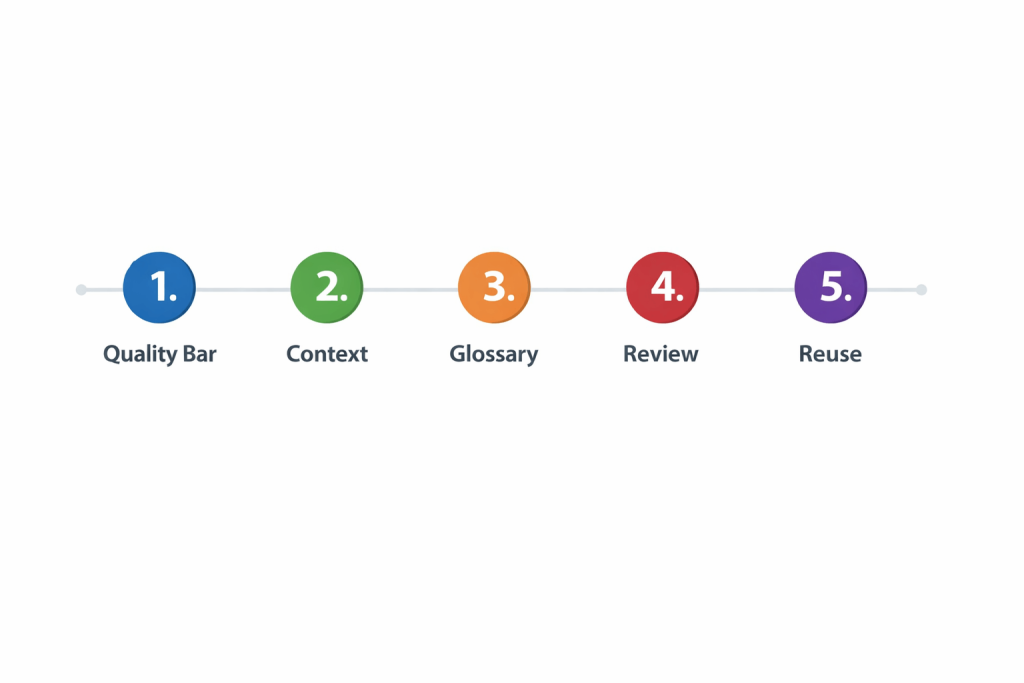
If you want a repeatable process (and fewer revisions), use this:
Step 1: Decide the “quality bar” before you translate
Pick one:
- Draft (internal only)
- Publishable (public-facing)
- Submission-ready (official/regulated)
If you’re anywhere near “submission-ready,” start here: Certified Translation Services.
Step 2: Provide context, not just text
A human translator works better with:
- target audience (public, customers, students, patients)
- tone (formal, friendly, authoritative)
- where it will appear (webpage, letter, banner, policy)
- any existing Welsh you already use
Step 3: Build a mini glossary (even 10 terms helps)
Include:
- brand/product names
- place names
- specialist vocabulary
- “must-keep” phrases
Step 4: Review like a publisher
Use this checklist:
- Does it sound like something a Welsh speaker would write?
- Is tone consistent across headings and CTA lines?
- Are key terms consistent with your glossary?
- Are numbers, dates, and units correct and clear?
- Does the layout still work?
Step 5: Reuse what’s approved
Once your Welsh is reviewed, treat it as a master copy. Don’t re-convert from scratch each time.
If you’d like this handled end-to-end, start with a quick request through Contact Us or go straight to Translation Services.
Copy/paste: a Welsh translation brief template
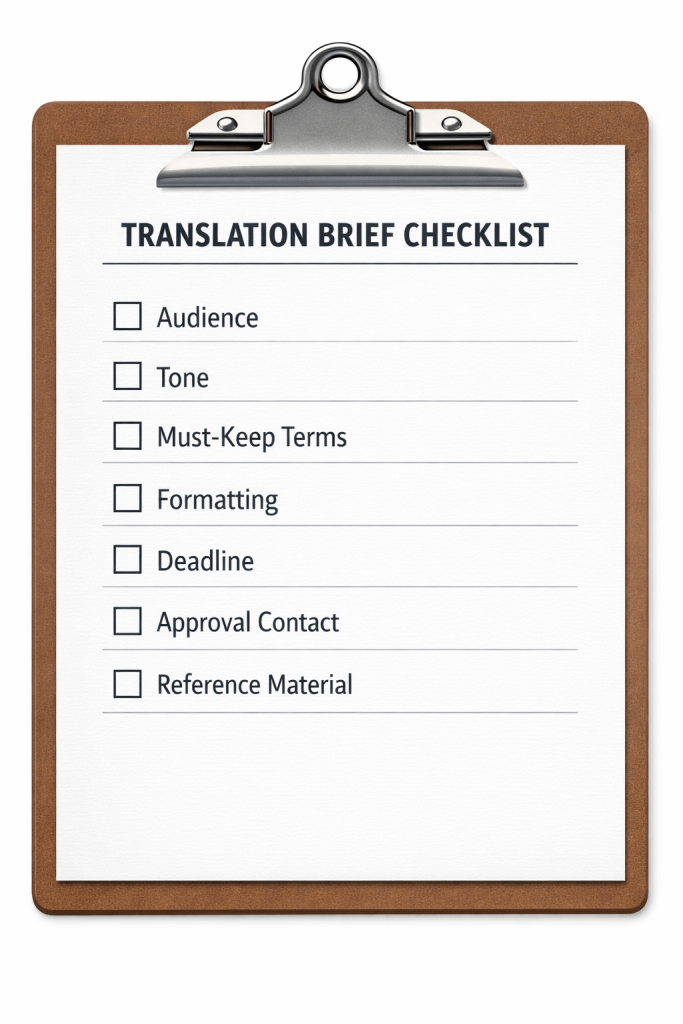
Use this when you request Welsh translation services to speed up turnaround and reduce revisions.
Project: English → Welsh conversion
Where it will appear: (website / brochure / policy / UI / email / other)
Audience: (public / customers / students / staff / patients / other)
Tone: (formal / friendly / authoritative / reassuring / direct)
Must-keep terms: (brand names, product names, legal terms)
Preferred naming: (place names, people names, organisation names)
Formatting needs: (tables, layout matching, bilingual side-by-side, etc.)
Deadline: (date/time + whether staged delivery is okay)
Approval contact: (who signs off Welsh)
Reference material: (links or examples of Welsh you already use)
If you’re ready to send files, the fastest route is to share a clear scan/photo and request a fixed quote via Certified Translation Services or message the team through Contact Us.
What clients look for (and what to look for in a provider)
When you compare Welsh translation services, focus less on promises and more on process.
Green flags
- Native Welsh linguists with subject experience
- A clear review/QA step (not just “translated and delivered”)
- Terminology consistency across projects
- Confidential handling for sensitive documents
- A provider that can support multiple formats (Word, PDF, InDesign, web content)
Questions worth asking
- Who translates and who reviews?
- How do you handle glossary/terminology?
- Can you match formatting exactly if needed?
- Can you deliver bilingual layouts?
- What’s your process if the receiving body has strict requirements?
If you want a starting point for pricing expectations, see Price Rate.
A quick credibility snapshot
“Amazing service. Quick turnaround and accurate translations, totally worth the price as it was handled by professionals experienced in legal documentation.”
“Highly recommend Transcribe Lingo for being prompt to respond to our last minute request! The service provided was thoroughly professional!”
For work where accuracy and acceptance matter, it’s worth using a provider that’s built around managed delivery rather than quick output. You can start with Welsh translation services or request a quote directly via Contact Us.
3) FAQ Section
What is English to Welsh conversion?
English to Welsh conversion usually means translating English text into Welsh for websites, documents, marketing, or bilingual communication. For public or official use, a human translator is often essential.
Is a free English to Welsh conversion tool accurate enough?
Tools can be accurate for simple, low-risk text, but they often struggle with tone, consistency, and Welsh-specific grammar. For customer-facing content, a human review is the safer choice.
When should I use a human translator for English to Welsh conversion?
Use a human translator for legal/official documents, public information, marketing copy, websites, and any text where mistakes could cause confusion, reputational harm, or rejection by an institution.
Do Welsh translation services include proofreading?
Many professional Welsh translation services include review steps, but it varies by provider. Always confirm the QA process, especially for high-stakes or publishable content.
How do I request Welsh translation services quickly?
Send the text/files, your intended audience, tone, and any must-keep terminology. If the document is for official use, request a quote via certified translation services and include the receiving body’s requirements.
Can I translate English to Welsh and keep the same layout?
Yes, but it often requires formatting-aware translation (especially for PDFs, tables, certificates, and bilingual layouts). A professional service can deliver Welsh that fits the final format cleanly.
