

Applying for Indefinite Leave to Remain (ILR) can feel straightforward until you hit the paperwork: documents from different countries, multiple formats, mixed languages, stamps, handwritten notes, and “supporting evidence” that seems endless.
This guide is designed to save you time (and avoid avoidable delays) by showing you which documents most often need ILR document translation, what “official” translations usually need to include, and how to prepare your files for a smooth, fast submission.
If you already have your documents scanned, you canupload your file securely for a quote and get a clear turnaround time.
The simple rule most applicants miss
For ILR applications, the safest approach is:
- If you plan to rely on a document and any part of it is not in English or Welsh, get it translated professionally.
- Translate the whole document, not just the “important bits” (including stamps, seals, endorsements, notes, and reverse pages).
That includes documents that look “mostly English” but contain key fields in another language (common with bank statements, household registers, and certificates with bilingual stamps).
What a Home Office-ready translation should look like
An ILR translation should be easy for a caseworker to match against your original document. That means:
- Full-page translation (not cropped or partial)
- Consistent names, dates, and numbers across all documents
- A proper certification statement (so it can be checked if needed)
- Clear formatting when the original uses tables (bank statements, payslips, registers)
If you’re unsure what format you need, this guide may help:how to get a certified translation.
ILR document translation checklist (most common categories)
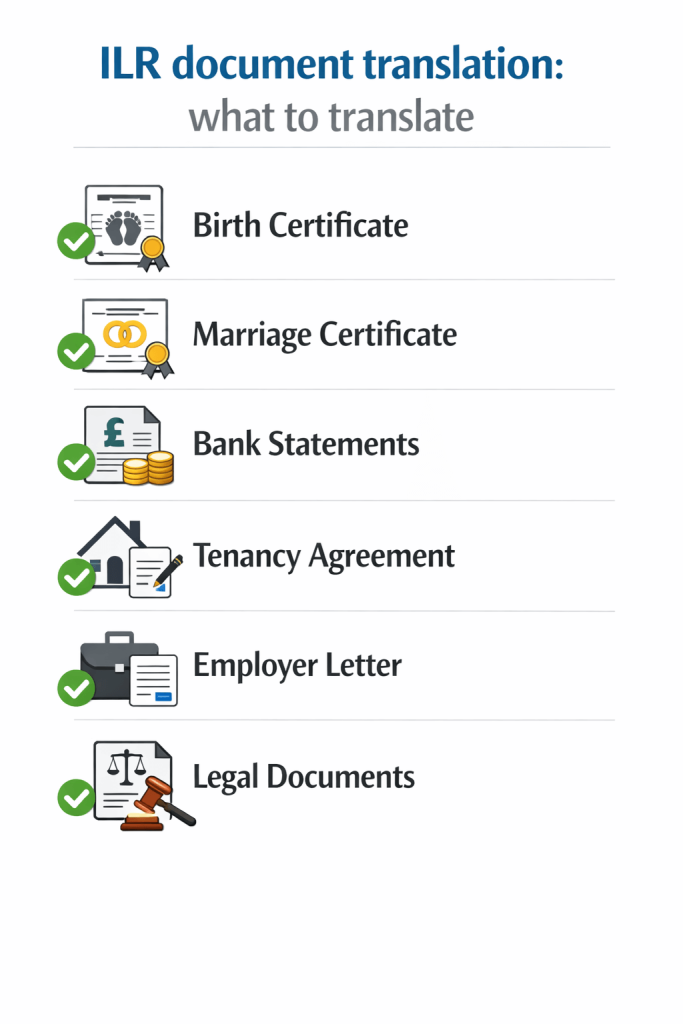
Below are the document types that most often need translating for settlement application submissions. You may not need all of these; it depends on your route and your personal circumstances. But these are the ones that most frequently appear in real-world ILR packs.
1) Identity and civil status documents
These are often the first documents people think of (and the easiest to miss if you assume “it’s obvious what it says”).
Common examples:
- Birth certificates (applicant and dependants)
- Start here: birth certificate translation services
- Marriage certificates / civil partnership certificates
- Start here: marriage certificate translation
- Divorce decrees / dissolution certificates
- Death certificates (where relevant)
- Name change evidence (deed poll equivalents, court orders, civil registry updates)
- National ID cards, family books, household registers
- Passports (only if you’re relying on non-English pages beyond standard biographical info)
Often missed: handwritten annotations, registry endorsements, marginal notes, and the reverse side of certificates.
2) Relationship and family evidence (where applicable)
If your ILR route relies on a partner or family relationship, translation needs often expand quickly.
Common examples:
- Marriage/civil partnership documents (see above)
- Birth certificates of children (see above)
- Family registration documents (household registers, family books)
- Legal custody or parental responsibility documents
- Court orders relating to family arrangements (where relied upon)
- Letters from schools, doctors, or authorities issued abroad (if you’re submitting them)
Tip: Photos don’t need translation. Captions, letters, and statements usually do.
3) Proof of residence and address history
Accommodation evidence is a major part of many ILR routes, and a surprising amount of it can be non-English if it’s issued abroad, printed by an overseas landlord, or connected to overseas property.
Common examples:
- Tenancy agreements and renewal addendums
- Letters from landlords, housing associations, or property management companies (if not in English/Welsh)
- Utility bills (if you’re using them as evidence and they are not English/Welsh)
- Council-style residence certificates (issued abroad)
- Property deeds, land registry extracts (overseas)
- Mortgage statements (overseas)
If you also need certified copies or notarisation for a specific recipient (rare for ILR, more common for overseas use), see:document certification help.
Often missed: tenancy schedules, annex pages, inventory lists, and stamp pages.
4) Employment and income evidence
This category creates the most “volume” — and it’s where partial translation causes trouble because the key proof is often embedded in tables and footnotes.
Common examples:
- Bank statements (when issued in another language or partially bilingual)
- Payslips (non-English format or employer-issued abroad)
- Employment letters (salary confirmation, role, start date, contract type)
- Employment contracts (if relied upon)
- Tax documents issued abroad (income records, tax returns)
- Pension statements (overseas)
- Business documents for self-employed applicants (overseas filings, certificates, accounts summaries)
If you’re translating a professional letter (employer reference, HR letter, sponsor letter), this can help:reference letter translation.
Often missed: currency details, account holder name formatting, “opening/closing balance” labels, and bank stamp pages.
5) Travel history and absences support
ILR decisions can be sensitive to absences, especially if you’re relying on discretion or need to explain travel patterns.
Translation may be needed for:
- Travel records or exit/entry confirmations issued abroad
- Police registration documents (where relevant)
- Official letters confirming reasons for travel (medical letters, employer letters, school letters)
Often missed: stamp pages or small official notes that contain the dates you’re relying on.
6) Criminal record and legal documents (only where relevant)
Not everyone needs these — but when you do, accuracy matters.
Examples:
- Overseas police certificates / criminal record extracts
- Court documents (judgments, orders, fines) relied upon in your application
- Legal declarations or affidavits issued abroad
- Official correspondence with overseas authorities
For complex legal formatting, use a specialist route:legal document translation.
7) Education and qualification documents (only where relied upon)
These are common if you’re relying on qualifications for English language requirements (or if you’re asked to provide specific evidence).
Examples:
- Degree certificates and transcripts (issued abroad)
- Professional licences (medical, engineering, finance)
- Academic letters from overseas institutions (if relied upon)
Tip: If your qualification is already in English, you typically won’t need translation — but you may need the correct supporting evidence for how it’s being used in your application.
Documents people think don’t need translation (but often do)
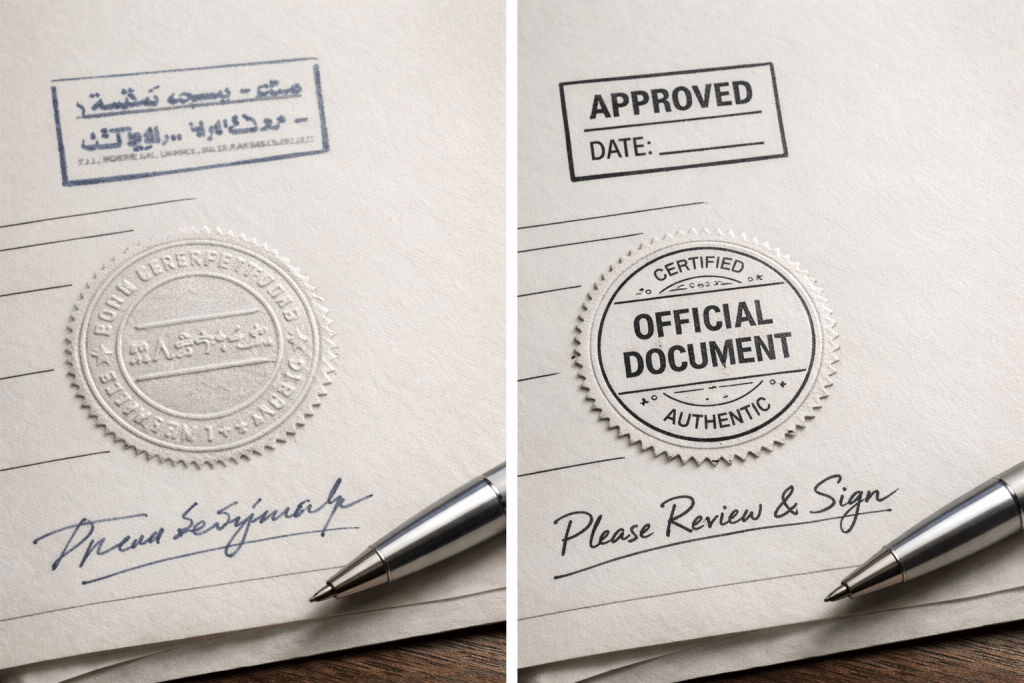
These items cause delays because they look “secondary” — until they become the missing link in your evidence chain.
- Stamps and seals: even if the main page is English
- Handwritten notes: especially on certificates and official letters
- Reverse pages: many certificates contain additional fields on the back
- Bilingual statements: where key fields (name, address, employer) are not in English/Welsh
- Screenshots from online portals: if you’re relying on them as evidence
- Appointment letters or official notices: when used to support timelines or compliance
A good translation mirrors the structure so the caseworker can compare quickly — not just “translate the words”.
Fast delivery starts with how you scan your documents
If you want a quick turnaround, the single biggest factor you control is file quality. Use this mini-checklist before you upload:
- Scan full pages (no cropped edges)
- Include every page (and the reverse side if it contains text/stamps)
- Use high resolution (clear enough to read small print and stamps)
- Keep documents separate (one file per document if possible)
- Name files clearly (e.g., Bank_Statement_Dec2025_FR.pdf)
- Avoid heavy filters (phone “scanner” apps are fine, but don’t over-sharpen)
When you’re ready:start your certified translation here.
How to avoid inconsistency across your ILR pack
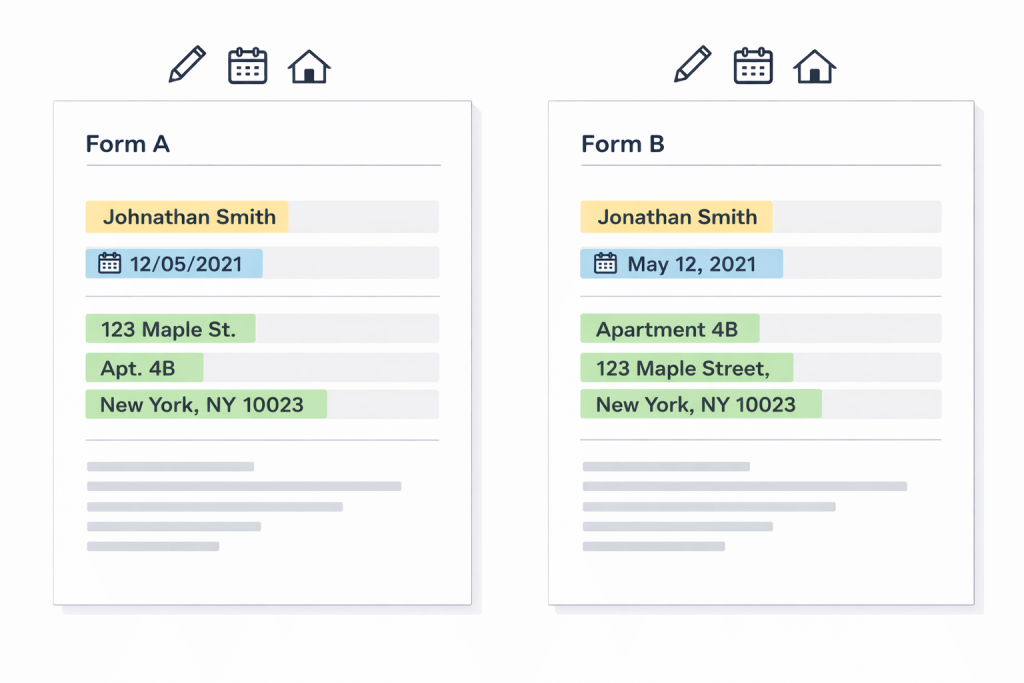
Even perfect translations can create confusion if the same detail appears differently in different places (especially names and addresses).
Before you submit, check these across all documents:
- Name order (surname first vs last)
- Spelling variations (accents, transliteration differences)
- Date formats (DD/MM/YYYY vs MM/DD/YYYY)
- Address formatting (street order, district names)
- ID numbers (spacing and punctuation)
If you have multiple documents that repeat the same details (bank statements month-by-month, long residence evidence, repeated letters), it’s worth translating them as a set so formatting and terminology stays consistent.
Do you need notarisation for ILR translations?
Usually, a certified translation is enough for UK immigration submissions. Notarisation is typically only needed when a specific authority explicitly requests it (more common for overseas use than for UK settlement applications).
If you’ve been told you need notarisation or an apostille, use the guided route here:notarised translation and apostille support.
A quick “translate or not?” decision tool
If you’re unsure about a document, ask yourself:
- Am I relying on this document to prove something important? (identity, relationship, income, residence, compliance)
- Would a caseworker need to read it to understand my claim?
- Does it contain any non-English/Welsh text — including stamps, notes, or tables?
If the answer is “yes” to any of the above, translation is the safer choice.
A practical example: what an ILR pack often includes
Here’s a typical real-world mix (varies by route), and what usually needs translating:
- Marriage certificate (if not English/Welsh): translate
- Bank statements showing salary income (if non-English fields): translate
- Tenancy agreement (if any section is not English/Welsh): translate
- Employer letter confirming role and salary (if non-English): translate
- Children’s birth certificates (if not English/Welsh): translate
- Household register / family book (if used to prove relationships): translate
This is why “ILR document translation” is rarely just one item — it’s often a small set that needs to match perfectly.
Ready to translate your ILR documents?
If you want a calm, straightforward process:
- Upload clear scans
- Tell us the document purpose (ILR / settlement application)
- Get a fixed quote and delivery time
- Receive a certified PDF ready to submit (hard copy available if you need it)
Start here:upload your document securely.
“Super fast, and Home Office accepted it with no questions!” — Maria G., Romanian to English (Birth Certificate)
“They posted the hard copy within 24 hours. Fantastic service.” — Ajay P., Hindi to English (Marriage Certificate)
Frequently asked questions
Do I need ILR document translation for every supporting document?
If you are relying on a document and it contains any non-English/Welsh text (including stamps, notes, or tables), translating it is usually the safest approach for settlement application submissions.
Can I translate my own documents for an ILR application?
For official submissions, self-translation is risky because the translation is expected to be independent and verifiable. A professional certified translation avoids that uncertainty.
What documents most commonly need translation for ILR applications?
The most common are birth certificates, marriage certificates, household registers/family books, overseas bank statements, tenancy agreements, employer letters, and overseas police/legal documents (where relevant).
How fast can I get UK immigration translations?
Turnaround depends on language and document complexity, but clear scans and complete pages speed things up. If you have a deadline, submit everything as one pack so formatting stays consistent.
Do I need notarisation for settlement application translation?
Usually not. Notarisation is typically only required if a specific authority explicitly requests it. For most UK immigration translations, certified translations are the usual route.
What’s the difference between a certified translation and a certified copy?
A certified translation confirms the translation is accurate. A certified copy confirms a photocopy matches the original. They solve different problems, and some applicants need both depending on what they are submitting.
