

If you’re submitting documents to a government body, university, court, bank, or employer, you’ll often be asked for a certified translation—not just a translation. That usually means a complete translation plus a signed statement (often called a certificate of accuracy) confirming the translation is true, complete, and produced by someone competent to translate.
This guide shows you how to get a certified translation quickly and correctly, whether you need it for immigration, study, work, legal matters, or official registrations.
Ready to get started? Upload your document and get a clear quote and turnaround time here: Transcribe Lingo Certified Translation UK
What a certified translation is (and what it isn’t)
A certified translation is typically:
- A full, faithful translation of the original document (including stamps, seals, notes, and headings)
- A signed certification statement confirming accuracy and translator competence
- Usually delivered as a secure PDF, with hard copy available if required
It is not the same as:
- A certified copy (“true copy”) of the original document (that’s a separate service where a professional certifies the copy matches the original)
- A notarised translation (where a notary verifies identity/signature steps—often for overseas use)
- A sworn translation (required in some countries where a translator is officially “sworn” by a court/authority)
If you’re unsure which one you need, the fastest way to avoid delays is to share the recipient’s wording. If they ask for “certified translation”, you may not need notarisation—unless they explicitly request it. See: Notarised Translation & Apostille
Step-by-step: how to get a certified translation

Step 1: Confirm the recipient’s requirement (this is where most mistakes happen)
Before you order anything, answer these four questions:
- Who is receiving it? (Home Office/UKVI, USCIS, IRCC, university, solicitor, employer, bank, embassy)
- Where will it be used? (UK, USA, Canada, EU, Middle East, etc.)
- Do they want digital, hard copy, or both?
- Do they specifically mention notarisation or apostille?
If the recipient has provided a checklist or guidance, keep it. That single screenshot often saves days.
If you need help choosing the minimum compliant route, you can start from here: Certified Translation Services
Step 2: Prepare a clean scan (or photo) of the entire document
Certified translations are only as good as the source document you provide.
For best results:
- Scan at 300 dpi if possible
- Photograph in good lighting, straight on, with all edges visible
- Include every page, including blank pages if they’re part of the set
- Include front and back if there’s any writing, stamps, or notes
- Don’t crop out stamps, signatures, barcodes, or marginal notes
If you’re working from a low-quality photo, tell your translator—so they can flag unclear text before delivery.
Step 3: Provide key details that must match your official records
This step prevents the most common “rejection reasons”:
- Your name must match your passport/ID exactly (including spacing and order)
- Confirm how you want dates shown (some bodies prefer the same format as the original; others prefer local format)
- If you have multiple spellings of a name across documents, tell your translator which spelling the receiving authority expects
- Provide any reference numbers that must appear clearly in the translation
If your document is Spanish (or contains Spanish names with accents), it’s especially important to keep names consistent. If you’re dealing with Spanish paperwork, see: Spanish Certified Translation
Step 4: Choose the right provider (and know what “certified” really means)
People often ask: “Can a translator certify documents?”
In most situations, yes—because the “certification” is the translator’s signed statement confirming the translation is accurate and they are competent to translate.
When comparing providers, look for:
- Real experience with official document formats (civil status, immigration, legal, academic)
- A quality-check process (review by a second linguist for accuracy/consistency)
- Clear, verifiable contact details on the certificate
- Secure handling for personal data (IDs, visas, certificates)
If you want a UK-focused service that’s commonly accepted for official submissions, start here: Certified Translation UK
Step 5: Make sure the certification statement includes what authorities expect
Different organisations phrase requirements differently, but a strong certification statement typically includes:
- A declaration that the translation is true/accurate/complete
- The date of translation
- The translator’s (or agency’s) full name
- A signature
- Contact details
- Often a reference number or job ID
Here’s a practical example of what you might see (wording varies by country and recipient):
“I confirm that I am competent to translate from [Language] to English and that this translation is a true and complete translation of the attached document.”
If you need a certified copy of the original as well as a certified translation (common for some applications), that’s a separate step. See: Document Certification Near Me
Step 6: Review the draft like an auditor (2 minutes can save weeks)
When you receive your translation, check:
- Names (every letter)
- Dates (day/month order, consistency)
- Numbers (passport numbers, certificate numbers, reference codes)
- Places (towns, regions, issuing authorities)
- Stamps/seals (they should be noted/translated appropriately)
If something is wrong, request a correction immediately—especially before you print or submit.
Step 7: Receive your final files in the format you need
Most official submissions accept a PDF (digital certified translation). Some still request hard copy with wet signature.
A well-run service can provide:
- Secure PDF delivery for upload/email submission
- Optional hard copy by post (tracked where needed)
- Like-for-like formatting where practical (tables, stamps, layout)
Need translations across multiple languages in one go? Browse coverage here: All Languages
Who can certify a translation?
This is one of the most searched questions for a reason: “Who can certify a translation?” and “Who can certify translated documents?”
In many cases, certification can be done by:
- A professional translator who completed the translation, or
- A translation company (with an authorised signatory), issuing a certificate of accuracy
You may need something else in addition if:
- The recipient asks for a notary (notarised translation)
- The document must be legalised for overseas use (apostille)
- The recipient needs a certified copy of the original document (a “true copy”)
If you’re dealing with legal or court material and want a professional, human-verified approach, this may help: Pro Translator
How to certify a translation (if you’re checking what you received)
If you’re reviewing a translation and asking: “How do I certify a translated document?” Use this quick checklist.
A properly certified translation typically comes with:
- The translated document (complete, including stamps/annotations)
- A signed certification statement (attached to the translation)
- Clear translator/agency identity and contact details
If you received a translation with no certificate, or a certificate with no signature/contact details, many authorities will treat it as incomplete.
How to get a certified translation online (fast, secure, and accepted)
If you want the simplest route, online ordering is usually fastest.
A reliable online process looks like this:
- Upload scan/photo/PDF
- Confirm language pair and purpose
- Receive quote + delivery time
- Translation + quality review
- Certified PDF delivered (hard copy optional)
Start from the Transcribe Lingo page that matches UK requirements here: Certified Translation Services UK
Or if you’re comparing costs before you proceed: Download the Price Rate Card
How to get a Spanish translation certified (common scenarios + what to watch for)
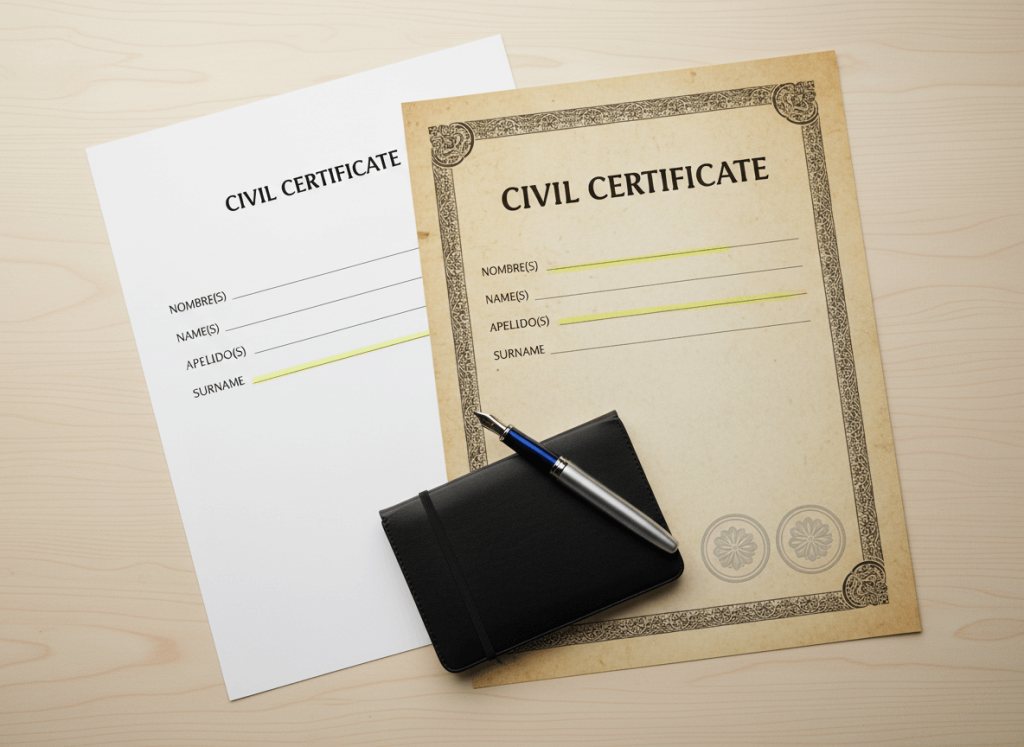
Spanish documents are among the most frequently certified, especially for:
- Birth and marriage certificates
- Police certificates
- Academic transcripts
- IDs and residence documents
Two common issues to avoid:
1) Names and double surnames
Spanish naming conventions can include two surnames and sometimes connecting words. Don’t “simplify” names in translation—make sure they match your passport/ID record.
2) Stamps, handwritten notes, and registry wording
Many Spanish civil documents contain formal registry language and stamps that must be reflected clearly in English.
If your project is specifically Spanish ↔ English, these pages can help:
Certified translation vs notarised translation vs apostille (quick clarity)
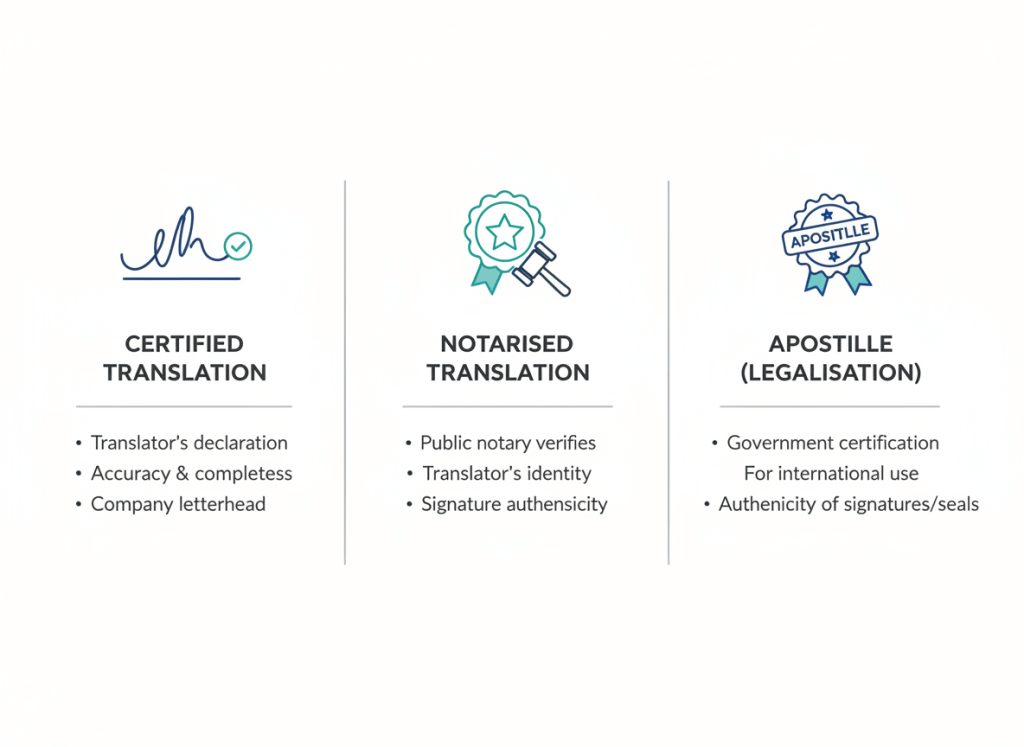
If your recipient says:
- “Certified translation” → you usually need a translator’s certificate of accuracy
- “Notarised translation” → you may need a notary step (identity/signature witnessing)
- “Apostille” → you’re legalising a signature/seal for overseas use (often after notarisation or solicitor certification)
If you’re handling overseas submissions and want a guided pathway, see: Notarised Translation & Apostille
How much does a certified translation cost (and what changes the price)
Pricing usually depends on:
- Document length (pages/words)
- Complexity (handwriting, stamps, dense legal language)
- Formatting needs (tables, certificates, like-for-like layout)
- Turnaround time (standard vs urgent)
- Whether you need hard copy, notarisation, or apostille
For a quick sense of typical pricing, you can start at: Certified Translation UK
Or check pricing resources here: Price Rate
“Rejected translation” prevention: the 10-point acceptance checklist
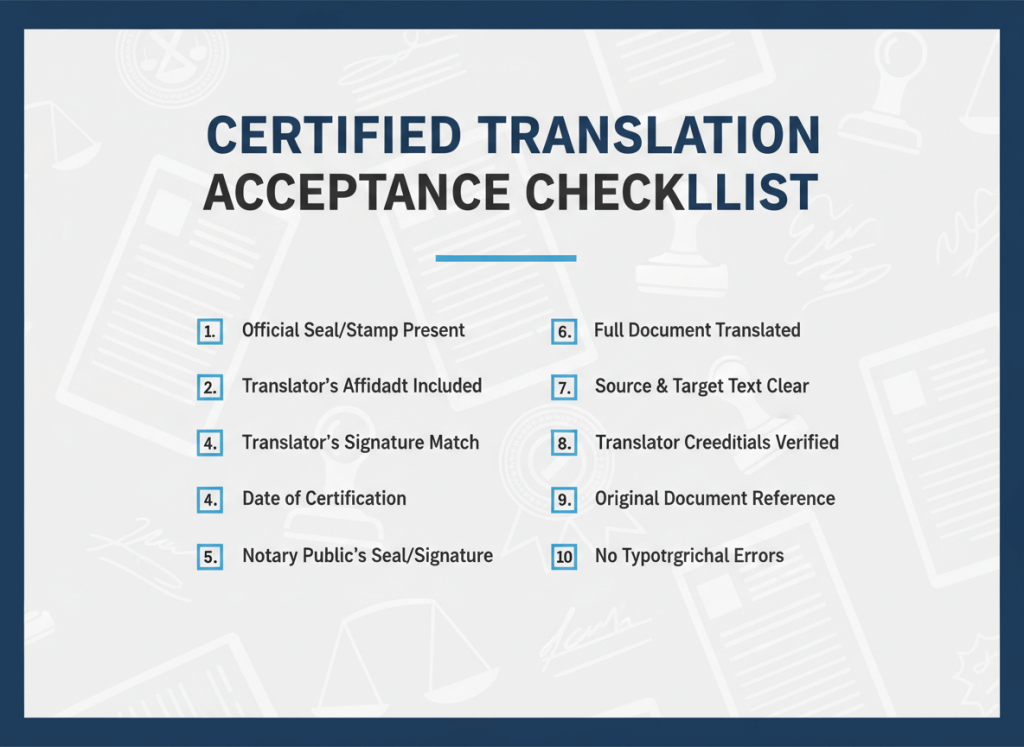
Before you submit, confirm:
- You included the original document (as required)
- The translation is complete (no missing stamps/pages)
- The certification statement is signed
- The certificate includes the date + contact details
- Names match your passport/ID exactly
- Numbers match character-for-character
- Dates are consistent and unambiguous
- The translation looks professional and readable
- Any unclear source text has been flagged/resolved
- You provided the format requested (PDF/hard copy)
If you want a process that includes human checks rather than “stamp and send”, this page explains the workflow clearly: Certified Translation Services Guide
A realistic example: choosing the right service in 60 seconds
Scenario: You’re applying for a UK visa and need to submit a birth certificate in Spanish.
A clean, reliable route is:
- Certificate of accuracy with signature/date/contact details
- PDF for upload submission
- Optional hard copy if requested
Start here: Birth Certificate Translation Services
If you also need the original document certified as a “true copy”, add: Document Certification Near Me
Why people choose Transcribe Lingo for certified translations
When your document is tied to an application, deadline, or legal requirement, the “right” translation is the one that’s accurate, complete, properly certified, and easy for the recipient to verify.
Transcribe Lingo supports certified translations with:
- Human translators experienced in official documents
- Quality checks for consistency (names, dates, numbers, terminology)
- UK-ready certification and optional hard copy
- Support across 100+ language pairs
- Clear communication and quick quoting
Start your request here: Request your Quote Now!
Prefer to ask a quick question first? Contact Us
Client snapshots
“I needed a certified translation for a visa application and was worried about name spelling. They confirmed the exact passport spelling before starting and delivered a certified PDF the next day.”
— Nadia K., Personal Immigration File
“Our admissions deadline was tight. The translation arrived clearly formatted, with a certificate attached and everything ready to upload.”
— Ben W., Postgraduate Applicant
“We had multiple documents with stamps and handwritten notes. The team flagged unclear areas early and the final pack was accepted without queries.”
— Ayesha R., Legal Support Coordinator
Frequently Asked Questions
1) How do I get a certified translation of a document?
You upload a clear scan/photo, confirm the target language and purpose, and a professional translator provides the full translation plus a signed certificate of accuracy. For UK use, start here: Certified Translation
2) Who can certify a translation in the UK?
In most cases, a professional translator or translation company can certify the translation by providing a signed statement confirming accuracy, date, and contact details. Some situations also require a solicitor/notary step (for certified copies, notarisation, or apostille).
3) Can a translator certify documents?
A translator can certify the translation (confirming it’s accurate and complete). Certifying a copy of the original (“true copy”) is different and may require a solicitor, notary, or other recognised professional: Document Certification
4) How do I certify a translated document for immigration?
Follow the recipient’s rules. Immigration authorities typically require the original-language document plus a full translation and a signed certificate of accuracy. If your destination also requires notarisation or legalisation, add that step: Notarized Translation
5) How do I get a certified translation online?
Upload your file, receive a quote and delivery time, approve, and get a certified PDF (hard copy optional). Start here: Certified Translation Services
6) How do I get a Spanish translation certified?
Provide the Spanish document in full (all stamps/pages), confirm the exact spelling of names as they appear on your passport/ID, and request a certified translation with a certificate of accuracy. Spanish-specific help: Spanish Certified Translation
