

If you’ve ever been asked to “transcribe this meeting” or seen “audio will be transcribed” on a recording tool and wondered what it actually means, you’re not alone.
In everyday life, in business, in healthcare and even in music, transcribe and transcribing come up a lot – but they don’t always mean exactly the same thing.
This guide from Transcribe Lingo breaks down:
- What transcribe and transcribed really mean
- How the meaning changes in different fields
- What a transcriber does in practice
- The difference between human and AI transcription
- When you can DIY – and when you should hand it over to a professional
By the end, you’ll have a clear, practical answer whenever someone asks, “What does it mean to transcribe this?”
“Transcribe”: the short answer
In simple terms:
To transcribe means to turn spoken words, notes, data or music into a written or otherwise recorded form, usually accurately and in full.
Major English dictionaries explain transcribe as “to make a written copy” of something, often dictated or recorded material, or to record thoughts, speech or data in written form.
Today, when people ask you to transcribe something, they usually mean:
- Converting speech to text – e.g. interviews, podcasts, meetings
- Typing up notes or handwritten material – e.g. scribbled lecture notes into a clean document
- Representing sounds or music in written notation – e.g. jazz solos written out for study
So if you’re searching what does transcribe mean, you can think of it as:
- Listening
- Capturing what’s there accurately
- Turning it into a clear, readable record – a transcript
What is transcribing in everyday language?
When most people talk about transcribing, they’re talking about speech-to-text.
Here are some very common situations:
- A researcher records focus group discussions and has them transcribed into text.
- A lawyer dictates case notes into a digital recorder; a transcriber creates typed, formatted documents.
- A content team turns a webinar or podcast into a written blog post and transcript.
- A doctor dictates patient letters; a medical transcriber produces structured clinical notes.
In all of these, transcribing means carefully listening and writing down what was said, often with:
- Correct spelling and grammar
- The right speakers labelled
- Timestamps and formatting that make the transcript easy to search and quote
Different meanings of “transcribe” in various fields
Although the core idea is “copying into another form”, transcribe has slightly different flavours depending on the context.
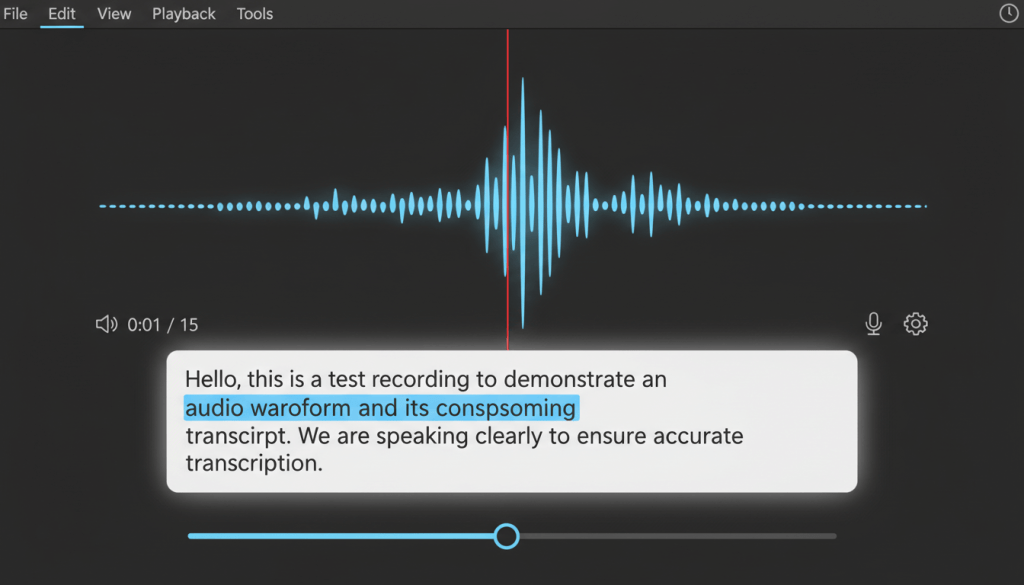
1. Transcribing speech and audio (the most common meaning)
This is the meaning most relevant to businesses, professionals and organisations:
Turning audio or video speech into written text.
Many modern guides define transcription as “converting spoken language into written text”, whether that’s done manually by a human or automatically by speech recognition software.
This is what people usually mean when they say:
- “Can you transcribe this call?”
- “We need these interviews transcribed.”
- “The webinar recording will be transcribed for attendees.”
The result is a transcript – a document that captures what was said (and sometimes how it was said).
Transcripts are used for:
- Minutes and records of meetings
- Legal evidence and case files
- Medical records and letters
- Research analysis
- Subtitles and caption files
- Searchable archives of audio and video
They’re also a key part of accessibility: web standards such as WCAG recommend transcripts or equivalent text alternatives for audio and video so that people who can’t hear, or who process text better than sound, can still access your content.
2. Transcribing in linguistics and phonetics
In linguistics, to transcribe often means:
Writing down speech sounds using a system of symbols – such as the International Phonetic Alphabet (IPA).
Dictionaries and linguists “transcribe” pronunciation, representing how words sound, not just how they’re spelt.
For example, the word transcribe itself might be transcribed with IPA symbols to show exactly how it’s pronounced.
3. Transcribing in music
Musicians also use transcribe:
Writing out music that you hear, or rewriting a piece of music for a different instrument or ensemble.
For example:
- A pianist listens to a jazz solo and transcribes it so others can play it.
- A composer transcribes an orchestral piece for piano.
This is still a kind of “copying into another form” – from sound into written notation.
4. Transcribing in genetics and biology
In biology, transcription describes a very specific process:
DNA is “transcribed” into RNA – a genetic copy in a slightly different format.
Unless you work in life sciences, you’ll rarely mean this when you talk about “transcribing” – but it’s another example of the same core idea: content copied into a new form.
What is transcribed – and what does transcribed mean?
You’ll often see phrases like:
- “The meeting was transcribed.”
- “Transcribed notes”
- “This call has been transcribed for quality and training purposes.”
Here’s what those forms actually mean.
“What is transcribed?”
Whatever you turn into a written record is what gets transcribed. For example:
- Audio files – recorded calls, interviews, voicenotes
- Video – webinars, training, YouTube content
- Handwritten notes – shorthand, notebooks, paper forms
- Music – solos, performances, arrangements
So if you ask, “What is transcribed in this process?” the answer might be:
“All doctor–patient consultations are recorded and transcribed into structured notes.”
“What does transcribed mean?”
Transcribed is the past tense or past participle of transcribe:
- “These interviews have been transcribed.”
- “You’ll receive the transcribed document within 24 hours.”
It simply means: already converted into written form.
“What does transcribing mean?”
Transcribing is the continuous form:
- “I’m transcribing the focus group now.”
- “Our team is busy transcribing today’s hearings.”
So if someone asks “what does transcribing mean?”, you can answer:
“It’s the ongoing process of listening and turning speech into accurate written text.”
What’s a transcriber?
If you’re wondering “what’s a transcriber?” – it’s the person or service doing the work.
A transcriber is someone who:
- Listens carefully to recordings or live speech
- Types what is said, usually word-for-word or very close
- Follows style rules and confidentiality requirements
- Produces a clean, structured transcript that others can use
Depending on their specialism, you might hear terms like:
- General transcriber – interviews, podcasts, business meetings
- Legal transcriber – court hearings, witness statements, legal conferences
- Medical transcriber – clinical notes, letters, reports and dictations
- Market research transcriber – focus groups, depth interviews, user research
- Media transcriber – reality TV, documentaries, subtitles
Professional transcribers combine:
- Excellent listening and language skills
- Strong spelling, grammar and punctuation
- Knowledge of technical terminology
- High levels of accuracy and speed
- A commitment to privacy and data protection
At Transcribe Lingo, this is exactly the kind of expertise clients rely on when accuracy, confidentiality and deadlines really matter.
Types of transcription you’ll come across
Even within speech-to-text, there are several styles of transcription. Understanding these helps you ask for exactly what you need.
Verbatim vs “clean” transcription

Verbatim transcription captures:
- Every word
- Filler sounds: “um”, “uh”, “you know”
- False starts and repetitions
- Laughter, pauses and significant sounds
This is essential for:
- Legal and court work
- Behavioural research
- User and UX research where tone and hesitations matter
Clean (or “intelligent”) transcription removes:
- Most fillers and false starts
- Obvious stumbles and repeated words
The result is a smoother read that keeps the meaning but is easier on the eye – ideal for reports, blogs or internal documents.
Time-stamped and speaker-labelled transcripts
Many projects also need:
- Timestamps – e.g. every 30 seconds or every speaker change, so you can jump back to the right moment in the audio.
- Speaker labels – especially in groups, panels or multi-party meetings.
These details turn a transcript from “nice to have” into a powerful working tool for teams.
Audio transcription vs video, captions and subtitles
Transcription is closely linked to subtitles and captions, but not quite the same.
- A transcript is generally a full written version of the audio, often presented as a separate document.
- Captions/subtitles are synchronised text on the video itself.
Accessibility standards highlight transcripts as an important way to make multimedia content usable for people who can’t access audio, or who prefer text.
Often, a high-quality transcript is the starting point for both captions and repurposed content such as blogs, articles and social posts.
Human transcribing vs AI tools: what’s the difference?
With AI and speech recognition everywhere, it’s natural to ask:
“Isn’t transcribing just something AI can do now?”
AI tools can be very helpful, especially for:
- Clear, single-speaker recordings
- Quick notes and summaries
- Rough drafts that a human can then tidy up
However, there are important differences between automated and professional human transcription.
Where AI transcribing works well
- Solo presenters with good microphones
- Short, non-sensitive recordings
- Drafting content where small errors don’t matter
- Internal working notes
In these cases, automatic transcription can save time – as long as a human still reviews the text for obvious errors.
Where a professional transcriber is the better choice
You’ll usually want a skilled human (or a professional service like Transcribe Lingo) when:
- Accuracy is critical – legal, clinical or compliance-related speech
- Multiple speakers overlap – meetings, focus groups, workshops
- Accents and dialects are varied
- Specialist terminology is used – medical, legal, technical or financial
- Sensitive data is involved and needs secure handling
A human transcriber can:
- Recognise context and jargon
- Resolve ambiguities
- Flag unclear audio
- Follow bespoke formatting and confidentiality rules
AI is a useful assistant; a professional transcriber is a quality guarantee.

Why transcription matters: accessibility, compliance and clarity
Understanding what “transcribe” means is only half the story. The bigger question is why transcribing matters so much.
Accessibility and inclusion
Transcripts:
- Help Deaf and hard-of-hearing users access spoken content
- Support people who process information better through reading
- Make it easier to translate and localise content
Guidance on digital accessibility, including standards based on WCAG and similar frameworks, emphasises transcripts as a key alternative for audio-only and video-only content.
Legal and regulatory compliance
In some contexts, having accurate, transcribed records is essential to:
- Demonstrate what was said and agreed
- Comply with sector standards (e.g. clinical documentation, financial advice scripts)
- Meet public sector and accessibility obligations in certain jurisdictions
While the exact requirements vary, having a reliable transcript is often your safest option.
Productivity and insight
Transcribed content is:
- Searchable – quickly find quotes, decisions and themes
- Shareable – stakeholders can scan a transcript instead of watching a full recording
- Reusable – one webinar can become blogs, social posts and training materials
For researchers, marketers and product teams, high-quality transcription is a shortcut to insight.
How to decide what kind of transcription you need
If you’re still asking, “what does it mean to transcribe this?”, here’s a simple way to decide what to ask for.
- Look at the purpose
- Internal notes only? A basic transcript may be enough.
- Evidence, reports, publications? You’ll want professional-level accuracy.
- Check the audio quality and speakers
- Clear audio, one speaker: AI plus light editing might be fine.
- Noisy environment, multiple speakers, strong accents: a specialist human transcriber is safer.
- Consider the content type
- Medical, legal, financial or public sector recordings usually need someone who understands the terminology.
- Creative, marketing and research content may need verbatim detail, speaker labelling and timestamps.
- Decide on the style
- Need every “um” and hesitation? Ask for verbatim.
- Prefer a smoother read? Ask for a clean or intelligent transcript.
- Think about security and confidentiality
- For sensitive or regulated data, choose a transcription partner with clear security, NDAs and data protection processes.
When to bring in Transcribe Lingo
If your recordings are important enough that you’re still googling what does transcribe mean, they’re probably important enough to get right the first time.
Transcribe Lingo helps you by:
- Turning interviews, meetings, legal proceedings and clinical dictations into precise, well-formatted transcripts
- Matching you with experienced transcribers for your sector – from healthcare and legal to market research and corporate communications
- Offering secure, confidential handling of sensitive data
- Providing flexible turnaround options when deadlines are tight
Whether you have one key interview or an ongoing volume of recordings, you can hand the audio over and receive ready-to-use transcripts that your team can trust.
Ready to have your recordings professionally transcribed? Upload your files to Transcribe Lingo today and get a tailored quote with turnaround times that work for you.
Frequently asked questions about transcribing
1. What does transcribe mean in simple terms?
In everyday use, to transcribe means to listen to speech (or read notes) and write it out as a clear, accurate text. If you transcribe a meeting, you’re turning what was said into a written document people can read and search later.
2. What is transcribing vs transcription?
Transcribing is the process – the act of listening and writing.
Transcription is the result – the finished written record, such as a transcript of a podcast episode or court hearing.
3. What does transcribed mean on a document?
If a document is described as transcribed, it means:
- It was copied from another source into written form – usually from audio, video or handwritten notes.
- It should represent what was said (or written) as faithfully as possible, within the chosen style.
For example, “transcribed interview” means the audio recording has been turned into text.
4. What’s the difference between a transcriber and a typist?
A typist mainly types written material, such as handwritten notes or drafts.
A transcriber specialises in:
- Listening to recordings or live speech
- Understanding different accents and technical vocabulary
- Producing accurate, formatted transcripts with the right tone and style
Many transcribers also edit AI-generated drafts to ensure they’re up to professional standards.
5. Can AI tools transcribe instead of a human?
Yes, many AI tools can automatically transcribe clear audio, and they’re useful for drafts and internal notes. But they:
- Struggle with overlapping speakers, heavy accents and noise
- Often mishandle names, jargon and sensitive contexts
- Do not guarantee confidentiality or compliance on their own
For high-stakes, specialist or sensitive recordings, a human transcriber – supported by technology where appropriate – provides a much more reliable result.
6. How do I get something professionally transcribed?
The usual steps are:
- Collect your audio or video files.
- Decide the style you need (verbatim vs clean, timestamps, speaker labels).
- Share the files securely with a professional transcription service like Transcribe Lingo.
- Receive your completed transcripts by the agreed deadline, ready to use or share.
If you’re unsure which options to choose, Transcribe Lingo can advise based on your sector, project and deadlines.
