
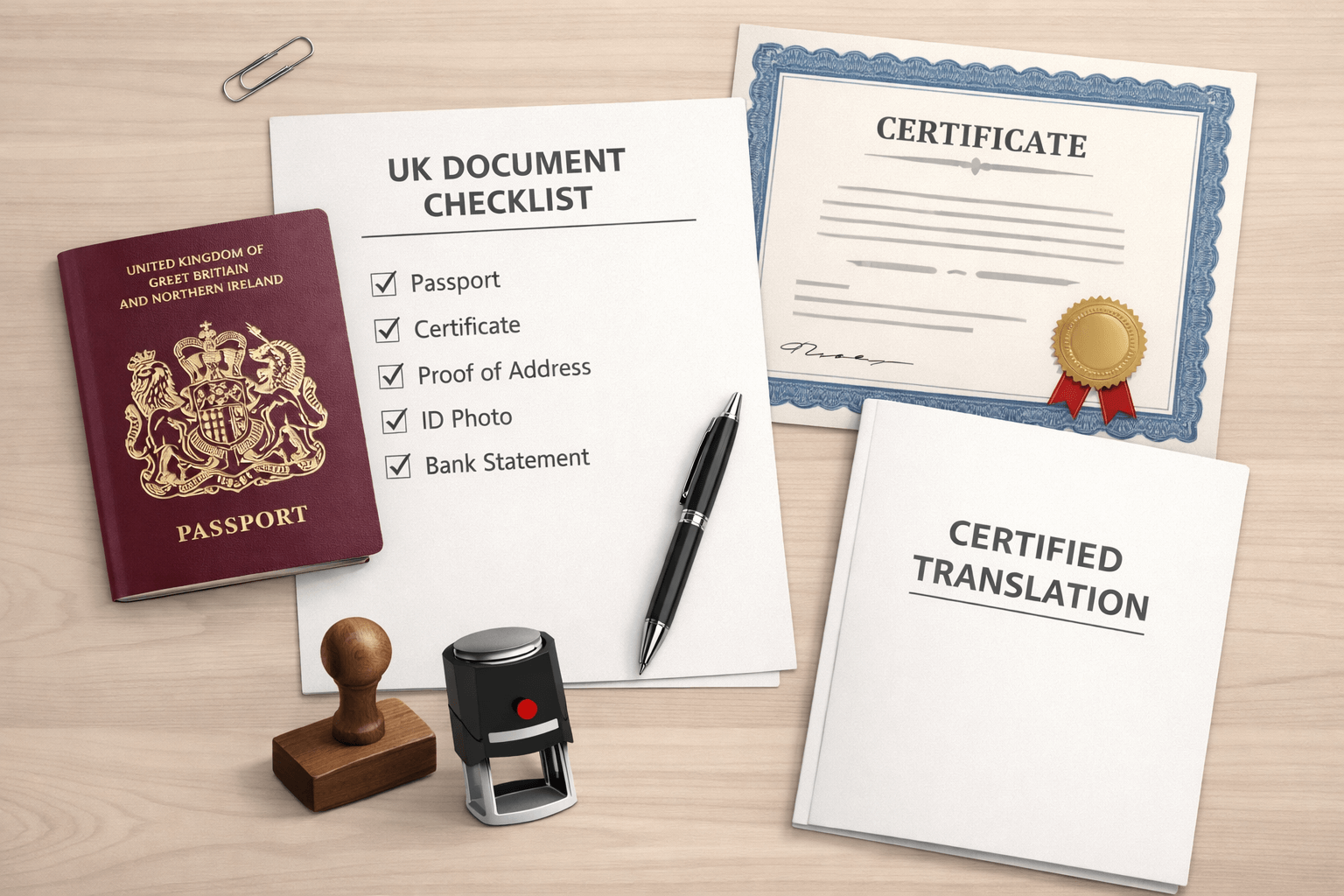
If you’ve typed certified translation services gov uk into Google, you’re not alone. People usually aren’t looking for “a government translation agency” at all. They’re trying to avoid a rejection, a delay, or an email that says: “We can’t accept your document.”
Here’s the reality: most of the time, you don’t need a mysterious “Gov UK certified” provider. You need a certified translation that matches the receiving authority’s checklist (and can be verified if they ask).
If you want to skip the guesswork, you can upload your document here and we’ll confirm what you need before we start: certified translation services.
The quick answer people are really searching for
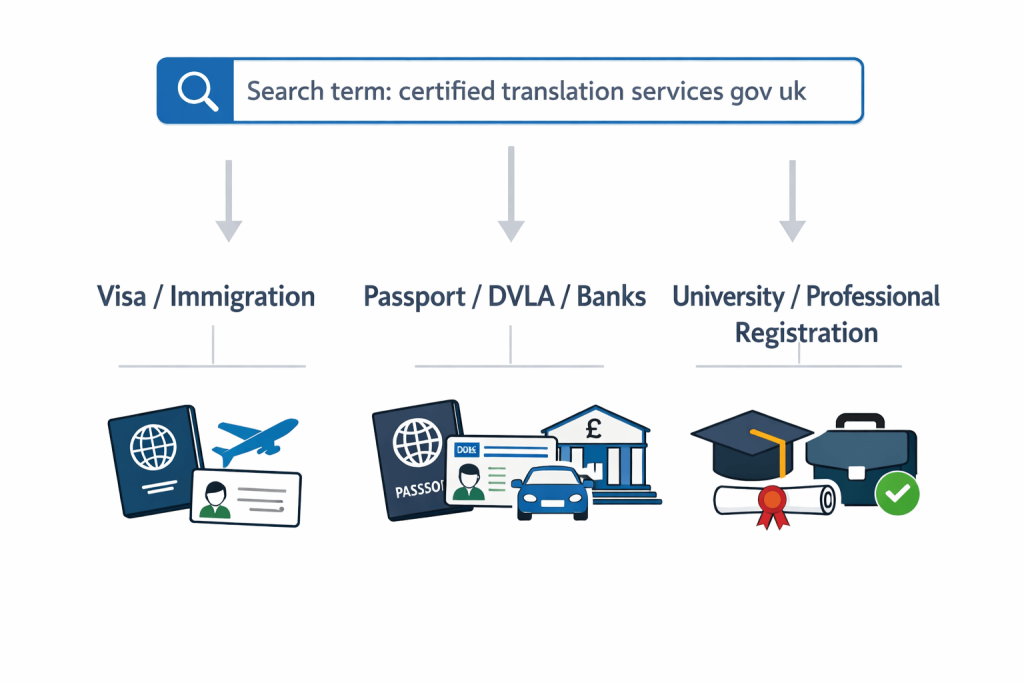
When someone says “certified translation services gov uk”, they usually mean one (or more) of these:
- “A translation that UK authorities will accept”
- “Home Office approved translation services” (a phrase people use to describe compliant translations)
- “Official translation services for my visa/passport/DVLA/university”
- “A registered translator UK” (someone with recognised professional credentials)
What you actually need depends on where you’re submitting the translation (Home Office, HM Passport Office, DVLA, a university, a bank, a court, an embassy, etc.) and whether they require extra steps like notarisation or legalisation.
Why this keyword is so confusing (and why some pages mislead you)
This search phrase causes confusion for three big reasons:
1) People assume GOV.UK lists “approved” translation companies
Many industries have official registers. Translation in the UK doesn’t work like that for most day-to-day applications. “Approved” is often marketing shorthand for “meets common requirements.”
2) “Certifying a document” and “certifying a translation” sound like the same thing
They aren’t. Certifying a document usually means someone signs a copy to confirm it matches the original. Certifying a translation means the translator (or agency) adds a written confirmation that the translation is accurate.
3) GOV.UK pages sometimes include lists (but not in the way people think)
Some GOV.UK pages publish overseas service-provider lists for convenience. Those lists are information-only and not endorsements, which is why relying on them as an “approval list” can backfire.
What UK authorities typically want from a “certified translation”
In practice, a certified translation is less about a special stamp and more about a clear, verifiable certification statement attached to the translation.
A safe certified translation package usually includes:
- A complete translation of the full document (not selected sections)
- A Certificate of Accuracy (or certification statement)
- The translator’s name
- The date of the translation
- Contact details (email/phone and address or company details)
- A signature (commonly requested) and/or company stamp
- A reference to the source document (document type, issuing country, ID number if visible)
If you want this handled end-to-end, start here: upload your file for certified translation.
Copy-paste: Certificate of Accuracy template (UK-friendly)
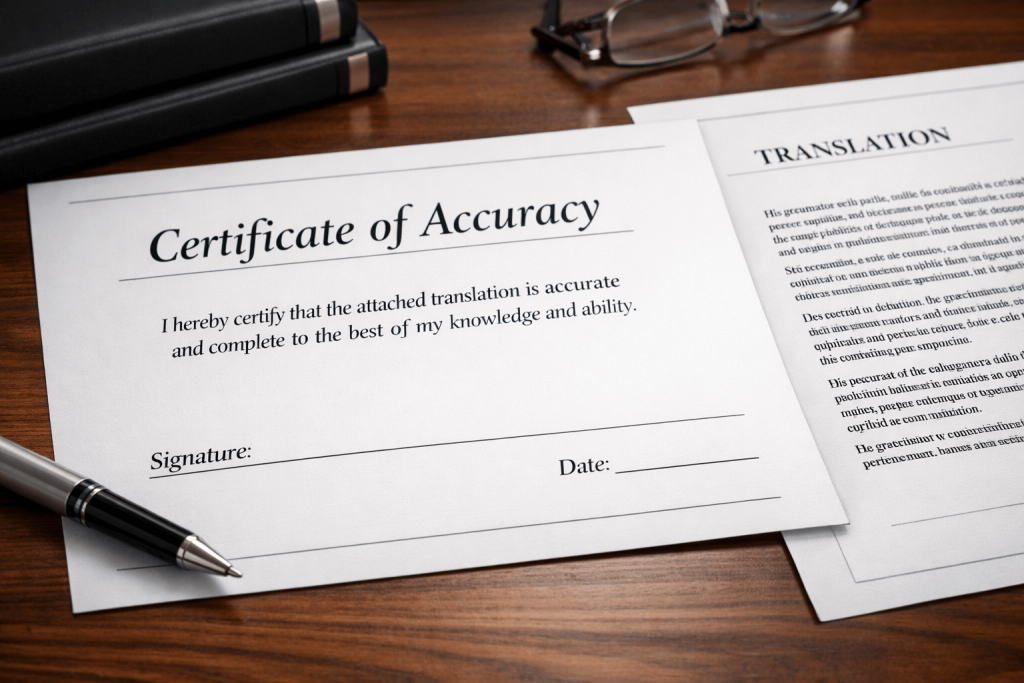
You can use this wording as a baseline (the safest versions are simple, explicit, and easy to verify):
Certificate of Accuracy (Certified Translation)
I, [Full Name], certify that I am fluent in [Source Language] and English, and that the attached document is a true and accurate translation of the original [Document Type] issued in [Country].
Translator / Authorised Representative: [Full Name]
Signature: _______________________
Date: [DD Month YYYY]
Contact details: [Email] | [Phone]
Address / Company: [Address] / [Company name, registration details if applicable]
Optional (only if helpful):
- Translator credentials / membership number: [e.g., professional membership]
- Notes on format: “Stamps, signatures and handwritten text have been translated or described.”
This template is one of the easiest ways to reduce “back-and-forth” and avoid avoidable rejections.
“Home Office approved translation services”: what that phrase really means
People search home office approved translation services because they want certainty.
What it usually means in plain terms:
- The translation is properly certified
- It includes the right details to be independently verified
- It’s produced by a professional translator or translation company
- It’s formatted so the reviewer can match it to the original document quickly
The practical test is simple: If the receiving authority emails you asking to verify the translator/agency, can they do it easily?
If you need a fast, compliant translation with a clear certification statement, you can start here: certified translation services.
“Registered translator UK”: what to look for (without overpaying)
People also search registered translator UK expecting an official government register. What you’re usually looking for is:
- A translator who can show professional credentials, relevant experience, and accountability
- A translation company with clear quality controls and traceable contact details
- A provider that can supply the right certification wording for your use case
A strong provider will happily answer:
- Who is translating it (role and accountability)?
- What certification statement will be attached?
- What will appear on the translation (name, signature, contact details, date)?
- Can you format it to match the original layout where helpful?
For ongoing document needs (legal, immigration, HR, compliance), you may also want a specialist sector workflow. For example: legal language services.
When a certified translation is not enough
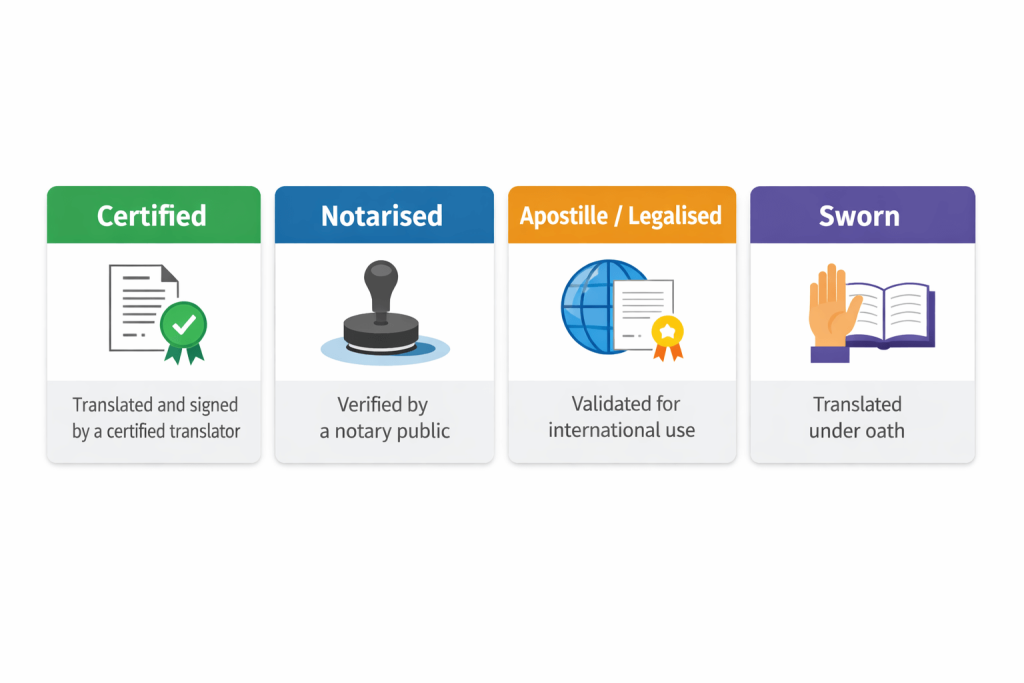
Sometimes “certified” is just step one. Here’s how to tell if you need more:
You may need notarisation if…
- The receiving organisation specifically demands a notary
- You’re asked to prove the identity of the person signing the certificate
- You’re submitting documents for certain overseas processes
You may need legalisation (apostille) if…
- You’re presenting documents internationally and the receiving country asks for an apostille on the original or related paperwork
(Important: legalisation rules vary by country and document type.)
You may need a sworn translation if…
- You’re submitting to a country that requires sworn/official translators under its legal system (common in parts of Europe and Latin America)
You may need certified copies if…
- The receiving body wants a certified true copy of the original document (separate from translating it)
If you’re unsure, the simplest way to avoid doing it twice is to upload your document and tell us where it’s being submitted. We’ll confirm the correct route before translation begins: contact us.
The rejection checklist: why translations get refused
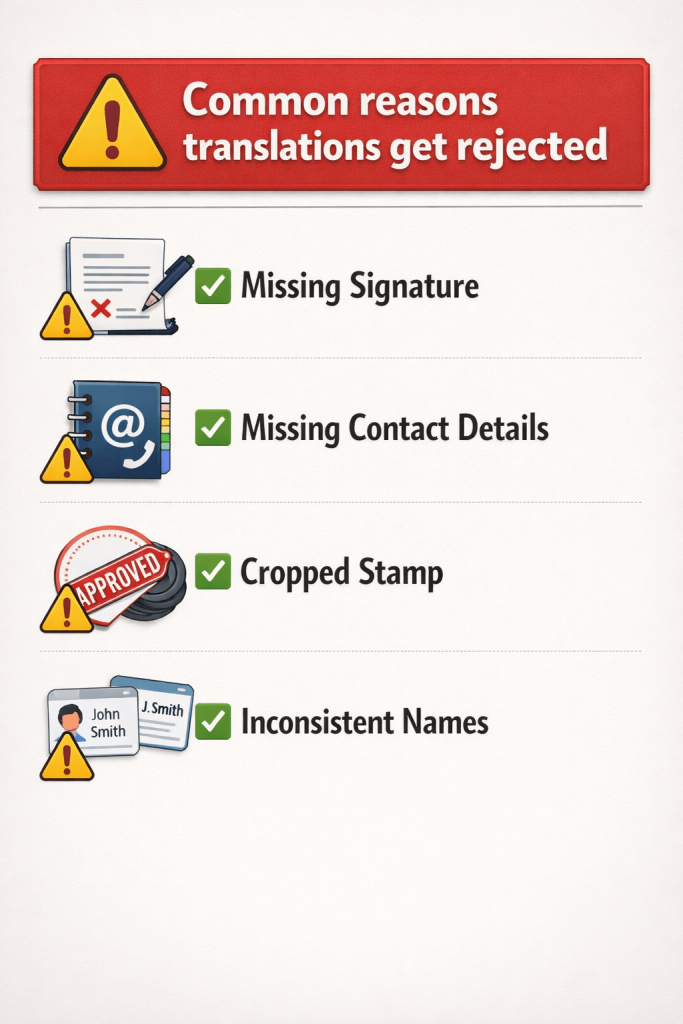
Most translation refusals are boring, predictable, and preventable. Common triggers include:
- Missing certification statement (or vague wording)
- No translator/agency contact details
- No date of translation
- Partial translation (only translating the “important bits”)
- The translation doesn’t match the document (names, dates, document numbers)
- Illegible scans or cropped stamps/signatures
- Formatting that makes it hard to compare with the original
- Self-translations (often rejected because they can’t be independently verified)
If you want it done once, correctly, start with a clear scan/photo and use a provider that builds the certification properly from the start: certified translation services.
What a “Gov UK-ready” certified translation looks like in real life
Here are three typical scenarios:
Scenario A: Visa or immigration application
You normally need a certified translation that includes:
- Translator/agency details
- Date
- Signature (commonly requested)
- Clear certification statement
- Full translation of every relevant element (including stamps/seals)
Scenario B: University or professional registration
You may need:
- Certified translation of transcripts/letters
- Consistent formatting and terminology (modules, grades, awarding body)
- Extra notes for stamps, signatures, or handwritten entries
Scenario C: DVLA, HM Passport Office, banks, employers
You may need:
- Certified translation with strong identity/contact details
- Clean formatting for fast verification
- Clear alignment to the original document layout
Want to confirm your exact requirement in one message? Use FAQs or send your document here: contact us.
How to get the right translation the first time (simple steps)
- Check the receiving authority’s wording (or forward it to us)
- Upload a clear scan/photo (include stamps, backs of documents if relevant)
- Tell us:
- where it’s being submitted
- your deadline
- whether you need digital copies, hard copies, or both
- We produce:
- the translation
- the certification statement
- consistent formatting that’s easy to verify
Start here: upload your file.
A note on pricing (what really changes the cost)
Certified translation costs are usually driven by:
- document length and complexity
- handwriting/stamps and formatting needs
- urgency (same-day / next-day turnaround)
- whether you need notarisation/legalisation steps
For a quick estimate, see price rate or upload your document for a quote: certified translation services.
What clients care about (and what we build into every job)
When documents are time-sensitive, clients don’t just want translation. They want confidence.
Common feedback we hear:
- “Quick turnaround and accurate translations.”
- “Prompt, supportive, and thoroughly professional.”
If you’re on a deadline, the fastest path is: upload your file.
FAQ
What does “certified translation services gov uk” mean?
It usually means “a certified translation that UK authorities will accept.” It’s not a specific GOV.UK service. What matters is that the translation is certified correctly and can be verified if requested.
Are there Home Office approved translation services?
People use this phrase to describe translations that meet common Home Office certification expectations (accurate translation statement, date, translator/agency name, signature, contact details). There isn’t one universal “approved list” for every situation, so compliance matters more than labels.
What should a certified translation include for UK applications?
A safe certified translation usually includes a Certificate of Accuracy stating it’s a true and accurate translation, the date, translator/agency name, signature (commonly requested), and contact details, plus a complete translation of the full document.
Do I need notarised translation services for the UK?
Often, no. Many UK submissions accept a properly certified translation. Notarisation is typically only needed if the receiving organisation specifically asks for it or if the document is being used for certain overseas processes.
How do I find a registered translator UK?
Look for a professional translator or translation company that can show credentials, clear accountability, and a certification statement that includes verifiable contact details. If you’re unsure, choose a provider that explains the certification format before you pay.
Can I translate my own documents and certify them?
For many official uses, self-translation is risky because it may not be considered independently verifiable. If the receiving authority has strict rules, a professional certified translation is the safest option.
