

In some countries, certification is a protected title awarded by a professional body or the courts. In others, there’s no government “translator licence”—and what people actually need is a certified translation (a translation with a signed statement of accuracy), not a “certified translator”.
This guide makes it simple. You’ll learn the recognised pathways in Canada, the United States, and key systems across Europe (including Germany, Ireland, and the UK)—plus New Zealand, India, and beyond. You’ll also get a practical checklist to verify credentials anywhere, so you can confidently choose the right route (or hire the right professional).
Quick note before we start: If your immediate goal is submitting documents to an authority (immigration, court, university, embassy), you likely need certified translation services, not a new career. If that’s you, you can use our certified translation services and upload your file for a fast quote.
What “Certified Translator” Means Around the World (In Plain English)
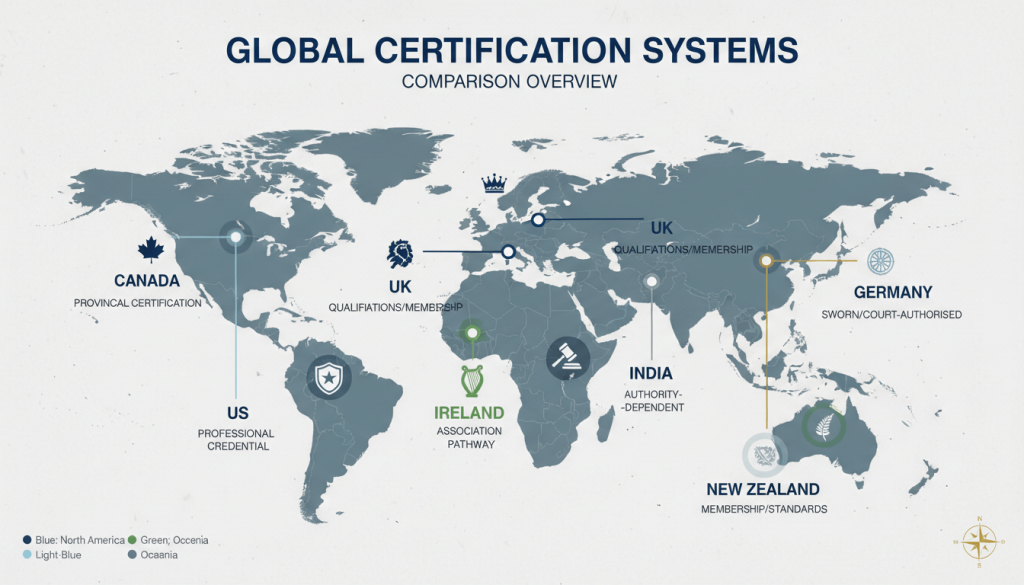
Here’s the fastest way to understand the landscape:
- Canada: Certification is typically handled through provincial/territorial bodies connected to a national umbrella. Title-based, structured pathways.
- US: There’s generally no state licensing for translators. The most recognised credential is typically national/private certification (plus organisation-specific requirements depending on where you work).
- Germany: “Certified” (for official documents) usually means a court-authorised / sworn translator. Highly formal.
- UK: No official “sworn translator” system. Credibility is usually built through professional qualifications and memberships.
- Ireland: Strong professional association pathway; “certified” is often tied to membership/assessment.
- New Zealand: Recognition often comes via professional membership and competency frameworks.
- India: No single national “certified translator” licence for general practice; requirements depend heavily on the receiving authority and document purpose.
How to Become a Certified Translator in Canada (Step-by-Step)
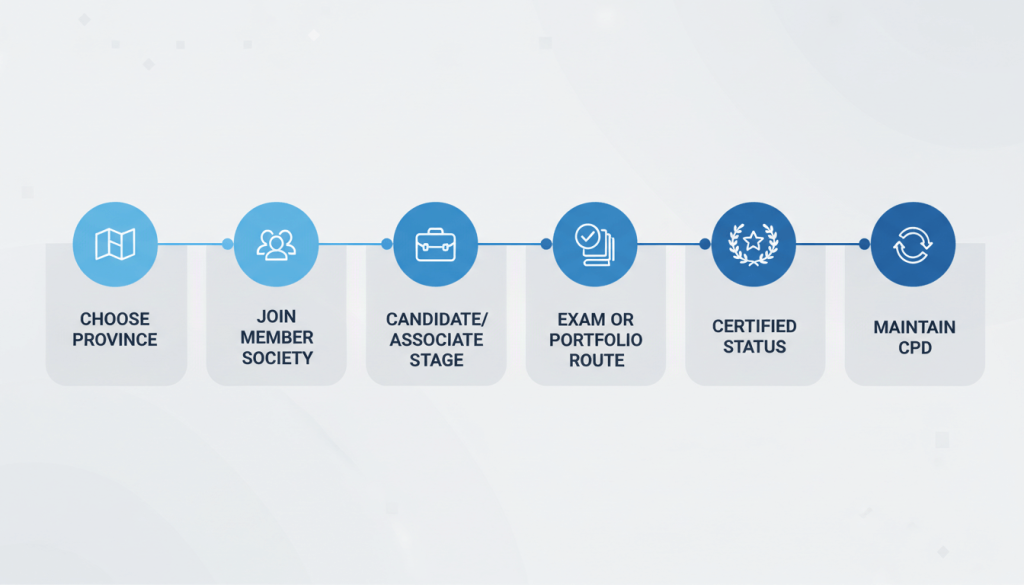
In Canada, translator certification is typically provincial/territorial, not “one national licence you apply for once”. The practical process looks like this:
Step 1: Pick your province (this matters)
Your route is shaped by where you live/work (or plan to). Certification and titles typically sit with local bodies (e.g., Ontario, Alberta, British Columbia).
Step 2: Build your foundation (what successful candidates usually have)
You don’t always need a translation degree, but you do need proof you can translate professionally. Strong foundations usually include:
- Advanced proficiency in both languages (writing quality matters as much as comprehension)
- Training in translation (degree, certificate, or equivalent)
- Specialisation (legal, medical, financial, technical, marketing)
- Professional experience (even if it starts with supervised/portfolio work)
Step 3: Join the relevant provincial/territorial body first
In Canada, you typically enter the profession through a member society (often starting as an associate/candidate category) and then progress to certification.
Step 4: Choose your certification pathway
Common pathways include:
- Examination route (sit a formal certification exam)
- On-dossier / portfolio route (certification based on assessed professional work, where available)
- Recognition/transfer (in some cases, if you’re already certified elsewhere)
Step 5: Prepare like it’s a professional audit (because it is)
Canadian certification isn’t about being bilingual. It’s about:
- Meaning-first accuracy
- Register and tone control
- Terminology consistency
- Clear, natural target-language writing
- Professional ethics and confidentiality
Step 6: Maintain your status
Certification isn’t a one-and-done checkbox. Most bodies expect you to uphold standards, follow a code of ethics, and stay current through professional development. (https://www.cttic.org/)
How to Become a Certified Translator in Ontario (ATIO)
If you’re searching how to become a certified translator in Ontario, your path usually starts with professional membership progression.
Practical steps:
- Build evidence of training and/or professional translation experience.
- Apply through the appropriate membership category.
- Progress towards certification via the recognised certification routes available to you (exam and/or dossier-based, depending on eligibility and current rules).
- Strengthen your profile: domain specialism + documented work + references.
Pro tip: Many applicants underestimate how much writing quality in the target language is assessed. Treat your English/French writing like a publishing standard, not “good enough”.
How to Become a Certified Translator in Alberta (ATIA)
If you’re searching how to become a certified translator in Alberta, be aware that eligibility can include residency/status requirements depending on the route and the professional body’s rules.
A typical progression looks like:
- Join as an associate category (where applicable).
- Complete ethics/proficiency requirements (where required).
- Sit assessments/exams and/or complete the certification process within required timeframes.
- Keep building a portfolio in a specialist niche (legal + immigration is a common starting niche, but it’s demanding—quality control matters).
How to Become a Certified Translator in British Columbia (and Portfolio Routes)
If you’re searching how to become a certified translator in Canada and you’re based in BC, you’ll often see portfolio/on-dossier routes discussed alongside examinations.
That route tends to require:
- A proven history of paid professional work
- Carefully selected samples meeting specific criteria
- Evidence of professionalism and consistency over time
Reality check: Portfolio routes aren’t “easier”. They’re different—and often just as strict because your real-world work is being judged.
How to Become a Certified Translator in the United States (What Actually Counts)

If you’re searching how to become a certified translator in the US, here’s the straightforward truth:
- In most cases, states do not license translators.
- “Certified translator” usually means you’ve earned a recognised professional credential, and/or you consistently meet the requirements of the agencies/clients you serve.
The most recognised pathway: build towards a national professional credential
A common US route looks like:
- Pick a language pair and specialism (generalists struggle to stand out).
- Build formal training (translation coursework, certificate, mentorship, structured practice).
- Build a portfolio (realistic, domain-specific samples).
- Earn a recognised credential (where relevant to your market).
- Create a professional workflow: glossary, style guide, revision process, QA.
The important distinction in the US: “Certified translation” vs “certified translator”
For many US uses (immigration filings, universities, HR, licensing boards), what’s needed is a certified translation—a translation accompanied by a signed statement confirming accuracy and completeness.
If you’re producing certified translations for clients, your professional credibility comes from:
- Demonstrable competence
- Consistent process and quality control
- Clear certification statements
- Appropriate notarisation when requested (not always required)
If you need help with the document side, you can use our certified translation services and we’ll handle the formatting, certification statement, and delivery.
How to Become a Certified Translator in California (and What People Usually Mean)
People often search how to become a certified translator in California when they actually mean one of three things:
- A translator with a recognised professional credential (general translation work)
- A court interpreter (a separate profession with its own credentialing)
- Someone who can provide certified translations (for USCIS, courts, universities)
A practical translation-focused plan:
- Build professional training + a niche (legal/immigration, medical, corporate)
- Build a portfolio that matches your niche
- Use a strict revision process (ideally second-person review)
- Earn credentials that matter to your clients (often national/professional rather than state-based)
- Market through credibility signals: samples, client outcomes, secure process, confidentiality
How to Become a Certified Translator in Florida, Georgia, Michigan, New York, and Texas
If you’re searching:
- how to become a certified translator in Florida
- how to become a certified translator in Georgia
- how to become a certified translator in Michigan
- how to become a certified translator in NY
- how to become a certified translator in Texas
…your best approach is to align with what your target clients actually recognise.
The simplest “do this next” plan for any US state
- Identify your target market (immigration, legal, healthcare, business, academic).
- Identify what that market recognises (credential, experience, vetting, references).
- Build a portfolio with realistic texts in that niche (not generic samples).
- Add a documented QA process (glossary + consistency checks + revision).
- If your work involves certified translations, make your certification statement process professional and consistent.
New York special note: Many people in NY need certified translations for immigration and university use. In those scenarios, the deliverable quality and certification statement matter more than a “state licence” (because it typically isn’t a thing).
How to Become a Certified Translator in Germany (Sworn / Court-Authorised Route)

If you’re searching how to become a certified translator in Germany, you’re typically dealing with a formal “sworn/authorised” system for official documents.
A practical overview of how this usually works:
- Prove high-level language competence in both languages.
- Demonstrate suitability and reliability (formal requirements apply).
- Show you understand legal terminology and formal document conventions.
- Apply to the competent authority (often tied to regional courts/state rules).
- Once approved, you’re authorised/sworn for specific language pairs and can produce translations that are officially recognised within that framework.
Key point: Requirements vary by German state. Always follow the authority rules in the region where you’re applying.
How to Become a Certified Translator in Ireland (ATII/ITIA Pathway)
If you’re searching how to become a certified translator in Ireland, professional credibility is often established through professional association routes and rigorous entry requirements.
A common pathway:
- Build formal qualifications and/or demonstrable professional experience.
- Apply through the relevant membership route.
- Pass assessments/examinations required for professional membership categories.
- Maintain professional standards and continued development.
How to Become a Certified Translator in the UK (and the Truth About “Sworn Translator UK”)
If you’re searching how to become certified translator UK (or how to become a sworn translator UK / how to become sworn translator in UK), you need one crucial clarification:
- The UK generally does not operate a formal “sworn translator” system in the way some European countries do.
So what does credibility look like in the UK?
- Recognised qualifications (translation-focused)
- Professional memberships and assessments
- A strong portfolio + specialist competence
- A clean process for certification statements when official documents are involved
Practical UK route (translation-focused)
- Choose a specialism (legal, medical, financial, technical).
- Pursue recognised translation qualifications.
- Build a portfolio with revision and domain-accurate terminology.
- Consider professional membership routes that assess competence.
- Learn “official document translation” conventions (format fidelity, seals/stamps where relevant, certification statements, notarisation when needed for overseas submission).
If your UK client needs documents for a country that requires sworn translations (e.g., some European jurisdictions), the solution is often:
- using a sworn translator recognised in that target jurisdiction, or
- producing a certified translation plus additional legal steps (depending on the receiving authority).
How to Become a Certified Translator in New Zealand
If you’re searching how to become a certified translator in New Zealand, professional recognition typically comes through:
- meeting eligibility criteria for professional membership, and/or
- demonstrating independently validated competency standards
A practical plan:
- Complete recognised translation/interpreting education or provide assessed equivalency.
- Build verified experience in a specialist niche.
- Join professional networks that require proof of competence.
- Align your work with the standards expected by the agencies you want to serve.
How to Become a Certified Translator in India (What’s Realistic)
If you’re searching how to become a certified translator in India, you’ll quickly notice there isn’t one single, universal “translator certification licence” for general practice.
What works in reality:
- Get solid training (language degree + translation study, or specialised translation education).
- Choose a market: legal/immigration, corporate, technical, media, academic.
- Build a portfolio with domain credibility (terminology and formatting matter).
- Work with a professional process: QA, confidentiality, version control.
- For official submissions, follow the receiving authority’s requirements (they may require notarisation, apostille, or specific formats).
If your goal is document acceptance abroad: focus on producing authority-ready certified translations with consistent formatting and a proper certification statement.
How to Verify a Translator’s Credentials Anywhere (A 60-Second Checklist)
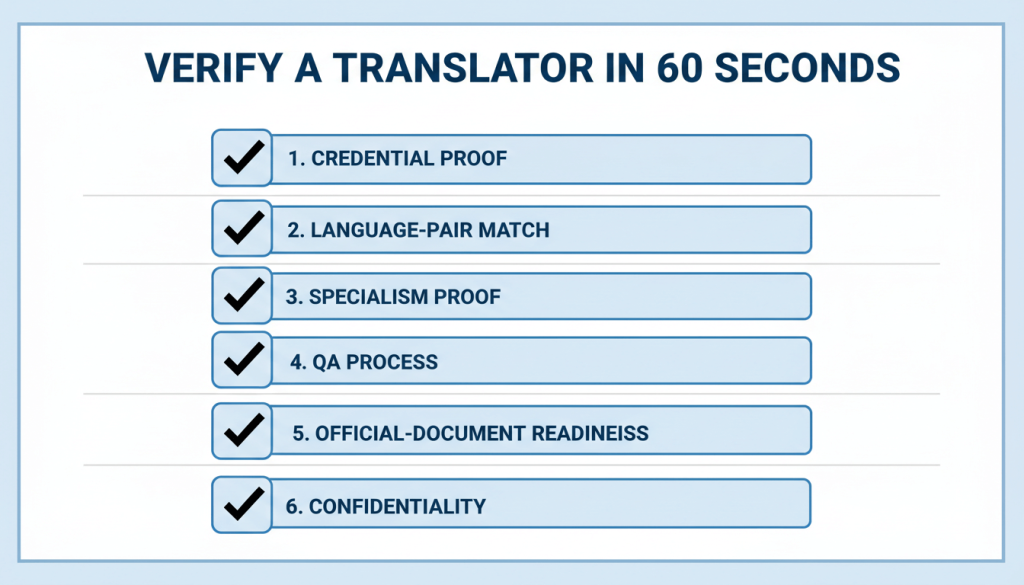
Whether you’re hiring someone—or building your own credibility—use this checklist:
- Credential proof: membership number, certificate, or listing in a professional directory
- Language-pair match: credential is for your language direction (not just “speaks both”)
- Specialism proof: past work samples in your domain (redacted if confidential)
- Process proof: revision/QA steps, terminology management, style consistency
- Official-document readiness: certification statement format, formatting fidelity, secure delivery
- Professional risk controls: NDA/confidentiality, data handling, clear turnaround commitments
What Clients Look for (and What You Should Build)
If you’re aiming to stand out internationally, focus on these credibility levers:
- Specialisation beats generalisation. Pick a lane and own it.
- Your writing quality is your brand. Especially in English/French.
- Process is what professionals sell. QA is part of the product.
- Consistency scales trust. Glossaries, style guides, and repeatable phrasing matter.
Need help turning your documents into authority-ready submissions? Our full suite includes translation plus supporting language deliverables like transcription services when you’re working from audio/video, and broader language services for complex projects.
Client feedback (anonymised)
- “The formatting matched our originals perfectly, which avoided back-and-forth with the university.” — N. O., Admissions Coordinator
- “We needed certified translations urgently; everything arrived on time and the certification was clear.” — S. K., Immigration Caseworker
- “Consistent terminology across multiple documents saved us hours during legal review.” — D. M., Paralegal
FAQs
How to become a certified translator in Canada if I don’t have a translation degree?
Many candidates build eligibility through a combination of language mastery, verified experience, training, and the recognised certification processes in their province. Focus on professional-level writing, domain expertise, and the pathway requirements where you live.
How to become a certified translator in Ontario or Alberta faster?
The fastest realistic route is usually: build documented experience in a niche, complete required ethics/proficiency steps (where applicable), and prepare intentionally for the certification route you qualify for (exam or dossier). “Faster” only works if your fundamentals are already strong.
How to become a certified translator in California, Florida, Georgia, Michigan, NY, or Texas?
In the US, most states don’t license translators. Build credibility through recognised credentials, portfolio strength, specialist competence, and a professional process—especially if you provide certified translations for immigration, universities, or courts.
How to become a certified translator in Germany if I live outside Germany?
Germany’s official-document system is tied to local rules and authorisation. If your work must be recognised in Germany, you typically need the sworn/court-authorised route for that jurisdiction and language pair.
How to become certified translator UK or a sworn translator in the UK?
The UK generally doesn’t have a formal sworn translator system. Build credibility through recognised qualifications, professional memberships/assessments, specialist portfolio work, and correct certification statements for official documents.
How to become a certified translator in New Zealand or India?
New Zealand often relies on professional membership and competency frameworks. India has no single universal “certified translator licence” for general practice; requirements vary by purpose and receiving authority. In both cases, build a rigorous portfolio and professional workflow.
