

If you’ve ever wondered how to become a court translator, you’re not alone—although most people searching this phrase are actually thinking of court interpreting (spoken) rather than court translation (written). Courts need both, and the pathways overlap—but the skills, expectations, and credentials can differ depending on the country and even the court.
This guide shows you exactly how to become a translator in court, how to be a translator for the court, and how to become a court-certified interpreter, with practical steps you can follow no matter where you live.
What a “Court Translator” Actually Does (and How It Differs from a Court Interpreter)

Court translator (written)
A court translator works with documents used in legal proceedings, such as:
- witness statements and affidavits
- indictments, pleadings, claims, and defences
- court orders and judgments
- police reports and disclosure bundles
- contracts, exhibits, evidence files, and correspondence
- immigration or asylum documents used in tribunal matters
A court translator’s work must be accurate, consistent, formatted correctly, and often certified (and sometimes notarised or legalised, depending on where the document is being filed).
Court interpreter (spoken)
A court interpreter works with speech in real time, including:
- hearings and trials
- solicitor/client conferences and consultations
- police interviews and interviews under caution
- tribunal hearings and immigration interviews
- remote hearings via video or telephone
Interpreting is a performance skill under pressure: you must retain meaning, tone, register, and legal nuance—often while speaking immediately after the original speaker.
Why the confusion matters
If you want to “work for the courts”, your first decision is:
- Do you want to interpret (spoken) in court?
- Do you want to translate (written) court documents?
- Or both? (Many professionals do—after they’ve become strong in one.)
The Fast Answer: The Core Steps to Court Work
No matter your country, the route usually looks like this:
- Become professionally bilingual (not just conversational)
- Prove high-level English and high-level target language ability
- Learn legal systems and court procedure (your jurisdiction + common law vs civil law basics)
- Train specifically for court interpreting or legal translation
- Pass the relevant exams (where applicable)
- Complete vetting / background checks (common for court work)
- Build documented experience (supervised hours, mock courts, portfolio, CPD)
- Get on the right register / panel / vendor list
- Work with agencies and legal teams to gain consistent assignments
- Keep CPD and ethics compliance strong—your reputation is everything
What Courts Actually Look For (Beyond “Speaking Two Languages”)
Courts don’t just need someone bilingual. They need someone who can demonstrate:
1) Legal accuracy under pressure
- precision with legal terms
- correct handling of names, numbers, dates, and charges
- no “tidying up” language or adding explanations
2) Register control
You must match the speaker’s level of formality—whether it’s judicial language, legal argument, or emotional witness testimony.
3) Ethical reliability
Courts require strict:
- confidentiality
- impartiality
- role boundaries (you interpret/translate; you don’t advise or advocate)
4) Process discipline
Professionals show up prepared:
- correct terminology lists
- case context awareness
- consistent formatting and certification when translating
5) Proven quality
This is why credentials, testing, and evidence of CPD matter so much.
Step-by-Step: How to Become a Court Translator

Step 1: Build legal-domain language fluency (not general fluency)
If you’re serious about how to be a court translator, your language level must handle:
- formal legal sentence structures
- archaic or jurisdiction-specific terms
- fixed legal phrases (and their true equivalents)
- ambiguity (and how courts interpret it)
Practical tip: Start a “court glossary” today. Divide it into:
- criminal law
- civil procedure
- family law
- immigration/tribunals
- evidence and disclosure
- sentencing and remedies
Add real terms you see in filings—then verify the correct meaning in context.
Step 2: Learn court documents and formatting expectations
Court translation isn’t only words—it’s also presentation. Learn how to reproduce:
- headings, stamps, references, pagination
- tables, exhibits, footnotes
- signatures, seals, certification blocks
- redactions and confidentiality markings
A common reason translations get rejected is layout mismatch or missing details (case number, page references, or document structure).
Step 3: Train in legal translation methods (not just “translation techniques”)
Legal translation requires:
- consistent term selection (term bases help)
- controlled ambiguity (don’t “fix” unclear originals)
- careful handling of false friends
- understanding legal effect (what the document does)
You’ll also need a process for:
- double-checking names/numbers
- verifying statutes, authorities, and case references
- documenting any illegible text or missing pages
Step 4: Build a portfolio that looks court-ready
Courts and legal clients don’t want “sample marketing copy.” They want evidence you can handle:
- witness statements
- contracts and annexes
- court orders / judgments
- police reports
- forms (immigration, tribunal, legal aid-related)
Create a portfolio with:
- 6–10 anonymised samples
- different document types
- a consistent formatting approach
- a clear certification example (where appropriate)
Step 5: Understand certification (and what it means in your country)
The phrase how to become a court certified translator can mean different things depending on jurisdiction.
In many places, “certified translation” means a signed statement of accuracy from a qualified professional or agency. In others, you may need:
- a sworn translator appointment
- a court-approved list placement
- a specific credential (or membership level)
Your job is to align with what the receiving court accepts—not what a general blog says.
Step 6: Get onto panels, vendor lists, and legal supply chains
Court translation work often flows through:
- court-approved vendors
- public sector frameworks
- law firms and barristers’ chambers
- language service providers handling court bundles
To be considered, you typically need:
- verified identity
- qualifications
- references
- insurance (often expected)
- secure handling process (data protection and confidentiality)
Step-by-Step: How to Become a Court-Certified Interpreter

If your goal is how to be a translator for the court in the sense of spoken language—here’s the interpreter pathway.
Step 1: Confirm which court system you’re targeting
Court interpreting requirements vary widely:
- state/provincial vs federal
- criminal vs civil vs family vs immigration
- spoken languages vs sign languages
- in-person vs remote courts
Start by identifying:
- the exact courts you want to work with
- whether your language is a “tested” language (with formal exams)
- whether there’s a register, certification exam, or consortium exam in your region
Step 2: Build interpreting skill (not just bilingual skill)
Court interpreting requires core modes:
- Consecutive interpreting (speaker pauses; you interpret)
- Simultaneous interpreting (you interpret while they speak)
- Sight translation (reading a document aloud in another language)
You’ll need trained ability in:
- memory and note-taking
- speed + precision
- legal register
- managing interruptions and objections
- handling slang, dialects, and emotional testimony
Step 3: Complete formal training (wherever possible)
Even if not legally required, structured training accelerates competence and credibility. A strong programme covers:
- court procedure
- ethics and role boundaries
- interpreter conduct
- terminology building
- mock hearings and exam-style drills
Step 4: Pass required tests and vetting
Many jurisdictions require:
- written exams (language + ethics + court terms)
- oral performance exams (consecutive/simultaneous/sight)
- orientation courses
- background checks and security clearance steps
Step 5: Start with the right entry point
Some systems offer tiers like:
- registered interpreter (for languages without oral exams)
- provisionally certified
- fully certified
Don’t ignore entry tiers—many professionals build hours there while preparing for full certification.
Step 6: Build courtroom credibility fast (without risking mistakes)
The safest way to grow is:
- shadowing and observation (where permitted)
- supervised practice through training providers
- mock court sessions
- mentoring
- gradual exposure: conferences → consultations → hearings → trials
Court work punishes overconfidence. You’re better arriving slightly under-booked and fully prepared than busy and sloppy.
Country-Specific Pathways (What “Court-Certified” Often Means)
United Kingdom (England & Wales, Scotland, Northern Ireland)
In the UK, court interpreting is strongly linked to:
- recognised interpreting qualifications (often Level 6 for public service interpreting)
- professional registration expectations
- security and conduct standards
If you’re UK-based, your practical roadmap is usually:
- gain a recognised public service interpreting qualification (law pathway if available)
- build evidence of hours and CPD
- apply to the right registers/panels and work through approved supply routes
United States
In the US, court interpreting is commonly structured around:
- state-level programmes (with their own requirements)
- consortium-based oral exams in many states
- federal certification for certain languages in federal courts
The practical roadmap is:
- pick your state(s)
- complete prerequisites (orientation, written exams, background checks)
- pass oral performance testing where available
- apply to court rosters and approved vendor routes
Canada / Australia / EU countries
Many jurisdictions have:
- national/provincial accreditation models
- court lists and vendor panels
- sworn translator frameworks for written court documents (in some EU countries)
Your move: focus on the receiving authority’s acceptance rules first—then backfill your credentials to match.
The Court-Ready Competency Framework (Use This as Your Self-Assessment)
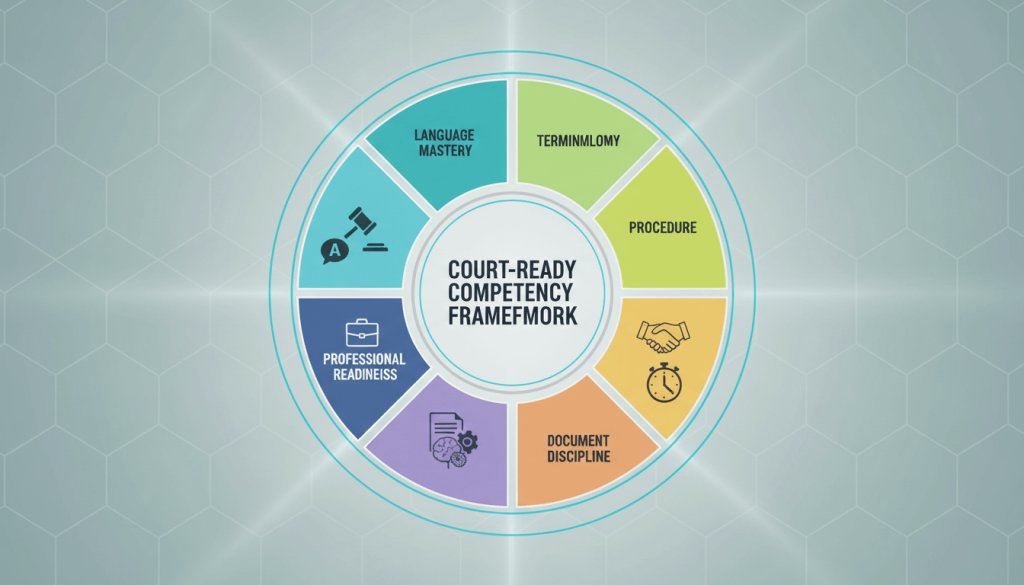
Before you chase badges or exams, score yourself honestly from 1–5 in each area:
- Language mastery (both languages; legal register included)
- Terminology control (consistent equivalents; no guesswork)
- Procedure familiarity (who speaks when; what documents mean)
- Ethics discipline (confidentiality, impartiality, boundaries)
- Performance skill (for interpreters: consecutive/simultaneous/sight)
- Document discipline (for translators: formatting, certification, consistency)
- Stress tolerance (accuracy under pressure, not after the fact)
- Professional readiness (insurance, contracts, secure handling, CPD)
Anything below a 4 is a training plan—not a personal failing. Build competence systematically.
What to Study (and How to Study It Without Wasting Time)
Train with realistic material
Court language isn’t the same as textbook language. Practise with:
- anonymised case summaries
- sample witness statements
- mock hearing scripts
- legal forms and orders
- recorded legal discussions (where permitted)
Use timed drills (this is where most people level up)
- 2 minutes consecutive → interpret
- 60 seconds simultaneous shadowing → interpret
- 10 lines sight translation → aloud, clean, accurate
- numbers drill (dates, currencies, addresses, charges)
Common Mistakes That Stop People Getting Court Work
- Treating court language like “general interpreting”
- Over-explaining instead of interpreting/ translating faithfully
- Weak note-taking (which becomes missing meaning)
- Fixing the original (courts need accuracy, not editorial improvements)
- Glossary chaos (changing terms every page)
- Underestimating dialects and register
- No evidence of professionalism (no portfolio, no CPD record, no process)
How Much Do Court Translators Make? (And What Impacts Earnings)
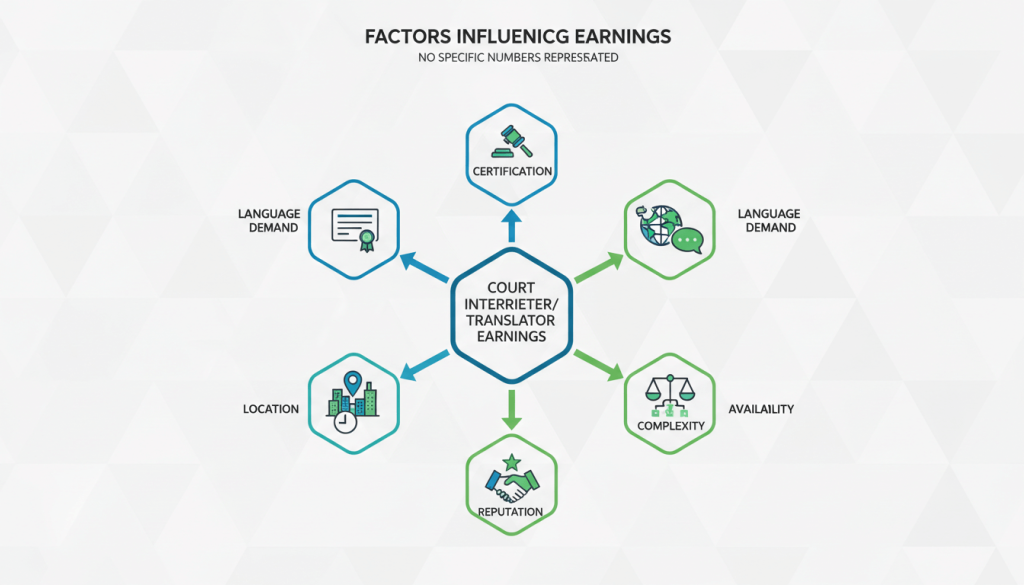
The honest answer: earnings vary hugely by country, language, court demand, and credential level.
What typically changes your earning power:
- Certification status (or being on a recognised register/panel)
- Language rarity (higher demand, fewer qualified professionals)
- Case complexity (serious crime, expert evidence, multi-day trials)
- On-call availability (urgent listings pay differently)
- Reputation (repeat instructions from legal teams)
- Location (large cities vs remote areas; travel policies)
- Mode (in-person vs remote; day rate vs hourly)
Real-world expectation: many court professionals work freelance, and income depends on consistency of bookings and reliability.
If you want stable growth, focus on:
- quality + consistency
- being easy to book and professionally responsive
- building relationships with agencies and legal teams
- keeping documentation airtight (timesheets, invoices, job records)
How to Get Your First Court Assignments (Without Guessing)
Start with realistic stepping stones
Many professionals build credibility by progressing through:
- legal consultations and solicitor meetings
- police/official interviews
- tribunal or administrative hearings
- short court hearings
- multi-day trials and complex matters
Where work comes from
- agencies supplying interpreters and translators for legal matters
- solicitors’ firms and legal aid suppliers
- public sector procurement routes
- specialist legal transcription/translation supply chains
The fastest way to be considered “low risk”
When a project coordinator books for court, they want certainty. You become low-risk by providing:
- clear credentials
- clear availability
- clear confirmation process
- reliable delivery (for translation)
- calm, professional conduct (for interpreting)
If You Need Court Translation or a Court Interpreter (Today)
If you’re reading this because you have a hearing, solicitor meeting, or a court bundle deadline coming up, don’t leave it to chance.
You can request a fast quote for:
- court interpreting (in-person, phone, or video)
- legal document translation with court-ready formatting
- certified translations where required
- transcription support for legal audio/video (where appropriate)
A good provider will ask the right questions upfront: venue, deadline, language/dialect, document type, and purpose—so the work is accepted the first time.
3) FAQ Section
How do I become a court translator with no experience?
Start by building legal-language competence and a portfolio of court-style documents, then seek supervised practice, mentoring, and entry-level legal translation work through agencies before moving into court bundles.
How to become a translator for the court if I only have bilingual skills?
Bilingual ability is the starting point, not the qualification. You’ll need training in legal language, ethics, and (for interpreting) consecutive/simultaneous/sight skills—plus whatever testing or registration your jurisdiction requires.
How to become a court certified translator in the UK?
In the UK, “court-certified translator” usually refers to legal translators who can provide certified translations accepted by authorities and courts. For court interpreting, recognised public service interpreting qualifications and registration routes are commonly expected.
How long does it take to become a court-certified interpreter?
It depends on your current level and your jurisdiction. Many candidates take several months to a few years to train, pass exams, complete vetting, and build courtroom-ready performance skill.
How much does a court translator make compared to a court interpreter?
Court interpreting often pays per hour, half-day, or full-day with travel policies, while court translation is commonly priced per word/page or per bundle. Earnings in both paths rise with credentials, demand, and reputation.
Can I do both court translation and court interpreting?
Yes, but it’s best to become excellent in one first. Translation and interpreting share legal terminology but demand different “production skills” and different error risks.
