

If you’ve ever wondered how to get into medical transcription – or whether it’s still worth it in the age of AI – you’re not alone. Healthcare providers still need accurate patient records, and someone has to turn fast, often messy clinical speech into clear, structured documentation.
This guide walks you through exactly what medical transcription is, what the jobs look like today, how to learn medical transcription (including from home and even using free resources), how to get medical transcription certification, what you can realistically earn, and how to turn it into a long-term career or business.
Throughout, we’ll be honest about the job outlook – including whether medical transcription is a dying field – and show you where the real, sustainable opportunities still are.
What Is Medical Transcription – and What Do the Jobs Involve?
Medical transcription is the process of turning dictated or recorded clinical speech into accurate written reports, letters and records.
A typical medical transcription job involves:
- Listening to audio from doctors, nurses and other clinicians
- Transcribing diagnoses, procedures, lab results and treatment plans
- Expanding abbreviations into clear, patient-friendly language
- Editing machine-generated drafts from speech recognition systems
- Formatting documents to fit electronic health record (EHR) templates
- Checking spelling, drug names and medical terminology
- Returning reports within strict turnaround times
According to the U.S. Bureau of Labor Statistics (BLS), medical transcriptionists work mainly for hospitals, physicians’ offices and third-party transcription providers, and they increasingly work remotely using EHR and transcription platforms.
When people ask “what is medical transcription jobs?” or “what is a medical transcription course?”, what they’re really asking is:
- What skills do I need?
- What will I actually do all day?
- How long will it take to train, and what will it cost me?
Let’s tackle those step by step.
Is Medical Transcription a Good Job or a Dying Field?
You’ll see headlines like “is medical transcription a dying field?” and “are medical transcription jobs being phased out?”, often linked to AI and voice recognition. The reality is more nuanced.

The data: decline in roles, but thousands of openings
The BLS projects that employment for medical transcriptionists will decline by about 5% between 2024 and 2034. Despite this, it still expects around 7,400 openings per year across the decade, largely because existing workers retire or move into other roles.
Industry analyses echo this: demand is being reshaped, not erased. AI and voice recognition handle more routine documentation, but skilled humans are still needed to edit, correct and quality-check complex reports and ensure compliance with EHR and legal standards.
So:
- Is medical transcription a dying field?
It’s shrinking as a traditional “type what you hear” job, but evolving into healthcare documentation and editing roles. - Is medical transcription still in demand?
Yes – especially for people who can edit AI output, handle complex specialties and understand privacy and compliance. - Is medical transcription a good career choice?
It can be, if you:- Enjoy detailed, quiet work
- Are comfortable with medical terminology
- Are realistic about pay and long-term prospects
- Treat it as a stepping stone into wider health documentation, coding or QA
Is Medical Transcription Hard?
It can be – but in a specific way.
You may find medical transcription hard if you:
- Struggle with concentration for long periods
- Dislike repetitive, detail-heavy work
- Find medical terminology overwhelming
- Are easily frustrated by unclear audio
You may find it a very good job if you:
- Enjoy puzzles and precision
- Have strong grammar and spelling
- Like working quietly on your own
- Are comfortable working at a computer for long stretches
- Want a flexible, work-from-home role in healthcare without a clinical licence
Think of it less as “typing” and more as micro-editing critical health information. If that appeals, you’re probably a good fit.
Step-by-Step: How to Get Into Medical Transcription
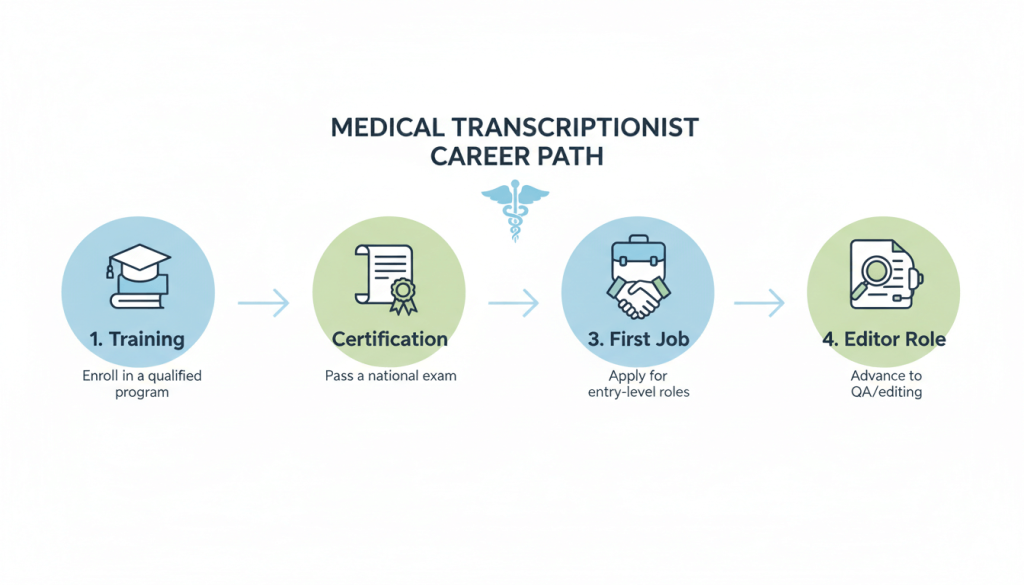
1. Understand the Role and Choose Your Path
Before you enrol in anything, decide what you’re aiming for:
- In-house medical transcriptionist
Employed by a hospital, clinic or GP practice. - Remote employee for a transcription provider
Working from home on a roster or shift pattern. - Freelance medical transcriptionist/editor
Contracting directly with providers or agencies. - Healthcare documentation specialist
A broader role combining transcription, editing, QA and sometimes scribing or EHR support.
If you’re in a market like India and asking how to start medical transcription or even how to start medical transcription business in India, the path is similar – but you’ll often provide services to overseas healthcare providers (for example in the US, UK, Australia) via BPO or specialist vendors.
Tip: Browse recent job ads for “medical transcriptionist” and “medical transcription editor” in your country. Note the requirements, software mentioned and whether roles are remote or on-site.
This will tell you how to apply for medical transcription jobs effectively later.
2. Meet the Basic Entry Requirements
Most medical transcription jobs expect:
- A high school diploma or equivalent
- Strong English grammar and spelling
- Typing speed of 55–70+ words per minute with high accuracy
- Basic computer skills (word processing, file management, cloud tools)
- A quiet workspace and reliable internet (especially if you’ll do medical transcription from home)
Some employers will train you from scratch; many prefer candidates who have already completed a medical transcription course or have transcription experience.
3. How to Learn Medical Transcription

If you’re wondering how to learn medical transcription or specifically how to learn medical transcription at home, you have three main routes: formal courses, structured online training, and self-directed learning.
What is a medical transcription course?
A typical medical transcription course covers:
- Medical terminology, anatomy and physiology
- Common diagnoses, procedures and drug names
- Healthcare documentation standards and report types
- Legal and ethical issues in health records
- Listening and transcription practice with real-world audio
- Editing of speech-recognition drafts
- Using transcription and EHR software
You’ll often do timed practice reports and receive feedback on accuracy and formatting.
How long is a medical transcription course?
Most programmes fall into two buckets:
- Certificate / diploma
- Duration: roughly 6–18 months, depending on whether you study part-time or full-time.
- Associate degree
- Duration: around 2 years full-time.
The fastest way in is usually a certificate programme focused on medical transcription and healthcare documentation.
How to learn medical transcription at home
If you can’t attend in-person training, you can:
- Enrol in an online medical transcription course with structured modules, assessments and instructor support.
- Build your own learning plan using:
- Medical terminology textbooks and flashcards
- Open course materials from universities and medical bodies
- Sample clinical dictations and practice reports
- Typing speed and accuracy tests
How to learn medical transcription at home free
Fully free routes are tough but not impossible. You can:
- Use freely available medical terminology glossaries and NHS/CDC disease resources
- Practise by listening to lectures, webinars and case discussions and typing them up
- Study example discharge summaries, radiology reports and clinic letters (with identifiers removed)
- Join online transcription communities and forums to learn from working professionals
You’ll still eventually need formal evidence of training or a strong portfolio of practice work to convince employers. But free learning can get you far enough to decide whether the field suits you before you invest.
4. How to Get Medical Transcription Certification
Certification is not always mandatory, but it can significantly improve your chances of getting hired and earning more – especially in competitive or remote roles.
In many English-speaking markets, the key credentials are:
- RHDS (Registered Healthcare Documentation Specialist) – typically for entry-level professionals
- CHDS (Certified Healthcare Documentation Specialist) – for experienced practitioners with advanced skills
Both are offered by the Association for Healthcare Documentation Integrity (AHDI) and generally require completion of an approved medical transcription training programme plus a proctored exam.
If you’re asking how to get a medical transcription certification or how to get medical transcription certification:
- Complete a recognised medical transcription course (online or in person).
- Check the latest eligibility criteria on the relevant professional body’s site.
- Book your exam and plan at least a few months of focused revision.
- Use mock exams and practice dictations to get comfortable with the format.
For some employers, certifications are a “nice to have”. For others – particularly US-based healthcare documentation firms – they’re a strong differentiator.
5. Build Experience – Even Before Your First Job
Employers hiring for entry-level medical transcription jobs want proof you can:
- Handle genuine clinical audio
- Maintain accuracy under time pressure
- Follow formatting and style rules
You can build this proof by:
- Completing assessed practice modules as part of a training course
- Volunteering or interning with local clinics or health NGOs (where allowed)
- Doing general transcription work (interviews, research, podcasts) to build speed and discipline
- Compiling a small portfolio of anonymised practice reports
At Transcribe Lingo, for example, we regularly see candidates whose applications stand out because they can talk through specific examples: “I completed 100+ clinical reports with 98% accuracy and consistent formatting”.
6. How to Apply for Medical Transcription Jobs
When you’re ready to move from training into paid work, focus on three things: positioning, proof and persistence.
Positioning
- Tailor your CV around healthcare documentation skills, not just “typing”.
- Highlight your medical transcription course, certificates and any related roles (admin in a clinic, general transcription, coding, etc).
- Use phrases employers actually search for, like “medical transcriptionist”, “medical transcription editor” and “healthcare documentation specialist”.
Proof
- Include metrics: accuracy rate, typing speed, number of reports completed.
- Show familiarity with EHR or transcription platforms where relevant.
- Attach or describe anonymised sample reports if allowed.
Persistence
- Apply to a mix of:
- Hospitals and clinics
- National and regional transcription providers
- Remote positions advertised internationally
- Expect tests: most employers will give you one or more audio files to transcribe under time limits.
If your long-term goal is to do medical transcription from home, it can be helpful to start with a structured role first, to get used to workflows and quality expectations.
7. Can You Do Medical Transcription From Home?
Yes. In fact, many people’s first question after “how to do medical transcription” is “can you do medical transcription from home?”.
Remote work is increasingly common in this field. Industry surveys and employer guides note that better technology and strong healthcare demand have helped shift many transcription roles out of traditional offices and into home-based setups.
To do medical transcription from home successfully, you’ll need:
- A quiet, secure workspace
- A fast, reliable internet connection
- A good headset and foot pedal (if required)
- Approved transcription and security software
- Strong self-discipline and time management
You’ll also need to comply with privacy and data-protection rules (for example, HIPAA for US patients), so expect background checks, non-disclosure agreements and strict policies about devices and storage.
If you’re self-teaching and asking how to do medical transcription from home without previous employment, start by practising with non-sensitive sample audio until you’re fast and accurate enough to pass employer tests.
8. How Much Does Medical Transcription Pay?
It’s natural to ask how much does medical transcription pay, how much do medical transcription make and even how much do medical transcription editors make before you commit.
Figures vary by country, experience and setting, but recent data suggests:
- The mean annual wage for medical transcriptionists in the United States is around $39,000, with an average hourly wage near $18–19.
- Some sources put the median salary in the range of $34,000–$38,000, with experienced professionals earning $50,000+.
For medical transcription editors – who specialise in editing AI-generated drafts and complex reports – salary surveys show higher averages, with hourly rates often significantly above standard transcriptionist roles in markets such as the US, depending on experience and location.
A few key points to keep in mind:
- Entry-level pay can be modest, especially in offshore or low-cost locations.
- Editors and QA specialists usually earn more than straightforward transcribers.
- Night shifts, specialist departments (like oncology or radiology) and high-turnover clinics may pay premiums.
- Pay-per-line or pay-per-audio-minute models reward speed and consistency – but can be stressful if audio quality is poor.
If you’re in India or similar markets and exploring how much does medical transcription make locally, expect lower base rates but opportunities to increase earnings by working with overseas clients or specialising as an editor.
9. How to Start a Medical Transcription Business (Including in India)

If you’d rather employ others than be an employee yourself, you might be asking how to start a medical transcription business or even how to start medical transcription business in India.
At a high level, the steps are:
- Research your target market
- Local clinics and hospitals
- Overseas providers looking to outsource
- Niche specialties (pathology, radiology, surgical centres)
- Decide your service mix
- Traditional dictation-to-text
- Editing and QA of speech-recognition output
- Additional services such as scribing, summarisation or coding support
- Handle compliance and legal structure
- Incorporate a company and set up business banking
- Put in place data-protection and confidentiality policies
- Ensure contracts address security and cross-border data transfer
- Build your delivery team
- Hire or contract trained medical transcriptionists and editors
- Implement QA processes and clear style guides
- Provide ongoing training as guidelines and technology change
- Invest in technology
- Transcription platforms and secure file transfer
- Encryption, backups and access control
- Analytics and dashboards to monitor turnaround times and error rates
- Win and keep clients
- Start with a pilot: one department, one specialty, one time zone
- Offer clear SLAs and transparent pricing
- Collect testimonials and use real data (accuracy, turnaround, error reduction) to build trust
Transcribe Lingo works with healthcare providers globally, so if your organisation would prefer to outsource instead of building a full transcription operation in-house, our team can help you scope and deliver a secure, scalable solution.
Career Paths Beyond Entry-Level Medical Transcription
Medical transcription is often a gateway into wider healthcare documentation roles. With experience, you can move into:
- Medical transcription editor / QA specialist
- Team lead or supervisor
- Healthcare documentation specialist or trainer
- Medical scribe or EHR workflow specialist
- Coding, billing or health information management roles
Training-focused guides emphasise that transcription skills – fast, accurate listening and documentation – provide a strong foundation for many health information careers.
If you treat medical transcription as part of a broader career in health information rather than the final destination, it becomes a far more resilient and rewarding path.
FAQs: How to Get Into Medical Transcription
How do I get into medical transcription with no experience?
Start by learning the basics of medical terminology and transcription, ideally through a certificate course or structured online training. Build a portfolio of practice reports, then apply for entry-level roles with providers who offer on-the-job training or editing support. Highlight your accuracy, typing speed and willingness to learn.
Is medical transcription a good career choice long-term?
It can be a good career choice if you enjoy focused, detail-oriented work and are comfortable learning new technology. The number of traditional roles is shrinking, but there is ongoing demand for people who can edit AI transcripts, handle complex specialties and move into broader documentation and QA roles. Treat it as a career in healthcare documentation, not just “typing”.
Are medical transcription jobs being phased out by AI?
Some traditional roles are being reduced as voice recognition improves. However, healthcare organisations and specialist firms still need humans to edit drafts, catch subtle errors, ensure reports make clinical sense and keep documentation compliant with legal and EHR standards. AI is changing the work, but not removing the need for skilled oversight.
Can I do medical transcription from home from the start?
Yes, but it’s easier if you have some training and practical experience first. Many companies offer remote entry-level roles, but you’ll usually need to prove your accuracy in tests and meet strict security requirements. If you’re completely new, consider starting in a structured environment or doing general transcription first to build speed and confidence.
How much do medical transcription editors make compared with transcriptionists?
Editors who specialise in reviewing and correcting AI-generated reports and complex dictations generally earn more than straight transcriptionists. Surveys in markets like the US report higher average hourly rates for medical transcription editors, with top earners in certain cities making significantly above the national average, depending on experience and employer.
How long does it take to learn medical transcription well enough to work?
If you study consistently, you can often finish a focused medical transcription course in 6–12 months and reach an employable level of accuracy, with some programmes running up to 18 months. Associate degree routes can take about two years. After that, expect another few months of on-the-job learning as you adapt to real-world audio and workflows.
