
Pricing translation is rarely “just a per-word rate”. If you’re wondering how to price translation services, you’re pricing risk, responsibility, subject-matter expertise, turnaround pressure, formatting effort, and the quality controls that stop a small error becoming a costly problem.
This guide shows you how to price translation services in a way that’s fair, repeatable, and easy to explain—whether you’re a freelancer building your first rate card or an agency pricing multi-language projects at scale. You’ll also see how clients should think about what they pay, so you can quote with confidence and win better-fit work.
If you’re buying translation and want a fast, fixed quote based on your actual file, you can request it here: Translation services.
What you’re really pricing (and why “cheap per word” often backfires)
A translation price should cover three things:
- Production: time to translate, research terminology, check numbers/dates/names, and format deliverables.
- Quality assurance: review, consistency checks, and corrections if anything is missed.
- Commercial reality: admin, comms, file handling, project management, tools, tax, and the risk of urgent or high-stakes work.
When any of those are underpriced, the project usually “pays for itself” later—via delays, disputes, or rework.
The main ways to charge for translation services (and when to use each)
There’s no single best model. Use the one that matches the job’s risk and predictability.
Per-word pricing (most common)
Best for: long documents, consistent text, straightforward file handling.
How it works:
Price = source word count × per-word rate (+ add-ons)
Watch-outs:
- Word count must be defined (source vs target). Industry default is usually source words.
- Per-word pricing can underprice “slow” content (tables, scanned PDFs, heavy formatting, or research-intensive text).
Per-page pricing (common for certificates and official documents)
Best for: passports, birth certificates, driving licences, academic transcripts—anything where the “work” is layout + accuracy rather than raw word volume.
Why it works:
A “page” price naturally covers stamps, seals, tables, and tricky formatting that per-word may miss.
If you handle official documents often, see: Certified translation services UK.
Hourly (great for messy, ambiguous, or multi-task work)
Best for: editing a bad source file, recreating layouts, transcreation workshops, terminology alignment, or short tasks where admin is the job.
Tip:
Hourly is easiest to defend when you define what’s included (e.g., translation + light formatting + one review pass).
Project-based / flat fee (best for client experience)
Best for: agencies, repeat clients, bundles, or any job where simplicity wins.
How it works:
You quote a fixed figure with clear scope (deliverables, turnaround, revisions, and assumptions).
This is often the easiest way to win work—clients buy certainty.
How much should I charge for translation services as a freelancer?
If you’ve ever Googled “how much should I charge for translation services”, you’ve probably seen wildly different numbers. That’s because a good rate depends on your capacity, costs, and niche—not what someone else charges.
Here’s a practical way to build a rate you can stick to.
Step 1: Calculate your minimum viable rate (MVR)
Your MVR is the rate that keeps you in business.
Start with:
- Target annual income (what you want to take home)
- Annual business costs (software, accounting, marketing, hardware, insurance, memberships, training, etc.)
- Tax buffer
- Billable capacity (your realistic working output)
A simple freelancer formula:
MVR per word = (Income + Costs + Tax buffer) ÷ Annual billable words
To estimate annual billable words, be honest about:
- Admin and client comms time
- Down days (illness, holidays, training)
- The fact that not every hour is billable
Step 2: Estimate your true productivity (not your best day)
Many translators can translate quickly on familiar, clean text—but slow down when:
- the source is poorly written
- terminology is specialised
- the file is messy (tables, scans, images)
- formatting must match the original
Create three productivity bands:
- Easy (clean general text)
- Standard (some research + moderate formatting)
- Complex (specialist + heavy QA/formatting)
Your pricing becomes consistent when your rate reflects the band.
Step 3: Add a minimum fee (this is where profit often lives)
Small jobs are dominated by admin, not translation time. A minimum fee prevents “£10 projects” that eat your day.
A simple rule:
- Minimum fee = your admin time + setup + delivery + payment friction
This single change often fixes underpricing overnight.
Step 4: Use a clear modifier list (so you don’t invent prices on the fly)
Create a one-page “pricing modifiers” note you apply consistently:
- Subject-matter complexity (legal, medical, technical, regulated)
- Urgency (same-day, weekend, overnight)
- File type / formatting (scanned PDFs, desktop publishing, tables)
- Certification requirements (statements, signatures, formatting constraints)
- Additional QA (second linguist review, terminology alignment)
- Client risk (new client, unclear brief, late approvals)
You’re not “adding random fees”—you’re pricing the real workload.
How to price translation services as an agency (without guessing)

Agency pricing isn’t “freelancer rate + a bit”. It’s a structured cost model with margin, because you’re selling delivery certainty, scalability, and quality control.
The agency pricing stack
A robust agency quote typically includes:
- Linguist cost (translation, editing, proofreading as needed)
- Project management (briefing, scheduling, queries, delivery control)
- QA and tooling (checks, terminology consistency, file handling)
- Risk buffer (tight deadlines, stakeholder changes, revisions)
- Margin (profit + reinvestment)
If you don’t explicitly price PM and QA, you’ll either lose margin or cut corners.
Choose a service tier that matches the risk
Instead of one rate, agencies win by matching workflow depth to the job:
- Standard translation: professional translator + essential QA checks
- Specialist translation: specialist translator + stronger terminology control
- High-stakes / publish-ready: translator + second linguist review + stricter QA
This is how you protect both quality and margin.
For regulated or official documents, route clients to a dedicated service page:
Certified translation services.
A practical agency rate card includes:
- Base rates by language group (common vs less common)
- Multipliers by specialism (general vs specialist vs legal/medical)
- Turnaround modifiers (standard / express / urgent)
- Add-ons (layout recreation, certified statements, notarisation coordination, glossary creation)
Build a rate card that sales teams can quote confidently
Once you have this, quoting becomes consistent—and clients experience you as “easy to work with”.
A quoting checklist you can copy (freelancers and agencies)
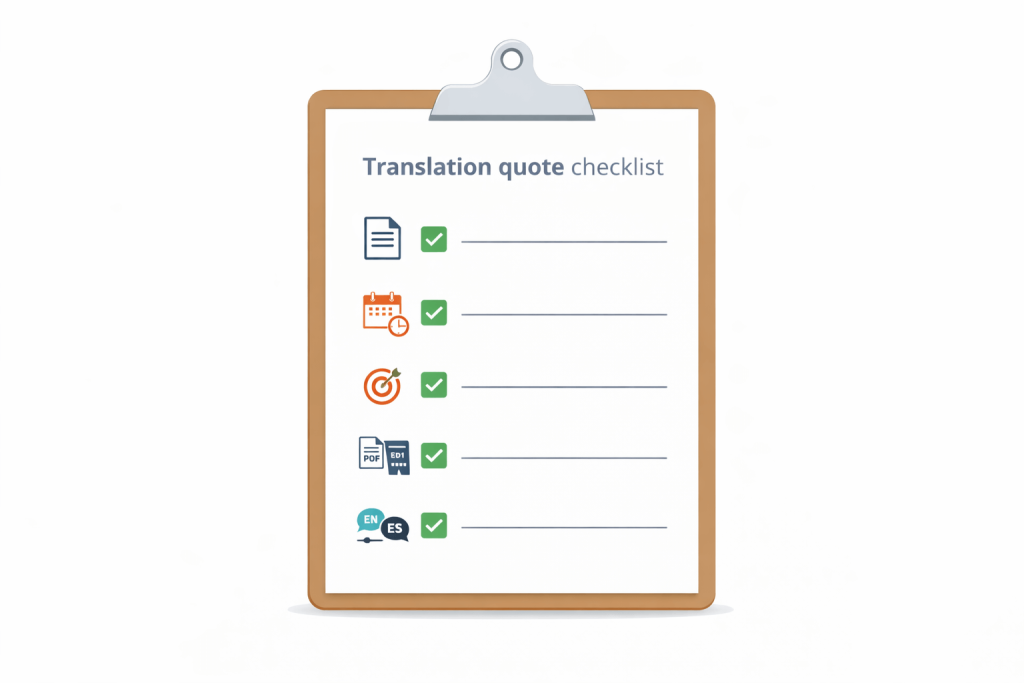
Before you price anything, get these answers. It prevents disputes and protects scope.
Project essentials
- Source language and target language(s)
- Purpose: internal understanding, publication, legal submission, marketing use
- Deadline and time zone
- Required format: Word, PDF, InDesign, spreadsheet, subtitles, etc.
- Any reference material: glossary, style guide, previous translations
- Preferred tone: formal, conversational, technical, brand voice
File reality checks
- Is the text selectable or scanned?
- Are there tables, stamps, handwritten notes, or images?
- Does the layout need to match the original “like-for-like”?
- Are there lots of repeats (good for consistency, not always for speed)?
Delivery and revisions
- What deliverables are included (editable file + PDF?)
- Is one revision pass included (and what counts as a “revision”)?
- Who signs off queries and terminology?
If a client can’t answer these, your quote should include assumptions and a change-control note.
Pricing factors that move the cost (and how to explain them clearly)
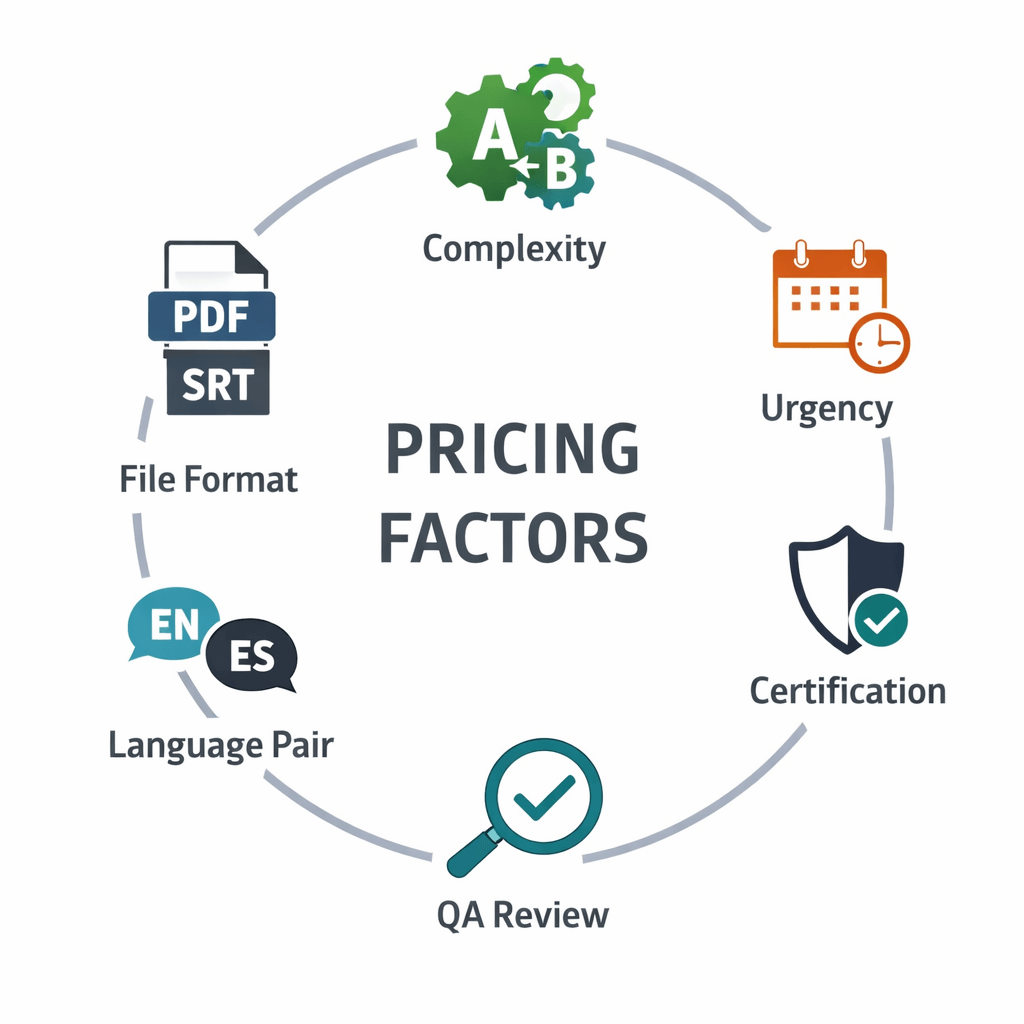
Clients don’t mind paying more when the “why” is obvious. Use plain language:
1) Complexity and risk
Legal/medical/technical content isn’t “hard because of vocabulary”—it’s hard because errors have consequences. That’s why it costs more.
2) Turnaround time
Urgency compresses QA time and forces rescheduling. If you offer urgent delivery, price it like a premium service, not a favour.
3) File type and formatting
A clean Word document is not the same as a scanned PDF full of tables and stamps.
4) Certification requirements
Certified documents often require:
- careful replication of formatting
- accurate handling of seals/stamps
- consistent names/dates/numbers
- a certification statement and controlled delivery
If you handle official documents often, you’ll want a dedicated workflow and a stable per-page model. See: Certified translation services UK.
5) Additional QA
A second linguist review (or specialist review) is a real cost—and often a client’s best value add-on for high-stakes content.
Examples: pricing scenarios (so you can sanity-check your quote)
Example 1: Freelancer, general document, standard turnaround
- Clean editable source file
- Single language pair
- Standard delivery
- Light formatting
Good fit for: per-word with a minimum fee.
Example 2: Agency, market research project, multiple deliverables
- Discussion guide + screener + consent forms
- Terminology consistency matters
- Fast turnaround and stakeholder edits
Good fit for: project-based quote with defined revision rules and a terminology note.
If you work in insights and research, this service area is designed for that workflow: Market research language services.
Example 3: Official documents bundle
- Certificates + IDs + supporting documents
- Layout fidelity matters
- Client wants acceptance-ready delivery
Good fit for: per-page pricing + clear turnaround options + controlled delivery.
Start here: Translation services.
How much should I pay for translation services as a client?

If you’re a buyer comparing quotes, ask one question:
“What exactly is included in this price?”
A higher quote may include:
- specialist translator assignment
- stronger QA (second linguist review)
- like-for-like formatting
- secure handling
- faster turnaround
- clearer accountability if anything needs fixing
A lower quote often excludes those things (sometimes without saying so).
What a fair quote usually specifies
- Pricing unit (per word, per page, hourly, or fixed)
- What counts as “a page” (if per page)
- Turnaround and delivery format
- Revision policy
- What’s included (formatting, QA depth, terminology handling)
- Any add-ons (apostille/notarisation coordination, hard copy delivery)
Red flags when you’re deciding what to pay
- No one asks what the translation is for
- The provider won’t confirm what’s included
- No QA process is mentioned
- Pricing feels “too good to be true” for high-stakes content
If you want a fast, fixed quote that matches your actual file and deadline, use: Contact Transcribe Lingo.
The most common pricing mistakes (and how to avoid them)
Mistake 1: Pricing only on word count
Fix: add a minimum fee + file/formatting modifiers.
Mistake 2: Offering rush work without charging for it
Fix: create an “urgent” service level and price it consistently.
Mistake 3: Underpricing revision cycles
Fix: include one controlled revision pass and define what it covers (typos, minor edits, not scope changes).
Mistake 4: Not pricing project management (agencies)
Fix: bake PM into your model or list it as a line item for complex projects.
Mistake 5: Not segmenting by specialism
Fix: create at least three bands: general, specialist, high-stakes.
A simple pricing framework you can use today
If you want one repeatable method:
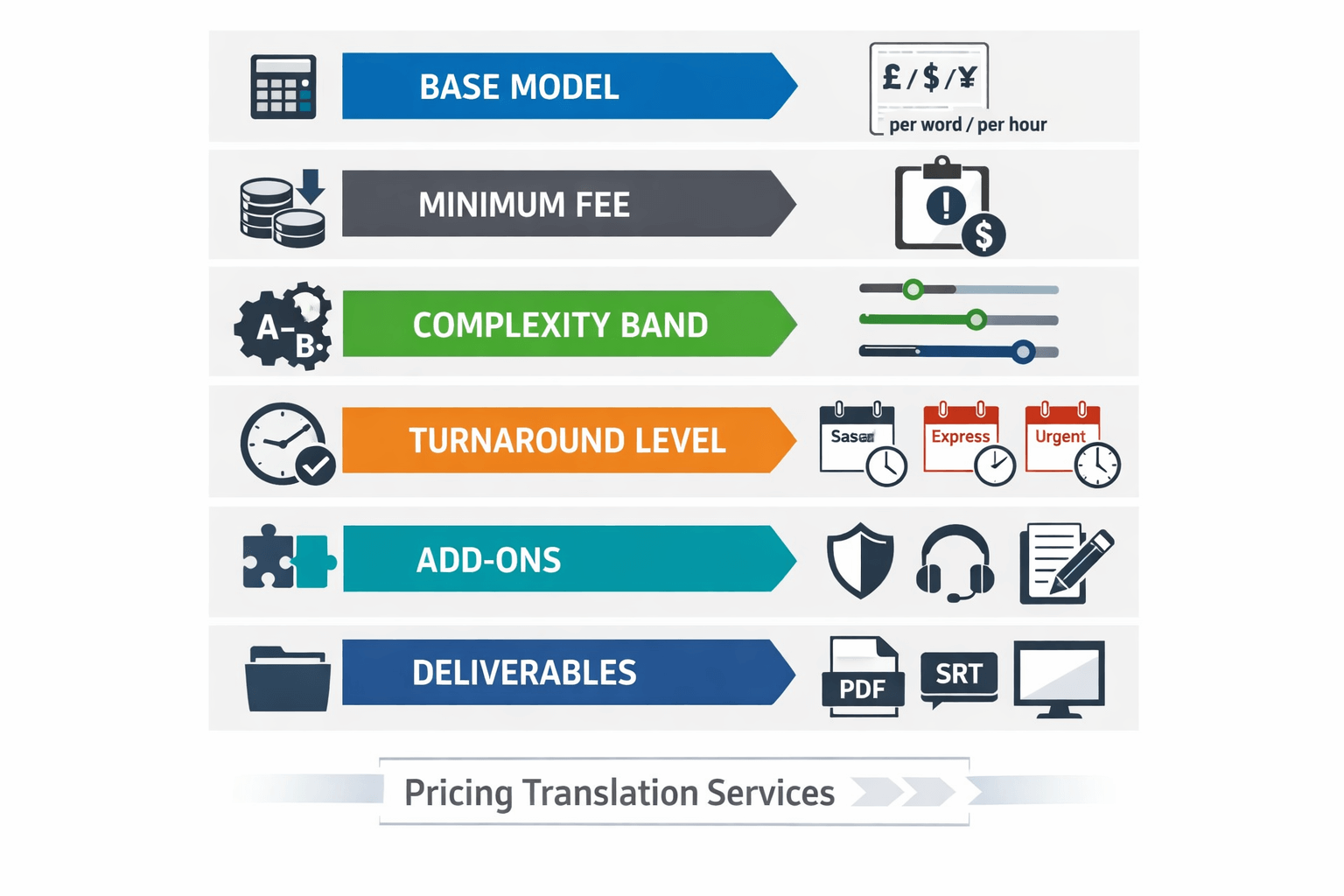
- Pick your base model (per word / per page / hourly / project)
- Apply a minimum fee
- Assign a complexity band (easy / standard / complex)
- Add turnaround modifier (standard / express / urgent)
- Add file/formatting add-ons (if needed)
- Define deliverables + revision rules
- Put assumptions in writing
That’s how you price translation services without second-guessing every quote.
To get a precise price on your document and deadline, start here: Request a quote.
FAQ
How do I price translation services per word?
Start with a base per-word rate that covers your income goals, costs, and realistic billable capacity, then apply modifiers for complexity, urgency, and formatting.
How much should I charge for translation services as a freelancer?
Charge enough to cover your minimum viable rate, add a minimum fee for small jobs, and raise prices for specialist, urgent, or high-risk work.
How do agencies price translation services?
Agencies typically price translation services by combining linguist costs, project management, QA/tooling, risk buffer, and a margin—often packaged as a fixed project quote.
Should I charge per page or per word for certified translations?
Per page works well for certificates and official documents because layout, stamps, and formatting effort can be significant even when word count is low.
How do I charge for translation services with urgent deadlines?
Use an express/urgent modifier that reflects compressed QA time and rescheduling effort, and define what “urgent” includes (e.g., delivery window and revision limits).
How much should I pay for translation services as a client?
Pay based on what’s included: QA depth, specialism, formatting, turnaround, and accountability. Compare quotes by scope, not just the headline number.
