
Starting a translation business is one of the few service businesses you can launch lean: a laptop, professional skills, and a clear offer. The challenge isn’t “doing translations” — it’s building a reliable service clients trust with their deadlines, reputation, and sensitive documents.
If you’re searching how to start a translation service, this guide walks you through setup, pricing, delivery, and the practical part most guides skip: how to offer translation services in a way that wins your first paying clients (and keeps them coming back).
A simple truth: Clients don’t buy languages. They buy risk reduction — accuracy, confidentiality, and “I can submit this with confidence.”
The quick-start checklist (read this first)
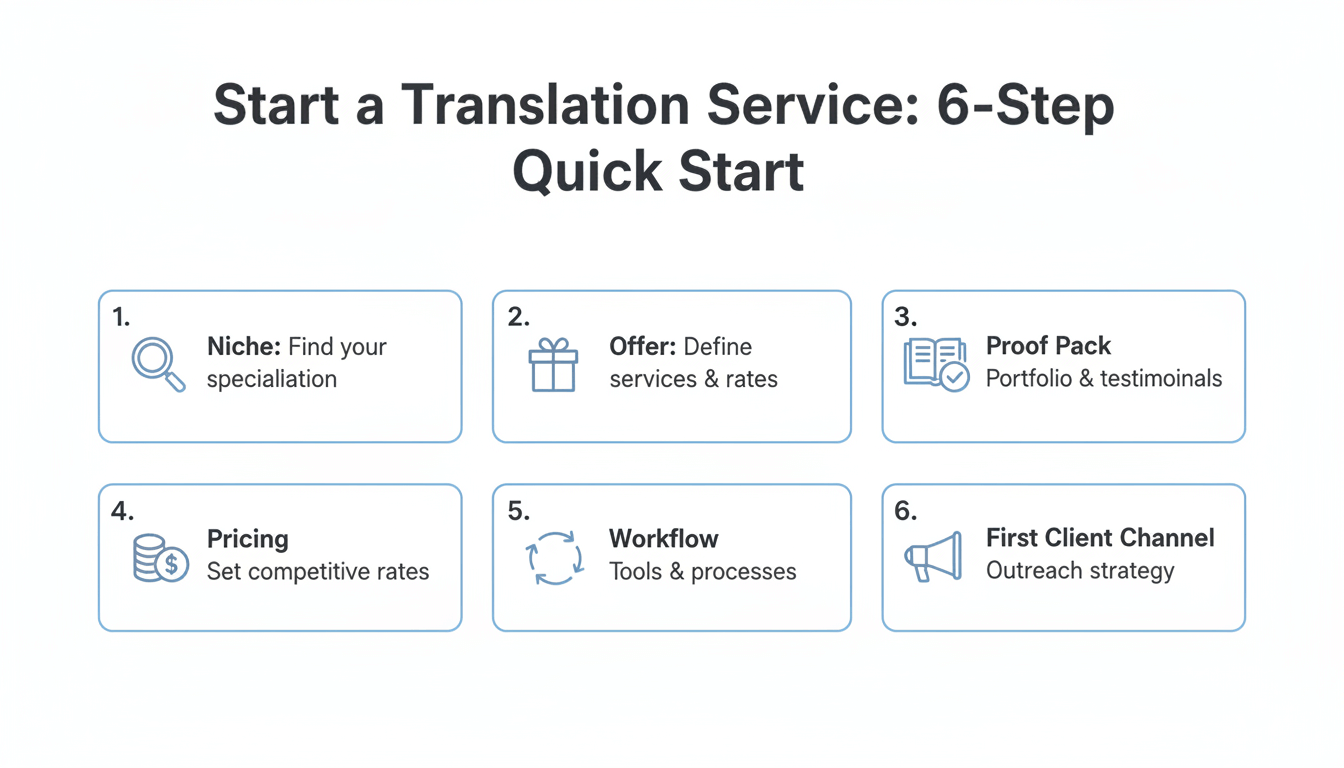
If you want the fastest path from “idea” to “first client”, focus on these:
- Pick one niche (industry + document type) and one primary language direction to start.
- Build a proof pack (samples, process, turnaround times, terms).
- Decide your pricing model (minimum fee + standard + rush).
- Create a simple delivery workflow (intake → quote → translate → review → deliver → aftercare).
- Launch one acquisition channel you can stick with for 30 days (outreach, referrals, agencies, or local partnerships).
- Track every enquiry in a simple spreadsheet and follow up like a professional.
If you’d like to see how a mature language services provider presents its offer and builds trust signals, browse Transcribe Lingo’s core services: Translation Services and Certified Translation Services.
Choose your business model (solo vs agency) — and commit to one for 90 days
There are two common ways to start:
1) Solo specialist (fastest, simplest)
You deliver the work yourself, keep margins high, and build direct relationships. This is the best starting point if you already translate professionally.
2) Micro-agency (higher ceiling, more moving parts)
You sell the work and manage delivery using a small network of translators/reviewers. You’ll need stronger systems: QA, vendor onboarding, file management, and client comms.
Rule of thumb:
- Start solo if you can deliver great work quickly in a niche.
- Start agency-style if you already have a trusted linguist network and project management experience.
Define your niche (this is where most new translation services lose)
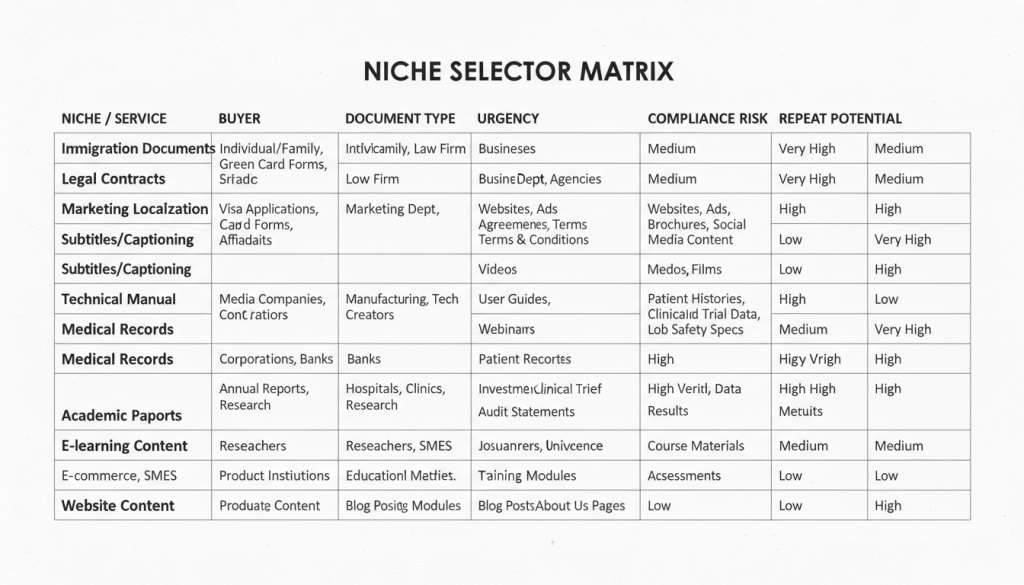
“Niche” is not just a language pair. It’s language pair + document type + buyer.
Here are niche examples that convert well because the buyer’s need is urgent and specific:
- Immigration & certified documents (birth certificates, marriage certificates, visas)
- Legal and court-related work (witness statements, contracts, evidence bundles)
- Business translation (policies, HR docs, tender responses)
- Marketing localisation (web pages, ad copy, product pages)
- Media & entertainment (subtitles, scripts, captions)
- Research (surveys, interviews, focus group transcripts)
Transcribe Lingo has dedicated service pages you can use as reference points for how to describe offers clearly, such as Business Translation Services and Marketing Translation & Localisation.
A simple niche test (use this before you build anything)
Ask:
- Who buys this? (solicitors, HR managers, universities, individuals, marketing teams)
- Why do they buy now? (deadline, compliance, submission, campaign launch)
- What do they fear? (rejection, misinterpretation, reputational damage)
- What proof do they need? (samples, process, certifications, reviews)
If you can answer those four questions, you’re positioned.
Decide what you’ll sell (your service menu should be tiny)
A mistake beginners make is offering everything. Instead, start with 2–4 packaged services that are easy to understand and quote.
Core translation services (common starting set)
- Document translation (general / specialist)
- Proofreading / revision (bilingual or monolingual)
- Certified translation (where required)
- Formatting / layout matching (optional add-on)
Add-ons that increase order value
- Rush turnaround
- Notarisation / legalisation coordination (where relevant)
- Glossary / terminology setup for businesses
- Style guide alignment (brand/house style)
If you want a ready example of how certified workflows are presented to clients, see: Certified Translation Services: Everything You Need to Know.
Set up your business “trust basics” (the unglamorous part that wins clients)
You don’t need a complex operation on day one. You do need the basics that signal professionalism:
The essentials
- A business name and email address that looks credible
- A one-page website (or landing page) with: services, sectors, turnaround, how it works, contact
- Clear terms: confidentiality, revision policy, payment terms, cancellation policy
- A standard NDA template (many clients will ask)
- A secure file handover method (client portal, encrypted link, reputable cloud storage)
If you handle personal data (most translation services do)
Treat confidentiality seriously from day one:
- Store files in organised folders
- Limit access
- Remove files when the project is complete (based on your retention policy)
- Avoid sending sensitive documents on unsecured channels
Professional signal you can copy: “Two-person check for high-stakes content.”
Even if you’re solo, you can build a workflow where another linguist reviews certain job types.
Build a delivery workflow you can repeat (and scale)
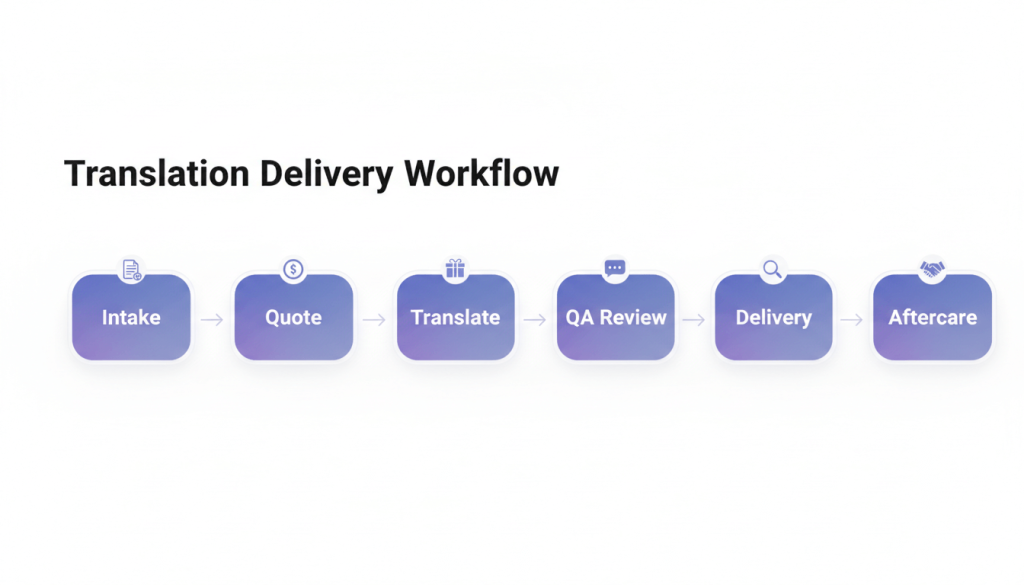
Your goal is consistency. Clients love predictable.
A practical translation workflow (simple but professional)
- Intake & clarification
Confirm language direction, purpose, deadline, file format, and whether certification is required. - Quote & scope
Confirm what’s included: translation, review, formatting, certificate statement, delivery format. - Translation (first pass)
Work using a glossary/term list if the client has one. - QA (second pass)
Check numbers, names, dates, formatting, missing lines, consistency, and tone. - Delivery
Provide final file + a clean PDF if needed. - Aftercare
Invite questions, fix genuine issues quickly, and request a review/testimonial once accepted.
If you’re building a service around official documents, look at how established providers phrase “how it works” and acceptance signals on Certified Translation Services.
Pricing: how to charge without undercutting yourself
Pricing is where new services either stall or burn out. You need three things:
- a pricing method you can explain
- a minimum fee so small jobs are profitable
- a rush structure so deadlines don’t punish you
Common pricing models (pick one primary)
- Per word (best for editable documents)
- Per page (common for scanned certificates and standard forms)
- Per hour (best for revision, transcreation, complex formatting)
- Per minute (common for audio/video, subtitles, voice-over scripts)
Your minimum fee (non-negotiable)
Set a minimum fee that covers:
- admin time
- client comms
- file setup
- QA
- invoicing/payment follow-up
This is what keeps you profitable when clients send “just one page”.
If you want to see how a professional provider positions transparent pricing access, you can reference Transcribe Lingo’s Price Rate Card.
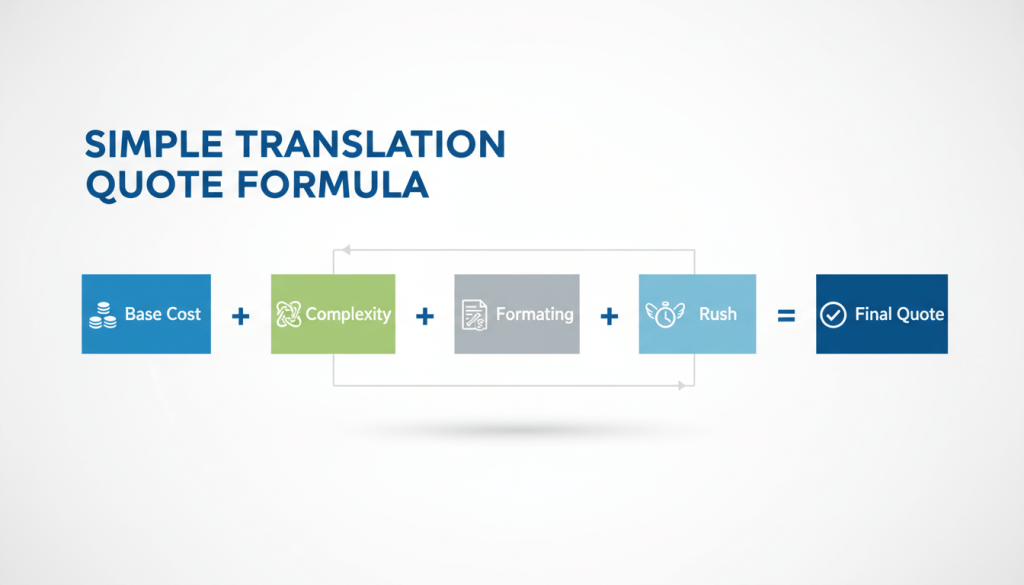
A simple quoting formula you can use today
Base cost (words/pages/minutes × rate)
- Complexity add-on (dense legal/technical, poor scans, handwriting)
- Formatting add-on (tables, certificates, stamps, layout recreation)
- Rush add-on (tight deadline)
= Final quote
Example (keep it simple in your email)
- Translation: £X
- Formatting/layout: £X (if needed)
- Certification statement: included / £X
- Delivery: PDF included; hard copy optional
Quality standards: what “good” looks like in a translation service
Quality is your differentiator, especially now. Most buyers have seen cheap, rushed translations. Your job is to set expectations and then exceed them.
Your non-negotiable QA checklist
- Names match exactly (spelling, order)
- Dates and numbers double-checked
- Headings and sections aligned with the original
- Any stamps/seals noted appropriately (when relevant)
- Consistent terminology (same term translated the same way)
- No missing lines, especially in scans and multi-page PDFs
Your “quality promise” (short enough to live on your website)
- Two-pass review on every job
- Confidential handling of all documents
- Fixes for genuine errors, fast and without drama
How to market translation services (without feeling salesy)

Marketing works when it’s specific and consistent.
Start with a “proof stack” (this wins trust faster than fancy branding)
- 2–3 short samples (sanitised, permission-based or mock samples)
- A clear process (“How it works”)
- Turnaround promises you can keep
- A few testimonials (even from small early projects)
- A short “about” that emphasises niche experience
Quick win: Ask every satisfied client for one sentence you can quote.
Example testimonial style (short and believable):
“Fast turnaround, accurate translation, and clear communication throughout.”
You can also build credibility by showing how you handle sensitive, official work (use the structure on pages like Certified Translation Services as a benchmark for clarity).
What to publish (even if you hate writing)
Create 5 short pages or posts that match real buyer questions:
- “Certified translation for visa applications: what’s included”
- “How long does a certified translation take?”
- “Translation vs localisation: what businesses actually need”
- “Common reasons documents get rejected”
- “How to send your documents securely”
How to advertise translation services (and not waste money)
Advertising is optional early on, but if you do it, keep it narrow:
High-intent ads (best for quick enquiries)
- “Certified translation [city]”
- “Translate birth certificate to English”
- “Legal translation [language pair]”
If you’re spending any money, your landing page must include:
- what you do
- typical turnaround
- what’s included
- how to get a quote (simple form)
- trust signals (reviews, process, confidentiality)
Low-cost advertising that still works
- Local business directories (especially for certified documents)
- Partnerships with solicitors, notaries, immigration advisers, accountants
- LinkedIn outreach to a tight niche (10 messages a day, consistently)
How to promote translation services and get your first clients (the practical playbook)
You need at least one reliable client channel. Here are four that work for beginners:
1) Agency subcontracting (fastest first income for many)
Agencies already have clients. Your job is to become a reliable supplier.
How to approach:
- Apply with a clean CV
- Provide a short niche list
- Offer to complete a test
- Respond quickly and deliver early
2) Direct outreach (best long-term margin)
Pick one buyer type (e.g., immigration solicitors, HR managers, marketing agencies) and send short, respectful messages.
What to say:
- what you specialise in
- what problems you remove (deadlines, compliance, accuracy)
- how to request a quote
3) Referral partnerships (quietly powerful)
Partners already speak to your buyers:
- notaries
- solicitors
- accountants
- relocation consultants
- student advisers
Offer a simple referral arrangement or reciprocal promotion.
4) Marketplace profiles (good for volume, mixed quality)
Platforms can help you get early reviews and practice your quoting process — but protect your pricing and boundaries.
Outreach templates you can copy (and personalise)
Email: to an agency (subcontracting)
Subject: [Language] translator — [niche] availability
Hi [Name],
I’m a [language] translator specialising in [niche: legal/immigration/marketing], with experience handling [document types]. I’m available for new assignments and happy to complete a short test if required.
Turnaround: [your standard], with rush options when needed.
Tools: [CAT tool if relevant].
Confidentiality: NDA-friendly and secure file handling.
If useful, I can share a short sample portfolio and references.
Kind regards,
[Name]
Email: to a direct client (solicitor / business)
Subject: Translation support for [their sector] — quick quotes
Hi [Name],
I help [type of clients] with [service] in [language pair], especially for [common use case]. Clients usually come to me when accuracy and turnaround matter (and when documents need to be submission-ready).
If you ever need support, you can send a file for a same-day quote and timeframe.
Best regards,
[Name]
LinkedIn message (short and low-pressure)
Hi [Name] — I work with [sector] teams on [language pair] translations, often for [use case]. If you ever need overflow support or a quick second opinion, happy to help.
Your first client delivery system (so you actually keep them)
The first project sets the tone. Aim for three things:
1) Speed of response
Even if you can’t start immediately, respond quickly with:
- confirmation you received files
- 2–3 clarifying questions
- a clear next step and timeline
2) Clarity in scope
Write down what’s included. Don’t assume the client understands “certified” or “formatting”.
3) A clean handover
Deliver in the format the client needs (often PDF + editable file). Include a short message:
- what you delivered
- what to check
- how to request tweaks
If you’re building a certified document offering, review how established providers explain acceptance and deliverables on Certified Translation Services (UK).
The 30-day plan to land your first clients
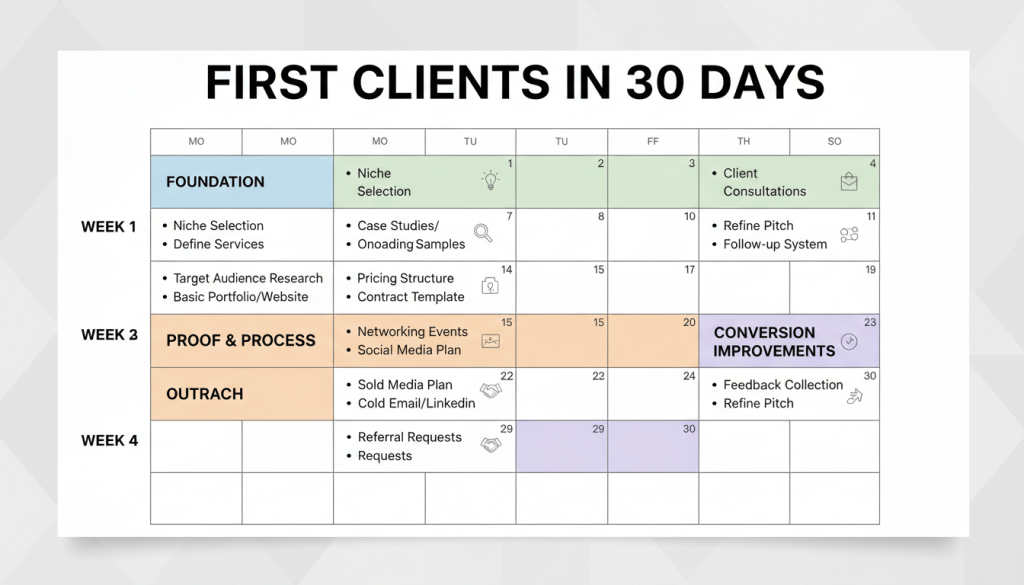
Week 1: Build your foundation
- Choose niche + offer (2–4 services)
- Build a one-page website or landing page
- Create your quote template + terms
- Produce 2 sample translations (sanitised or mock)
Week 2: Build your proof and process
- Create a one-page “How it works”
- Write your QA checklist
- Set your minimum fee + rush policy
- Create a simple intake form (what language, deadline, purpose)
Week 3: Start outreach (daily)
- Identify 50 targets (agencies or direct clients)
- Send 10 personalised messages per day
- Track responses and follow-ups
Week 4: Improve conversion
- Refine your messaging based on replies
- Add one testimonial (even from a small job)
- Tighten your niche positioning
- Increase your quote speed
When to scale (and how to avoid quality slipping)
Scale only after you’ve proven:
- consistent enquiries
- consistent delivery
- pricing that supports extra review time
Scaling options that keep quality intact
- Add a second reviewer for high-stakes work
- Build a vetted linguist roster (start with 3–5)
- Use a shared glossary and style guide
- Standardise project handover
Common mistakes (avoid these and you’ll grow faster)
- Offering everything instead of one clear niche
- Underpricing and then rushing, causing errors
- No minimum fee, so small jobs drain your day
- No written scope, leading to “just one more thing” requests
- Skipping QA, especially on dates, numbers, and names
- Overpromising turnaround before you’ve built capacity
- Loose file handling with sensitive documents
Prefer to outsource instead of building a service from scratch?
If your real goal is simply to get high-quality translation done (rather than building a translation business), Transcribe Lingo can help with managed delivery across translation, transcription, and interpreting.
- Start with a quick consultation via Contact Us
- For official documents, explore Certified Translation Services
- For pricing transparency, request the Price Rate Card
FAQs
How do I start a translation service with no clients?
Start with a niche, a proof pack (samples + process), and one acquisition channel. The fastest early routes are agency subcontracting, partnerships, or consistent direct outreach.
Do I need qualifications to start a translation service?
Qualifications help, especially for specialist or certified work, but clients primarily buy proof: samples, reliability, and clear quality controls. Professional memberships and sector experience can strengthen trust.
How should I price my translation services as a beginner?
Pick one pricing model (per word/per page/per minute), set a minimum fee, and add clear rules for rush work and complex formatting. Your pricing must cover admin, QA, and delivery — not just “translation time”.
How can I market translation services without spending on ads?
Focus on a tight niche, publish a simple website with proof and process, build referral relationships (notaries, solicitors, advisers), and do consistent outreach with tracking and follow-up.
What’s the best way to advertise translation services?
If you advertise, aim at high-intent needs (certified documents, legal translation, specific language pairs) and send traffic to a landing page that clearly states turnaround, what’s included, and how to request a quote.
How do I promote translation services to businesses (B2B)?
Lead with outcomes (deadline protection, accuracy, confidentiality), show a short case-style example, and offer a simple next step: “Send a file for a same-day quote.”
