
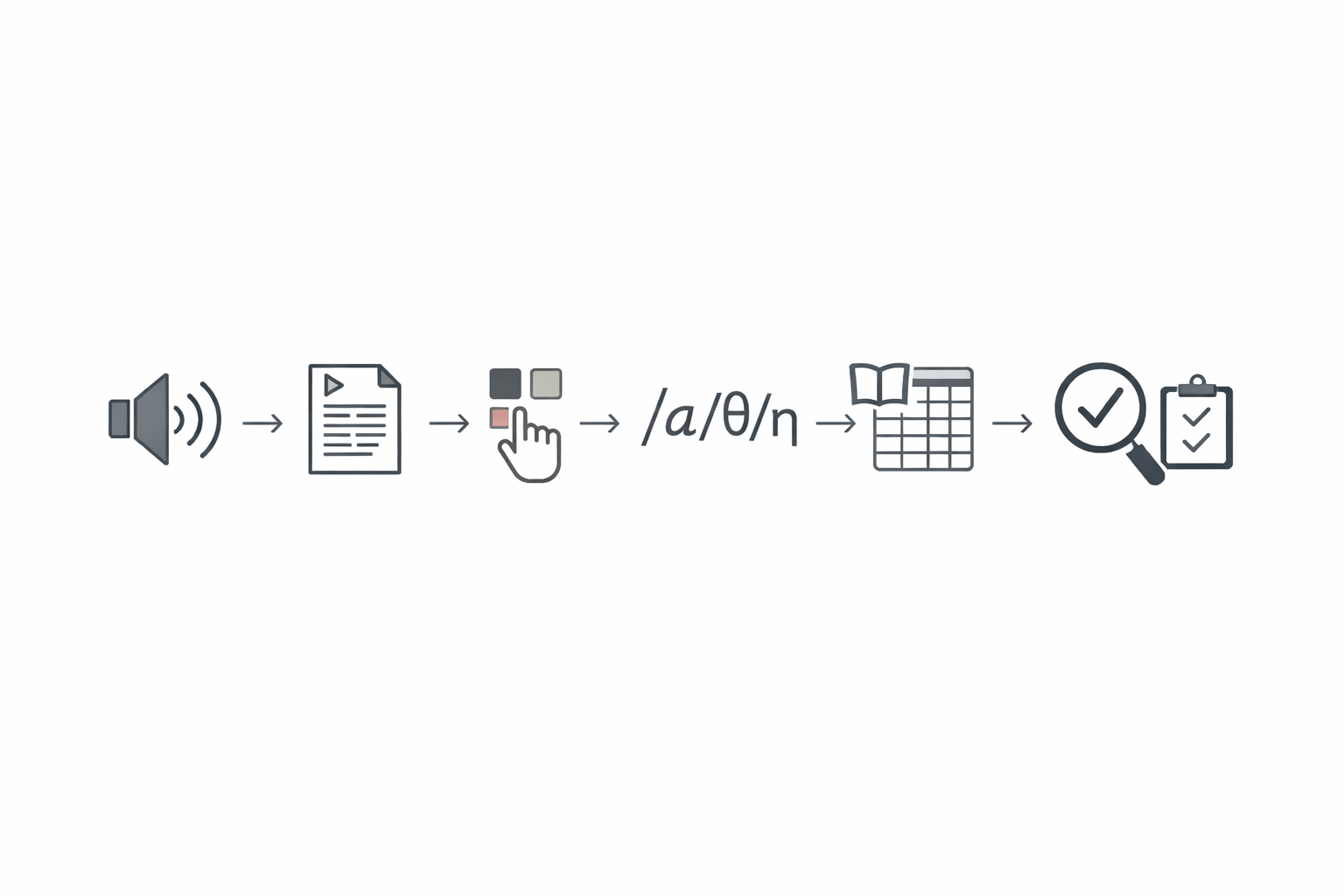
If you’re wondering how to transcribe lexicon entries for a linguistics module, you’re usually being asked to turn a messy reality (speech) into a consistent, searchable set of dictionary-style entries: word → pronunciation → meaning → notes. The hard part isn’t knowing IPA symbols—it’s building a method you can repeat for 50, 200, or 2,000 entries without losing consistency.
This guide gives you a practical workflow, a copy-paste template, and the quality checks that keep marks (and sanity) intact.
Got hours of recordings to work through? If you need a clean, time-stamped transcript first (so you can focus on phonetics and analysis), upload your audio and we’ll return an editable document you can build your lexicon from.
What “transcribing a lexicon” actually means
In linguistics, a lexicon is your organised set of lexical entries (think: mini dictionary). To transcribe the lexicon usually means you’re doing at least one of these:
- Phonemic transcription (contrastive sounds) for each entry: /…/
- Phonetic transcription (detailed pronunciation) for tokens: […]
- Both, where you store the phonemic form in the lexicon and attach phonetic notes/variants underneath
A good lexicon entry isn’t just “a word in IPA”. It’s consistent, documented, and checkable.
The fastest way to start (10-minute setup)
Before you transcribe anything, set these rules once:
- Pick a target variety (e.g., “Southern British English”, “General American”, “Speaker A’s dialect”).
- Decide your level of detail
- Lexicon default: phonemic (/…/)
- Add phonetic detail ([…]) only when it matters (allophones, assimilation, tone, etc.)
- Choose citation form (the form you’ll list as the headword)
- Nouns: singular (“cat”)
- Verbs: base form (“run”)
- Multiword items: decide spacing/hyphens once
- Set a style guide (one page)
- Stress marking, syllable boundaries, length marks, tone marks
- How you’ll treat reductions (schwa, elision), linking /r/, etc.
- Create your entry template (use the one below)
Do this once and your lexicon will look like it was built by a research team, not assembled the night before submission.
A step-by-step workflow for transcribing lexicon entries
Step 1: Collect tokens you can trust
You can’t build a clean lexicon from unclear audio.
Aim for:
- At least 2–5 tokens per word (more if the word varies a lot)
- Different speech rates (careful vs casual) if your assignment asks for variation
- Clear metadata: speaker, date, context (reading list, interview, conversation)
If you’re recording your own data, do yourself a favour:
- Quiet room, phone close to mouth, airplane mode on
- Ask speakers to repeat the target word in a short carrier phrase (e.g., “Say ___ again.”)
Step 2: Do a first-pass transcript (orthographic)
This is where many students waste time. Don’t jump into IPA immediately.
First, make a basic written transcript (even rough) so you can:
- find every token quickly
- compare contexts
- keep your place
If your recording is long, it can be faster to get a time-stamped transcript first, then do the phonetic work on selected excerpts.
Step 3: Segment the target word and listen in loops
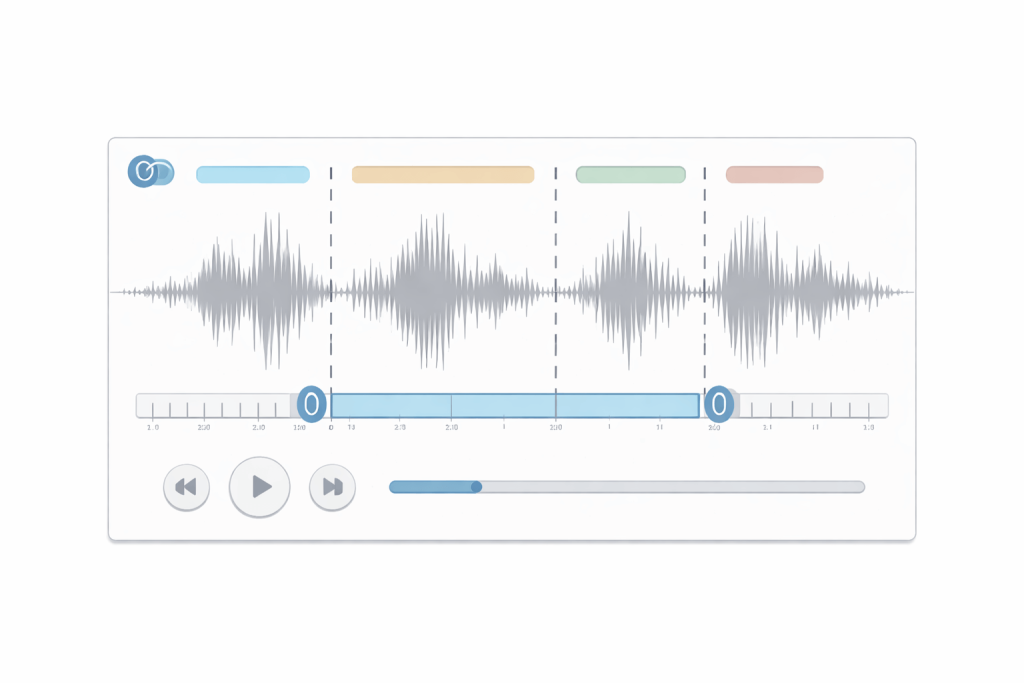
Pick one word. Work token by token.
A reliable loop method:
- Listen once for overall shape (syllables + stress)
- Listen again for consonants
- Listen again for vowels
- Finally, listen for processes (aspiration, devoicing, nasalisation, vowel reduction)
If you use acoustic tools, don’t let them “decide” for you—use them to confirm what you already hear.
Step 4: Choose phonemic vs phonetic transcription (and don’t mix them)
Here’s the simplest rule for students:
- Your lexicon line should usually be phonemic: /…/
- Your token notes can be phonetic: […], especially when:
- the word changes with context (assimilation, flapping, glottalisation)
- the assignment asks for allophony
- you’re comparing speakers/accents
Example (format, not a universal pronunciation claim):
- Lexicon: /t/ as a phoneme
- Token note: [tʰ] word-initial, [ɾ] between vowels (some dialects), [ʔ] in certain positions
Write what fits your target variety and your course conventions.
Step 5: Add predictable variation as rules, not chaos
A lexicon becomes powerful when you separate:
- Underlying form (phonemic)
- Surface variants (phonetic) with conditions
Instead of listing five random pronunciations, write:
- Variant A occurs before voiced consonants
- Variant B occurs in fast speech
- Variant C occurs in careful citation form
That reads like analysis, not guesswork.
The lexicon transcription template you can copy-paste
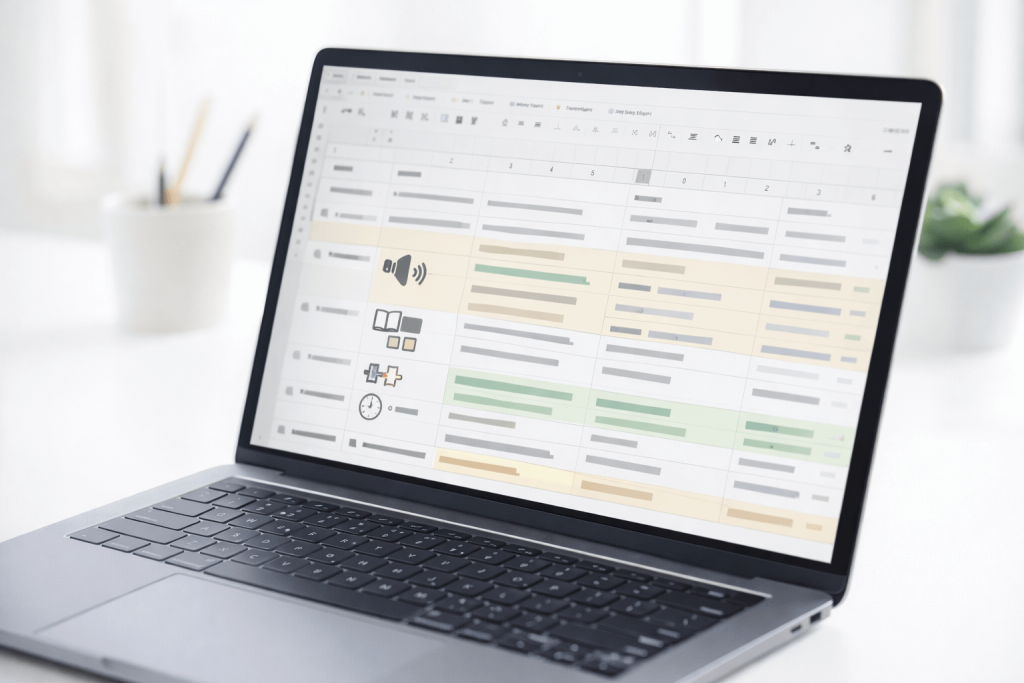
Use this table format (spreadsheet-friendly). Keep it consistent for every entry.
| Field | What to write |
| Headword | citation form (your chosen dictionary form) |
| Part of speech | N / V / Adj / Adv / etc. |
| Gloss/meaning | short and concrete |
| Phonemic form | /…/ (your default lexicon transcription) |
| Syllables + stress | syllable breaks + primary/secondary stress (if relevant) |
| Phonetic notes | […] token details, allophones, reductions |
| Variants | listed variants with conditions (“fast speech”, “before nasal”, etc.) |
| Minimal-pair check | note any contrasts this entry supports |
| Source | recording ID + timestamp(s) or elicitation context |
| Comments | uncertainty, alternative analyses, cross-references |
A worked mini-example (structure you can imitate)
Headword: “record” (noun)
Phonemic form: /ˈ…/
Notes: stress contrast with verb form; reduced vowel in unstressed syllable; careful vs casual token differences; add timestamps.
(Use your own language/dialect and your course symbol conventions.)
“How do I transcribe the lexicon” for an assignment without losing marks?
Most marking rubrics reward the same three things:
1) Consistency beats perfection
A lexicon that’s 90% accurate but perfectly consistent often scores higher than a lexicon with occasional brilliance but inconsistent rules.
Use a “decision log”:
- “I mark primary stress with ˈ before the stressed syllable.”
- “I only use diacritics when the feature is contrastive or requested.”
2) Your checks must be visible
Make your quality control explicit:
- minimal pairs you tested
- places you re-checked
- how you handled uncertain tokens
3) Separate data from interpretation
Keep:
- what you heard (token-level notes)
- what you claim (phonemic entry + rules)
That distinction signals maturity.
Quality checks that catch 80% of common errors
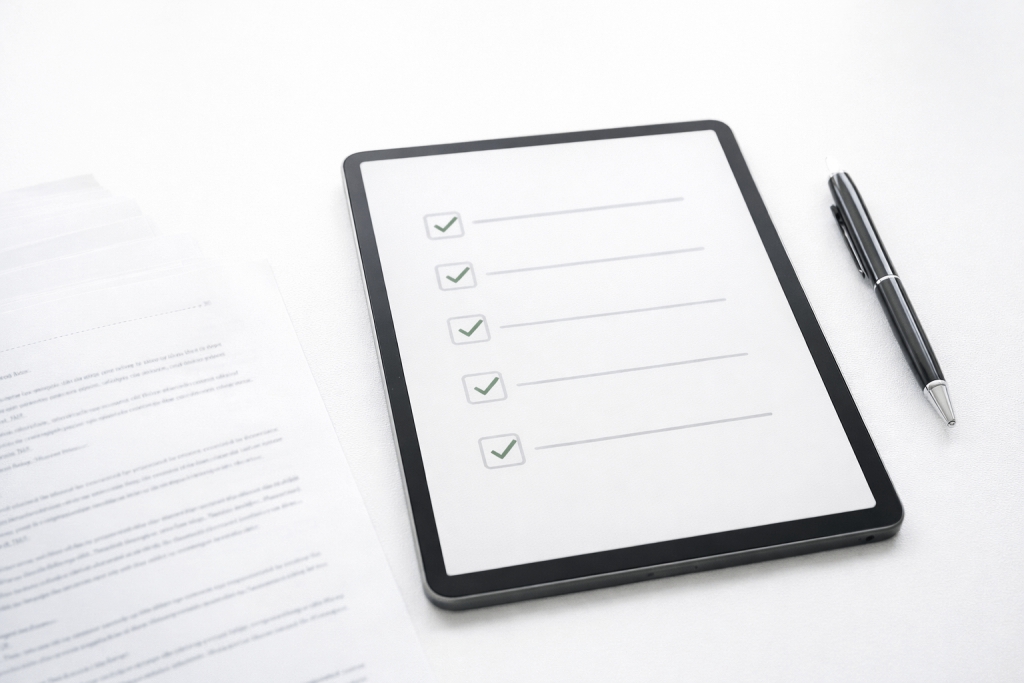
Build a “lexicon sanity checklist”
Run this after every 10–20 entries:
- Same sound, same symbol (no drifting between similar IPA symbols)
- Stress marking consistent across entries
- Syllable boundaries follow your chosen rule
- Vowel length/quality not randomly mixed
- Variants have conditions (not just a list)
- Minimal pairs recorded where relevant
- Every entry has a source (even “elicited wordlist, Speaker A”)
Do a “reverse lookup” test
Pick 10 entries at random:
- Can you re-identify the token in the audio quickly?
- Does the transcription still feel right after a day away?
- Would a classmate understand your conventions without asking you 20 questions?
If not, tighten the style guide.
Tools that make lexicon transcription easier (and faster)
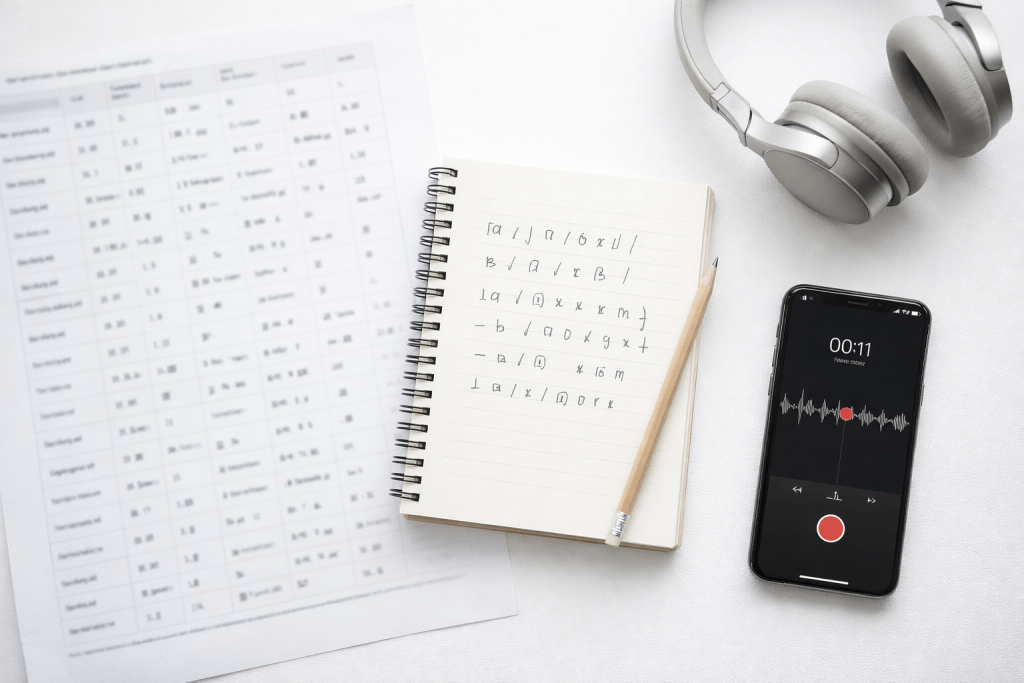
You don’t need a complicated toolkit—just the right basics:
- IPA chart (for reference while you transcribe)
- IPA keyboard (or a shortcut list for your most-used symbols)
- A spreadsheet (your lexicon database)
- Annotation software for time-aligned segments (optional but helpful)
- A consistent font that renders IPA cleanly
If you’re drowning in audio, get a time-stamped transcript first, then focus your phonetic energy on the exact sections that matter for analysis.
Common pitfalls (and how to avoid them)
Pitfall 1: Treating phonemic and phonetic brackets as decoration
Fix: Use /…/ for phonemic, [… ] for phonetic—always.
Pitfall 2: Over-transcribing
Fix: Put detail where it earns you marks: contrasts, allophony, variation, tone/stress patterns.
Pitfall 3: Inconsistent vowel choices
Fix: Commit to a target variety and use it consistently. If you change variety mid-lexicon, label it and explain why.
Pitfall 4: No documentation trail
Fix: Every entry gets a source ID (recording name + timestamp, or elicitation note).
When “lexicon” means a pronunciation lexicon for speech tech
Some students meet “lexicon” in computational linguistics or speech modules, where a pronunciation lexicon is a file that maps words to pronunciations so ASR/TTS systems stop misreading names, jargon, and place names.
If that’s your module, your workflow still holds—but your output may need:
- a structured lexicon format (often XML/CSV style)
- multiple pronunciations per entry
- language tags and alphabet specification (often IPA)
The same rules apply: be consistent, document variants, and keep a clean template.
If you actually meant “transcript”, not “transcription” (Dr MGR Medical University)
A surprising number of searches for “how to transcribe lexicon” are really about how to get a transcript (an academic record). If your real question is how to get transcript from Dr MGR Medical University, here’s the simplest path:
- Use the university’s Apply Online portal for student services
- Select the service for Transcript / Consolidated Marksheet (wording varies by service list)
- Prepare scans of your mark statements/mark sheets and degree/provisional certificate (as requested for your selected service)
- Submit the requisition letter in the format the portal asks for, and keep confirmation details for tracking
If you want, you can also request a time-stamped transcript of any supporting audio/video (interviews, viva recordings, lectures) to help with documentation—just upload the file and specify the format you need.
A practical close: how to finish your lexicon faster this week
If you’re on a deadline, here’s the order that gets results:
- Build your style guide (one page)
- Create the template (spreadsheet)
- Do a rough transcript (timestamps if possible)
- Transcribe phonemically first (complete coverage)
- Add phonetic detail only where it matters
- Run the sanity checklist every 10–20 entries
- Polish the final 10% (formatting, consistency, sources)
And if your bottleneck is the raw audio, get a clean transcript first so your time goes into analysis—not pausing and rewinding 3,000 times.
3) FAQ Section
How do I transcribe the lexicon for my linguistics assignment?
Start with a one-page style guide (target variety, stress rules, brackets), build a spreadsheet template, transcribe phonemically for every entry, then add phonetic notes only where variation or allophony matters.
What’s the difference between phonetic and phonemic transcription in a lexicon?
Phonemic transcription (/…/) captures contrastive sounds you treat as phonemes in your analysis. Phonetic transcription ([…]) captures surface detail (allophones, reductions, fine timing/quality). Most student lexica store /…/ as the main entry and keep […] as notes.
Can I use automatic tools when learning how to transcribe lexicon entries?
You can use them to speed up a first-pass transcript and to locate tokens, but you should verify pronunciations yourself. Automatic output often misses reductions, allophonic detail, and speaker variation—exactly the points many modules assess.
How many examples per word do I need to transcribe the lexicon properly?
A practical minimum is 2–5 tokens per word, more for variable items. If time is tight, prioritise more tokens for high-frequency words and for items central to your analysis (stress patterns, alternations, tone, etc.).
How do I handle multiple pronunciations in one lexicon entry?
Keep one default phonemic form, then list variants with conditions (fast speech, before nasals, careful citation form, speaker-specific variant). Avoid unlabelled lists.
How to get transcript from Dr MGR Medical University?
Use the university’s Apply Online portal for student services, select the transcript/consolidated marksheet service, upload the required documents (typically mark sheets and degree/provisional certificate), and keep the submission confirmation for tracking.
