
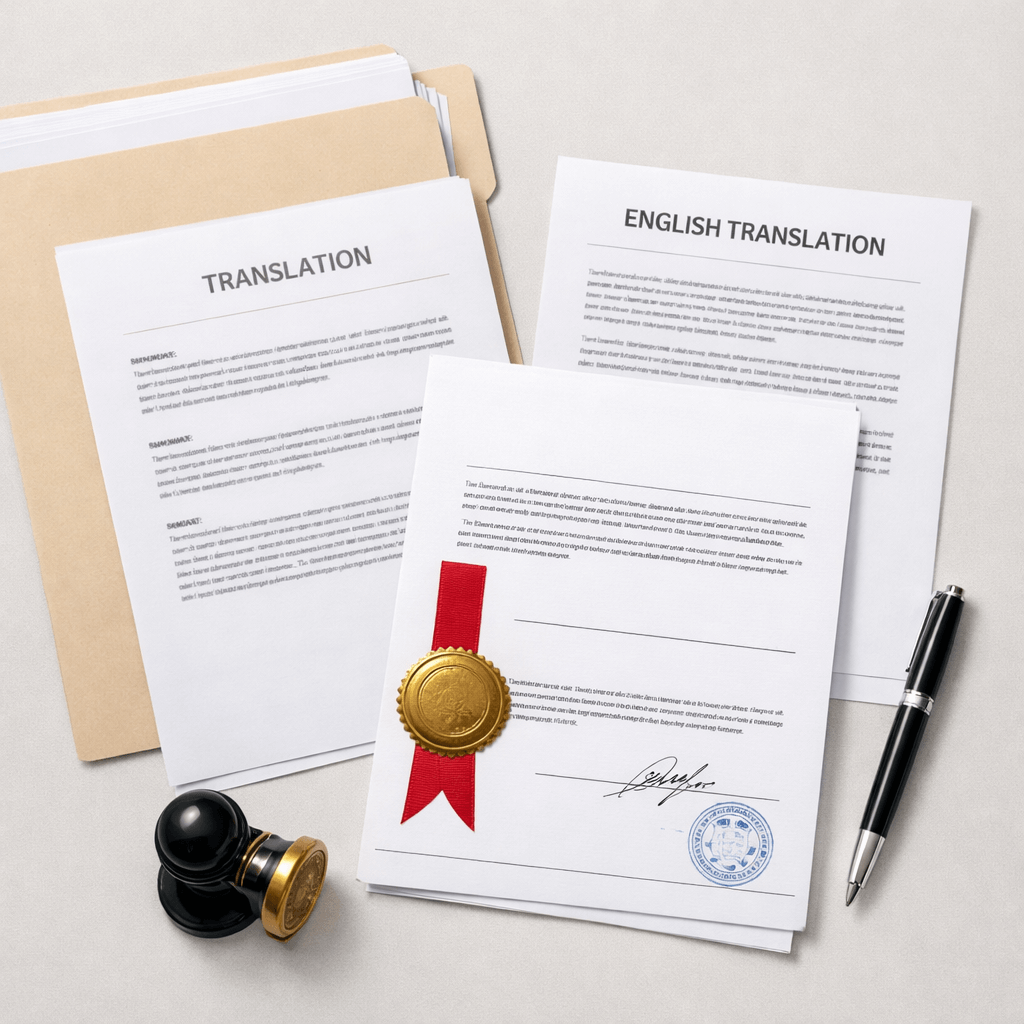
If you’ve been told to “translate and notarize” a document, it can feel confusing fast. Do you need a certified translation, a notarised translation, or an apostille as well? And what does the notary actually verify?
This guide walks you through the real-world process—so your documents are accepted the first time, whether you’re submitting them for immigration, a university, a bank, a court, or an overseas authority.
**Need help today?** Upload your document to Transcribe Lingo and we’ll confirm the simplest compliant route (certified vs notarised vs apostille) before you pay.
What “notarised translation” actually means (and what it doesn’t)
A **notarised translation** is usually:
– A **complete translation** of your document, plus
– A **translator’s declaration/certificate** confirming the translation is accurate, plus
– A **notary witnessing and attesting the signature** on that declaration (or on a related statement).
**Important:** The notary is typically **verifying identity and witnessing a signature**—not “approving the translation quality”. The accuracy responsibility sits with the translator and the certification wording.
In the UK, you’ll often see the spelling **notarised**. In the US and some other markets, you’ll see **notarized**. The requirement is the same idea; the spelling is not the issue.
Do you actually need notarisation? A quick decision check
Before you spend extra money or lose time, confirm what the receiving organisation needs. Use this quick check:
You usually need a certified translation (not notarised) when:
– You’re submitting to many UK authorities, universities, employers, banks, or solicitors
– The instructions say “certified translation” or “translator’s certificate”
You may need a notarised translation when:
– The instructions explicitly mention “notary”, “notarised translation”, or “notarized translation”
– A consulate/embassy demands notarisation
– A foreign authority needs a notarial act tied to your translation
– You’re preparing documents for an **apostille** or further **legalisation**
You may also need an apostille (after notarisation) when:
– Your documents will be used internationally and the receiving country requires an apostille
– The instructions say “apostille”, “legalisation”, or “Hague Convention apostille”
**If you’re unsure:** Send the recipient’s wording to Transcribe Lingo. We’ll tell you the minimum compliant route (and help you avoid paying for steps you don’t need).
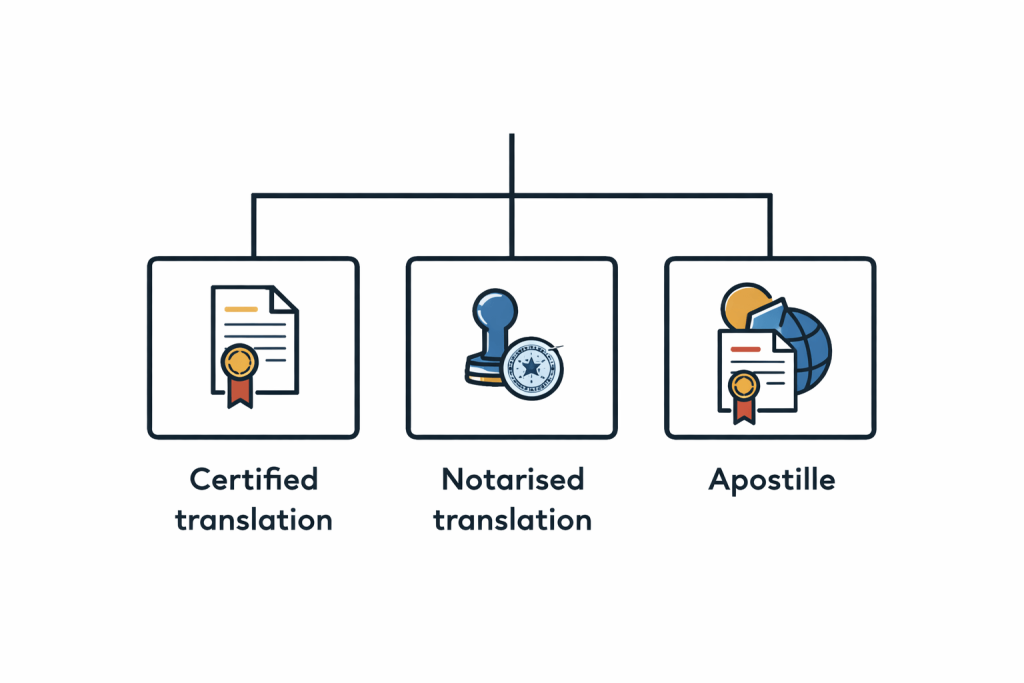
Certified vs notarised vs apostille: the difference in plain English
Here’s the simplest way to think about it:
– **Certified translation** = the translator/agency confirms accuracy in writing
– **Notarised translation** = a notary witnesses and attests the signature on the certification
– **Apostille** = an authority confirms the notary’s signature/seal so it’s accepted abroad
– **Consular legalisation** = extra embassy/consulate validation for some countries (often after notarisation)
A practical example
If a university says: “Provide a certified translation,” you likely don’t need a notary.
If a foreign ministry says: “Provide notarised translation with apostille,” you likely need:
1) translation + certification, then
2) notary, then
3) apostille.
How to translate and notarize a document: the step-by-step process
Below is the process that reliably works for most countries and institutions.
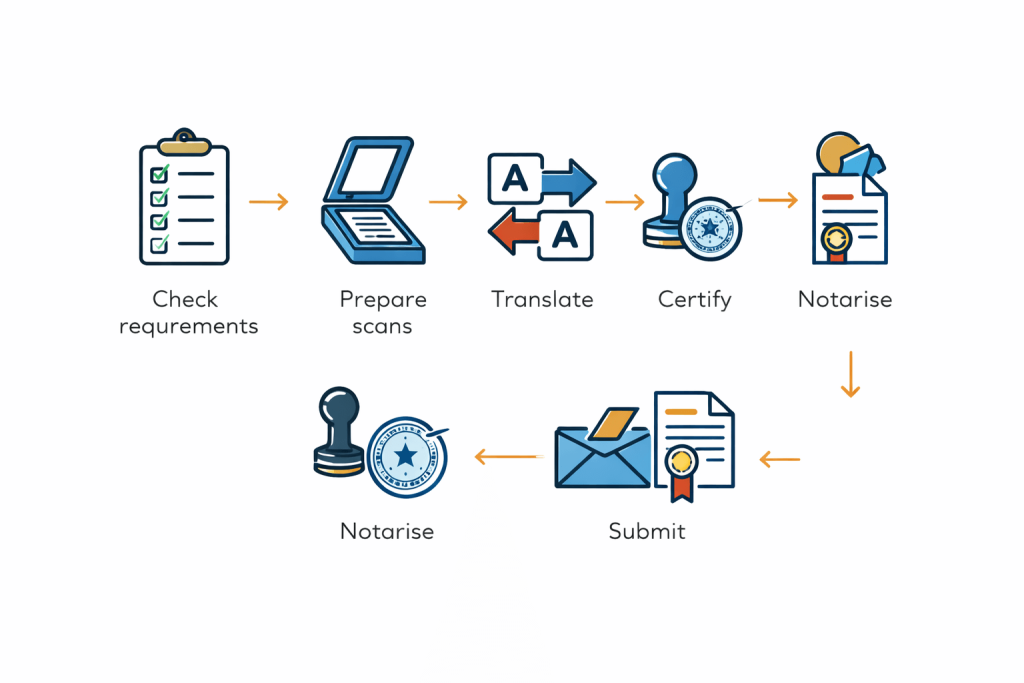
Step 1: Confirm what the recipient requires (don’t guess)
Ask:
– **certified**, **notarised**, or **apostilled/legalised** documents?
– **digital PDFs**, or do they require **hard copy** originals?
– require a specific language format (for example, Arabic for certain jurisdictions)?
– require the translator to include specific wording (full name, signature, date, contact details)?
This 2-minute check can save days.
Step 2: Prepare clear scans (and include everything)
Provide:
– A clean scan/photo of the whole page (including stamps, signatures, marginal notes)
– Any reverse side text if applicable
– Multi-page documents in the correct order
If your scan is cut off or blurry, you risk rejection—especially for civil documents.
Step 3: Use a professional translator who knows official formatting
A good certified translation should:
– Translate **all** text (including stamps, seals, handwritten notes)
– Preserve key formatting (tables, headings, reference numbers) where practical
– Keep names/dates consistent across documents
– Include a proper translator’s certificate/declaration
**Fast, safe route:** Upload your file to Transcribe Lingo. We’ll assign a specialist linguist and include the correct certification wording for your destination.
Step 4: Get the translation certified (the foundation step)
Even when notarisation is required, the core deliverable is still a certified translation plus the translator’s signed certificate.
Typical certificate elements include:
– Statement that the translation is complete and accurate
– Translator/agency name and contact details
– Signature and date
– Reference number (recommended for tracking)
Step 5: Notarise the translator’s signature (or the correct signing party)

This is the step most people misunderstand.
**In many cases, the notary will:**
– Verify the identity of the signer
– Witness the signing
– Attach a notarial certificate or stamp/seal
The signer is often:
– The translator, or
– An authorised representative of the translation agency, depending on how the certificate is issued
**Tip:** Don’t assume you can sign anything and “get it notarised.” The receiving authority may reject it if the wrong person signs.
Step 6: Apostille/legalisation (only if required)
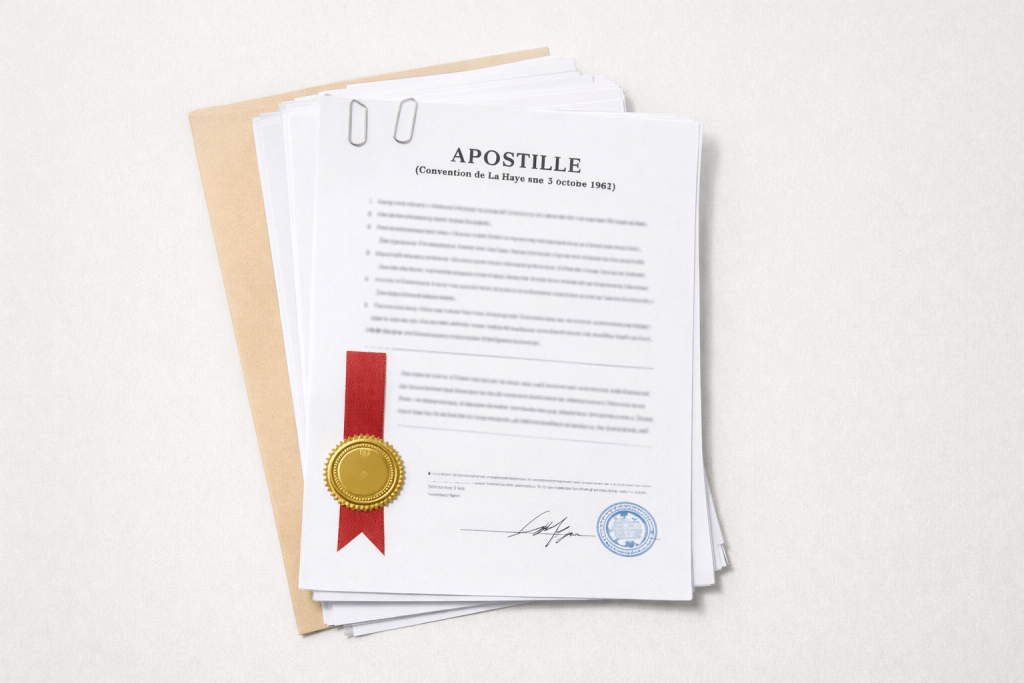
If you’re told to obtain an apostille/legalisation, it usually applies to the **notary’s signature/seal**, not to the translation text itself.
You may have:
– Apostille attached to the notarised certificate, or
– Apostille attached to a notarised bundle, depending on destination rules
Step 7: Deliver in the correct format (digital, hard copy, or both)
Many applications now accept PDF scans. Others still demand physical originals.
A safe standard package includes:
– Certified translation PDF
– Notarised certificate page(s)
– Optional apostille/legalisation
– Tracked hard copy delivery if needed
**Want it handled end-to-end?** Transcribe Lingo can coordinate translation, certification, notarisation, and apostille routing where required.
Can I translate and notarize a document myself?
This is one of the most common questions, and the answer depends on the context.
Can I translate and notarize a document?
Sometimes you can translate your own document, but it’s often a risky choice:
– Many institutions prefer (or explicitly require) an independent translator
– Conflicts of interest can cause delays
– If your formatting or certificate wording is wrong, you may have to redo everything
Can I notarize a translated document?
A notary generally notarises a **signature**, not a translation. In most scenarios, the notary is attesting:
– The identity of the person who signed the translator’s certificate, or
– A sworn statement attached to the translation
So you’re not “notarising the translation”—you’re notarising the declaration/signature that accompanies it.
Do translated documents need to be notarized?
Often, **no**—unless the receiving body specifically asks for it.
A lot of rejections happen because people pay for notarisation when they only needed:
– A correctly prepared certified translation, with proper certification wording
If the recipient didn’t explicitly request a notary, you can usually avoid the extra step.
Does a certified translation need to be notarized?
Not automatically.
A certified translation is usually accepted on its own for many official uses. Notarisation becomes relevant when:
– An overseas authority insists on a notary public’s involvement
– You’re preparing a chain for apostille/legalisation
– The institution requires an additional identity/witnessing layer
If you can share the exact instruction line from the recipient, you can typically confirm the requirement in minutes.
Where to get birth certificate translated and notarized near me
If you’re searching “where to get birth certificate translated and notarized near me,” you have three common options:
Option A: A translation agency that coordinates notarisation (simplest)
Best for speed, compliance, and avoiding mistakes—especially when apostille may follow.
Option B: Hire a translator, then find a notary yourself
This can work, but it’s easier to get the signing steps wrong (wrong signer, missing notarial wording, inconsistent names).
Option C: Local notary plus local translator
Useful if your recipient requires in-person signing, or you must present originals locally.
**Choosing the right provider (quick checklist):**
confirm whether notarisation is actually needed
provide a proper certification statement
can advise if apostille/legalisation is required
have experience with your destination country/authority
**If you want it handled in one go:** Upload your birth certificate and your destination requirement to Transcribe Lingo. We’ll confirm the correct pathway and turnaround before you proceed.
Do translated birth certificates need to be notarized?
Sometimes—but only when the receiving body demands it.
Birth certificates are often used for:
– Immigration/visas
– Passport matters
– Marriage registration abroad
– Citizenship applications
Many authorities accept certified translations. Some require notarised translations, especially for overseas filings or when an apostille chain is required.
How to get a notarized translation of a driver’s license
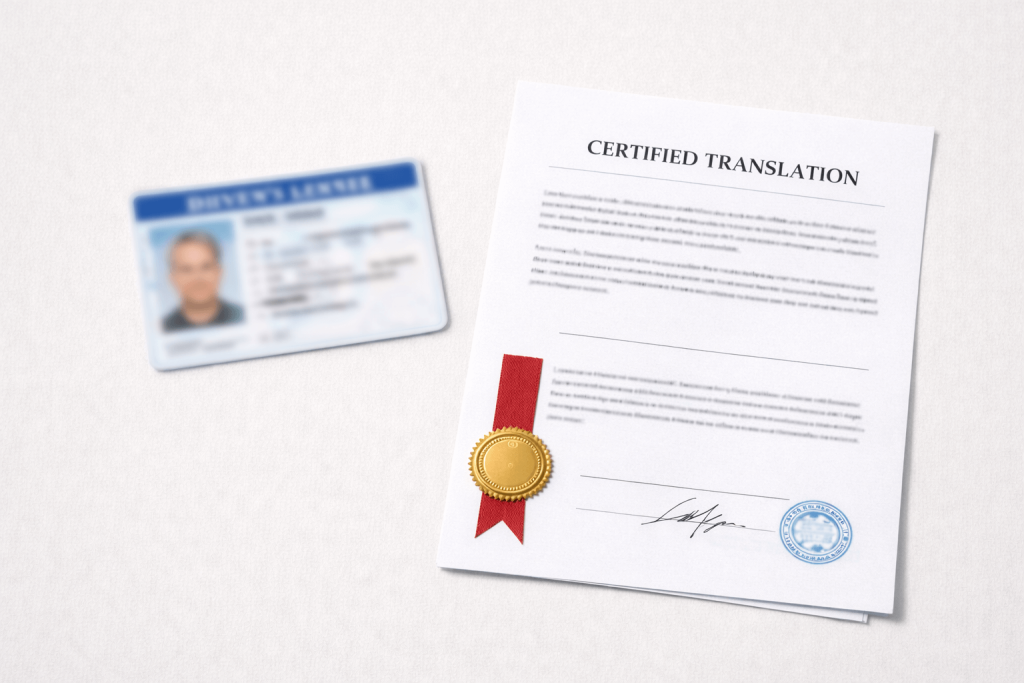
If you need a notarized translation of a driver’s lic/ence, pay attention to these details:
What to include
– Front and back of the licence
– Issue/expiry dates
– Licence number
– Categories/classes (exact)
– Address fields (if shown)
– Stamps, issuing authority, and any codes
Common reasons driver’s licence translations are rejected
– Missing back side details
– Inconsistent spelling of names vs passport
– Categories/classes omitted or “summarised”
– No certification statement, or unclear translator details
The safest approach
1) Provide clear scans of both sides
2) Request a certified translation with a precise, complete layout
3) Add notarisation only if explicitly requested by the receiving authority
Typical turnaround times and what affects cost
Costs vary, but they usually depend on:
– Language pair and technicality
– Page count and formatting complexity
– Whether you need notarisation and/or apostille
– Whether hard copies and courier delivery are required
– Urgency (same-day vs standard)
If you’re on a deadline, the fastest way to get an accurate quote is to upload your document and include:
– Destination country
– Receiving organisation
– Deadline
– Whether you need digital, hard copy, or both
The “accepted first time” checklist (use this before submitting)
Use this checklist to prevent preventable rejections:
– All pages are translated (including stamps and handwritten notes)
– Names match the spelling used in your passport/application
– Dates are formatted consistently (and accurately)
– The translator’s certificate includes signature, date, and contact details
– Notary steps (if needed) were done with the correct signer
– Apostille/legalisation (if needed) is attached to the correct part of the bundle
– You have a clean PDF version for online uploads, plus hard copy if required
**If you’d like a quick review:** Send your scans and recipient instructions to Transcribe Lingo and we’ll confirm what you actually need before anything is finalised.
FAQs
Do translated documents need to be notarized?
Not usually. Only notarise a translation if the receiving authority explicitly requests notarisation or an apostille/legalisation chain.
Does a certified translation need to be notarized?
A certified translation is often accepted without notarisation. Notarisation is typically only needed for overseas use or when a recipient insists on a notary’s involvement.
Can I notarize a translated document?
A notary generally notarises a signature on a declaration/certificate. You’re usually notarising the translator’s signed certification, not “the translation” itself.
Can I translate and notarize a document myself?
It depends on the recipient. Some allow it; many prefer an independent professional translator. If acceptance matters, using a professional service reduces risk.
Where to get birth certificate translated and notarized near me?
Look for a translation provider that can also coordinate notarisation (and apostille if needed). This reduces errors and speeds up turnaround.
How to notarize a translated document correctly?
Ensure the correct signer signs the translator’s certificate in front of the notary, and that the notary attaches the appropriate notarial certificate/seal for your destination requirements.
