
If you’ve searched for a registered translator UK, you’re probably trying to avoid a costly mistake: a translation rejected by an authority, a contract translated incorrectly, or a “certified” document that turns out not to be acceptable. The problem is that the phrase registered translator gets used loosely, and that’s where people get burned.
This guide gives you a practical, repeatable way to vet and verify translator credentials for anything from visas and universities to legal filings and regulated business documents. You’ll get a clear checklist, a simple scoring system, and real-world examples you can copy-paste into your own procurement or personal due diligence.
In a hurry? Use the 60-second rule:
If a translator (or agency) can’t clearly answer “registered with who, and how can I verify it?”—pause the purchase.
What “Registered Translator UK” Actually Means (and What It Doesn’t)
In the UK, the translation market includes outstanding professionals—and also plenty of people who can market themselves well without having the competence for high-stakes work. The key issue: “registered translator” isn’t a single protected title with one universal government register for all translation work.
So when someone says they’re “registered,” treat it like a claim that needs context:
“Registered” can mean one of four things
- Listed in a professional directory (membership-based)
- Holds a recognised translation qualification (skills-based)
- Works for an accredited company (process-based)
- Meets a specific authority’s acceptance criteria (purpose-based)
A credible provider will tell you which one applies—and show you how to confirm it.
Registered Translator Certification UK: The Credential Types That Matter
People often mix these up. Here’s the plain-English difference:
Membership (directory + code of conduct)
A translator may be a member of a recognised professional body and appear in a public directory. This can be a strong signal, especially when paired with specialisations and evidence of continuing professional development.
Qualification (proof of translation competence)
Qualifications show capability. In UK contexts, you’ll often hear about:
- Certificate in Translation (working-level competence)
- Diploma in Translation (advanced/professional competence)
These aren’t the only valid routes, but they are widely recognised shorthand for tested skill.
Certification (what makes a translation “certified” for use)
A certified translation isn’t just “a good translation.” It usually includes a signed statement of accuracy and specific details (name, date, contact details, etc.). Requirements vary by destination, so your first step is always: Who is this for, and what do they require?
Accreditation (company-level quality/process signals)
For business and regulated documents, procurement teams often look for defined quality workflows (review steps, revision by a second linguist, traceability, secure handling). This can matter more than any single credential when the risk is high.
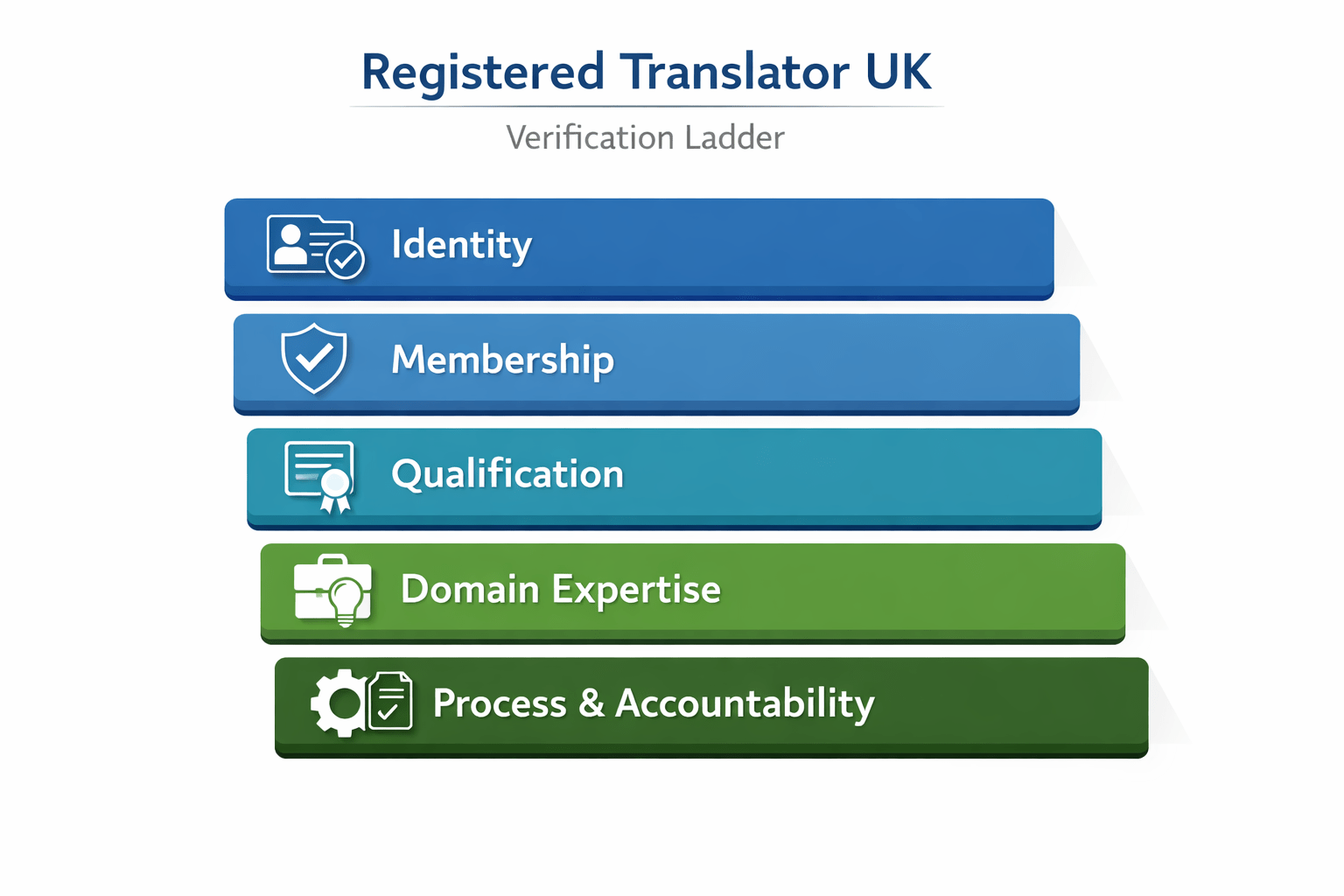
The Verification Ladder: A Simple Way to Vet Any “Registered Translator UK” Claim
Use this five-level ladder to avoid overcomplicating your decision.
Level 1 — Identity you can trace
Minimum you should have:
- Full legal name (or company name)
- Contact details
- A physical address or registered business presence
- A clear way to reach a responsible party if something goes wrong
If Level 1 is weak, stop. Anonymous “WhatsApp-only” translation services are where problems start.
Level 2 — Membership you can verify
Ask for:
- Professional body name
- Membership grade/status (not just “member”)
- Directory listing link or member number (where applicable)
What good looks like: You can independently confirm membership via a directory or member-check tool.
Level 3 — Qualification that matches the task
Ask for:
- Translation qualification(s)
- Language pair(s) covered by the qualification
- Specialism evidence (legal, medical, financial, technical)
Tip: A “certificate in translation” can be meaningful, but it must match the language direction and the task complexity.
Level 4 — Domain competence (proof they understand your subject)
Ask for:
- Relevant samples (redacted)
- Glossary handling approach
- How they manage terminology, names, dates, and official formatting
What good looks like: They ask clarifying questions you didn’t think to ask.
Level 5 — Process and accountability
Ask:
- Do they use a second-person review (revision)?
- What is their error-correction policy?
- What’s their approach to confidentiality and data handling?
- Can they produce the required certification wording for your destination?
What good looks like: Clear workflow, clear responsibility, clear paper trail.
A Practical Scoring System (Copy/Paste)
Use this quick rubric to compare options without getting lost in marketing claims.
| Area | Score 0 | Score 1 | Score 2 |
| Identity & traceability | Anonymous / unclear | Partial details | Fully traceable |
| Verifiable membership | None / unverifiable | Claimed only | Independently verifiable |
| Qualification fit | Unrelated/none | Some relevance | Strong fit for purpose |
| Subject-matter competence | Generic claims | Some evidence | Clear evidence + asks smart questions |
| Quality process | No review step | Unclear | Defined workflow + accountability |
Interpretation
- 0–4: High risk (avoid for official/regulated use)
- 5–7: Moderate risk (OK for low-stakes, not ideal for authorities)
- 8–10: Low risk (suitable for official or business-critical work)
Step-by-Step: How to Verify Credentials (Without Becoming an Expert)
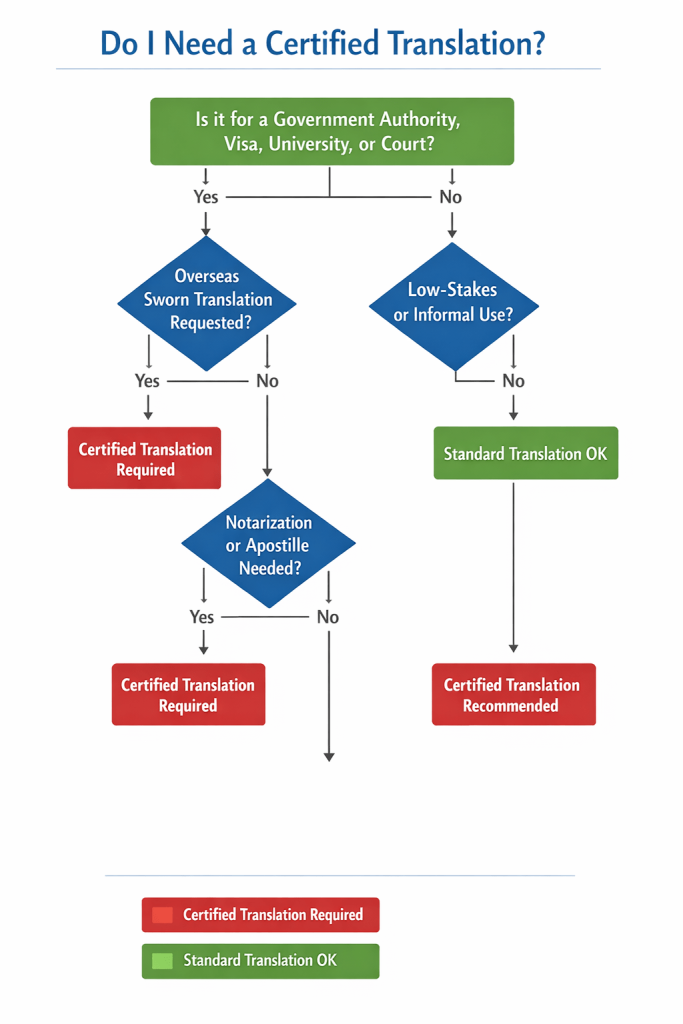
Step 1: Confirm what the translation is for
Before you verify anyone, verify the requirement. Ask the receiving body (or check their published guidance):
- Do they require a certified translation?
- Do they require a specific wording on the certification statement?
- Do they need the translator’s contact details, signature, date, and/or company stamp?
- Do they require notarisation or an apostille (usually separate from translation itself)?
Why this matters: You can hire an excellent translator and still get rejected if the certification format doesn’t match the destination’s rules.
Step 2: Ask the “registered with who?” question
Here’s a message you can send:
“Hi, before I proceed I need to verify credentials. Which register or professional body are you registered with, and what’s the quickest way for me to confirm your membership or listing?”
A trustworthy provider will answer plainly, without defensiveness.
Step 3: Verify membership and listing
If the translator claims professional membership, verify it through official channels (directory/member check where available). Don’t rely on:
- Screenshots (easy to fake)
- Badges pasted on websites
- “Certified” icons without context
Pro tip: Some professionals choose not to be publicly listed for privacy reasons. If that’s the case, the provider should offer an alternative verification route (e.g., member check by name, or confirmation via the organisation).
Step 4: Validate the qualification (especially for high-stakes work)
A translator certification UK claim is stronger when paired with an actual translation qualification, especially for official submissions or regulated industries.
Ask:
- What qualification do you hold?
- Does it cover my language direction (e.g., Spanish → English)?
- Is it relevant to my subject area?
You’re not trying to interrogate them—you’re trying to match risk to competence.
Step 5: Check the certification statement before you pay
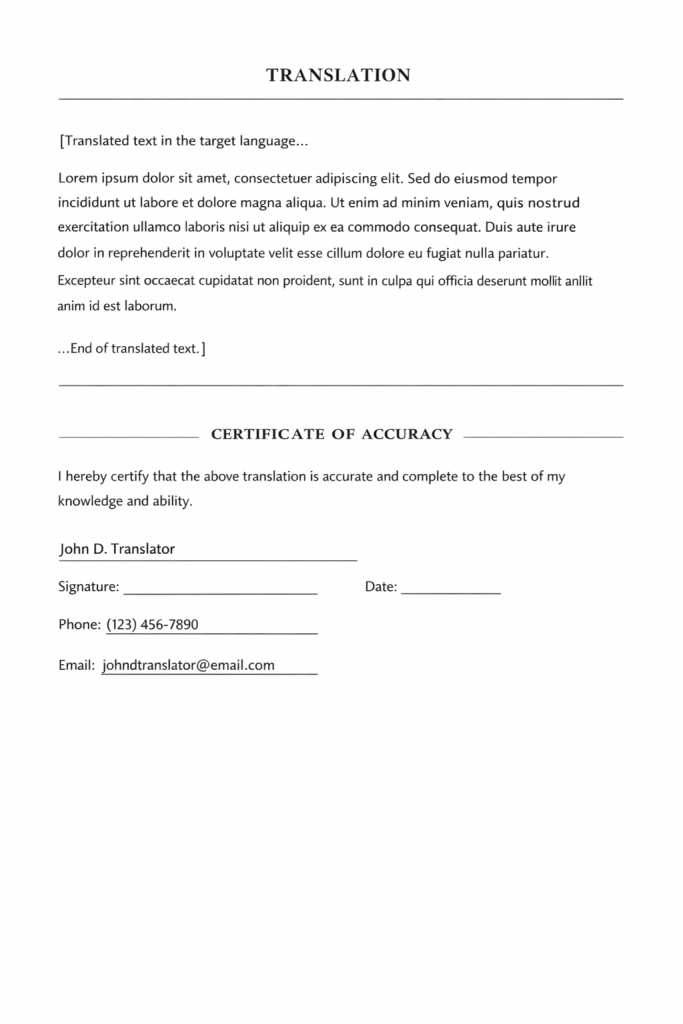
This is where many people get rejected.
Ask to see:
- The exact certification statement template they use
- Whether it includes all required fields for your destination
- Whether they can include extra elements (e.g., formatting notes, translator’s declaration, company details)
A strong provider will confirm this upfront and align the certificate wording to your receiving authority.
Step 6: Test their process with one “small but revealing” question
Pick one detail that often causes rejections:
- Name order and spelling
- Date format expectations
- Transliteration approach
- How they handle stamps, seals, handwritten notes, and marginalia
Ask:
“How do you handle names, dates, and stamps on official documents to minimise rejection risk?”
If the answer is vague (“We just translate it”), you’ve learned what you need to know.
The Most Common Red Flags (and Why They Matter)
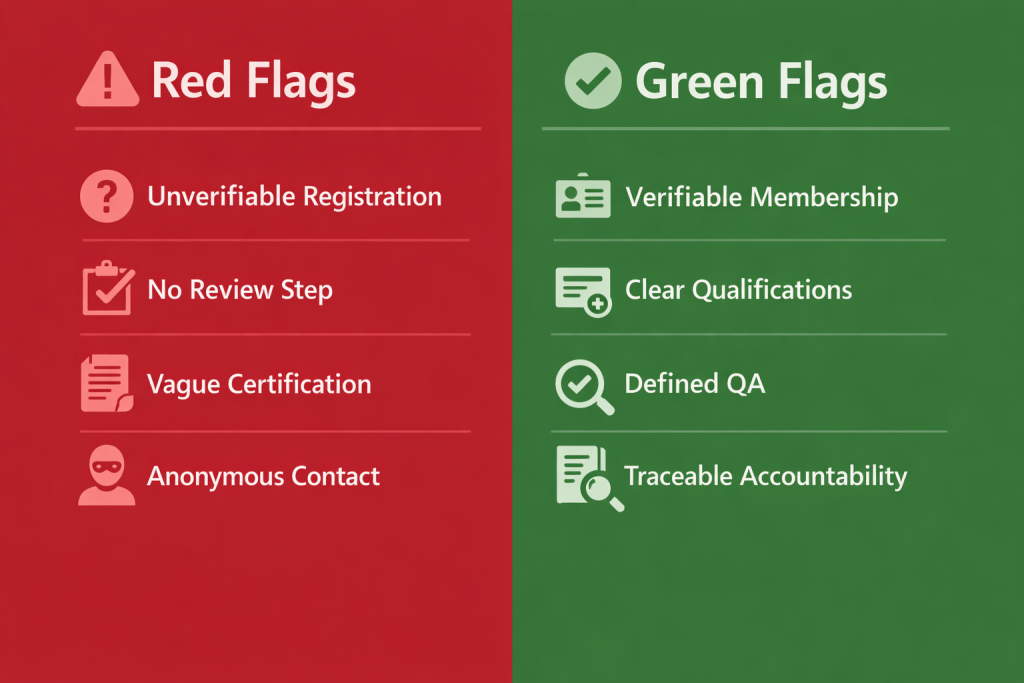
Red flag 1: “Registered translator” with no verification route
If you can’t independently confirm the claim, treat it as marketing.
Red flag 2: No clarification about destination requirements
A professional will ask: Who is it for? What country? What authority? What format?
Red flag 3: “Certified translation” without a real certification statement
A certified translation is usually more than a PDF with text—it needs a declaration and traceable details.
Red flag 4: Unrealistic promises for complex work
Speed is possible, but only with process. Beware:
- No mention of review
- No subject-matter specialist
- No accountability
Red flag 5: AI-only workflows for official documents (without oversight)
For casual content, automation can be fine. For legal/immigration/regulated documents, you want human accountability and a defensible process.
“Sworn Translator UK” Requests: What to Do When the UK Works Differently
Many countries use a formal system of sworn or court-appointed translators. UK institutions often accept certified translations, but overseas authorities may ask for something specific (for example, “sworn translation,” “court translator,” or “legalised translation”).
If you’re facing that wording:
- Ask the authority what they accept in the UK context
- Determine whether they want notarisation or an apostille
- Ensure the translator/agency can produce documentation that matches the destination’s expectation
This is exactly where paying for “cheap and fast” can become expensive.
Case-Style Examples (What Verification Looks Like in Real Life)
Example 1: Visa supporting documents
You have a birth certificate and bank letter not in English. The risk is rejection due to missing certification elements.
Good approach
- Confirm required certificate elements
- Verify the translator/agency is traceable and accountable
- Ensure the final delivery includes the full certification statement and matches formatting expectations
Example 2: University admissions
You have transcripts and degree certificates.
Good approach
- Ask whether they require certified translations from specific sources
- Ensure consistent transliteration of names across all documents
- Confirm that stamps/seals and letterheads are handled correctly
Example 3: Business contract for a regulated supplier
The risk is misinterpretation of obligations and liability clauses.
Good approach
- Choose a provider with a defined review workflow
- Verify legal translation experience
- Request a terminology plan (key terms, defined translations, consistency rules)
The “Verification Email” Template You Can Reuse
Copy, paste, edit:
Subject: Credential verification for translation request
Hi [Name],
Before I proceed, I need to confirm a few details for compliance and acceptance:
- Which professional register or body are you registered with (if applicable), and how can I verify it?
- What translation qualifications do you hold for this language pair?
- Do you provide a certification statement with name, signature, date, and contact details as required by the receiving authority?
- What review/quality check step is included before delivery?
- Can you confirm how you handle names, dates, stamps/seals, and handwritten notes on official documents?
Thanks,
[Your name]
If they answer clearly, you’re likely dealing with a professional. If they dodge or get defensive, you’ve saved yourself a problem.
When an Agency Beats a Freelancer (and When It Doesn’t)
Choose a vetted agency when:
- You need certified translation for authorities
- You need guaranteed continuity (backup linguists, deadlines)
- The subject is specialised (legal/medical/technical)
- You need secure handling, audit trails, and project coordination
Choose a specialist freelancer when:
- You can verify their credentials and experience easily
- The subject is narrow and they are a known expert
- Your workflow is simple (single document, low complexity)
For many people, the sweet spot is a managed service that combines verified linguists + strong QA + clear accountability.
Need a Registered Translator UK You Can Verify?
If you’re translating documents for an authority, a university, or a regulated business process, the safest move is to use a provider that can show you verification routes before you pay.
- For official submissions and certification: certified translation services
- For business-critical documents and localisation: business translation services
- For multilingual meetings, hearings, and appointments: language interpretation services
- For recorded evidence, interviews, and compliance documentation: professional transcription services
Prefer to send your files first and get a clear go/no-go recommendation? Contact Transcribe Lingo and we’ll point you to the right service based on your destination and risk level.
3) FAQ Section
What does “registered translator UK” mean?
“Registered translator UK” usually means the translator is listed with (or a member of) a professional organisation or directory, or works with an accredited provider. Because “registered” can be used loosely, always ask registered with who and verify via official channels.
Is there an official government register for translators in the UK?
Not for all translation work. Some professions and contexts have specific registers or directories, but there isn’t a single universal government register for every type of translation. The safest approach is verifying membership, qualifications, and accountability for the specific use case.
What is translator certification UK for Home Office or visa documents?
For many visa and immigration-related submissions, translations typically need a signed accuracy statement and specific identifying details (such as date, name/signature, and contact details). Always confirm the exact requirements for your route and receiving office before ordering.
Is a certificate in translation enough to prove a translator is qualified?
A certificate in translation can be a strong signal—especially when it’s a recognised qualification and matches the language direction and document type. For higher-risk work, combine it with verified membership, relevant specialism, and a clear quality process.
How can I check if a translator’s membership claim is real?
Ask for the professional body name and the verification method (directory listing or member check). Avoid relying on screenshots or website badges alone. If the translator isn’t publicly listed, they should provide an alternative verification route.
Do I need notarisation or an apostille for a certified translation?
Sometimes—but not always. Notarisation and apostilles are separate from translation and depend on the receiving authority and the country where the document will be used. Always verify what the authority requires before paying for extras.
