
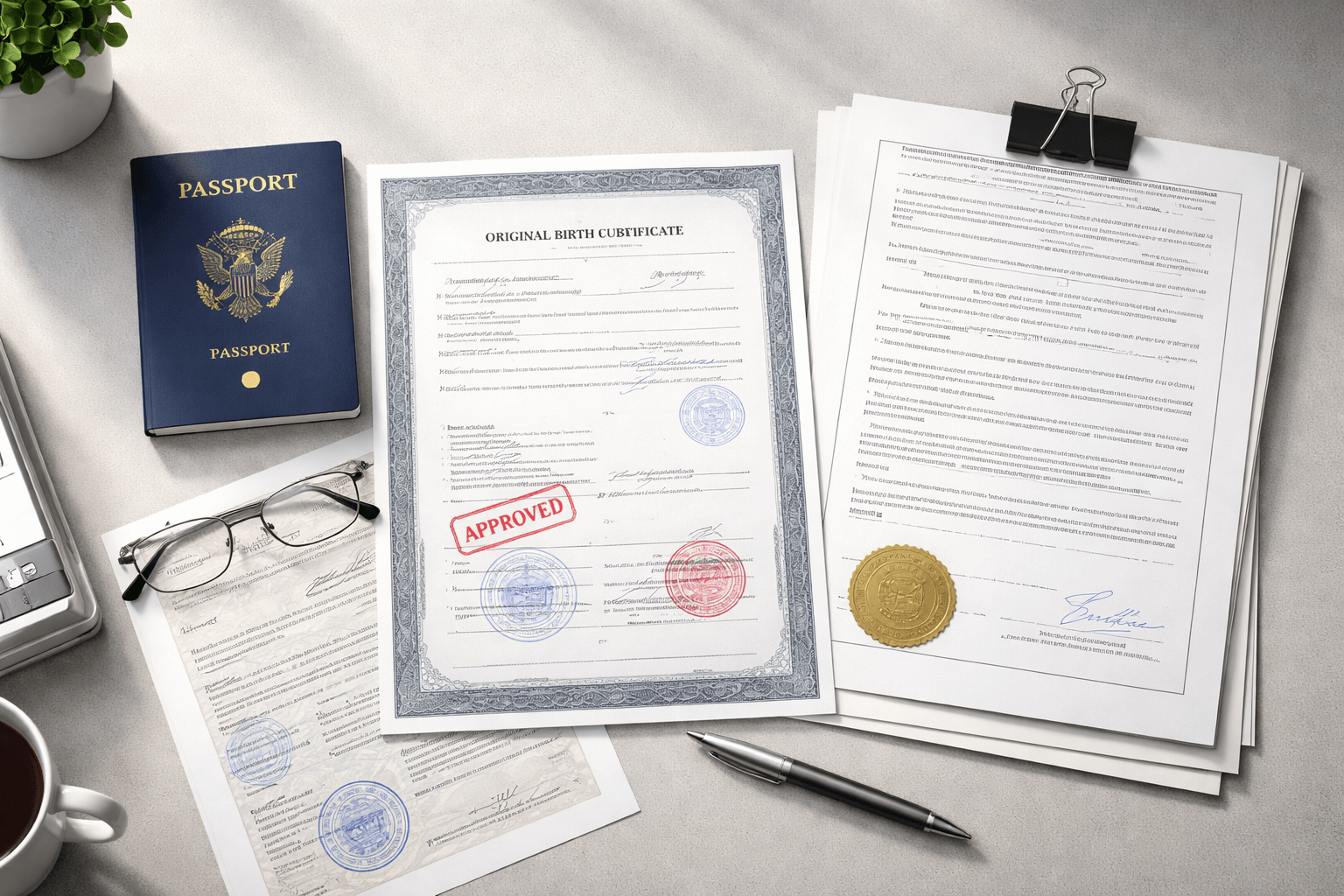
If you’ve ever been told “we need a sworn translation”, it usually means the receiving authority wants a translation produced by a translator who is officially authorised (often via a court, ministry, or national register) and who can certify the translation with a stamp, signature, and formal declaration.
That matters because, in many countries, a sworn translation is treated as an official document in its own right — not just a linguistically accurate version of the original.
If you’re unsure what the destination authority expects, upload your document to Transcribe Lingo and tell us where it’s being submitted. We’ll confirm the correct format before work starts.
What is a sworn translation?
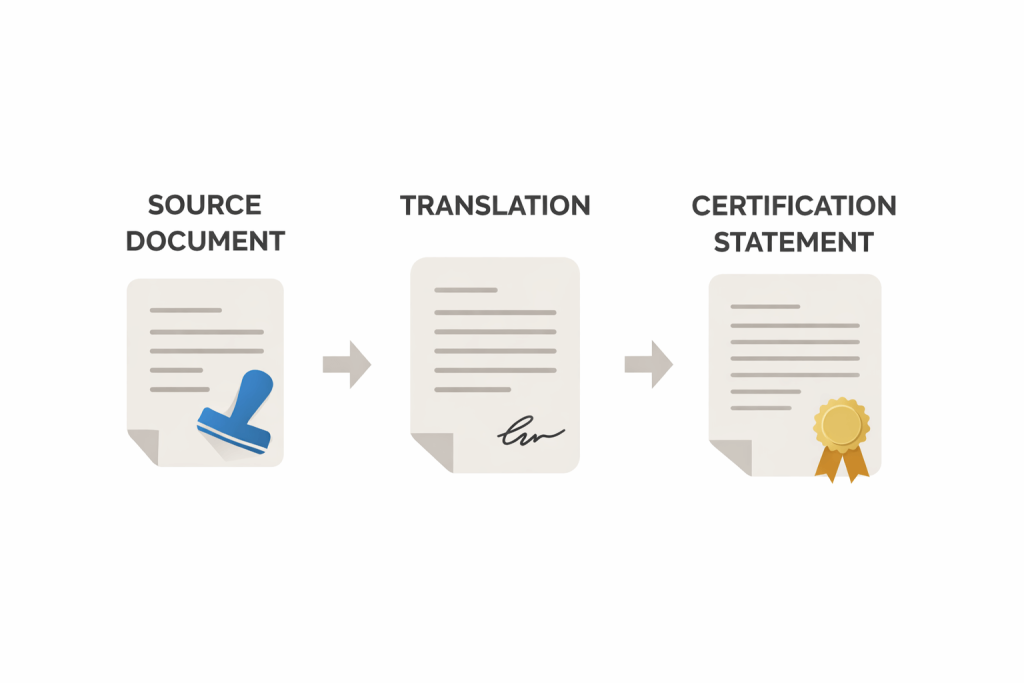
A sworn translation is an official translation produced by a translator who has legal authorisation to certify their work for use with public bodies (courts, registries, ministries, consulates, universities, licensing authorities).
A sworn translation typically includes:
- The translated text
- A certification statement (sometimes called an attestation, declaration, or sworn statement)
- The sworn translator’s stamp/seal and signature (often with a registration/ID number)
- A “bound” or “attached” format that links the translation to the source document so pages can’t be swapped
You’ll often see different local names for the same idea, for example:
- France: “traduction assermentée” (sworn translation)
- Spain: “traducción jurada” (sworn translation)
- Germany: “beglaubigte/beeidigte Übersetzung” (certified/sworn translation)
- Netherlands: sworn translation by a translator registered in the national register
- Belgium: sworn translator/interpreter registered in the national register
Important: “Sworn” refers to the translator’s legal status, not the document type. The same birth certificate can be translated as a standard translation, a certified translation, or a sworn translation — depending on where you’re submitting it.
Sworn translator vs sworn interpreter
These are often confused (and sometimes bundled together in the same national register), but they’re different roles:
- A sworn translator certifies written translations for official use.
- A sworn interpreter provides spoken interpreting in official settings (courts, police interviews, notarial signings, asylum or immigration interviews), where the interpreter may be required to have a recognised status and be appointed through official channels.
If your situation involves both (for example, a court hearing plus translated exhibits), you may need a sworn interpreter and sworn translations as separate deliverables.
Sworn translation vs certified, notarised, and apostilled (what’s the difference?)
Different countries use different “proof of authenticity”. Here’s the simplest way to think about it:
| Type | What it proves | Who provides it | Common use |
|---|---|---|---|
| Sworn translation | Translator is officially authorised and certifies accuracy | Court/Ministry-registered sworn translator | Civil status, immigration, courts, registries (often in civil-law countries) |
| Certified translation (UK/US style) | Translator/agency certifies accuracy in a signed statement | Professional translator or agency | UK Home Office, USCIS, universities, employers (often enough in common-law countries) |
| Notarised translation | Identity/signature is witnessed (not the translation’s accuracy) | Notary public / solicitor | Embassies, certain foreign authorities, legal filings |
| Apostille / legalisation | The notary/official’s signature/seal is authenticated for overseas use | Government legalisation office | Cross-border use of notarised documents |
Practical takeaway:
- If an authority says “sworn translation”, they usually mean a translator with official status in the relevant country.
- If they say “notarised” or “apostilled”, they’re asking for a legal authentication step, not a different translation style.
When do you need a sworn translation?
You’re most likely to need a sworn translation when your document is going to a public authority that must rely on formally certified documents.
Common scenarios include:
- Civil status and family matters: birth, marriage, divorce, death certificates; adoption documents; name change records
- Immigration and citizenship: nationality applications, residence permits, visas, right-to-work and registration processes
- Courts and legal disputes: judgments, pleadings, police reports, witness statements, powers of attorney, affidavits
- Education and professional recognition: diplomas, transcripts, professional licences, registration with regulated bodies
- Corporate and notarial filings: certificates of incorporation, articles of association, company registry extracts, notarised deeds
Quick “you probably need sworn” signals
If the recipient mentions any of the following, don’t guess — clarify:
- “Translation by a court-appointed / sworn / registered translator”
- “Official translation with stamp and signature”
- “Translator must appear in the national register”
- “Translation must be bound to the original”
- “Accepted only if produced in [country] by an authorised translator”
Countries that commonly require sworn translations (and how it usually works)
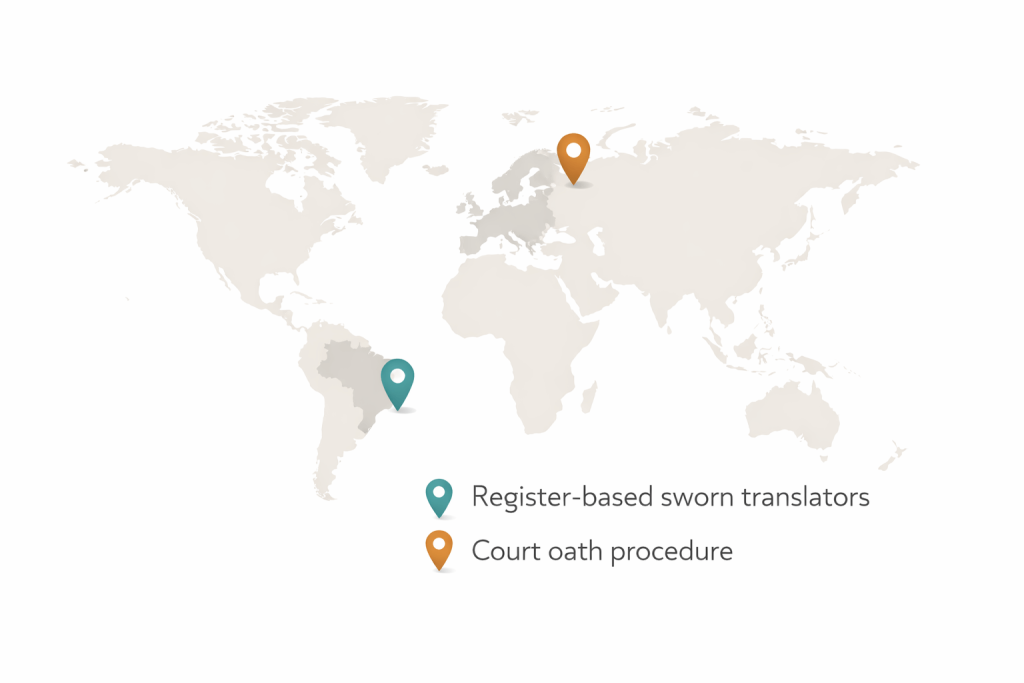
Requirements vary by authority and document type, but these examples cover the systems people most often encounter.
Countries with well-defined sworn/official translator registers
In these countries, sworn translators are commonly found via official databases or state/court lists:
- France – sworn translators are linked to courts (often via Court of Appeal lists)
- Spain – sworn translators/interpreters are accredited and searchable via an official directory
- Germany – translators/interpreters may be sworn/authorised under state rules and searchable via official databases
- Austria – court-certified and sworn experts/interpreters are searchable via official justice databases
- Netherlands – sworn translators/interpreters are searchable through the national register
- Belgium – sworn translators/interpreters appear in the national register
- Poland – sworn translators are searchable via the Ministry of Justice register
- Brazil – sworn translators (“tradutores juramentados”) are authorised via state commercial boards (Juntas Comerciais)
Countries where “sworn” may mean a court procedure (not just a register)
Some places use a court/tribunal oath process for “sworn” translations, sometimes called an affidavit translation or asseveration.
- Italy – sworn translation is often associated with a formal oath/certification procedure (commonly referred to as “asseverazione”)
A safer way to use country information
Instead of relying on a generic list, focus on who will receive the document:
- National government body (immigration/ministry)
- Local registry office (birth/marriage registration)
- Court/notary
- University/professional regulator
Then match the translation type to that authority’s stated requirement.
If you tell Transcribe Lingo where the document will be submitted (country + authority), we’ll advise whether you need a sworn translation, a UK-style certified translation, or notarisation/apostille.
How to get a sworn translation that won’t be rejected

1) Confirm the destination requirement in one sentence
Ask the receiving authority:
- “Do you require a sworn/court-authorised translator?”
- “Must the translator be registered in your country?”
- “Do you need the translation notarised or apostilled as well?”
This one step prevents the most common (and costly) mistake: paying for the wrong format.
2) Provide the complete document (including stamps and back pages)
Authorities often reject translations when:
- The original had stamps/notes that were omitted
- The reverse side had essential details
- Pages were missing or unclear
Send scans that include everything, even blank backs, stamps, handwritten notes, and marginal text.
3) Use a sworn translator for the correct language direction
In many countries, sworn authorisation is language-pair specific. A translator sworn for Language A → Language B may not be authorised for Language B → Language A.
4) Get the format right (not just the words)
A good sworn translation package usually includes:
- Clear page numbering that matches the source document
- A certification page with place/date, translator details, signature, stamp
- A method of linking translation to source (binding, stapling, sealing, or a formal attachment statement)
5) Plan for legalisation if needed
Sometimes the authority wants both:
- sworn translation and apostille/legalisation
- or notarisation then apostille/legalisation
If you’re on a deadline, mention that upfront — legalisation steps add time.
How to find a sworn translator near me (without the usual pitfalls)

Searching “sworn translator near me” can work, but it’s not the best verification method on its own. Use this approach instead:
- Start with the official register (most countries with sworn systems publish searchable directories).
- Check the authorisation details (languages, ID number, location, status).
- Match the requirement to the authority (some bodies require a translator authorised in a particular region/state).
- Ask for proof of status if anything looks unclear (a screenshot of the register listing or authorisation details is usually enough).
- Avoid “self-sworn” promises that can’t be validated (a stamp is only meaningful if the status behind it is verifiable).
If you’d rather not navigate this, Transcribe Lingo can coordinate the correct route — whether that’s a sworn translator in the destination country or a certified translation with notarisation/apostille where appropriate.
Alternatives to sworn translation (when “sworn” isn’t actually required)
Many people are told “sworn” when what the organisation truly needs is simply a translation they can trust — with an accepted certification method.
Option A: Certified translation (common in the UK, US, and other systems)
A certified translation is usually a professional translation accompanied by a signed certificate of accuracy. This is commonly accepted for:
- UK administrative submissions (including many visa/immigration applications)
- USCIS-style immigration submissions
- Universities and employers (depending on their rules)
Option B: Notarised translation
A notary (or solicitor in some contexts) witnesses the translator’s identity/signature. This may be requested by:
- Consulates and embassies
- Overseas registries that want additional authentication
- Certain legal or corporate filings
Option C: Apostille/legalisation
This is not a translation method — it’s authentication for overseas use. You may need it when presenting documents internationally, especially if a notary or official certification must be validated.
Option D: Sworn translation produced in the destination country
Some authorities insist the sworn translator must be authorised in their jurisdiction. If your submission is in a country with that rule, you’ll need a local sworn translator (even if you have a perfectly good certified translation already).
Not sure which path applies? Upload the document and tell us the destination authority — we’ll recommend the fastest compliant option.
Real-world examples (so you can recognise your situation)
Example 1: Birth certificate for a civil registry appointment abroad
You’re registering a marriage or residency and the office asks for a “sworn translation”.
What usually works best: a sworn translation produced by an authorised translator in that country’s recognised system, with official certification formatting.
Example 2: Degree certificate for professional recognition
A regulator needs proof your qualification matches local standards.
What usually works best: a translation that matches the regulator’s exact requirements (often sworn in many European civil-law settings, but sometimes certified + apostille depending on the destination).
Example 3: Power of attorney for property or notarial use
Notaries are strict about format and certification.
What usually works best: sworn translation and (where required) notarisation/apostille/legalisation to authenticate the chain of signatures.
Why clients use Transcribe Lingo for official translations
- Specialist linguists for legal, civil status, and academic documents
- Clear advice on the correct format before you pay for the work
- Optional notarisation and apostille/legalisation routes where required
- Secure handling of personal data and sensitive documents
- Fast turnaround options when deadlines are tight
FAQ
Do I need a sworn translation for the UK?
Often, no. Many UK submissions accept a certified translation with a certificate of accuracy. Some overseas authorities, however, may still require sworn translations or notarisation/apostille depending on the destination.
What’s the difference between a sworn translator and a sworn interpreter?
A sworn translator certifies written translations for official use. A sworn interpreter provides spoken interpreting in official settings such as courts, police interviews, and notarial appointments.
Can a UK notary make a translation “sworn”?
A notary can witness a signature (notarisation) and support legalisation (apostille), but that isn’t the same as a sworn translator’s official status in countries that require court-authorised sworn translations.
