
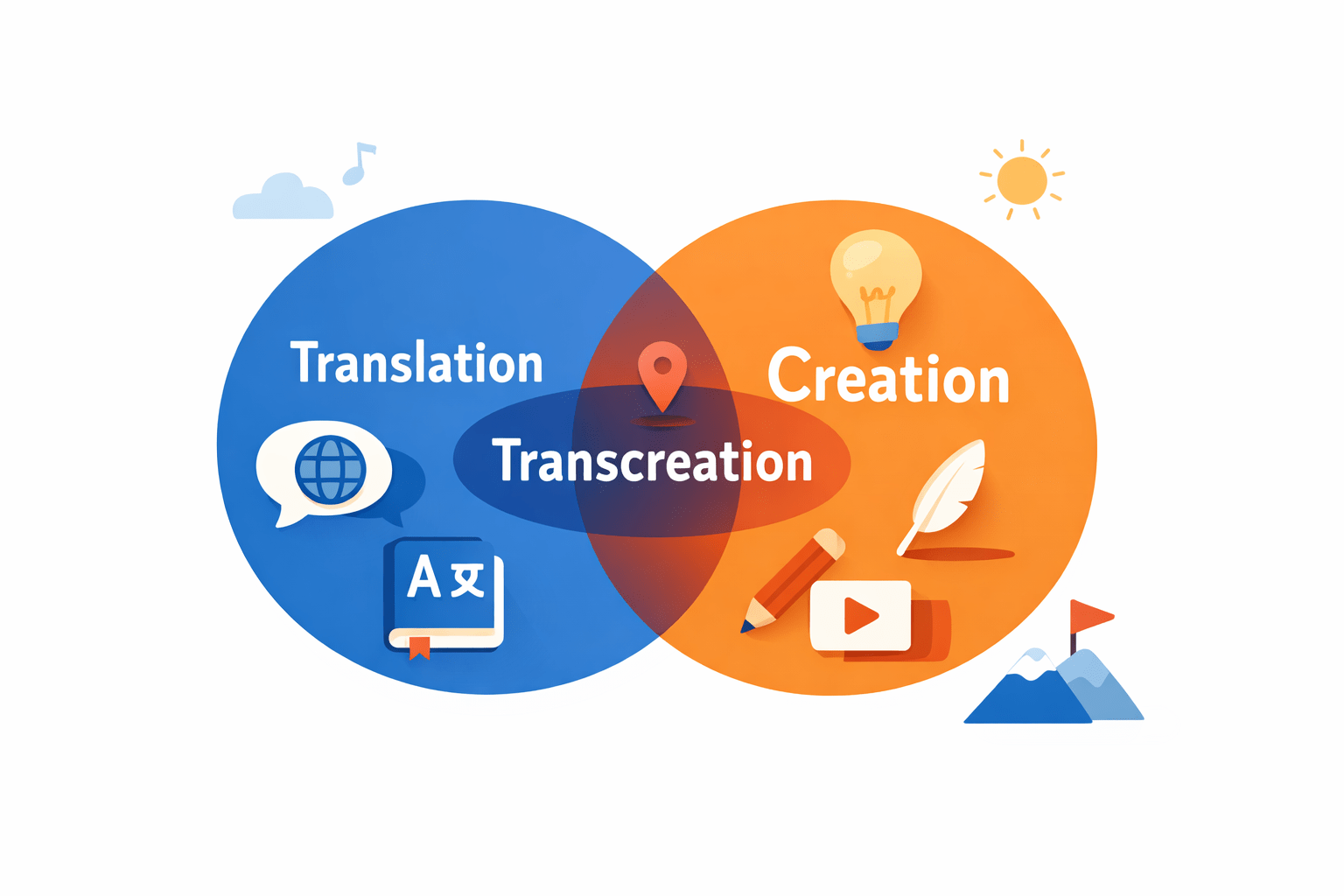
If you’re searching for transcreation meaning, you’re probably trying to answer a practical question: Do I need a faithful translation, or do I need something that sells, persuades, and feels native in-market? That’s exactly where transcreation comes in.
Transcreation is what you use when meaning alone isn’t enough. When your content needs to land with the same punch, personality, and emotional impact in another language, you don’t “translate” it, you recreate it.
If your next campaign includes taglines, paid ads, landing pages, app store copy, social content, video scripts, or brand storytelling, this guide will help you choose the right approach and avoid the most expensive kind of localisation mistake: a perfectly accurate translation that doesn’t work.
Want help adapting creative content for new markets? Explore our marketing translation and localisation services or get in touch for a fast quote.
What transcreation means (in plain English)
Transcreation is the creative adaptation of a message from one language to another so it produces the same effect on the target audience.
Not the same words. Not always the same structure. The same impact.
Think of it as translation + copywriting + cultural strategy.
A good transcreation keeps the intent and brand voice, while changing what needs to change (wordplay, rhythm, references, humour, imagery, even the concept) so the message feels like it was originally created for that market.
A quick definition you can use internally
Transcreation: rewriting content in another language to preserve the original intent, tone, and persuasive effect, even when the wording changes substantially.
Transcreation vs translation vs localisation (what’s the difference?)
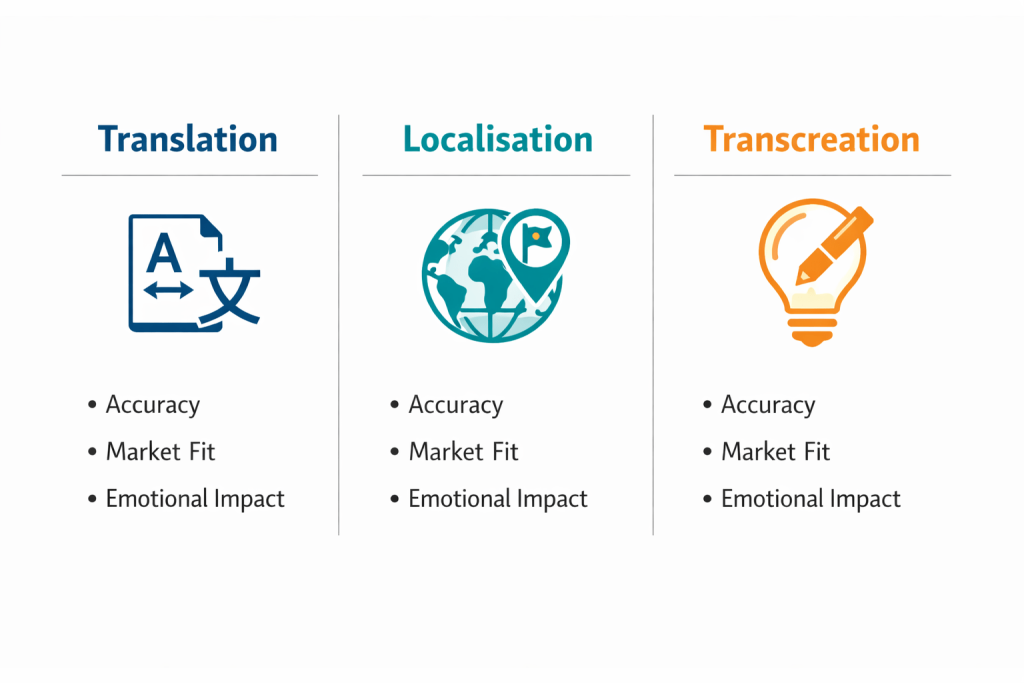
Here’s the simplest way to separate them:
| Approach | Main goal | Best for | “Success” looks like |
| Translation | Accuracy of meaning | Legal, technical, policy, product specs, support docs | Correct, clear, consistent |
| Localisation | Market fit across language + context | Apps, websites, UI, formats, currencies, regional conventions | Feels normal and usable in-market |
| Transcreation | Emotional + commercial impact | Taglines, ads, landing pages, social, brand voice, video scripts | Gets the same reaction and results |
If your content must be verbatim-accurate, translation is usually the right tool. If your content must convert, transcreation often wins.
To see how we handle different content types, start with our translation services and marketing translation and localisation services.
When transcreation beats translation (the “high-stakes content” rule)
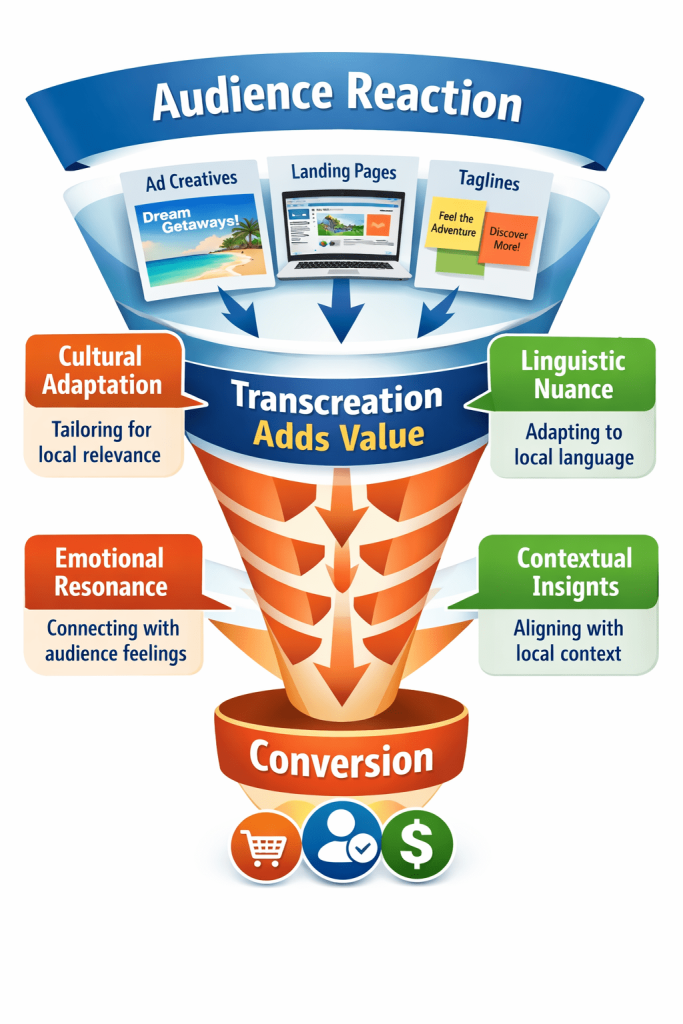
A helpful rule of thumb:
If the content’s job is to influence behaviour, consider transcreation.
That includes content designed to:
- make someone click, buy, subscribe, or sign up
- make your brand feel premium, playful, rebellious, or trusted
- build desire, urgency, belonging, or confidence
- feel witty, memorable, or culturally “in”
Common examples where transcreation usually outperforms
- Taglines and slogans
- Paid ads (search, social, display)
- Landing pages (especially above the fold)
- Email subject lines and hero copy
- Brand campaigns and manifesto messaging
- App store descriptions and promo highlights
- Video scripts and voiceover lines
- Influencer briefs and social captions
- Product naming (when meaning + connotation matters)
If you’re launching in multiple regions, transcreation also helps you avoid brand drift: the subtle way your “voice” turns generic as it gets translated repeatedly.
When you should not use transcreation
Transcreation is powerful, but it’s not a default. Use it when impact matters more than literal fidelity.
Translation is usually better for:
- contracts, terms, compliance policies
- medical or safety content
- technical manuals and specifications
- legal evidence or certified documents
- regulated claims (where wording must match approvals)
- repetitive content where consistency is critical (FAQs, help centres)
If your content includes both creative and regulated sections (common in healthcare, fintech, and insurance), a blended approach often works best: translate the regulated parts, transcreate the persuasive parts.
What a transcreation agency actually delivers
A strong transcreation process doesn’t just hand you “one translation.” It gives you creative options and explains the thinking.
Depending on the asset, a transcreation agency may provide:
- 2–5 alternative versions for key lines (taglines, CTAs, headlines)
- A short rationale for each option (tone, cultural fit, connotations)
- A brand voice alignment check (does it sound like you?)
- In-market review (especially for humour, slang, taboo risks)
- Optional back-translation (not as the goal, but as a safety check)
- Consistency notes (preferred terms, banned phrases, style preferences)
If your campaign is multilingual, you’ll also want a system that keeps creative consistency across markets. That’s where transcreation becomes part of broader website translation and localisation and campaign rollout workflows.
A practical way to decide: the 6-question transcreation test
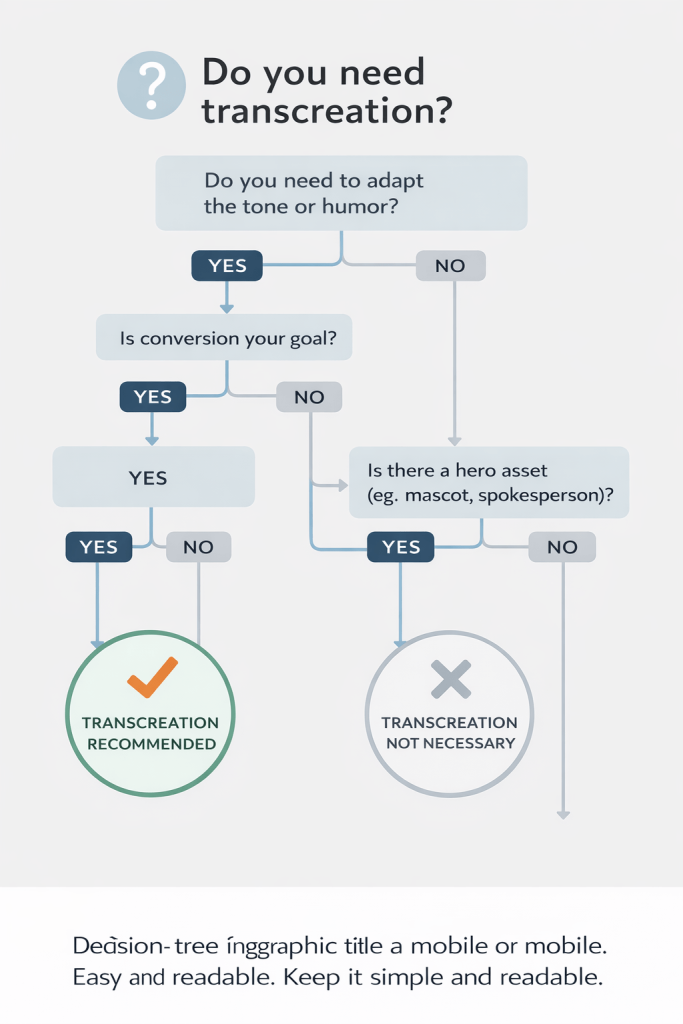
Answer these quickly. The more “yes” answers, the more likely you need transcreation services.
- Does the content rely on tone or personality?
- Would a flat translation weaken the brand?
- Is there humour, wordplay, rhyme, or cultural references?
- Is the goal to persuade (click/buy/sign up)?
- Would awkward phrasing hurt trust or premium feel?
- Is this a “hero” asset that will be seen by thousands (or millions)?
0–1 yes: translation is usually fine
2–3 yes: localisation + light creative adaptation
4–6 yes: strong case for transcreation
If you’re unsure, send the asset and the target markets and we’ll recommend the most efficient approach: contact our team.
Transcreation examples (what changes, and why)
Below are simple examples to show how transcreation differs from translation. (These are illustrative, not tied to any real brand.)
Example 1: A tagline with an idiom
Source (English): “Kickstart your day.”
Literal translation (problem): may sound mechanical or unclear in some languages.
Transcreation (goal): keep energy + momentum, use a local expression that feels natural.
A transcreator might choose a phrase that conveys:
- “start strong”
- “get moving”
- “energise”
- “set the tone”
Example 2: A premium brand promise
Source (English): “Skin science. Real results.”
A transcreation might adjust:
- rhythm (two short beats)
- connotation of “science” (clinical vs reassuring)
- what “real results” implies legally or culturally
Example 3: A CTA that doesn’t convert cross-culturally
Source (English CTA): “Get started now.”
In some markets, urgency-heavy CTAs can reduce trust. Transcreation might pivot to:
- reassurance (“Speak to an expert”)
- clarity (“Request your quote”)
- friction reduction (“Upload your file securely”)
If you’re building multilingual landing pages, transcreation pairs well with marketing translation and localisation services so headlines, CTAs, and value props keep converting.
The transcreation brief (copy-paste template)
Great transcreation starts with a brief. Here’s a simple one you can paste into an email or project form:
1) Asset type: (tagline / landing page / ads / email / video)
2) Target markets + language variants: (e.g., Spanish (MX), Spanish (ES))
3) Audience: (who they are, what they care about, what they fear)
4) Goal: (click / sign up / purchase / brand lift / awareness)
5) Brand voice: (3–5 adjectives + examples of “on-brand” lines)
6) Must-keep: (product names, legal phrases, core claim boundaries)
7) Must-avoid: (words, topics, humour style, taboo areas)
8) Competitors: (what you want to sound like / not sound like)
9) Context: where it appears (banner, TikTok, app store, email subject line)
10) Success metric: CTR, conversions, brand recall, time-on-page, etc.
If you’d like, you can send the asset with this template and we’ll advise whether you need translation, localisation, or full transcreation: request a quote here.
How transcreation is priced (and why it’s rarely “per word”)
Translation often fits per-word pricing because the output stays structurally similar.
Transcreation is different: it’s closer to creative work. Pricing is typically based on:
- the type of asset (tagline vs full landing page)
- the number of options/variants required
- research needs (market + audience nuance)
- review layers (in-market review, brand review, legal check)
- turnaround time
If you need budgeting clarity before you commit, our price rate page is a helpful starting point, and we can quote your exact assets once we see them.
Quality control: how to keep transcreation “on brand” across markets
Creative freedom is the point, but it needs guardrails. Strong workflows include:
- A single source of truth for brand voice and terminology
- Do-not-translate lists (product names, features, legal phrases)
- Tone calibration: one sample asset to “lock” voice per language
- Variant selection: you choose the best option for each hero line
- Consistency checks across pages, ads, and app store listings
- In-market validation for humour, slang, cultural sensitivity
For media-heavy campaigns, you may also need a full localisation layer (subtitles, captioning, voiceover). If that’s your situation, see our guide to media localisation.
Common transcreation mistakes (and how to avoid them)
- Asking for transcreation without a brief
Result: random creativity, inconsistent voice. - Measuring transcreation by literal similarity
Result: you reject the best option because it “looks different.” - Using the wrong reviewer
If internal reviewers don’t understand the target culture, they often “correct” the copy into something awkward. - Ignoring where the text lives
A line that works as a billboard headline may fail as a button CTA. - Skipping legal or claims checks
Transcreation can accidentally strengthen a claim. Regulated industries should set clear boundaries.
A simple takeaway: what transcreation is really for
Transcreation exists for one reason: to protect performance when language changes.
When your content is meant to move people, transcreation helps you move them in every market.
If you’re launching internationally and you want your messaging to feel native (not “translated”), we can help you choose the right level of adaptation and deliver it with the right specialists.
Start with a quick brief and we’ll respond with a clear plan, timeline, and quote:
→ Contact Transcribe Lingo
→ Or review our marketing translation and localisation services
3) FAQ Section
What is the transcreation meaning in marketing?
Transcreation in marketing means rewriting a message in another language so it creates the same persuasive impact as the original, even if the wording changes significantly.
Is transcreation the same as creative translation?
They’re closely related. “Creative translation” is often used as an umbrella term, while transcreation usually implies a higher level of rewriting, brand voice work, and conversion-focused adaptation.
When should I use transcreation services instead of translation?
Use transcreation services for high-visibility, conversion-driven content like taglines, ads, landing pages, app store copy, and campaign messaging where tone and emotional response matter.
What does a transcreation agency deliver?
A transcreation agency typically delivers multiple creative options for key lines, plus rationale, brand voice alignment, and (when needed) in-market review or back-translation for quality assurance.
How do you brief a transcreation agency?
Provide the audience, goal, brand voice, must-keep terms, must-avoid topics, where the copy will be used, and what success looks like (CTR, conversions, brand recall). A short, clear brief dramatically improves results.
Can transcreation help with localisation projects?
Yes. Transcreation is often the “creative layer” inside broader localisation, especially for websites, apps, and media where you need both functional usability and strong brand impact.
