

London is one of the UK’s biggest hubs for multilingual work, but “translation jobs London” can mean anything from in-house translators to localisation project managers, public service interpreters, subtitlers, and language specialists working on AI projects. This guide breaks down what’s actually hiring, what pay signals to trust (and which to ignore), and the fastest entry routes into sustainable work.
If you’re applying right now, use this page as a checklist: job titles to search, skills that move the needle, and the practical steps that turn “bilingual” into “billable”.
The London translation market in 2026
London’s language economy is bigger than it looks because “translation” shows up inside other job families:
- Legal and public sector: courts, immigration, policing, safeguarding, social care
- Healthcare: NHS appointments, mental health, maternity, community care
- Corporate London: finance, compliance, HR, internal comms, investor updates
- Media and tech: marketing, gaming, product localisation, UX writing, subtitling
- Language + AI: data annotation, language model evaluation, linguistic QA
A simple reality check: on major job boards, “translation” roles around London often number in the hundreds at any given time, while “translator” roles alone can look smaller because many employers list them under language specialist, localisation, content, compliance, or interpreting instead.
The three markets you’re really choosing between
Most London opportunities fall into one (or more) of these lanes:
- Document translation (written)
- Contracts, court bundles, policies, medical notes, corporate documents
- Often remote/hybrid; quality assurance is a big differentiator
- Interpreting (spoken / live)
- On-site or remote (phone/video); higher stakes, stricter credentials
- Scheduling and availability can matter as much as linguistic skill
- Localisation (product + marketing)
- Apps, websites, games, UX, brand voice, subtitling, transcreation
- More corporate ladders, clearer progression, broader “language + tech” expectations
Roles in London: what the titles usually mean
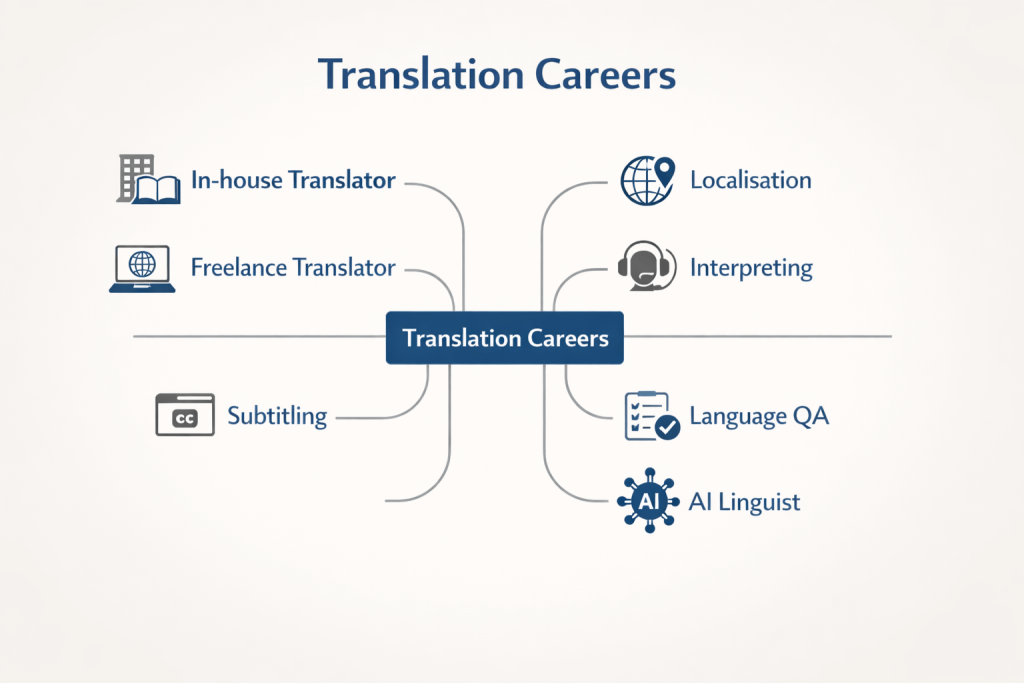
Below are the roles you’ll keep seeing in job ads and what hiring managers typically expect.
In-house Translator
What you do: translate, edit, proofread, maintain glossaries, liaise with stakeholders.
Common sectors in London: legal, finance, consulting, government suppliers, international NGOs.
Pay signals: steady salary, benefits, clearer boundaries than freelance.
Best entry route: portfolio + domain focus (legal/finance/medical) + consistent QA habits.
Typical “must-haves” in ads
- Native-level writing in the target language (often English)
- Excellent proofreading and revision discipline
- Familiarity with CAT tools (even at basic level)
- Evidence you can handle sensitive/confidential material
Freelance Translator (Agency or Direct)
What you do: deliver translation projects to brief, build client relationships, manage your own workflow.
London reality: a lot of work is London-based clients but fully remote delivery.
Pay signals (the ones that matter)
- A clear rate structure (per-word / per-hour) plus minimum charge
- A defined revision step (review/QC), not “just translate and send”
- Domain premiums (legal/medical/technical usually pay more than general)
Red flags
- “Urgent” + vague scope + no talk of style guide/terminology
- No purchase order / contract / payment timeline
- Unrealistic daily volumes with “perfect quality” expectations
Localisation Specialist / Localisation Project Manager
What you do: coordinate language delivery across products, manage vendors, run QA, handle tooling and handoffs.
Why it’s hot in London: lots of international businesses and tech-adjacent teams.
Pay signals
- Salaried roles often sit above general translator pay
- Clear tooling stack (TMS, CAT, QA tools)
- Cross-functional coordination is valued as much as linguistic skill
Best entry route
- Start in LQA, vendor coordination, or content ops
- Build comfort with tickets, style guides, terminology workflows, and stakeholder updates
Linguistic QA (LQA) / Language Quality Reviewer
What you do: review translations inside apps/websites, catch UI issues, tone problems, truncation, inconsistent terminology.
Good for beginners because: your “translation” is anchored by product context and clear rules.
Pay signals
- Strong briefs, checklists, bug-tracking systems
- More predictable workload than pure translation in some environments
Legal Linguist / Compliance Linguist
What you do: translate or review legal text with high precision; sometimes bilingual drafting support.
London advantage: strong demand from law firms, corporate legal teams, compliance-heavy industries.
Pay signals
- Domain tests are stricter
- Precision and confidentiality are heavily screened
- Clear escalation process for ambiguity (good sign)
Public Service Interpreter (PSI) / Community Interpreter
What you do: interpret in healthcare, courts/tribunals, local authority settings, safeguarding contexts.
Pay signals
- Credential requirements are common (and a good sign)
- Clear booking rules (minimum hours, travel, cancellation terms)
Reality check: interpreting is not “translation, but spoken”. It’s a distinct professional discipline with different performance pressures.
Conference Interpreter
What you do: simultaneous or consecutive interpreting for conferences, corporate events, international meetings.
Pay signals
- Team setups, equipment, realistic prep time
- Higher rates; fewer entry-level roles
Subtitler / Captioner / Media Localisation Specialist
What you do: create subtitles, captions, time-coded deliverables, sometimes adapt scripts for voiceover.
Pay signals
- Clear guidelines (reading speed, style rules, segmentation)
- Tool expectations (subtitle editors, QA checks)
If your work touches multimedia, you’ll also see related service demand around voiceover and subtitling delivery pipelines (useful context if you want a corporate-facing path later): voiceover and subtitling services.
Language Specialist in AI / Linguistic Data Roles
What you do: evaluate outputs, label data, validate grammar/meaning, improve language model behaviour.
Pay signals
- Tests are common
- Clear quality metrics and reviewer calibration
- Strong NDAs and data handling rules
Pay signals: how to tell if a role is worth it (before you apply)
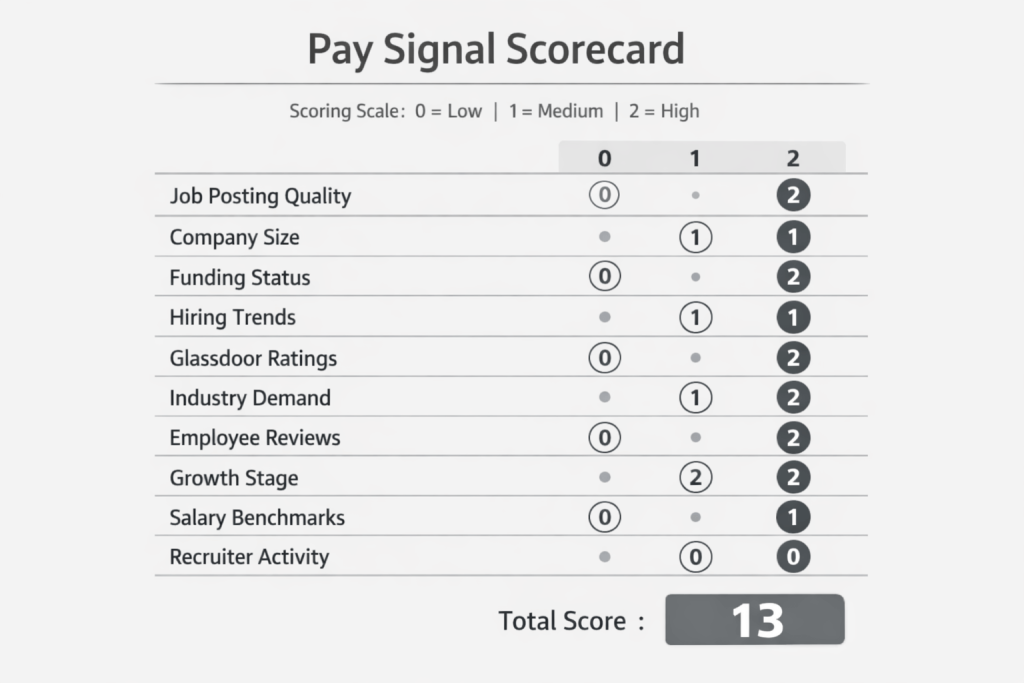
London pay ranges vary wildly because “translation” roles include teaching-adjacent roles, bilingual customer service, interpreting, localisation, and specialist linguist work. Instead of chasing one number, learn to read the signals.
Employed pay: typical London bands you’ll see
These are broad, real-world ranges you’ll commonly see across London postings (your language pair, niche, and credentials move you up or down):
- Entry-level language roles (support / coordinator / junior LQA): ~mid-£20ks to low-£30ks
- In-house translator (generalist): ~low-£30ks to low-£40ks
- Specialist translator (legal/medical/technical): ~mid-£30ks to £50k+
- Localisation PM / senior language ops: ~£40k to £60k+
- Senior specialist roles: can push beyond £60k, especially in high-impact or leadership scopes
Interpreting pay: the “minimum booking” tells you more than the hourly rate
For interpreting, pay is often structured around:
- Minimum session length
- Travel/time allowances
- Cancellation terms
- Special requirements (court, safeguarding, specialist medical)
If the ad doesn’t mention these, it’s often a sign the workflow is immature.
Freelance pay: compute your effective hourly rate
Per-word rates look attractive until you factor in admin, queries, formatting, QA, and client management.
Use this simple calculation:
Effective hourly rate = (Project fee − admin costs) ÷ (translation + QA + admin hours)
Example: A 3,000-word job at £0.10/word = £300
If it takes you 4.5 hours translation + 1.5 hours QA + 1 hour admin = 7 hours
Your effective hourly rate is ~£42/hour (before tax/overheads).
Now compare that to a “£0.06/word” job with heavy formatting, unclear brief, and lots of back-and-forth. Cheap work becomes expensive fast.
The Pay Signal Scorecard (steal this for every job ad)
Score each item 0–2 (0 = missing/weak, 2 = strong). Total out of 20.
- Brief quality: clear purpose, audience, style requirements
- Domain fit: sector matches your strengths
- Quality process: revision/QC is defined
- Tooling clarity: CAT/TMS expectations make sense
- Terminology handling: glossary or escalation process exists
- Security expectations: sensible confidentiality/data handling
- Payment clarity: timeline, method, fees specified
- Realistic turnaround: deadlines match complexity
- Client maturity: named stakeholders, structured comms
- Growth potential: repeat work, progression, training
Rule of thumb
- 16–20: prioritise
- 11–15: apply if it builds your niche
- ≤10: only if you’re deliberately filling gaps (and the risk is priced in)
Entry routes: 7 realistic ways into translation jobs in London
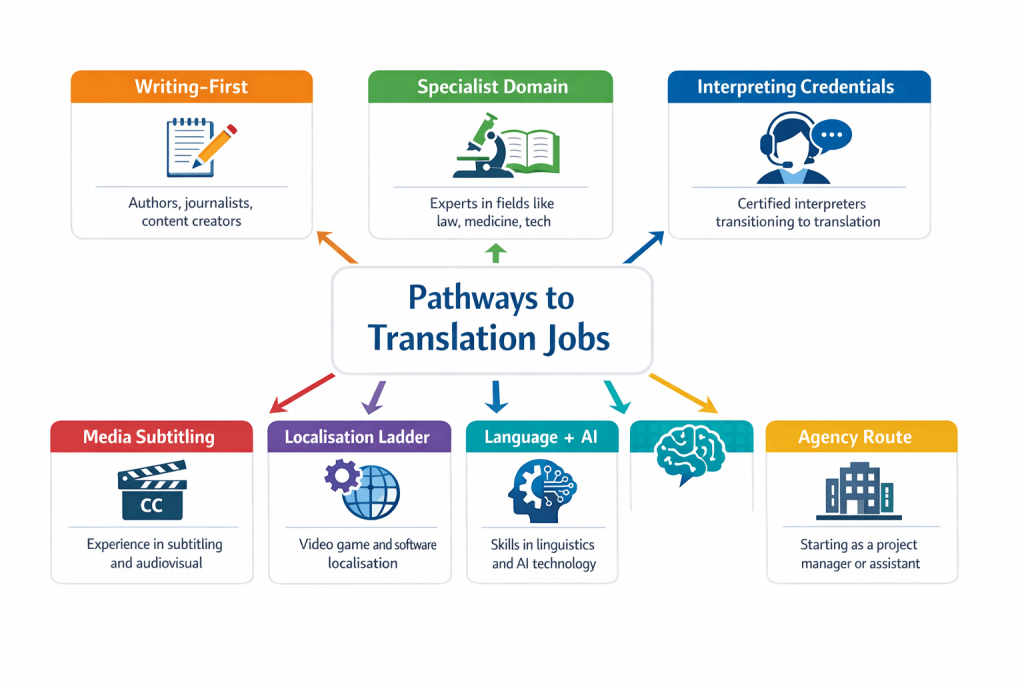
1) The “language + writing” route (fastest for general roles)
If your target language writing is strong, you can enter through:
- junior LQA
- bilingual content support
- editorial assistant roles in multilingual teams
- entry-level translation in a narrow domain
What makes you stand out: a small portfolio + proof you can write professionally, not just “fluently”.
2) The specialist route (law, healthcare, finance)
London rewards subject-matter credibility. If you have:
- law background
- healthcare experience
- financial/compliance exposure
you can position yourself as a domain linguist rather than a generalist.
A credible niche does more for your employability than a long list of languages.
3) The interpreting route (structured credentials, higher stakes)
If you want public service interpreting:
- treat it as a profession with training, ethics, and performance standards
- expect vetting, DBS checks in some environments, and strict conduct rules
- build experience in lower-stakes settings first (where appropriate)
4) The localisation route (best long-term corporate ladder)
Localisation roles often hire for:
- organisation, clarity, stakeholder communication
- comfort with tooling and process
- ability to spot meaning and UX problems, not just linguistic errors
Entry points:
- LQA
- vendor coordinator
- content operations
- junior localisation PM
If you’re curious about where localisation meets real business delivery, explore the kinds of work agencies run in marketing and product contexts: marketing translation and localisation and game localisation services.
5) The media route (subtitles/captions)
Subtitling is an underrated entry point because your portfolio becomes easy to demonstrate:
- before/after clips (where rights allow)
- time-coded samples
- style compliance examples
If you can deliver accurate, readable subtitles quickly, you’ll build a strong “language + production” profile.
6) The language + AI route (new titles, transferable skills)
These roles value:
- consistent judgement
- error categorisation
- attention to detail
- strong native writing
This can be a powerful stepping stone into localisation, QA, and content roles.
7) The agency route (volume + mentoring by process)
Agencies can be a strong early-career pathway because they enforce:
- briefs
- deadlines
- QA expectations
- professional communication habits
If you want to understand how professional delivery works end-to-end, study a real agency workflow and quality stance. At Transcribe Lingo, projects are matched to sector-specialist linguists and handled with managed QA—useful context even if you’re job-hunting: translation services and language interpretation services.
The London job search strategy that actually works
Search smarter: use title clusters, not one keyword
Instead of only “translation jobs London”, rotate these searches:
- translator / in-house translator
- localisation specialist / localisation project manager
- LQA / language quality reviewer
- bilingual editor / multilingual content
- legal linguist / compliance linguist
- subtitler / captioner
- public service interpreter / community interpreter
- language specialist / linguistic analyst
Apply with a “portfolio-first” approach
For most language roles, your CV is only step one. Your portfolio gets you shortlisted.
A strong starter portfolio (3–5 pieces) includes:
- one general business document sample
- one domain sample (legal/medical/finance—pick one)
- one revision example (show what you changed and why)
- one terminology/glossary snippet
- one short style guide excerpt (tone rules you followed)
Keep it clean, anonymised, and formatted like real deliverables.
Pay negotiation: what to say (without sounding awkward)
If you’re employed in translation job
Ask about:
- scope creep boundaries (extra languages, extra domains)
- revision expectations
- stakeholder load (how many departments you support)
- remote/hybrid patterns
- learning budget (CAT tools, courses, memberships)
If you’re freelance in translation job
Ask early:
- purchase order + payment terms
- minimum charge
- revision stage (who reviews, how feedback is handled)
- file format and DTP expectations
- confidentiality requirements
One sentence that works well:
“To confirm the right rate and timeline, could you share the target audience, required style, and whether you need a separate revision pass?”
That one line signals professionalism and protects your margins.
The 30-day entry plan (designed for London hiring patterns)

Week 1: pick your lane + build your “proof”
- Choose one niche (legal / medical / finance / marketing / product)
- Create a 1-page portfolio index (links + one-line description per sample)
- Update LinkedIn headline to match your target role (not “freelance translator” if you want in-house LQA)
Week 2: tool confidence (not mastery)
- Learn the basics of one CAT tool workflow (projects, TM, glossary, QA checks)
- Build a mini glossary (30–50 terms) in your niche
- Practice consistent revision: do a translation, sleep on it, revise the next day
Week 3: targeted applications + outreach
- Apply to 10–15 roles that match your lane
- Send 10 direct messages to hiring managers or team leads with:
- one-line niche
- one portfolio link
- one relevant achievement
Week 4: test prep + interview readiness
- Create a “test kit” template:
- cover sheet (assumptions, questions, terminology choices)
- final deliverable formatting
- QA checklist (consistency, numbers, names, dates, punctuation)
You’ll look senior even if you’re early-career.
What clients and employers actually buy (and how to show it)
Employers don’t just hire language skill. They hire risk reduction.
Three credibility signals that get you trusted faster
- You ask the right questions before translation
- You have a consistent QA routine
- You respect confidentiality (and can explain your approach)
If you want to see how professional clients evaluate quality and reliability, browse real-world language delivery contexts such as certified translation services (where formatting and acceptance criteria matter) and transcription services (where accuracy, timestamps, and privacy are non-negotiable).
Hiring in London right now? Here’s the shortcut

If you’re a hiring manager trying to fill translation capacity, the fastest way to avoid churn is to stop treating translation like a commodity. The winning setup is:
- a defined brief (audience + purpose)
- a named reviewer
- a style guide and glossary
- realistic deadlines
- a partner who can scale and match subject matter
Transcribe Lingo supports legal, healthcare, market research and corporate teams with sector-matched linguists and managed QA. If you need coverage quickly, you can get a free quote and upload your files for a fast assessment.
“Amazing service. Quick turnaround and accurate translations, totally worth the price…”
“Highly recommend Transcribe Lingo for being prompt… thoroughly professional!”
“We’re glad to have Transcribe Lingo as our long-term transcription partner…”
3) FAQ Section
1) What qualifications do I need for translation jobs in London?
For many entry roles, you don’t need a specific degree, but you do need strong target-language writing, evidence of translation ability (portfolio), and basic tool/process awareness. For specialist areas (legal/medical) and interpreting, formal training and credentials are far more common and often required.
2) What is the average pay for translation jobs in London?
Pay varies by role type. Entry-level language roles often start in the mid-£20ks to low-£30ks, while in-house translator roles commonly sit in the low-£30ks to £40ks. Specialist and localisation roles can move into the £40ks–£60k+ range depending on scope and seniority.
3) Are there many freelance translation jobs in London UK, or is it mostly remote?
Much of the work is remote even when clients are London-based. You’ll still see London as a location because stakeholders, industries, and meetings are centred there, but delivery is typically digital.
4) How can I get my first translation job in London with no experience?
Start with a tight niche, build a small portfolio (3–5 samples), learn one CAT workflow, and apply to adjacent roles like LQA, bilingual content support, or vendor coordination. These routes get you paid experience faster than waiting for a “junior translator” title.
5) What languages are most in demand for translation jobs in London?
Demand changes, but London commonly needs major business and community languages across public services, healthcare, and corporate sectors. The strongest demand is usually where there’s both high population usage and high-stakes communication (legal, medical, immigration, safeguarding).
6) Where should I look for jobs London translation roles beyond job boards?
Network through professional bodies, attend London language industry events, approach agencies, and connect with localisation and content teams in London companies. Also search for “language specialist” roles that don’t use the word “translation” in the title.
