
If you’ve searched translator certification UK, you’ve probably noticed a problem straight away: everyone seems to mean something slightly different. Some people mean a qualified translator. Others mean a certified translation for the Home Office. Others mean an agency that’s certified to a standard like ISO 17100.
This guide clears it up without the jargon. You’ll learn what “certification” can legitimately mean in the UK, what it definitely does not mean, and how to choose the right option for visas, universities, courts, employers, or business work.
If you already have a document and a deadline, you can jump straight to a practical route: upload your file and get a clear quote via Transcribe Lingo’s certified translation service or translation services.
The fast answer (save this)
In the UK, there is no single government-issued “translator licence” that makes someone official in the way “sworn translators” work in some other countries.
Instead, “translator certification UK” usually points to three different things:
- Translator credentials (qualifications and professional memberships)
- Certified translations (a translation that includes a signed certificate of accuracy for official use)
- Certification for translation services (company-level standards such as ISO 17100)
Most people who need something “certified” for the Home Office, passport applications, DVLA, or universities don’t actually need a “certified translator” as a title. They need a certified translation (the document + a properly-worded certification statement).
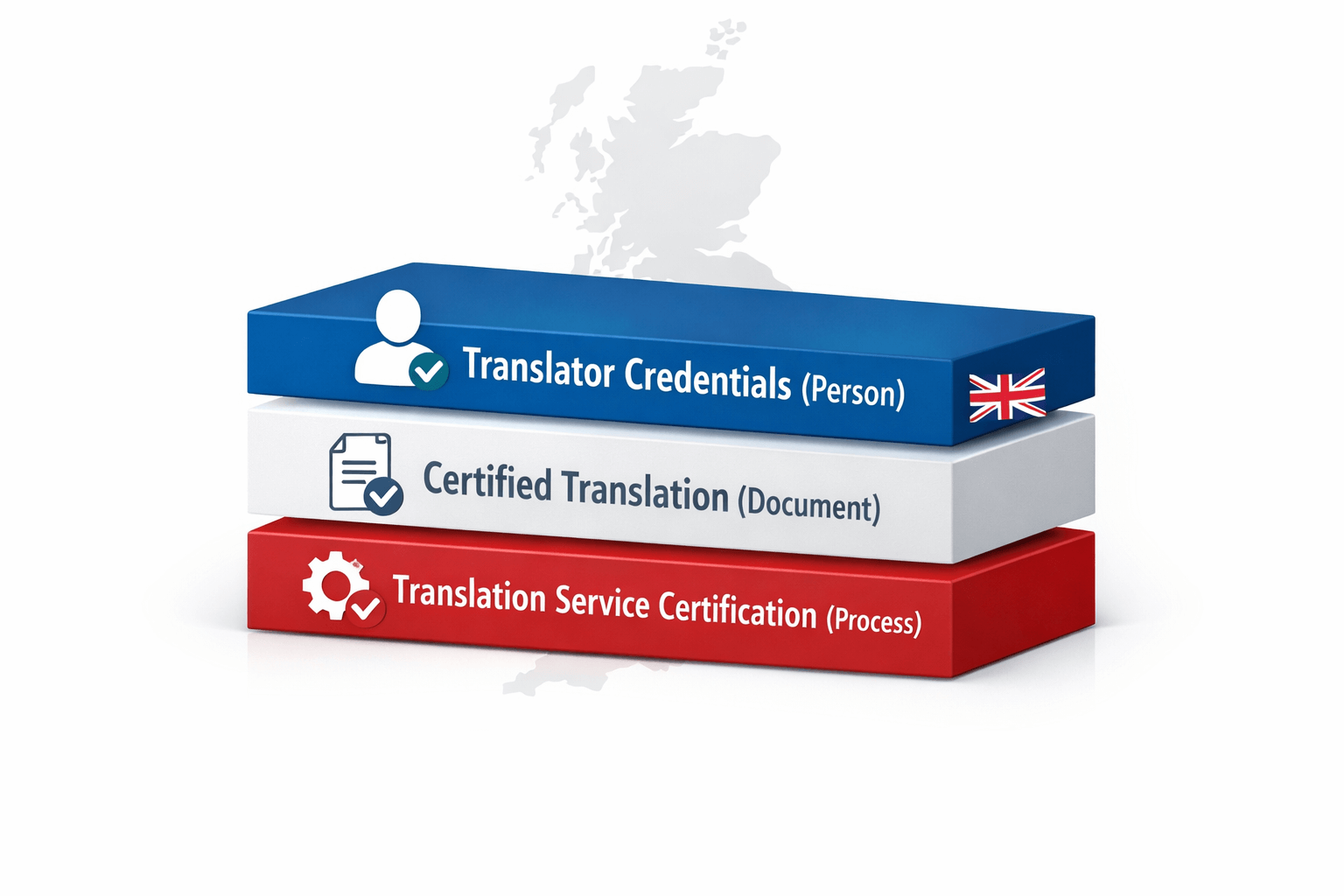
The UK “certification” landscape in one picture
Think of it like a three-layer stack:
Layer 1: Translator credentials (person)
What it signals: training, tested ability, experience, ethics
Examples: a certificate in translation, a diploma/degree, assessed professional membership
Layer 2: Certified translation (document)
What it signals: the translation is complete and accurate, signed and verifiable
Examples: certificate of accuracy for UK authorities, universities, employers
Layer 3: Certified translation service (company/process)
What it signals: a documented workflow, review steps, vendor requirements
Examples: ISO 17100 process alignment/certification (and sometimes ISO 9001)
A strong outcome often combines all three: qualified linguists + correct certification wording + a controlled review process.
What “translator certification” can mean in the UK (the legitimate meanings)
1) A certificate in translation (a qualification)
A certificate in translation is a formal qualification that assesses or teaches translating skills. It’s often used as evidence of capability when a client or employer wants proof that the translator has been trained and tested.
When it matters most
- Applying for translation roles or joining professional bodies
- Working with organisations that require credential checks
- Building credibility in specialist fields (legal, medical, technical)
When it matters less
- When an authority only cares that your translation document includes a compliant certification statement (Layer 2)
Practical tip: If you’re hiring, ask: Is the translator qualified for this domain? A certificate is useful, but so is proven sector experience.
2) A recognised professional membership (assessed standards)
In the UK, professional membership can function like “certification” in everyday language, because it often involves:
- entry requirements (qualifications and/or experience)
- assessments for certain membership grades
- codes of conduct and complaints procedures
- continuing professional development expectations
This is why many public-facing guides refer to “accredited” or “registered” translators via professional registers.
What to look for (as a buyer)
- membership level (some levels are assessed; some are entry-level)
- language pair(s)
- specialisms (legal, medical, finance, marketing)
- whether the person is happy to sign a certificate of accuracy that is independently verifiable
3) A protected or formal professional designation (limited context)
Some titles/designations have specific meanings and criteria. If a translator uses a designation, you should be able to verify it through official registers or the relevant body.
Why this matters: It helps you separate genuine credentials from marketing phrases.
What “translator certification” does not mean (myths that cause rejections)
Myth 1: “Certified translator” is a universal UK legal status
It isn’t. The UK doesn’t operate a single central licensing system for translators across all uses.
Myth 2: If a translator is “certified”, every translation is automatically accepted
Acceptance depends on the receiving body’s rules and whether your translation includes the right certification statement, contact details, date, and signatures.
Myth 3: Notarised translation is always required
Notarisation is a separate step. Many UK submissions require a certified translation (certificate of accuracy) but not notarisation. Notarisation tends to appear when a specific authority (often overseas or a court/embassy) requests it.
If you’re unsure, Transcribe Lingo can advise whether you need certified, notarised, or apostilled work via notarised translation and related services.
Myth 4: “ISO certified” means the translator is personally certified
ISO standards like ISO 17100 relate to translation service processes (company-level). They do not automatically certify an individual’s linguistic talent.
The part that actually gets checked: certified translations for official use (UK)
If your goal is to submit documents to the Home Office/UKVI, universities, employers, DVLA, or HM Passport Office, the key is usually the certification statement on the translation.
What a UK-certified translation usually includes
A certified translation is typically:
- a complete translation of the original document
- accompanied by a signed statement (often called a “certificate of accuracy”)
In plain English, the certificate says:
- the translation is a true and accurate translation of the original
- the translation date
- the translator’s (or agency’s) full name and signature
- contact details so the translation can be independently verified
- (sometimes) the translator’s credentials, especially for certain application contexts
A ready-to-copy certificate of accuracy template (example)
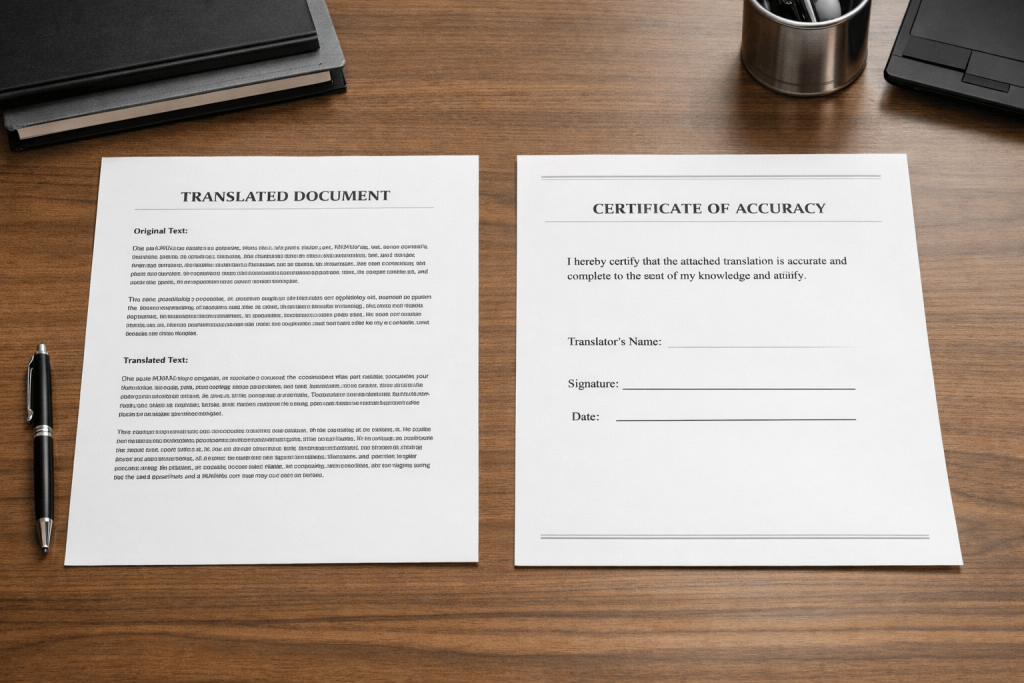
You can use this as a checklist when reviewing what you receive:
Certificate of Accuracy
I, [Full Name], confirm that I am fluent in [Source Language] and English and that the attached translation is a true and accurate translation of the original document in [Source Language].
Document: [Document type + reference number if applicable]
From: [Source Language] Into: English
Date of translation: [DD Month YYYY]
Signature: ____________________
Translator / Agency: [Name]
Contact details: [Email, phone, address/website]
Credentials (if required): [Qualification / membership / experience summary]
Important: Always follow the receiving body’s instructions first. If they specify exact wording, match it.
“Certified translation” vs “notarised translation” vs “apostille” (don’t mix these up)
Certified translation
A translation with a certificate of accuracy signed by the translator/agency.
Notarised translation
A certified translation where a notary verifies the identity of the signer and witnesses the signature. This is sometimes requested for overseas use or specific institutions.
Apostille (legalisation)
A government-issued authentication (often used for overseas submissions) that verifies the notary/official signature so it’s recognised internationally.
If you’re dealing with overseas authorities, it’s common to need a chain: translation → notarisation → apostille. If you’re dealing with a UK authority, you often need translation → certificate of accuracy only.
Certification for translation services (ISO 17100) — what it really tells you
A lot of organisations search “certification for translation services” because they want repeatable quality at scale.
What ISO-style standards typically cover
- defined steps (translation + revision/review)
- competence requirements for translators and revisers
- documentation and traceability (project files, version control)
- client brief handling, terminology, confidentiality
- corrective action process if something goes wrong
What it doesn’t guarantee
- that a translator is a subject-matter expert in your niche
- that your document will be accepted if the certificate wording is missing or incorrect
- that a job will be perfect without a good brief, legible scans, and clear requirements
Buyer-friendly takeaway: standards matter most when you need consistent delivery across many documents, languages, or stakeholders.
How to choose the right “certification” for your situation (quick decision guide)
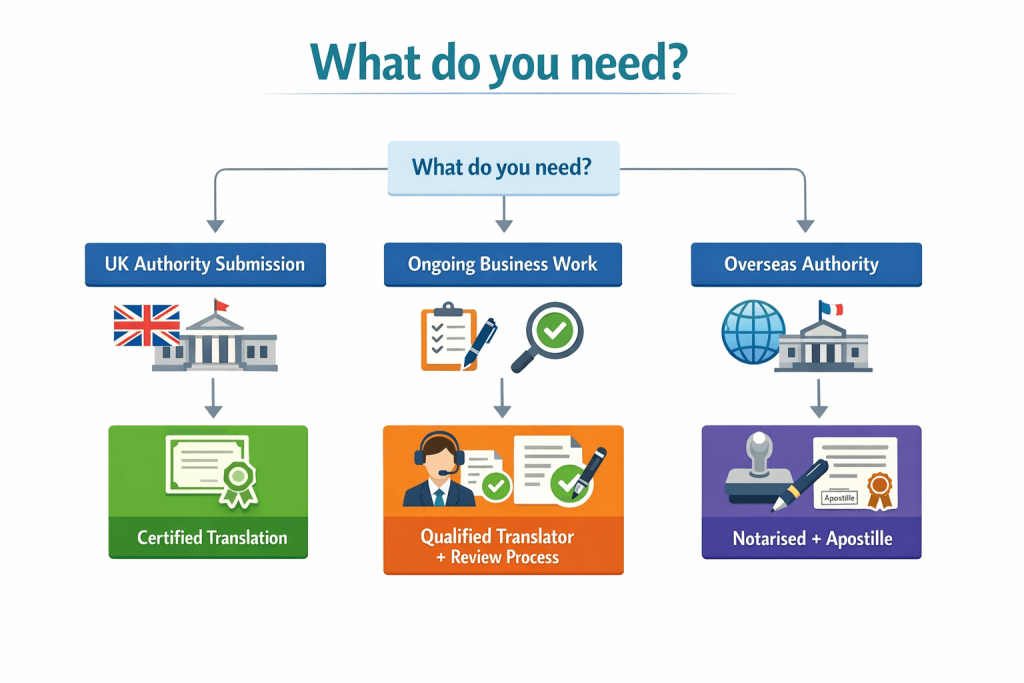
If you’re submitting to a UK authority
You usually need: Certified translation (Layer 2)
Ask for: compliant certificate of accuracy + verifiable contact details
Start here: Certified Translation Services UK
If you’re hiring a translator for ongoing work (business / research / legal teams)
You usually need: Translator credentials (Layer 1) + controlled process (Layer 3)
Ask for: domain experience, review steps, glossary handling, confidentiality controls
Start here: Translation Services
If you’re unsure which level you need
Don’t guess. Send the requirement wording (or a screenshot of it) and your files for a quick check.
Fast route: Contact Transcribe Lingo or view typical service costs on the price rate page.
A practical verification checklist (use this before you pay)
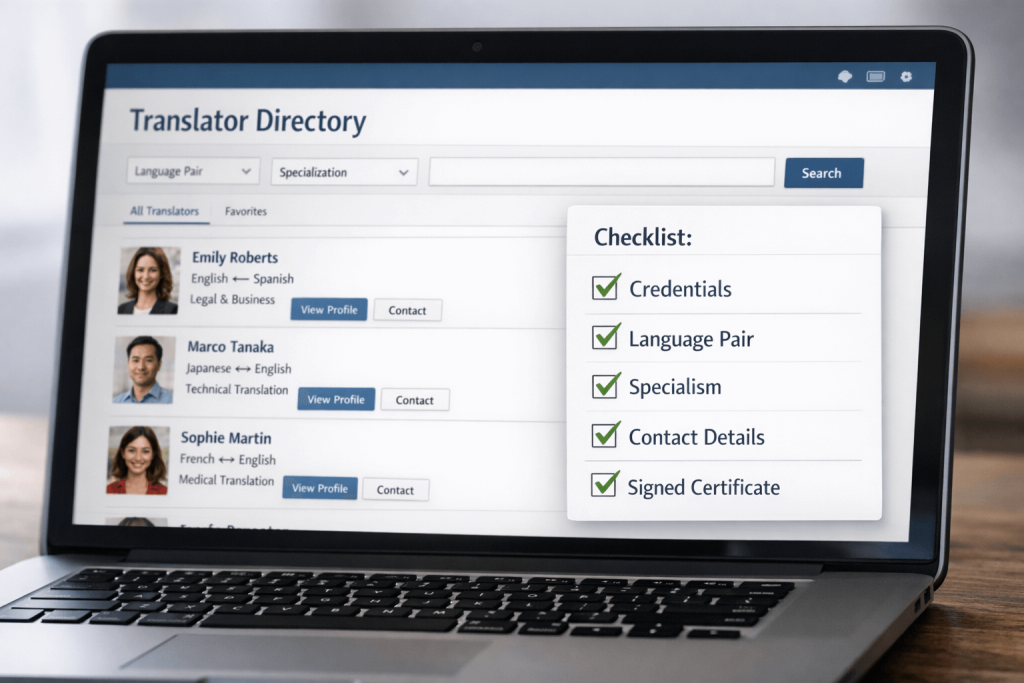
Step 1: Confirm what the receiving body actually wants
Look for phrases like:
- “certified translation”
- “translation can be independently verified”
- “translator’s credentials”
- “notarised” / “apostille” (only if explicitly required)
Step 2: Check the translation will be complete
A common rejection trigger is missing:
- stamps, seals, signatures, marginal notes
- reverse-side text
- handwritten annotations
Step 3: Check the certificate of accuracy contains the essentials
You want all of these:
- true/accurate statement
- date
- name + signature
- contact details
- credentials (where requested)
Step 4: Sanity-check the “quality markers”
- names are consistent with passports/IDs
- dates are in the correct format
- numbers match (reference numbers, totals, addresses)
- formatting is readable and clearly mapped to the original
If a translator is reluctant to sign a verifiable certificate, that’s a red flag for official submissions.
Real-world examples (what people should do)
Example A: UK visa or immigration documents
Typical need: certified translation with a verifiable certificate of accuracy
Common mistake: a friend translates it, or the certificate is missing contact details
Better approach: send all pages (including stamps) and request a certificate that matches the requirement wording
If you’re on a deadline, the quickest route is usually a managed service where formatting and certification are handled correctly: get a certified translation quote.
Example B: University admissions or professional registration
Typical need: certified translations of transcripts, diplomas, references
Common mistake: partial translation (only the “important” parts)
Better approach: translate everything and keep consistent terminology for modules, grading scales, and institutional terms
Example C: Court or solicitor-related documents
Typical need: specialist legal translation, sometimes notarised depending on jurisdiction
Common mistake: using a generalist translator unfamiliar with legal phrasing
Better approach: request a legal specialist, confirm confidentiality handling, and confirm whether notarisation is actually required
What Transcribe Lingo does differently (and why it matters)
When you need “certified” work, reliability is often less about buzzwords and more about getting the boring details right: completeness, consistency, correct certification wording, and a verifiable audit trail.
Transcribe Lingo provides:
- Certified translations issued with a clear certificate of accuracy
- Fully managed translation services for business, legal, and specialist work
- Optional notarised translations when a notary step is required
- Clear guidance when clients aren’t sure what to ask for
Client feedback (recent):
“Amazing service. Quick turnaround and accurate translations, totally worth the price…”
“Highly recommend… prompt to respond to our last minute request… really supportive throughout…”
“We’re glad to have Transcribe Lingo as our long-term transcription partner, never lets you down!”
If you want a straightforward answer in one message, send your document and tell us the purpose (visa, passport, university, court, employer). You’ll get a clear quote and timeline without guesswork: Contact us.
FAQ
1) Is there an official translator certification in the UK?
There is no single, universal government-issued translator licence across all uses in the UK. “Translator certification UK” usually refers to qualifications, professional memberships, or document-level certified translations.
2) What is a “certificate in translation”?
A certificate in translation is a formal qualification that assesses (or teaches) translation skills. It’s evidence of training and capability, and it can support professional membership applications or client credential checks.
3) Do I need a certified translator for UKVI/Home Office?
Most applicants need a certified translation that includes a signed certificate of accuracy with date, signature, and contact details so it can be independently verified. Some routes also ask for translator credentials.
4) What must a certified translation include in the UK?
Typically: a complete translation plus a certificate stating it’s a true and accurate translation, the date, the translator/agency name and signature, and contact details. Some cases also require credentials to be listed.
5) Is ISO 17100 the same as translator certification?
No. ISO 17100 is a translation service/process standard (company-level). It can be a strong trust signal for how work is managed and reviewed, but it isn’t a personal “translator certificate”.
6) What’s the difference between certified and notarised translation?
A certified translation includes the translator/agency’s signed certificate of accuracy. A notarised translation adds a notary step to witness/attest the signature, usually when a specific authority requests it (often for overseas use).
