

If you’ve ever wondered “what are transcribing jobs – and are they actually worth it in the UK?”, you’re not alone. With remote work on the rise and AI tools getting louder, many people are looking at transcription as a flexible side income or full-time career.
This guide breaks down exactly what transcribing jobs involve, how much you can realistically earn in the UK, what skills you need, and how to become a transcriber or court transcriber – without the fluff.
What are transcribing jobs?
In simple terms, transcribing jobs involve listening to audio or video and turning speech into accurate written text.
You might be asked to transcribe:
- Market research interviews and focus groups
- Podcasts and YouTube videos
- Business meetings, webinars and training sessions
- Medical letters or clinical notes
- Legal meetings, hearings and court proceedings
A person doing this work is usually called a transcriber or transcriptionist. The core responsibilities are:
- Listening carefully to recordings or live speech
- Typing what is said (often word-for-word)
- Following style guides and formatting rules
- Checking spelling, grammar and terminology
- Protecting confidentiality and data security
Transcribing jobs can be:
- General transcription – everyday content such as interviews, podcasts and meetings
- Specialist transcription – e.g. medical or legal
- Court reporting / court transcribing – verbatim records of court proceedings
- Captioning and subtitling – transcribing and timing text for video
Most roles are remote and freelance, but there are also in-house roles with transcription companies, law firms, NHS trusts and courts.
How do transcribing jobs work day-to-day?
Although each company has its own workflow, most transcribing jobs follow a similar pattern:
- You receive the brief
- Audio or video files (often via a secure portal)
- Instructions: strict verbatim vs cleaned-up, speaker labels, timecodes, template, deadline
- You set up your tools
- Laptop or desktop
- Headphones (ideally closed-back)
- Transcription software that lets you slow audio, rewind easily and add timestamps
- Optionally: a foot pedal, text expander, and dual screens for faster work
- You transcribe and edit
- Listen, type, rewind, repeat
- Check technical terms and names with online research
- Proofread carefully before delivery
- You submit and get paid
- Freelancers are commonly paid per audio minute, per audio hour, per word, or per project
- Some in-house roles pay an hourly or annual salary
How much do transcribing jobs pay in the UK?
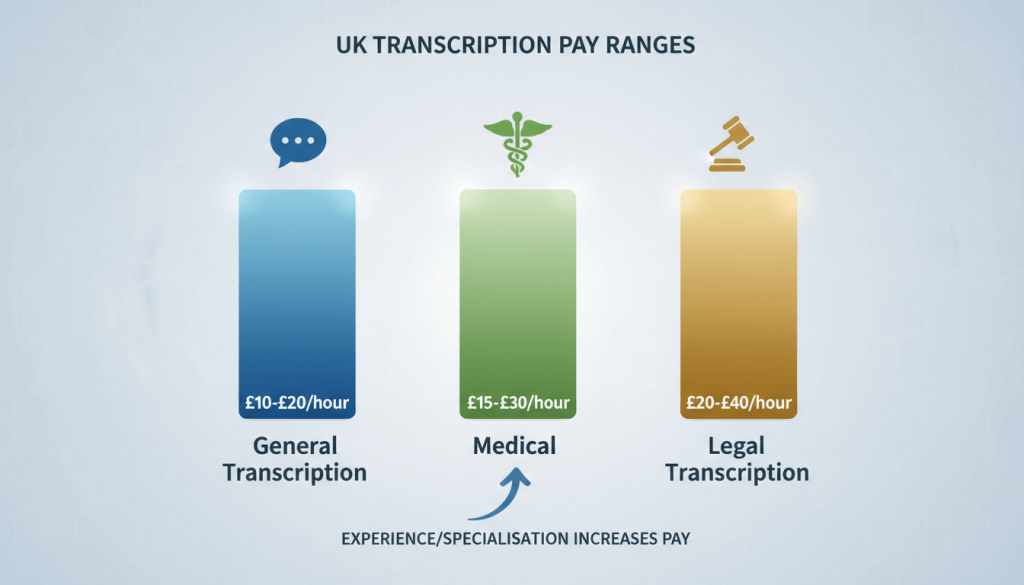
There’s a lot of hype online, so let’s look at current UK data and realistic ranges.
General transcription pay
Recent UK salary data suggests:
- Average transcriptionist salary: around £25,700 per year according to Indeed UK.
- Glassdoor data for “transcriptionist” shows a typical base pay band of £19k–£25k per year, with an average around £22k.
For freelancers paid per audio minute, UK-based agency Transcript Divas reports:
- Average: ~£1.04 per audio minute
- Range: £0.65–£3.50 per audio minute, with higher rates for specialist and rush work
If it takes you about 4 hours of work to transcribe 1 hour of audio (a common benchmark for newer transcribers), that average £1.04 per audio minute works out roughly like this:
- 60 minutes of audio × £1.04 = £62.40
- £62.40 ÷ 4 hours ≈ £15.60 per working hour (before tax and expenses)
As your speed and accuracy improve – and especially if you specialise – your effective hourly rate can climb significantly. IPSE’s analysis of freelancers estimates that UK freelance transcribers can average around £24,000 a year, with higher rates for specialist work.
Medical transcription pay
- Indeed UK reports an average salary of roughly £28,500 per year for medical transcriptionists.
Medical work tends to pay more because you need to be comfortable with anatomy, medical terminology and healthcare documentation.
Legal and court transcribing pay
There isn’t a single UK-wide pay band for legal transcribers and court reporters, but several indicators suggest:
- Legal / court transcription roles frequently sit in the mid-£20k to mid-£30k range per year, depending on employer, location and experience.
- Specialist roles such as court reporter / verbatim reporter typically require higher shorthand or stenography speeds and deep legal terminology knowledge, which supports higher pay bands.
Factors that change your rate
Your pay will vary based on:
- Type of transcription – general vs medical vs legal vs court
- Client – direct clients usually pay more than big platforms
- Turnaround time – same-day and overnight work often carry surcharges
- Audio quality – noisy or multi-speaker files are harder and may be priced higher
- Your speed and accuracy – the faster you work at high quality, the better your effective hourly rate
Are transcribing jobs legit?
Short answer: yes, many transcribing jobs are completely legitimate – but there are also scams and low-quality offers you should avoid.
Legitimate online transcription companies usually:
- Do not charge you to apply (except sometimes a reasonable background-check fee)
- Provide clear information about how to apply and how you’ll be paid
- Explain their payment structure (per minute, per hour, etc.) and payment schedule
- Require you to pass a test or sample file
- Use professional email addresses and websites, not free accounts and generic landing pages
Red flags to watch for:
- Up-front “training” or “software” fees to access jobs
- Unrealistic earning claims for very little work
- Poorly written websites with no real company details
- Requests to work outside official platforms or pay channels
If a company fails to explain how work is assigned, what you’re paid, or when you’ll be paid, treat it with caution.
Are transcribing jobs worth it?
Whether transcribing jobs are worth it depends on your goals.
Why people like transcribing jobs
- Work from home anywhere with a decent internet connection
- Flexible hours – good for carers, students and portfolio freelancers
- Low formal barriers – many entry-level roles don’t require degrees, just skills
- Great if you enjoy language, detail and working independently
- A stepping stone into editing, copywriting, subtitling, legal support or market research
Downsides to be realistic about
- Income can be inconsistent, especially if you rely on gig platforms
- Many beginner roles are lower paid, so you must build speed to earn well
- Listening intensely for hours is mentally tiring and can be hard on your posture and hearing
- Competition has increased globally, and AI is handling simple, clean audio – leaving humans with the more complex, technical or messy work
For many people, transcription is a solid side income or flexible part-time role. It can absolutely be worth it if you:
- Approach it as a serious skill, not an “easy money” hack
- Aim to specialise (legal, medical, court, finance, market research, etc.)
- Treat yourself as a professional service provider, not just someone “doing typing”
Types of transcribing jobs in the UK
1. General transcription
You’ll typically work on:
- Interviews and focus groups for market research
- Academic research interviews and lectures
- Podcasts, webinars and online courses
- Corporate meetings, HR interviews and training sessions
This is usually where beginners start. You’ll learn to handle different accents, speakers and recording quality.
2. Medical transcription
Medical transcriptionists convert clinical audio into structured documents – for example:
- Clinic letters
- Discharge summaries
- Operation notes
These roles require a solid understanding of medical terminology and healthcare documentation. Many employers expect specific medical transcription courses or experience, and some roles sit within the NHS or private healthcare providers.
3. Legal transcription
Legal transcribers handle:
- Solicitor–client meetings
- Witness statements and interviews
- Tribunals and hearings
- Expert reports and conferences
You’ll need excellent written English, attention to detail, comfort with legal terminology, and high confidentiality standards. Formal legal training or prior legal office experience is a plus.
4. Court transcriber / court reporter
A court transcriber (often called a court reporter or verbatim reporter) produces verbatim records of court proceedings – criminal trials, civil hearings, depositions and more.
Key aspects of the role:
- Capturing every spoken word, often in real time
- Using stenography, voice-writing technology, or advanced court recording systems
- Creating transcripts used by judges, barristers, solicitors and appeal courts
- Working with highly confidential and sometimes distressing information
In the UK, these roles may be:
- Employed by transcription providers contracted to HM Courts & Tribunals Service
- Based in court buildings or working from secure offices/home with encrypted systems
It’s more specialist than general transcription and usually pays more, but requires higher entry standards in speed, accuracy and sometimes formal training.
Skills you need for transcribing jobs
You don’t usually need a degree to get started, but successful transcribers share a specific skill set.
Core skills:
- Fast, accurate typing – ideally 60+ words per minute
- Strong grammar, spelling and punctuation
- Excellent listening skills – especially with background noise and multiple speakers
- Attention to detail – names, numbers, acronyms, terminology
- Research skills – checking spellings, jargon, company names and references
- Time management – hitting deadlines consistently
- Confidentiality and professionalism – handling sensitive material appropriately
Helpful personal traits:
- Patience – you will replay tricky sections many times
- Comfort working alone and staying focused
- Willingness to learn new tools and style guides
Basic equipment for transcription work
You can start with surprisingly little, then upgrade as you go. IPSE and other professional bodies highlight a similar list:
- A reliable computer (laptop or desktop)
- Stable broadband
- Over-ear headphones that block out background noise
- Word processing software – e.g. Microsoft Word or Google Docs
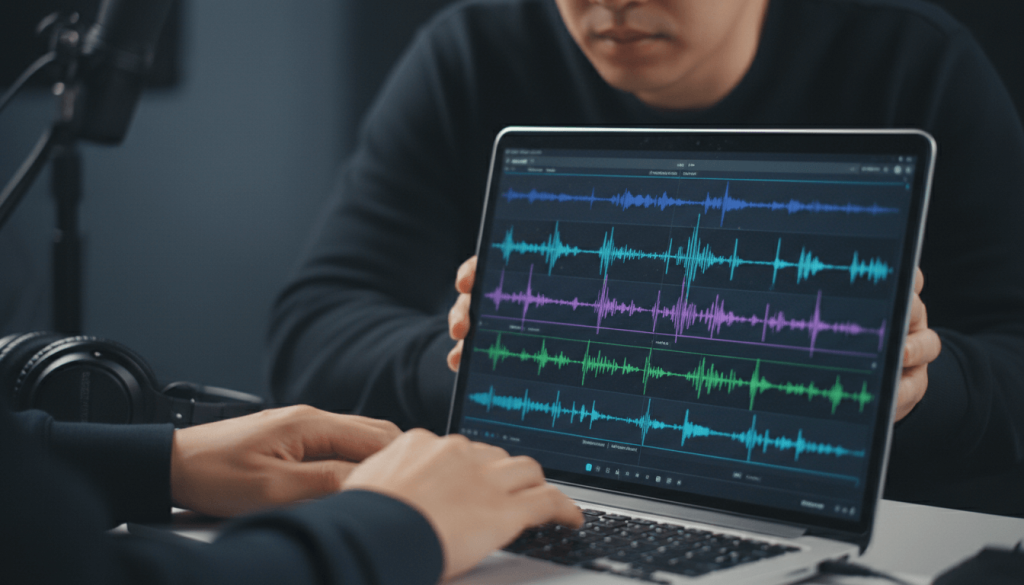
- Transcription software – to control playback, slow down audio and insert timestamps
- Optional but very useful:
- Foot pedal for hands-free audio control
- Text expander / macros for frequently used phrases
- Dual monitors to see audio, transcript and research at the same time
How to become a transcriber in the UK: step-by-step
The phrase “how to become a transcriber in UK” is searched a lot – and the process is more straightforward than many people think.
Step 1: Decide what kind of work you want
Ask yourself:
- Do you want general transcription (broad variety, easier to enter)?
- Are you drawn to medical or legal subjects?
- Eventually interested in court transcribing or live captioning?
Your answer will shape what you study and who you approach.
Step 2: Build your typing and listening foundations
- Use free typing practice tools to get your speed up.
- Practise transcribing short YouTube videos, podcasts or speeches.
- Compare your text with subtitles or scripts to spot errors.
Step 3: Learn the basics of transcription style
- Practise speaker labels, paragraphing and punctuation for speech.
- Try strict verbatim (every um, ah and false start) and clean verbatim (tidier text).
- Look at example transcripts from reputable agencies to understand expectations.
Step 4: Assemble a simple starter toolkit
At minimum:
- Laptop or desktop
- Headphones
- Free or low-cost transcription software
- A place to store files securely (cloud storage with encryption or a secure drive)
As you gain paid work, reinvest in better headphones, a foot pedal and dual screens.
Step 5: Create a small portfolio
You don’t need paying clients yet – just evidence of your skills:
- Transcribe a 5–10 minute podcast and polish it as if for a client
- Transcribe a short mock interview between friends or colleagues
- Choose a technical talk in an area you know (law, medicine, finance, tech)
Package a few samples into a simple PDF or links to Google Docs.
Step 6: Apply to transcription companies and platforms
To get early experience and regular work, many UK transcribers start with:
- UK-based agencies such as Transcript Divas, Accuro, Take Note, and others – many accept freelancers who pass a test.
- Global platforms like Rev, GoTranscript, TranscribeMe, CastingWords and similar – these are competitive but provide practice and feedback.
Read each company’s application page carefully and follow instructions exactly.
Step 7: Register as self-employed and organise your admin
Once you start earning consistently:
- Register as self-employed with HMRC (or via an accountant)
- Track your income and expenses (software, equipment, home office costs)
- Put money aside for tax, National Insurance and professional development
If you prefer not to deal with direct clients, you can build a steady income purely via agencies. If you enjoy client contact, you can gradually add direct clients for higher rates.
How to become a court transcriber in the UK

The keyword “how to become a court transcriber” points to a more specialised path than general transcription.
1. Build a strong base in general and legal transcription
Before courts will trust you with verbatim records, you’ll usually need:
- Several years of high-accuracy transcription
- Comfortable handling legal terminology, case references and procedural language
- Evidence you can meet strict deadlines and confidentiality requirements
2. Develop specialist speed and accuracy
Court reporters and verbatim reporters often need:
- Very high typing or stenography speeds (e.g. 180 words per minute or more)
- The ability to concentrate intensely for long sessions
- Confidence handling stressful or emotionally heavy content
Some court reporting roles involve shorthand or stenotype machines, others use digital audio and real-time transcription technology. Training routes include:
- Specialist court reporting programmes
- Legal secretarial or legal administration courses
- On-the-job training with approved transcription providers
3. Apply to approved court transcription providers
In the UK, many courts outsource transcription to approved companies. These providers:
- Recruit experienced legal transcribers and court reporters
- Set their own accuracy benchmarks, tests and onboarding
- Often require you to undergo security vetting
Building a record in legal transcription for solicitors, barristers’ chambers, police or government is a common stepping stone.
Are transcribing jobs legit – and are they worth it long-term?
To answer both popular queries – “are transcribing jobs legit?” and “are transcribing jobs worth it?”:
- Yes, there are many reputable UK and international companies offering genuine work-from-home transcription opportunities.
- It’s “worth it” if you treat it like a profession: invest in skills, specialise and choose clients carefully.
Many experienced transcribers:
- Use transcription to fund further study or creative work
- Move into editing, subtitling, accessibility services, legal support or market research operations
- Combine transcription with translation, interpreting or copywriting for a diversified freelance career
How Transcribe Lingo can help
At Transcribe Lingo, we work with organisations across the UK and internationally that need accurate, human-led transcription for interviews, podcasts, legal matters, healthcare projects and more.
If your organisation wants:
- Reliable human transcription for UK and global accents
- Support with market research, legal or medical recordings
- A partner that understands data protection and confidentiality
you can start your project today by contacting Transcribe Lingo for a tailored quote. Our team matches your recordings with experienced transcribers who understand your sector and deliver polished, ready-to-use transcripts.
FAQs: What are transcribing jobs?
1. What exactly are transcribing jobs?
Transcribing jobs involve listening to recorded or live speech and creating an accurate written transcript. This can include interviews, meetings, lectures, podcasts, medical dictation and court hearings. You follow specific formatting rules, label speakers and ensure the text is clear and error-free.
2. Do I need qualifications to become a transcriber in the UK?
You usually don’t need a formal degree to start general transcription. Many companies focus on your typing speed, listening skills and test results rather than your academic background. Specialist roles (especially medical and legal) may require targeted training or certification.
3. How do I become a transcriber in the UK with no experience?
Start by improving your typing speed, practising with sample audio and learning basic transcription formatting. Then apply to entry-level transcription platforms and UK agencies that accept beginners who pass a test. Build a portfolio, deliver excellent work, and gradually move towards better-paying specialist clients.
4. How do I become a court transcriber?
First gain experience in general and legal transcription, then look for training or roles related to court reporting or verbatim transcription. You’ll need very high speed and accuracy, strong legal terminology knowledge and the ability to handle confidential material. Many court roles are offered through approved transcription providers to the courts.
5. Are transcribing jobs legit?
Yes, many transcription jobs are legitimate, but you must be selective. Genuine companies do not charge large up-front fees, clearly explain how you’ll be paid, and usually require a skills test. Be wary of vague job ads promising high earnings with little effort.
6. Are transcribing jobs worth it in the UK?
They can be, particularly if you value flexibility and enjoy working with language. Average UK salaries for transcriptionists are in the mid-£20k range, with higher earning potential for specialist medical, legal and court work. The more you invest in your skills and reputation, the more “worth it” transcription becomes over time.
