

If you’ve ever been told to provide a “certified translation”, it usually means one thing: the person reviewing your documents needs a translation they can trust, verify, and file without chasing you for fixes.
A certified translation is not just the translated text. It’s the translation plus a signed declaration confirming the translation is complete and accurate, along with clear details about who did it and how they can be contacted.
This guide explains what certified translation means, what a certified translation looks like, and when you need one—so you can submit documents with confidence (and avoid delays).
Need yours done quickly? Upload your document and we’ll confirm the right certification format for your purpose: Certified translation services.
What does certified translation mean?
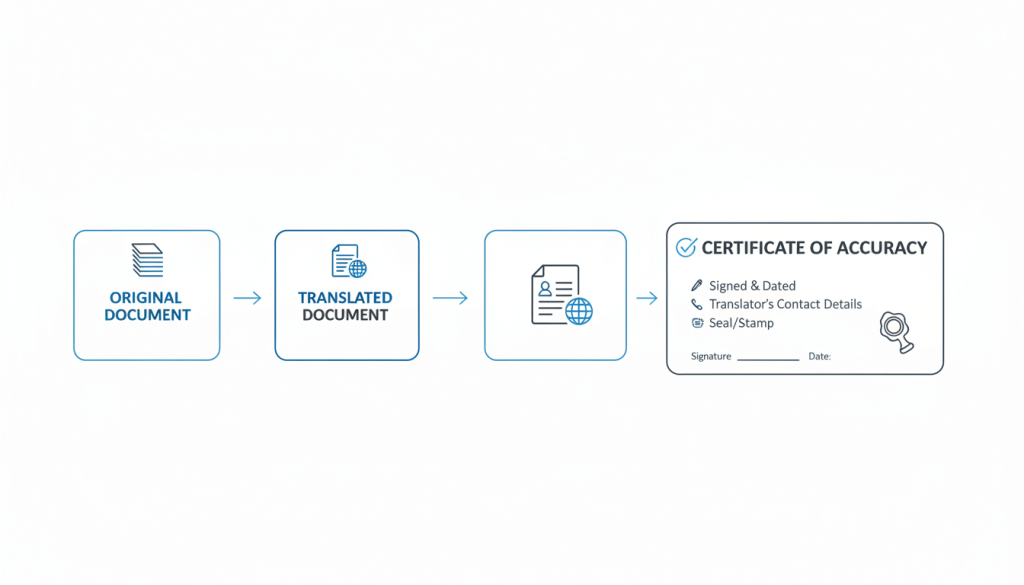
A certified translation is a translation of a document that includes a certificate of accuracy (sometimes called a certification statement). That certificate is a signed statement confirming the translation is a true and accurate translation of the original document.
In other words, when someone asks “what is a certified translation of a document?” they’re asking for two things:
- The translated document (complete, accurate, and properly formatted)
- A signed certification statement with the translator/agency details
What a certification statement typically confirms
Most certifying statements include:
- A declaration that the translation is complete and accurate
- The source language and target language
- The translator’s or agency’s name
- Signature
- Date
- Contact details (so the translation is verifiable)
What is a certified English translation?
A certified English translation is simply a certified translation where the target language is English (often for immigration, universities, banks, courts, or employers).
If you’re submitting documents in the UK, you’ll often see wording like:
- “Documents must be in English (or Welsh) or accompanied by a certified translation.”
If you’re submitting documents in the US, you’ll see similar language for English translations, particularly for immigration and official filings.
What does a certified translation look like?
People often imagine special paper, seals, or an official stamp. In reality, what matters most is the certification statement and verifiable details.
A certified translation often arrives as:
- A PDF containing:
- The translated pages
- A certification page attached (or included at the end)
- Optional printed hard copy (some authorities prefer or request this)
A simple example of a certificate of accuracy (sample text)
Certificate of Accuracy
I certify that I am competent to translate from [Source Language] into English, and that the attached translation of [Document Name] is a true, complete, and accurate translation of the original document to the best of my knowledge and belief.Name: [Translator / Agency Name]
Signature: ____________________
Date: [DD Month YYYY]
Contact details: [Email / Phone / Address]
Tip: Many rejections happen because the certificate is missing contact details, a date, or the translation isn’t clearly linked to the original (e.g., no document title/reference).
If you want your translation packaged in the most commonly accepted format for official use, start here: Upload your document for a quote.
Certified vs notarised vs sworn: what’s the difference?
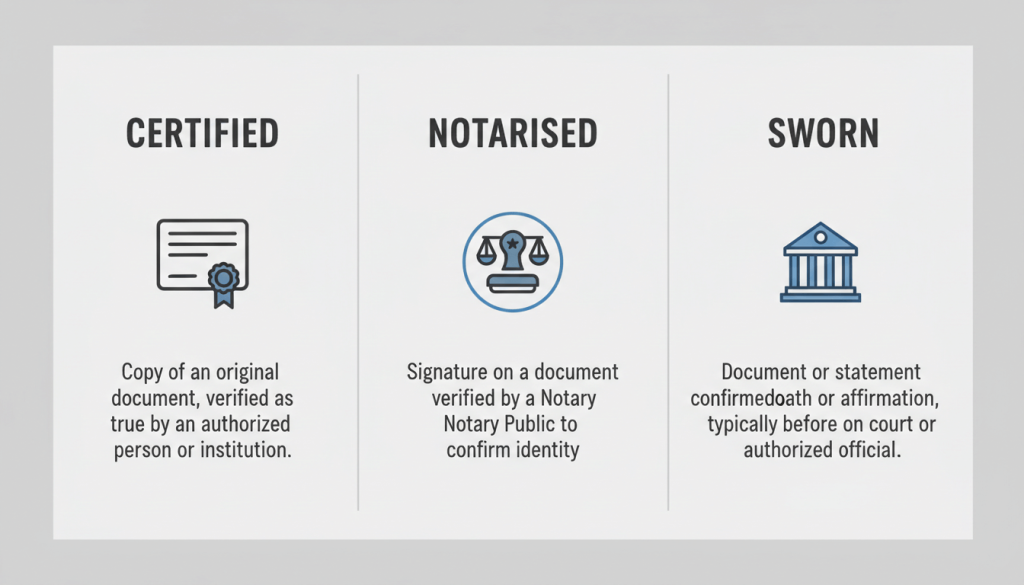
These terms get mixed up a lot—and different countries use them differently.
Certified translation
- Translation + signed certification statement confirming accuracy and completeness
- Commonly requested for immigration, universities, banks, and many official submissions
Notarised translation
- A notary verifies the identity of the signer (usually the translator or a representative)
- Notarisation does not automatically prove the translation quality—it confirms the signature/identity
Sworn translation
- In some countries, “sworn” translators are officially appointed/registered and their translations have legal standing by default
- In the UK, requirements vary by organisation; many institutions accept certified translations without a “sworn” system
Practical rule: Always follow the receiving organisation’s exact wording. If they ask for “notarised” or “sworn”, that’s a different requirement than “certified”.
When do you need a certified translation?
You typically need a certified translation when the person reviewing your document must rely on it as “official”. Common scenarios include:
Immigration and visa applications
Certified translations are frequently required for supporting documents such as:
- Birth certificates, marriage certificates, divorce decrees
- Police certificates
- Financial and employment evidence
- Name-change or court documents
Universities, professional registration, and academic admissions
Often requested for:
- Transcripts and diplomas
- Letters of enrolment or completion
- Professional certificates
Courts, solicitors, and legal matters
Often requested for:
- Witness statements and evidence bundles
- Contracts, court orders, affidavits
- Powers of attorney and legal correspondence
Mortgages, property, and banking
Often requested for:
- Bank statements, payslips, employment letters
- Marriage certificates (for joint applications)
- ID documents and proof of address
Businesses and corporate filings
Often requested for:
- Company documents, shareholder/board resolutions
- Regulatory submissions and compliance paperwork
If you’re unsure whether your authority requires certification, send us the requirement text (or a screenshot) and we’ll advise you: Contact Transcribe Lingo.
What a certified translation service actually does (and why it matters)
A certified translation service is not just “someone who speaks two languages”. It’s a controlled process designed for accuracy, consistency, and acceptance—especially when the consequences of an error are expensive.
A robust service typically includes:
- A qualified translator matched to your document type (legal, academic, medical, corporate)
- Careful handling of names, dates, addresses, stamps, and handwritten notes
- Formatting that mirrors the original (so reviewers can cross-check easily)
- A final quality review
- A properly completed certification statement
For official submissions, this process isn’t a luxury—it’s how you avoid rework.
How to get a certified translation (step-by-step)

- Collect the clearest version of your document
A scan is best, but clear photos usually work. - Confirm where it’s being submitted
The exact destination matters (country and organisation). - Confirm the certification format required
Certified only? Notarised? Sworn? Apostilled?
If you don’t know, we’ll help you confirm. - Translation + quality checks
Accuracy, formatting, consistency, and proper handling of stamps/notations. - Certification is prepared and attached
Signed, dated, and verifiable. - Delivery in the right format
Typically secure PDF, with optional posted hard copy if needed.
Ready to start? Get a free quote here.
The most common reasons certified translations get rejected
These are the issues that cause delays most often:
- Missing certification details (no date, no signature, no contact details)
- Names don’t match IDs (spacing, order, transliteration, or spelling inconsistencies)
- Partial translation (stamps, marginal notes, and handwritten fields skipped)
- Incorrect formatting (reviewer can’t match translated sections to the original)
- The translator is not identifiable (no company/translator details for verification)
Name accuracy matters more than people realise
If your name appears differently across documents (e.g., passport vs certificate), the translation should preserve what’s on the source document while also keeping consistency wherever possible.
If you have a preferred spelling for Latin characters (common with Arabic, Cyrillic, or Asian scripts), tell us upfront so we can apply it consistently across your pack.
How much does a certified translation cost?
Pricing usually depends on:
- Language pair
- Document length (word count and layout complexity)
- Urgency
- Number of documents
- Whether you need notarisation or other extras
A useful way to think about it:
Total cost = translation effort + formatting complexity + certification handling + delivery needs
To avoid surprises, send your document and your deadline first—then the quote can reflect what you actually need: Upload for an instant quote.
A ready-to-submit certified translation checklist
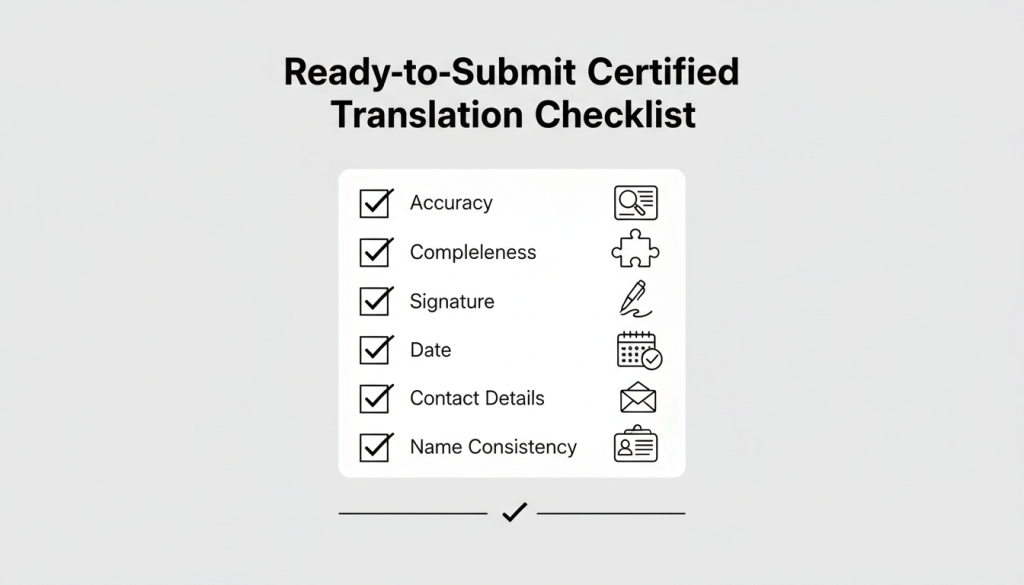
Before you submit, check the translation pack includes:
- ✅ Full translation of all visible text (including stamps/handwritten notes where readable)
- ✅ Clear document identification (document title/type and page order)
- ✅ Certification statement confirming accuracy and completeness
- ✅ Translator/agency name and signature
- ✅ Date of certification
- ✅ Contact details for verification
- ✅ Consistent spelling of names, places, and IDs across documents
If you’re submitting multiple documents (e.g., visa or university pack), ask for a quick consistency check across the full set—this is where many avoidable errors live.
Helpful extras that improve acceptance (and reduce follow-up questions)
Depending on where you’re submitting, these additions can help:
- Translator’s notes for unclear text or illegible sections (instead of guessing)
- Formatting that mirrors the original (especially for certificates and forms)
- Consistent transliteration rules across all documents in your pack
- Hard copy posting when requested by a solicitor, lender, or embassy
If you tell us the destination and purpose, we’ll package it accordingly: Contact our team.
3) FAQ Section
What is certified translation?
A certified translation is a translated document accompanied by a signed certificate stating the translation is complete and accurate, with the translator/agency details and date.
What does certified translation mean for official documents?
It means the translation must be verifiable and formally declared accurate—so the receiving organisation can rely on it for decisions and record-keeping.
What does a certified translation look like?
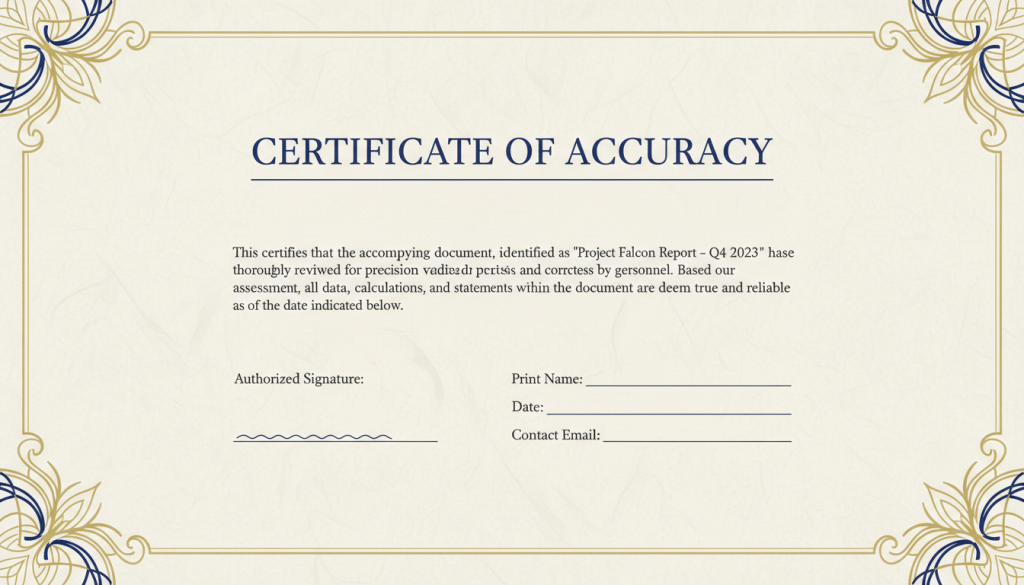
It typically looks like a normal translation plus an attached “Certificate of Accuracy” page, signed and dated, with contact details for verification.
What is a certified English translation?
It’s a certified translation where the target language is English, commonly requested for immigration, education, legal, and financial submissions.
Do I need notarisation as well as certified translation?
Only if the receiving organisation specifically requests notarisation. Many authorities accept certified translations without notarisation, but requirements vary.
Can I certify my own translation?
Some organisations allow it, many do not. For official submissions, using an independent professional is the safest route—especially where identity verification and accountability matter.
