


If you’re asking what is the best online translation service, the honest answer is: the best option depends on what’s at stake. Translating a casual email is one thing. Translating a visa document, a medical report, or a contract is something else entirely.
This guide helps you choose confidently—without overpaying, risking rejection, or relying on “close enough” translations.
In a hurry? Use this 60-second rule:
- Low risk (for understanding only): an online translator can be fine.
- Medium risk (client-facing, brand, important details): use a professional translator or a reviewed human translation service.
- High risk (legal, medical, immigration, certified): use a professional translator with a proper QA process—and get certification if required.
If you need a human-led translation with clear turnaround and support, you can start here: get a fast, free quote.
What “online translation service” actually means (and why it matters)
People use “online translation service” to describe three very different things:
- Instant machine translation tools
Great for speed. Not built for accountability, formatting, or official acceptance. - Online human translation platforms
You upload a file, pay online, receive a human translation—sometimes with an editor pass. - Professional translators / translation agencies operating online
You still upload and manage everything digitally, but you get:
- subject-matter expertise
- a review process
- support on requirements (certified, notarised, formatting)
- a named point of contact and accountability
When people get burned, it’s often because they expected option (3) but bought option (1).
A simple way to choose: The “Risk Ladder”
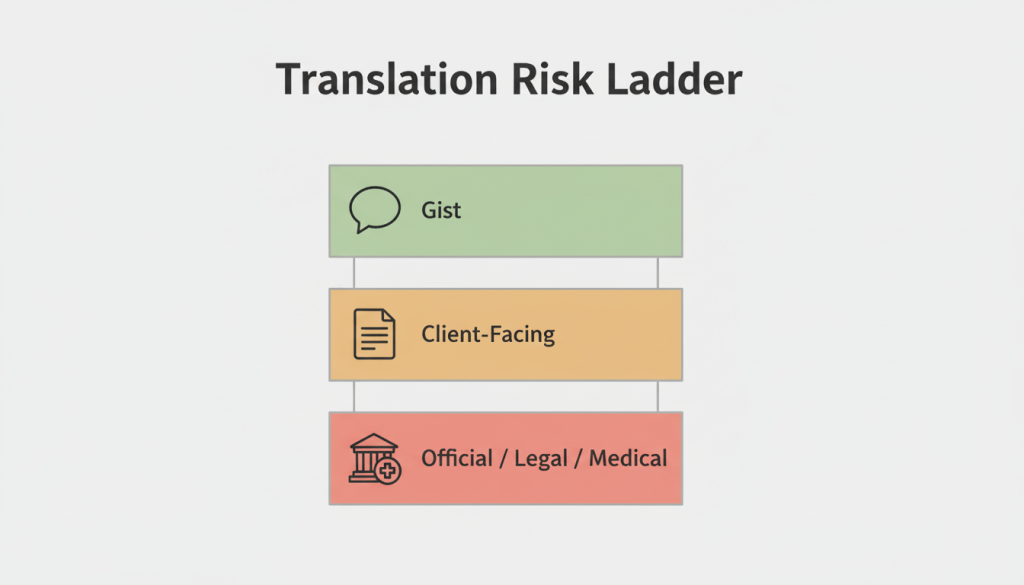
Use the ladder below before you click “Translate”.
Green: OK for machine translation (usually)
Use this when the goal is understanding, not submission:
- reading a website article
- translating chat messages
- internal notes and rough summaries
- brainstorming phrasing (with caution)
Still do this: remove personal data before pasting, and don’t treat the output as final.
Amber: Use a professional translator (recommended)
Use human translation when accuracy and tone matter:
- customer emails and support replies
- CVs and cover letters
- policies and HR documents
- product descriptions and web pages
- market research materials (discussion guides, survey questions)
This is where mistranslations are costly—just not always legally catastrophic.
Red: Use a professional translator + review (often certified)
Use a professional translator when mistakes can cause rejection, liability, or harm:
- immigration and visa documents
- birth/marriage certificates and official records
- legal agreements, witness statements, court bundles
- medical reports, consent forms, patient information
- compliance documents and regulated industries
If the document must be submitted to an authority, you may also need certification. Here’s what that looks like in practice: Certified Translation Services UK and Birth Certificate Translation Services.
What makes the best online translation service? A practical checklist
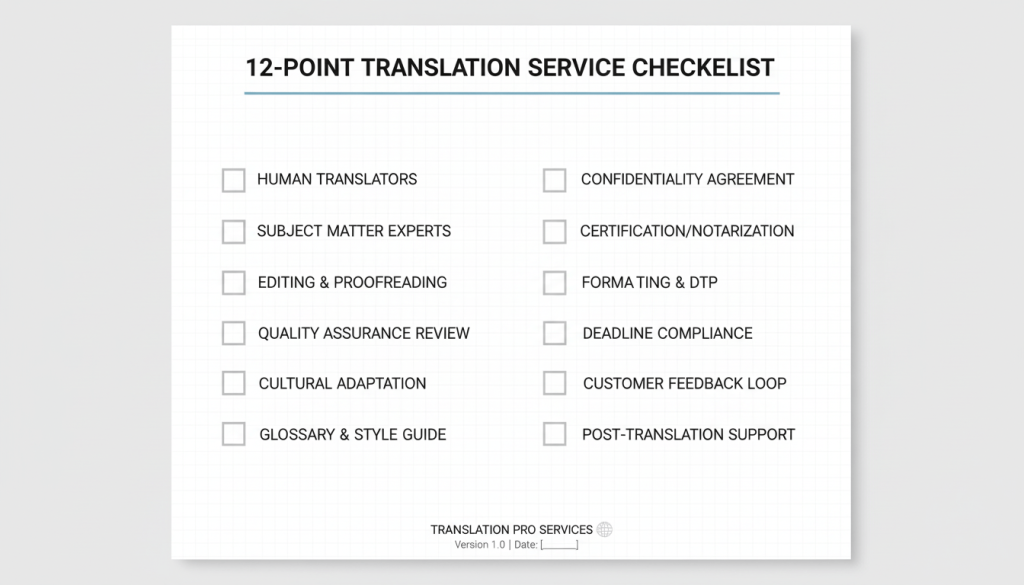
When comparing providers, don’t start with price. Start with process.
The 12-point “Best Online Translation Service” checklist
A strong service will clearly offer most of these:
- Human translators (not raw AI output)
- Subject-matter matching (legal to legal, medical to medical)
- Second-person review (editor or reviser pass)
- Terminology control (names, dates, places, official wording)
- Formatting support (tables, stamps, letterheads, like-for-like layout where practical)
- Clear confidentiality practices (NDAs, limited access, secure transfer)
- A way to ask questions (you’ll be surprised how often one detail needs clarification)
- Transparent turnaround (realistic ETA, not vague promises)
- Quality guarantees (what happens if there’s an error?)
- Certification options (when required)
- Consistency for larger projects (glossaries / translation memory)
- Human support (a named coordinator beats ticket-only systems for critical work)
If a provider can’t explain their process in plain English, that’s a warning sign.
Online tools vs professional translators: a clear comparison
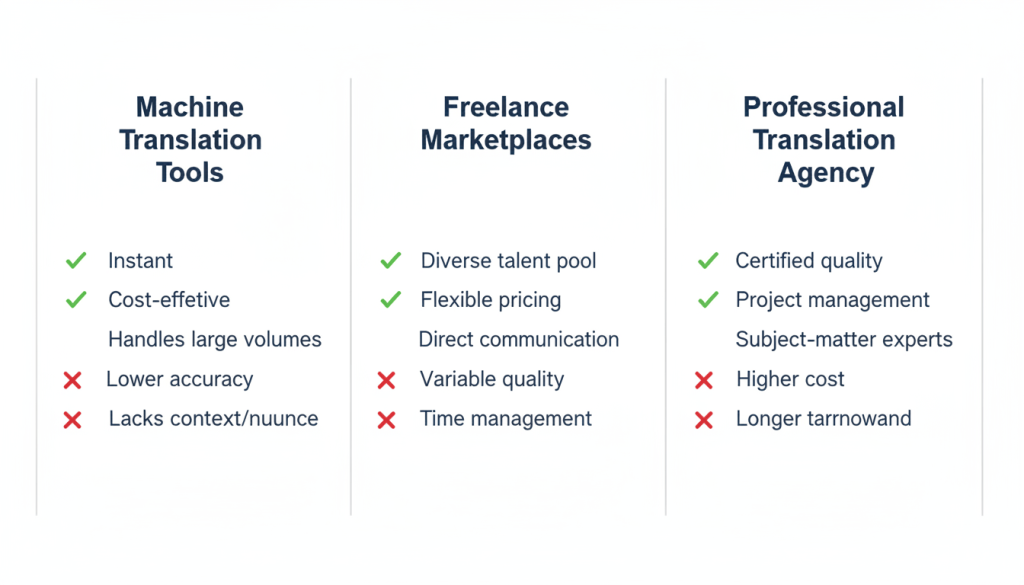
Online translation tools (machine)
Pros
- instant
- free/low-cost
- useful for gist
Cons
- no accountability or certification
- context errors and false confidence
- formatting loss (tables, stamps, footnotes)
- risky for sensitive information
Freelance marketplaces (you hire an individual online)
Pros
- potentially affordable
- direct access to the translator
- great if you already know who to hire
Cons
- quality varies widely
- review/editing often costs extra
- vetting is on you
- deadlines and availability can be fragile
Professional translators / agencies (online ordering, human QA)
Pros
- matched expertise + review process
- support with requirements (official, certified, formatting)
- reliable delivery and communication
- scalable for multi-document work
Cons
- not the cheapest option
- you should still choose carefully (some “agencies” resell raw machine output)
The “3-question test” to spot the right service fast
Before you buy, ask:
- Who will translate this—what’s their background?
You want more than “native speaker”. You want relevant experience. - Is there a review step—by a second linguist?
One-pass translations are where avoidable errors slip through. - Can you handle the exact use case (certified / official / submission)?
If you need certification, ask what’s included (statement, signature, date, contact details, and how it’s delivered).
If you’re not sure what level you need, start with a quick file upload and ask for guidance. Transcribe Lingo will advise after reviewing the document: Get a fast, free quote.
Real-world examples: where “good enough” becomes expensive
Example 1: The “one digit” problem (medical)
A machine translation can mishandle units, negations, or dosage phrasing—small errors with big consequences. For anything medical, choose a professional translator with review.
Example 2: The “name mismatch” problem (official documents)
Authorities care about consistency. A single surname spelling variation, reordered names, or transliteration differences can trigger delays or rejection. A professional translator will create a consistent naming approach across every page.
Example 3: The “legal meaning drift” problem (contracts)
Machine output can sound fluent while changing obligations (“shall” vs “may”, “termination” clauses, jurisdiction phrases). Professional legal translation is about meaning and enforceability—not just words.
What to do if you need certified translation online
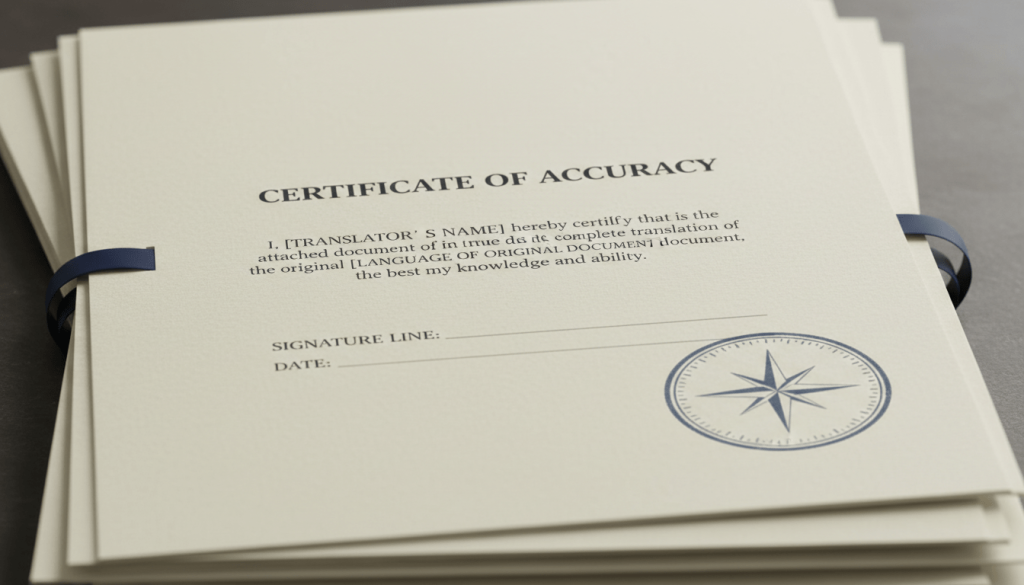
If your document is for a visa, immigration application, university, court, or other official submission, you may need a certified translation.
A proper certified translation typically includes:
- the full translation
- a signed statement confirming it’s complete and accurate
- date and contact details
- a reference number / letterhead (where applicable)
Start here for UK-specific guidance and options:
“What is Lamparray translation service?” (quick clarification)
Some people search what is lamparray translation service after seeing it on a Windows PC. In many cases, that phrase refers to a device-related background service (not a language translation platform).
If you’re looking for document or website translation, focus your search on terms like:
- “professional translation service”
- “certified translation online”
- “translation agency UK/USA”
- “human translation with review”
And use the checklist above to vet any provider properly.

A straightforward way to start (without committing upfront)
If you want a safe, online process with human translators and clear support:
- Upload your file and tell us the purpose (visa, legal, medical, business, etc.)
- We confirm the correct approach, timeline, and cost
- You receive a completed translation in the right format
Start here: get a fast, free quote.
If you’d like to understand typical pricing structures before uploading, you can also view: Price Rate.
FAQs
What is the best online translation service for official documents?
For official documents, the best online translation service is one that uses professional human translators, includes a review step, and can provide certification if required.
Are online translators accurate enough for legal translation?
They can be fluent but still legally wrong. For contracts, court documents, or anything submitted to an authority, use a professional legal translator with review.
Is a professional translator better than an online translation service?
Not always—many professional translators work through online services. What matters is the process: expertise, review, confidentiality, and accountability.
Can I get a certified translation online in the UK?
Yes. You can upload documents online and receive a certified translation digitally (and hard copies if needed), as long as the certification meets the receiving body’s requirements.
What is Lamparray translation service?
People often search this after seeing it on a computer; it commonly refers to a device-related system service rather than a language translation provider. For document translation, use human translation services or professional translators.
Which is better: machine translation or human translation?
Machine translation is best for speed and basic understanding. Human translation is best when accuracy, tone, formatting, confidentiality, or official acceptance matters.
