
If you’re searching which technical translation you need, you’re probably in one of these situations: a product is going overseas, a regulator wants documentation in the local language, your engineers need specs translated yesterday, or your safety team is worried a mistranslation could become a real-world incident.
Here’s the truth: “technical translation” isn’t one service. Manuals, specification sheets and safety documentation behave differently, carry different risks, and need different quality controls. The right choice saves time, cost and rework. The wrong choice creates support tickets, non-compliance, returns — and in safety-critical scenarios, something far worse.
If you want a fast, practical recommendation based on your actual files, you can upload your documents and request a quote — we’ll come back with the best approach, timeline and a fixed scope.
The 60-second selector: what are you translating and who will use it?
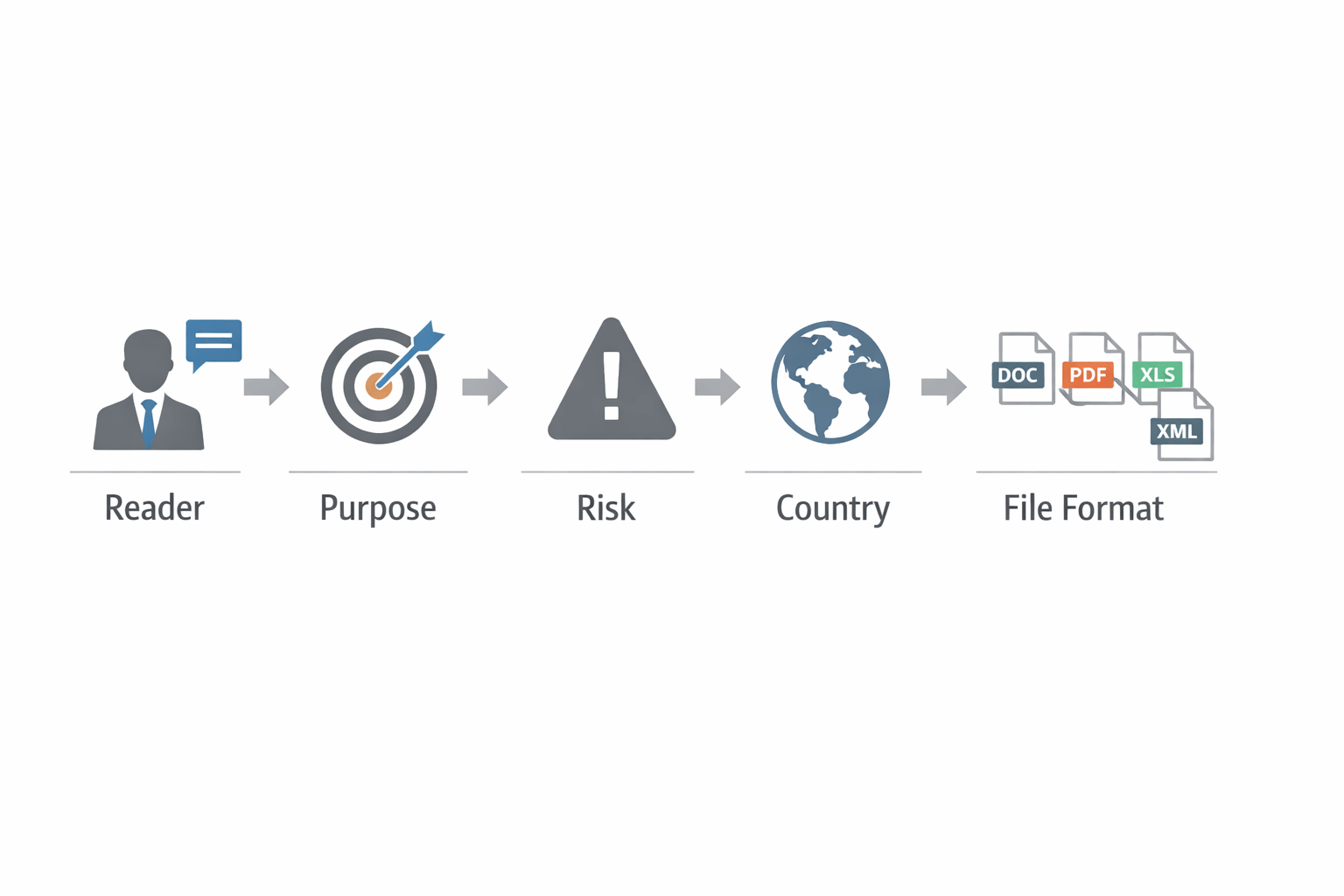
Answer these five questions (quickly, honestly). Your answers will point you to the right type of technical translation.
- Who is the reader? End-user, technician, engineer, auditor/regulator, warehouse team, healthcare professional
- What’s the purpose? Use it safely, install/maintain, approve/certify, train staff, sell/ship
- What happens if a sentence is misunderstood? Minor inconvenience, downtime, product damage, injury, legal risk
- Where will it be used? Countries/languages, local standards, labelling rules, import requirements
- What’s the format? Word/PDF, Excel tables, InDesign, CAD callouts, XML/help files, labels/artwork
Keep those in mind — now let’s match your document to the right service.
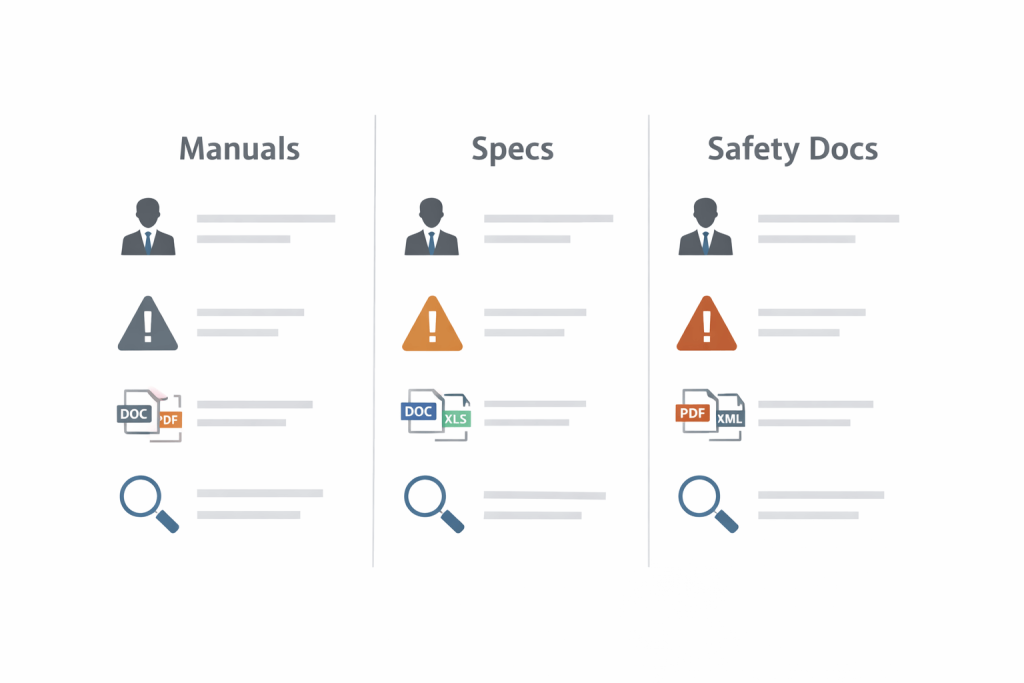
Quick match table: manuals vs specs vs safety docs
| Your document type | Best-fit technical translation | Why it’s different | Must-have QA |
|---|---|---|---|
| User manual / instructions for use | User-facing technical translation | Clarity + consistency beats literal wording | Terminology check, controlled language, functional review |
| Installation / maintenance guide | Procedural technical translation | Steps must be unambiguous and repeatable | Step-by-step validation, warnings check, formatting integrity |
| Specification sheet / datasheet | Engineering/spec translation | Numbers, units, tolerances, naming conventions | Unit verification, table QA, symbol/notation consistency |
| Safety data sheet (SDS/MSDS) | Regulated safety documentation translation | Standard structure + controlled hazard language | Section structure QA, hazard terminology QA, locale requirements review |
| Risk assessment / SOP / work instruction | Operational & compliance translation | Process language must match site practice | Cross-document consistency, role/task clarity, controlled terms |
| Labels / packaging / warnings | Safety labelling translation | Space constraints + strict wording | Short-text QA, warnings hierarchy check, artwork proofing |
| Technical training materials | Training translation/localisation | Must be learnable, not just correct | Readability review, terminology alignment, scenario accuracy |
| Software UI + help centre for a device | Technical localisation | Character limits + functional strings | Pseudoloc/length checks, glossary lock, in-context review |
If you’re still unsure, start from risk: the higher the consequence of misunderstanding, the more specialised the technical translation workflow should be.
The three “levels” of technical translation (and when to choose each)
1) Standard technical translation (best for low-risk content)
Choose this when the outcome of a mistake is mostly confusion, not harm.
Typical documents
- Product brochures with light specs
- Non-critical internal documentation
- General engineering overviews
What you should still expect
- Subject-matter translator
- Terminology consistency
- Basic formatting preservation
2) Professional technical translation with independent review (best for most manuals and specs)
This is the sweet spot for most businesses: accurate, consistent and fit for real use.
Typical documents
- User manuals and installation guides
- Maintenance procedures
- Specification sheets and datasheets
- Internal SOPs and QA procedures
What makes it “professional”
- Independent second-linguist review
- Terminology management (glossary/termbase)
- Table, unit and formatting QA
- Clear deliverables (final files + change log if needed)
If you need this kind of support regularly, consider a fully managed approach via our translation services team so you’re not re-explaining terminology every time.
3) Safety-critical / regulated technical translation (best for SDS, safety instructions, compliance packs)
Choose this when a mistranslation can lead to harm, non-compliance, recalls, fines, or rejected submissions.
Typical documents
- SDS/MSDS and chemical safety documentation
- Safety instructions for machinery
- High-risk work instructions
- Compliance packs for regulated industries
- Labels/warnings where wording matters
What changes in the workflow
- Stricter QA checkpoints
- Glossary lock + forbidden terms list
- In-country review (when required)
- Stronger traceability (version control, approvals)
If any of your technical documents are also required for official submission (for example, authorities requesting certified documents), you may need certified translation services alongside the technical workflow.
Manuals: how to choose the right technical translation for user instructions
User manuals fail internationally for one main reason: they’re translated like engineering text, but read like customer support.
A good manual translation is:
- Actionable: users can do the thing without guessing
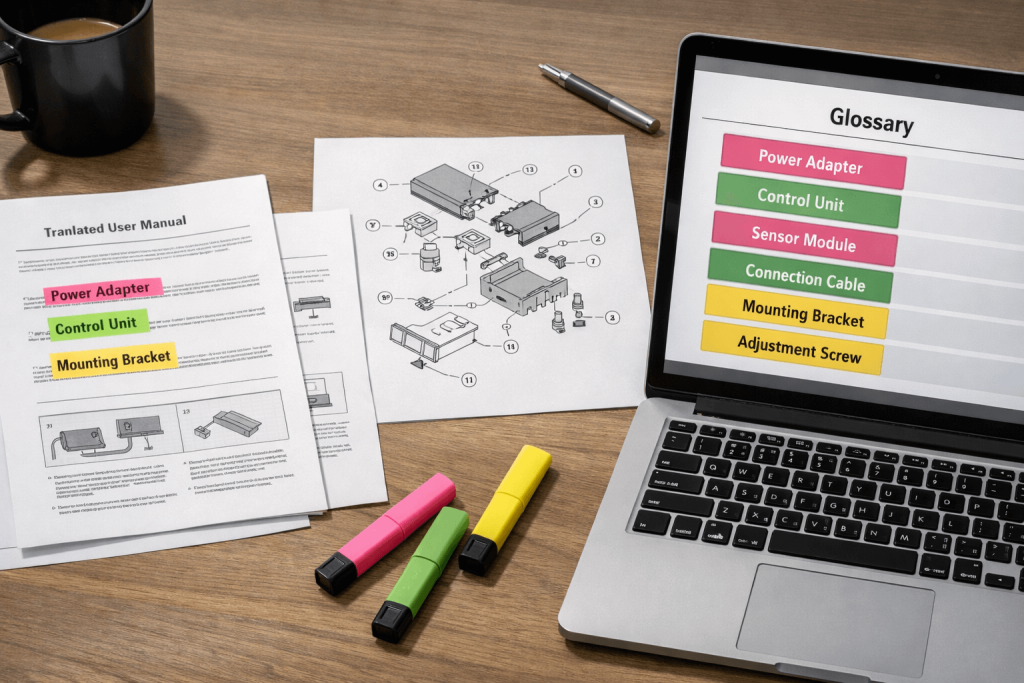
- Consistent: the same button, part, component and action always uses the same term
- Safe: warnings are clear, placed correctly, and don’t get “softened”
- Local-ready: measurements, conventions, and product naming make sense to the target market
Manual translation checklist (copy/paste this into your brief)
- Who is the user (consumer, trained technician, field engineer)?
- Is this a new product or an update to an existing manual?
- Do you have a glossary, parts list, UI strings, or prior translations?
- Are there safety warnings and pictograms that must remain consistent?
- Do you need layout replication (same page design) or “content only”?
Common manual translation pitfalls (and how to avoid them)
- Step ambiguity: “Tighten securely” becomes vague in another language
- Fix: enforce explicit steps (tool, torque, direction, sequence)
- Inconsistent terminology: “socket”, “port”, and “connector” swap places
- Fix: glossary lock + term QA
- Unit confusion: decimal separators, torque units, temperature conventions
- Fix: unit verification + locale rules
- Layout breaks: tables shift, callouts detach, screenshots mislabel
- Fix: technical DTP + final proof
If your manual is large or frequently updated, a technical translation company should also help you avoid translating the same content twice through structured versioning and terminology reuse. That’s exactly what our business translation services team is set up to handle.
Specs and datasheets: what makes engineering translation different
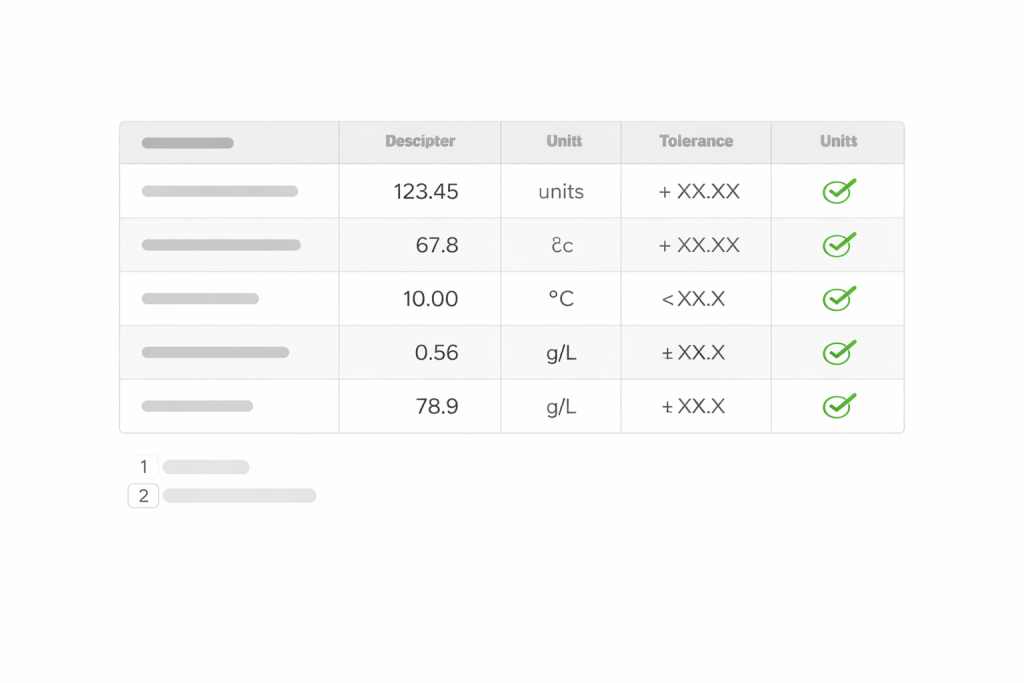
Specs are deceptively short and dangerously easy to mistranslate — because a single symbol can flip meaning.
What “spec translation” must protect
- Units and tolerances: mm vs cm, Nm vs ft-lb, ± ranges, min/max
- Standard notation: symbols, superscripts, Greek letters, IEC/ISO terms
- Table integrity: headings, footnotes, conditions, test parameters
- Part naming conventions: internal part numbers, BOM terms, revision IDs
- No creative synonyms: in specs, “equivalent” can be wrong even if it sounds right
Ask for this if you’re translating specs
- Table-by-table QA: someone verifies that each cell maps correctly
- Unit validation: conversions only when instructed (and documented)
- Notation consistency: symbols, decimals, separators, formatting rules
- Bilingual deliverable option: helpful for engineering sign-off
Mini example: why specs need their own QA
In a datasheet, “operating temperature: –10 to 50°C” is not the same as “operating temperature: 10 to 50°C”. A missing dash can become returns, warranty claims, or a safety incident. Specs need a workflow that treats numbers and symbols as first-class content — not “just text”.
Safety docs (SDS, risk assessments, warnings): choose a regulated workflow, not a fast one
Safety documents are where “close enough” becomes unacceptable.
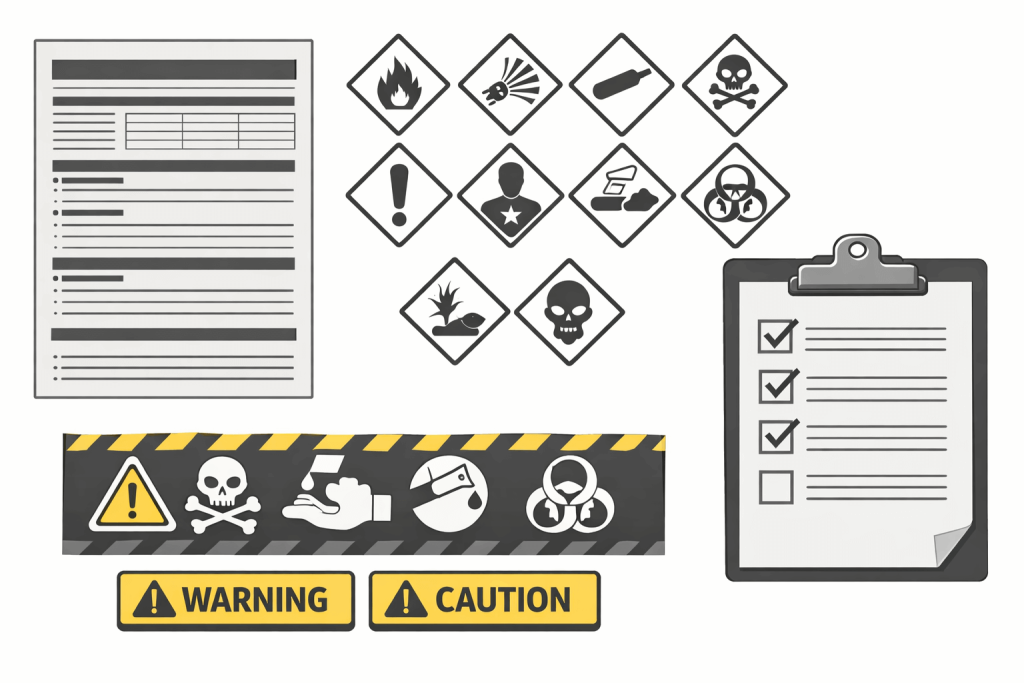
If you’re translating an SDS/MSDS
An SDS isn’t a marketing document. It’s a structured safety instrument, typically with fixed sections and tightly controlled hazard language. A proper SDS translation workflow focuses on:
- Maintaining the correct section structure and headings
- Preserving hazard statements, precautionary statements, and signal words
- Keeping consistency across product names, ingredients, and exposure controls
- Ensuring the final text reads like a compliant safety document in the target language
If you’re translating risk assessments, SOPs and work instructions
These documents live in real workplaces. That means:
- Role clarity matters (“operator”, “supervisor”, “competent person”)
- Controls must be explicit and repeatable
- Safety hierarchy must stay intact (danger vs warning vs caution, where applicable)
- Consistency across the entire safety pack is critical (one term per concept)
If you’re translating labels and warnings
Space constraints increase risk. Short warnings can’t afford ambiguity. The workflow should include:
- Short-text QA
- Artwork proofing and final sign-off
- Consistency with the manual, SDS, and product UI (same naming)
If your safety documentation needs to be used for onboarding or operational training, consider combining translation with structured rollout support via our translation agency team in Great Britain — especially when you’re deploying across multiple sites or languages.
The “risk score” method: a practical way to decide how much QA you need

Use this simple scoring model (0–10). Add up your points:
- Safety impact: could misunderstanding cause injury? (0–3)
- Regulatory exposure: could this be inspected, audited, submitted? (0–3)
- Operational impact: could this stop production, cause downtime, scrap? (0–2)
- Complexity: dense tables, formulas, diagrams, constrained labels? (0–2)
Score 0–3: Standard technical translation (with glossary recommended)
Score 4–7: Professional technical translation + independent review
Score 8–10: Safety-critical/regulatory workflow + stricter traceability
Want us to do this scoring for you across a document set? Send the files here and we’ll recommend a workflow per document type.
What a good technical translation company should deliver (beyond “the translation”)
If you’re choosing a technical translation company, look for deliverables that reduce risk and speed up future updates:
1) A glossary you can reuse
- Approved terms (and forbidden alternatives)
- Part names, UI strings, safety phrases
- Consistent naming across manuals, specs and labels
2) A QA approach you can see
- Independent review (not just self-check)
- Terminology checks
- Formatting and table integrity checks
- Version control across revisions
3) Layout and file handling that fits your workflow
- Works with Word, Excel, PDF, InDesign and structured content
- Protects tables, callouts, diagrams and numbering
- Returns in the formats your team needs (and doesn’t break your templates)
4) Sensible questions before work begins
If they don’t ask who the audience is, where the product will ship, and what “wrong” looks like, they’re guessing.
Real-world scenario snapshots: which technical translation would you choose?
Scenario A: 120-page user manual for a consumer device
Best fit: Professional manual translation + independent review
Why: User-facing clarity and warning integrity matter more than literal phrasing
Extra: Layout replication if you’re shipping printed manuals
Scenario B: Two-page datasheet for procurement and engineering teams
Best fit: Engineering/spec translation with table and unit QA
Why: The risk is in numbers, symbols, conditions and footnotes
Extra: Bilingual output for internal sign-off
Scenario C: SDS pack for exporting chemicals to multiple markets
Best fit: Regulated safety documentation translation workflow
Why: Structure and controlled hazard language are non-negotiable
Extra: Locale-specific consistency across the entire pack
Scenario D: SOPs and training materials for a manufacturing site with multilingual staff
Best fit: Operational & compliance translation + training readability review
Why: Procedures need to be learnable and repeatable under real conditions
Extra: Consider combining translation with on-site language support where needed
(If you want a reference point for complex operational deployments, see how language support improves training and safety communication in our manufacturing case study.)
Your technical translation brief template (copy/paste)
Use this to get faster quotes and better results:
- Document type: manual / specs / SDS / SOP / label / training
- Target languages and countries: (list)
- Audience: end-user / technician / engineer / regulator
- Purpose: safe use / installation / compliance / training / procurement
- Source files: Word/Excel/InDesign/PDF/CAD callouts
- Reference material: prior translations, glossary, parts list, UI strings
- Must-keep items: product names, part numbers, warning hierarchy, units
- Delivery format: editable source + print-ready PDF, or content-only
- Deadline: (include what’s fixed and what’s flexible)
Send that with your files via Contact Us and we’ll recommend the exact technical translation workflow that fits.
FAQs
Which technical translation do I need for a user manual?
For most manuals, choose professional technical translation with independent review, plus terminology control. Manuals must be easy to follow, consistent, and safe — not just linguistically correct.
Which technical translation is best for specification sheets and datasheets?
Choose engineering/spec translation with table-by-table QA and unit verification. Specs fail when symbols, tolerances, or conditions are mishandled, even if the language reads well.
Do safety data sheets (SDS/MSDS) require a different technical translation service?
Yes. SDS/MSDS typically needs a regulated safety documentation translation workflow focused on structure, controlled safety language, and consistency across the full safety pack.
How do I choose a technical translation company for safety-critical documents?
Look for independent review, documented terminology controls, strong version management, and careful handling of warnings, tables, and controlled phrases. If they don’t ask risk and audience questions, they’re not treating safety content properly.
Can I translate manuals, specs, and safety docs as one project?
You can — and often should — as long as the workflow treats each document type differently. The best approach is a single glossary and consistent terminology, with specialised QA per document type.
What should I send to get an accurate quote for technical translation services?
Send the source files (preferably editable), target languages/countries, intended audience, and any glossary or prior translations. If you’re unsure, upload the files and we’ll advise the best route.
