
If you’ve ever asked for transcribing and translating and received the wrong output (or an invoice that doubled because the scope wasn’t clear), you’re not alone. These two services sound similar, but they solve different problems and produce different deliverables.
This guide makes it simple. You’ll learn:
- what transcribing and translation actually are (in plain English)
- when you need one, the other, or both
- the fastest workflow for multilingual audio and video
- what to ask for so you get the right format the first time
The simplest definitions for transcribing and translating (in one minute)
Transcribing= turning spoken audio/video into written text in the same language.
Translation = turning content from one language into another language, while keeping meaning, tone, and intent.
Here’s the shortcut most teams use:
If your starting point is audio/video, you’re usually transcribing first.
If your starting point is a document, you’re usually translating first.
But there are important exceptions (and they matter).
Transcribing vs translating: the real differences that affect your project
1) What changes
- Transcribing changes format (speech → text)
- Translation changes language (Language A → Language B)
2) What the output looks like
A transcribing might be delivered as:
- Word / Google Doc transcript
- speaker-labelled transcript
- time-coded transcript (useful for editing, research, compliance)
- verbatim vs cleaned-up (intelligent) transcript
A translation might be delivered as:
- translated document (Word/PDF)
- bilingual document (source + target)
- translated subtitles/captions (timed text files)
- translated scripts for voiceover/dubbing
3) What “accuracy” means
- In transcribing, accuracy is about capturing what was said (names, numbers, wording, timestamps).
- In translation, accuracy is about carrying meaning faithfully (terminology, tone, culture, context), sometimes requiring re-phrasing so it reads naturally.
4) Who should do the work
When quality matters, both services benefit from specialists:
- Transcribers trained in listening, formatting, and consistency (especially with accents, cross-talk, technical terms).
- Translators trained in writing, terminology management, and subject matter (legal, medical, research, technical, marketing, etc.).
The deliverables people confuse for transcribing, translating, subtitling and interpretation (and why it causes rework)
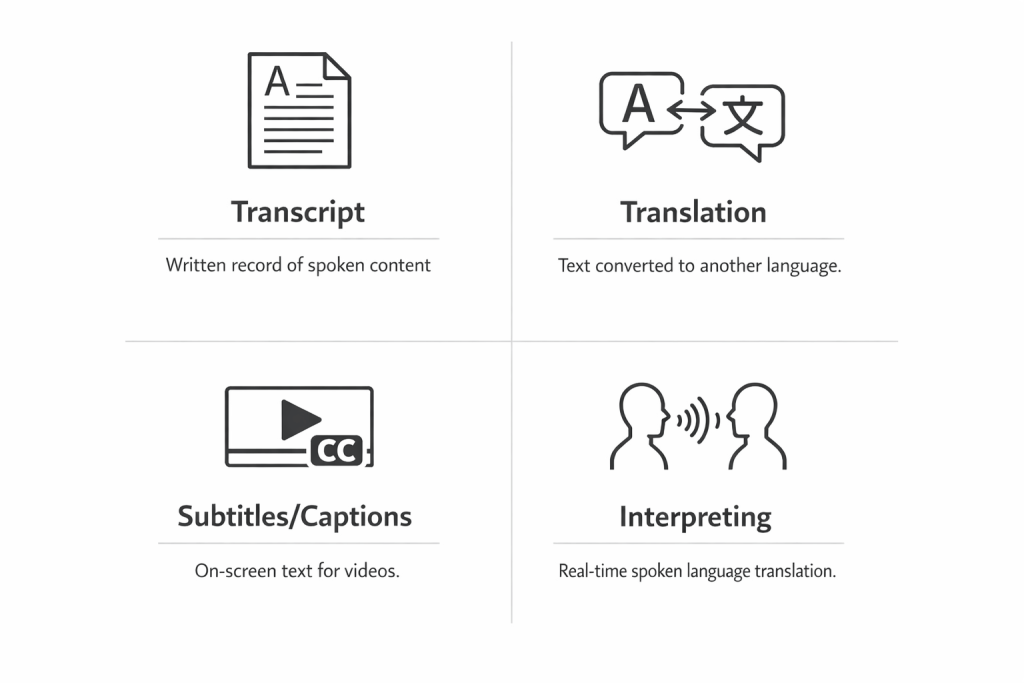
A lot of “wrong order” requests come from mixing up these four outputs:
- Transcript (same language, written text)
- Translation (different language, written text)
- Subtitles / captions (timed text that appears on-screen)
- Interpretation (spoken, real-time language support during live conversations)
If you need live multilingual meetings, you don’t want transcribing or translation first. You want interpreting. If you need on-screen text for a video, you likely need captioning/subtitling, which often starts with transcribing.
(If you’re unsure, Transcribe Lingo covers all three service types, so you can brief one team and get the right workflow:translation services,audio transcribing services, andinterpreting.)
When you need transcribing only
Choose transcribing when your audience speaks the same language as the recording, but you need the content in text form.
Common examples:
- Meeting minutes, stakeholder interviews, board discussions
- Legal interviews, hearings, witness prep, disclosure bundles
- Medical dictation, clinic notes, patient letters (with confidentiality safeguards)
- Academic lectures and qualitative research interviews
- Podcast episodes and webinar repurposing
- Internal documentation for training and knowledge-sharing
Quick win: transcribing makes audio searchable
A good transcript turns “60 minutes of audio” into something you can:
- skim in 2 minutes
- quote accurately
- tag, code, and analyse
- reuse as reports, summaries, articles, or captions
If you’re comparing providers, this guide helps you spot what matters before you send files:what a transcribing service actually includes.
When you need translation only
Choose translation when you already have text in one language and need it in another language.
Common examples:
- Contracts, policies, employee documents
- Market research questionnaires and survey instruments
- Product manuals, technical documentation, SOPs
- Marketing copy and brand content
- Certified documents for official submission (where required)
If you’re dealing with official submissions, you may need a certified translation rather than a standard translation: certified translation services.
When you need both transcribing and translation
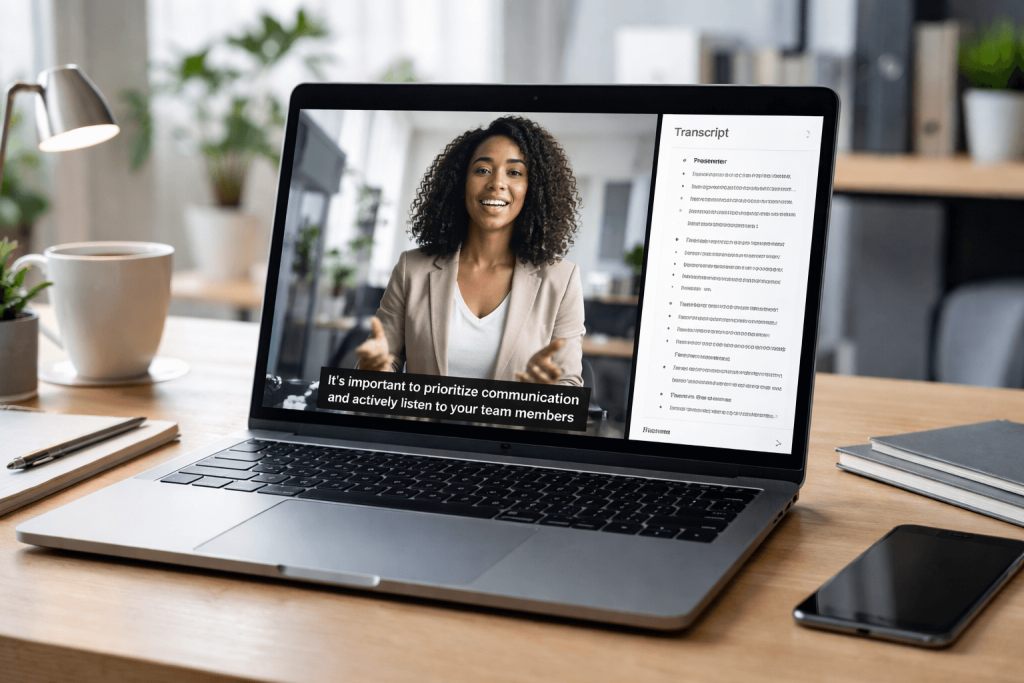
This is the most common “scope confusion” zone — and also where the biggest efficiency gains are.
You usually need both when:
- the source is audio/video
- the audience is multilingual
- the output must be usable (searchable transcript, subtitles, translated report, etc.)
Typical use cases where both are needed
- Multilingual interviews (market research, HR, compliance, legal)
- Training videos for international teams
- Webinars and conferences you want to publish globally
- Documenting investigations across regions/languages
- Media localisation: captions, subtitles, voiceover scripts
If your end goal is on-screen text or localisation, these services are often part of one content pipeline: voiceover and subtitling services.
The two best workflows for multilingual audio (and how to choose)
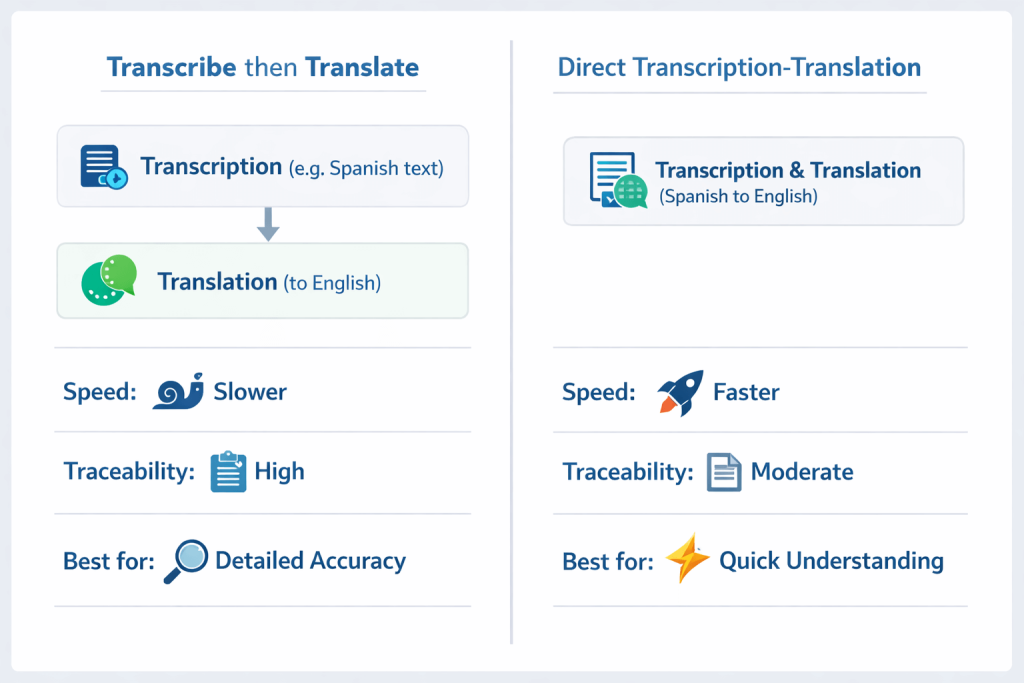
There are two legitimate ways to handle multilingual audio/video projects. The right choice depends on what you’ll do with the text afterwards.
Workflow A: Transcribe first, then translate (best for precision + reuse)
Audio (Language A) → Transcript (Language A) → Translation (Language B)
Choose this when you need:
- auditability (what was said vs what was translated)
- quoting and referencing in the original language
- bilingual review (stakeholders who want to check both versions)
- better terminology control (glossaries, names, numbers)
This workflow shines in legal, medical, compliance, and research settings.
Workflow B: Direct “transcribing-translation” (best for speed + simple deliverables)
Audio (Language A) → Written output in Language B
Choose this when you need:
- a fast translated transcript to understand the content
- a summary/report in the target language
- quick turnaround for internal decisions
This can be efficient, but you give up some traceability unless you also request timestamps or a bilingual format.
A practical decision checklist (use this before you brief anyone)
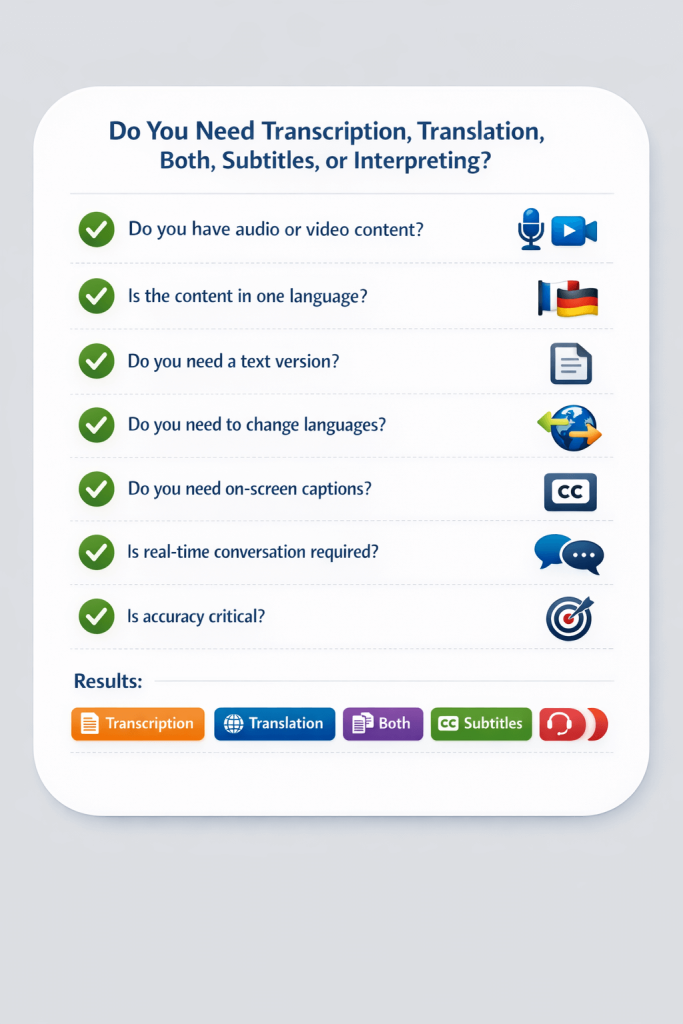
Answer these seven questions and you’ll know exactly what to request:
- Is your source audio/video or a document?
- Do you need the output in the same language or a new language?
- Will the text be used for subtitles/captions, analysis, legal records, or publication?
- Do you need speaker labels (e.g., Interviewer/Respondent) and timestamps?
- Is verbatim required, or should it be cleaned for readability?
- Is the subject matter sensitive (GDPR/confidentiality/NDA)?
- Do you need certified translation statements for official submission?
If you’re not sure, you can simply share your use case and ask for the recommended workflow: contact Transcribe Lingo.
What “good” looks like: quality signals for transcribing and translation
Trabscribing quality signals
- consistent speaker labelling
- correct names, brands, acronyms, and numbers
- clean formatting (headings, paragraphs, readable structure)
- optional timestamps (by minute or by speaker turn)
- clear handling of unclear audio (marked consistently)
- confidentiality safeguards for sensitive recordings
Translation quality signals
- consistent terminology (especially regulated or technical terms)
- tone that fits the context (legal vs marketing vs clinical)
- cultural clarity (idioms handled properly, no literal awkwardness)
- formatting preserved (tables, headings, numbering)
- bilingual delivery when stakeholders need to review
Common mistakes that cost time (and how to avoid them)
Mistake 1: Asking for “translation” when you only need transcription
Fix: specify “transcription in the same language” and request speaker labels/timestamps if needed.
Mistake 2: Asking for “transcription” when you need translated subtitles
Fix: request “transcription + translation for subtitles” and specify the file format (e.g., SRT, VTT).
Mistake 3: Not stating whether you need verbatim
Fix: choose one:
- Verbatim (captures false starts, fillers, cross-talk if required)
- Intelligent verbatim (cleaned for readability while keeping meaning)
Mistake 4: Forgetting the final use case
Fix: include one sentence like:
“This transcript will be used for qualitative coding and reporting.”
or
“This translation will be submitted to an authority, so it must match the source closely.”
Copy/paste brief you can use today
Use this exact template to avoid back-and-forth:
Project: Transcribing and translating (audio/video)
Source language: ____
Target language(s): ____
Output needed: / Intelligent)
Speaker labels: (Yes/No)
Timestamps: (None / Every __ minutes / Per speaker turn)
Format: (Word / Google Doc / SRT / VTT / PDF)
Purpose: (Research / Legal / Training / Publication / Internal)
Deadline: ____
Confidentiality: (NDA required? Yes/No)
Reference materials: (glossary, names list, agenda, slides)
Why teams use Transcribe Lingo for projects like this
With Transcribe Lingo, you can:
When transcription and translation touch real decisions — legal, clinical, research, public-facing content — the workflow matters as much as the words.
- brief one team for transcription, translation, subtitling, and interpreting
- request secure handling for sensitive audio and documents
- get support from project managers who keep formatting, deadlines, and deliverables consistent across languages
Client feedback often highlights what businesses care about most:
“Amazing service. Quick turnaround and accurate translations, totally worth the price…”
“Highly recommend… prompt to respond to our last minute request… thoroughly professional!”
“We’re glad to have Transcribe Lingo as our long-term transcription partner, never lets you down!”
Ready to move from “what do we need?” to “let’s get it done”? Upload your files and share your purpose and deadline: get a free quote.
3) FAQ Section
What’s the difference between transcribing and translating?
Transcribing turns spoken audio/video into written text in the same language. Translating converts content from one language into another while preserving meaning and intent.
Do I need transcription before translation for audio recordings?
Often, yes — especially when you need traceability, quotes, or bilingual review. In some cases you can request direct transcription-translation into the target language for faster understanding.
What should I request for multilingual interviews: transcript, translation, or both?
If you need analysis, compliance, or reporting, request both (source transcript + target translation). If you only need comprehension in one language, a translated transcript may be enough.
Are subtitles the same as transcription or translation?
No. Subtitles are timed text that appears on screen. They usually require transcription first, then translation (if multilingual), and delivery in subtitle formats like SRT or VTT.
What’s the difference between verbatim and intelligent verbatim transcription?
Verbatim captures speech exactly (including fillers or cross-talk if requested). Intelligent verbatim cleans speech for readability while preserving meaning, making it easier to scan and analyse.
Can I get transcription and translation with confidentiality for sensitive recordings?
Yes. For sensitive content, request secure transfer, limited access, and an NDA where required. Also specify whether the audio includes personal data or regulated information
