
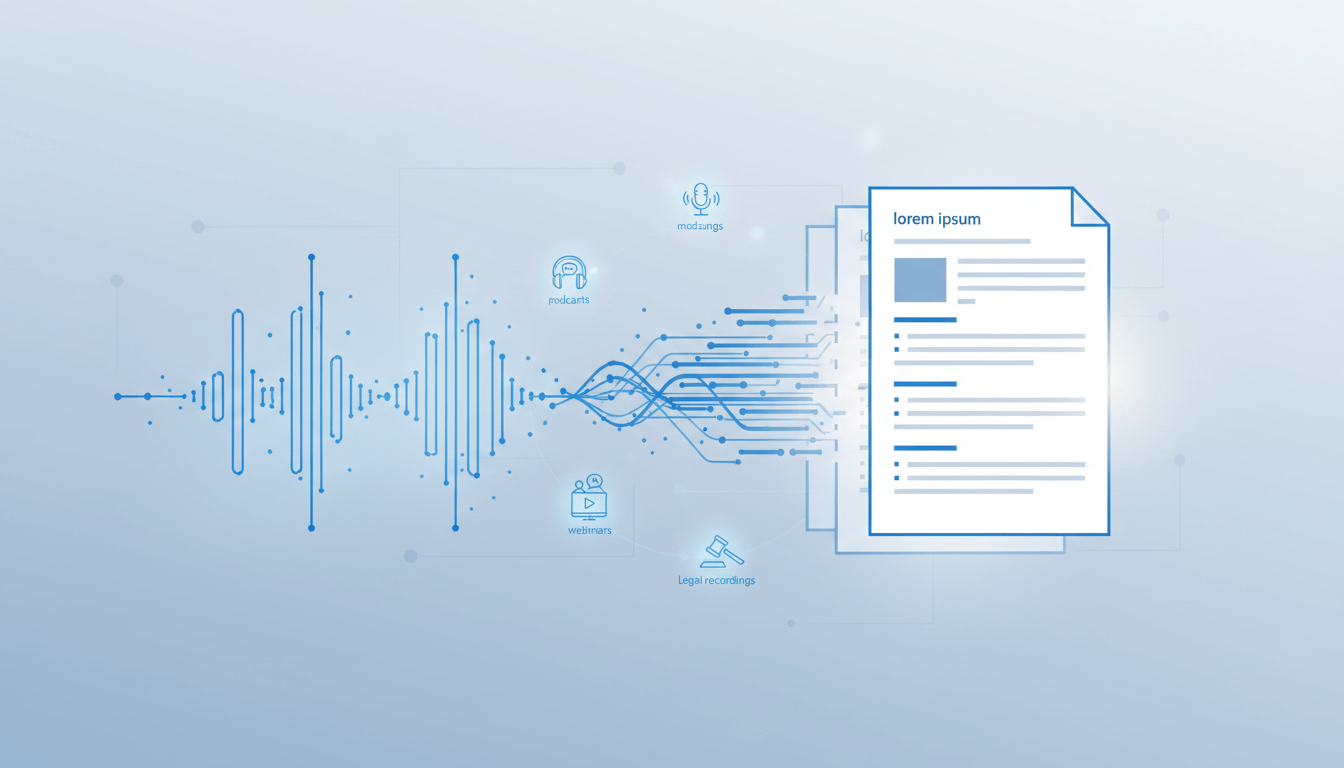
A transcription service turns spoken words from audio or video into written text. The result is a transcript: a document that can be read, searched, reviewed or used as a written record. Depending on the brief, it may include speaker labels, timestamps, strict or clean verbatim wording and agreed formatting.
Transcription services help researchers, legal teams, healthcare organisations, podcasters, businesses and universities work with recorded speech. They can handle different languages and subjects, but the scope, review process and level of detail must be agreed for each recording. Translation into another language, subtitling, and summarising are separate deliverables unless specifically included.
This guide explains how transcription works, what different transcript styles mean, human versus AI transcription, who uses a professional service, and how to request an appropriate quote. If you are ready to enquire, see professional transcription services or contact TranscribeLingo.
What does a transcription service do?
Transcription is a process; a transcript is its written output. A professional service takes a recording, follows the client’s instructions, creates a text version of the speech and checks it to the agreed quality requirements. The transcript may identify the interviewer and respondent, include elapsed-time markers and distinguish intelligible speech from words that cannot reliably be heard.
A typical example is a researcher who records a sixty-minute interview and wants a readable text copy with speaker labels. A legal team may instead request fuller verbatim detail and particular notation for interruptions. A business team might need an accurate clean-verbatim record of a meeting. The same recording can require different handling depending on its purpose.
Transcription is not simply typing what a software tool suggests. The words must be supported by the recording: negation, names, monetary figures, numbers and dates are especially important. A clean transcript must not silently turn “I think we should not proceed” into “We should proceed”.
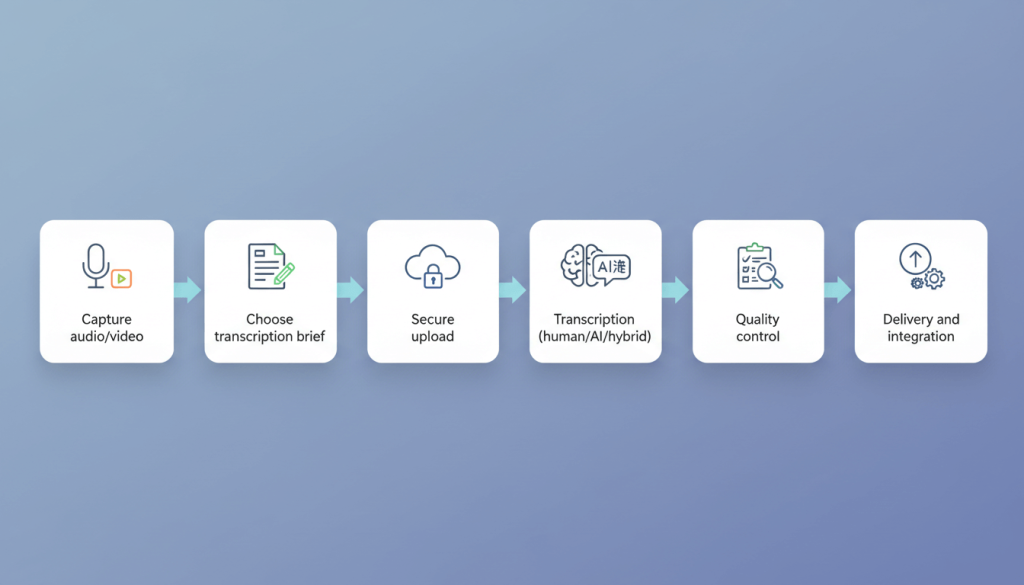
How professional transcription services work: six steps
1. Prepare and check the recording
Collect the correct audio or video files and confirm they play to the end. Note their language, duration, file type, sound clarity and expected number of speakers. Poor microphone placement, clipped speech, background noise and speakers talking at once can complicate the work. The source file should be kept available for checking.
2. Agree the transcript style and format
Specify full or strict verbatim, clean/intelligent verbatim, or an expressly approved edited version. Tell the provider whether you require speaker identification, timestamps, a supplied template, UK English spelling, bilingual presentation, specialist terminology or captions. The client should define what edits are permitted, because providers use style labels differently.
3. Obtain the quote and agree file handling
Provide recording length, language, subject, number of speakers, audio-quality concerns, desired output and deadline. Ask the provider to confirm availability, included review, delivery format, revision arrangements and price. If the recording is confidential, agree an approved transfer method, data-access rules and any relevant contractual requirements before sending it.
4. Create the transcript
A transcriptionist may listen directly to the source, automatic speech recognition (ASR) may create a draft, or a hybrid approach may combine the two. In every case, uncertain speech, simultaneous speakers and unusual terminology need an appropriate process. Never invent an inaudible word simply because it would make the sentence plausible.
5. Review against the recording
Quality assurance can include listening back while following the text, checking names, terminology, numbers, negation, speaker changes and timestamps, then proofreading the final file. Proofreading without replaying audio may fix spelling but fail to identify a missing phrase or mistaken speaker. The review depth should reflect the agreed purpose and sensitivity.
6. Deliver the agreed output
The provider supplies the requested Word, text, PDF or other specified format. Check that every source file is accounted for and that the version, language and formatting match the brief. Record unresolved questions and arrange any permitted correction or clarification.
Human, AI and hybrid transcription compared
If you are evaluating actual transcription applications, compare the documented features and limitations in our best transcription software guide for 2026 before choosing an AI-only or hybrid workflow.
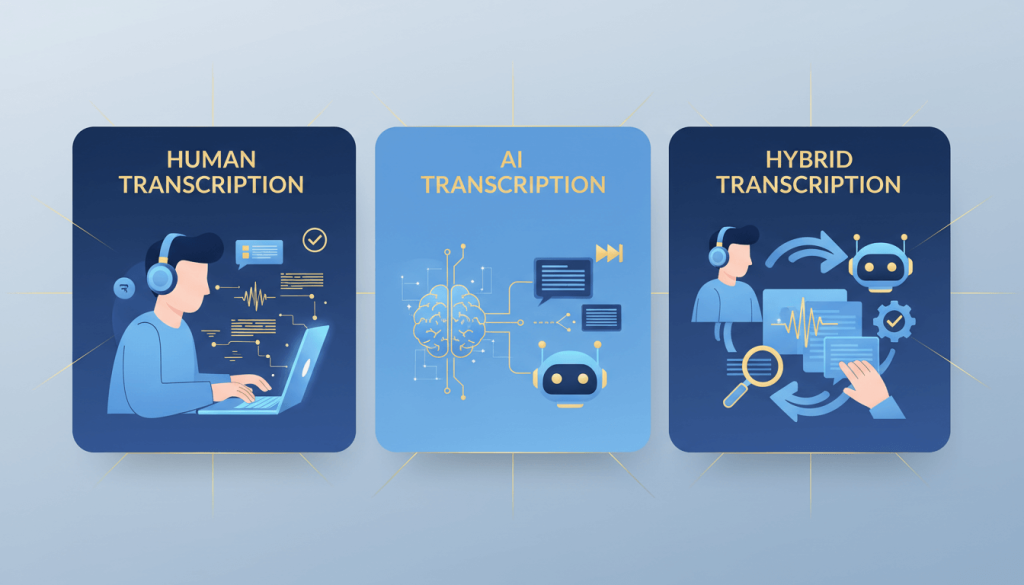
These are ways of creating a transcript, not guaranteed quality ratings. Accuracy varies with the recording, language, terminology and amount of review. Automatic tools can work well on clear material but may omit, mishear or invent words. Human work also needs quality control, especially in specialised or sensitive contexts.
| Method | Practical advantage | What to watch |
|---|---|---|
| Human transcription | Context-aware listening, clarification and more control over style | Time and quality depend on the recording and the skill and review process used |
| AI / automatic speech recognition | A fast first draft for clear, supported recordings | Errors with noise, accents, technical terms, names, speakers and numbers |
| Hybrid: AI draft plus human review | Combines speed with audio-based correction | The result is only as reliable as the actual checking against the recording |
For low-risk internal notes, an unreviewed automated draft may be adequate if everyone knows its limitations. When wording is relied upon in legal, medical, research or contractual settings, an appropriate human review and formal project specifications become more important.
Types of transcription services and output
Full verbatim, clean verbatim and edited transcription
Full/strict verbatim retains agreed speech details such as fillers, repetitions, false starts and meaningful sound cues. Clean or intelligent verbatim usually removes agreed verbal clutter without changing substantive meaning. Edited text may be rephrased for publication and should be clearly distinguished from a faithful transcript. Find a side-by-side example in our verbatim transcription guide.
Audio and video transcription
Both audio recordings and the soundtrack of video content can be transcribed. A video transcript is a written record; synchronised captions and subtitles require additional timing, presentation and possibly translation work. Tell the provider if you need a caption file rather than only a document.
Speaker-labelled and timestamped transcripts
Interviews and focus groups may need numbered speaker labels, role names or approved pseudonyms. Timestamps can identify speaker changes or regular intervals so readers can return to the correct passage. If a voice cannot reliably be identified, a neutral label is preferable to an invented speaker.
Multilingual and specialist transcription
A recording can be transcribed in Turkish, Arabic, French, German or another spoken language. Turkish audio → Turkish text is transcription. Producing English text from the Turkish recording normally also requires translation. Legal, medical and technical topics may need glossaries, specialist expertise and more stringent confidentiality arrangements.
Who actually uses transcription services?
The following are illustrative examples rather than claims about individual TranscribeLingo customers.
| Sector | Typical use |
|---|---|
| Market research | Interview and focus-group transcripts for coding, analysis and identifying themes |
| Legal | Accurate records of recorded instructions, interviews or discussions, with handling requirements agreed |
| Healthcare and clinical research | Dictation, research interviews and clinically sensitive recordings requiring terminology checks |
| Business and financial teams | Meetings, calls and presentations that need a written reference |
| Media, podcasts and journalism | Interview transcripts, quotes, editorial research and repurposed content |
| Universities and education | Research interviews, lectures, discussions and study materials |
Legal, clinical and regulated work does not automatically become officially compliant merely because it was transcribed. A receiving organisation may impose additional requirements for authentication, format, accuracy or approved personnel.
Transcription vs captions, subtitles, translation and summaries
| Deliverable | Meaning |
|---|---|
| Transcript | Written record of what is said in the source audio or video |
| Captions | Synchronised on-screen words plus relevant non-speech sound information for accessibility |
| Subtitles | Synchronised on-screen dialogue, in the same language or a translated language |
| Translation | Content accurately conveyed into a different language |
| Meeting notes or summary | Selective points, decisions or actions rather than a verbatim speech record |
A transcript can support content accessibility and searchability, but it is not automatically a replacement for accurate captions, accessible media controls or other accessibility measures. See transcription versus captioning for more detail.
What affects transcription quality, pricing and turnaround?
A quote should take account of the actual effort and risk, not just the recording’s running time. Sixty minutes of clear, single-speaker dictation is different from sixty minutes of overlapping voices and background noise.
- Length and file count: How much playable audio is involved, and whether files are complete.
- Clarity and overlap: Distortion, accents, low volume, people interrupting and unclear names.
- Language and topic: Language pair if translation is needed, dialect and specialist terminology.
- Formatting requirements: Strict verbatim, timestamps, speaker labels, annotations or client templates.
- Additional deliverables: Translation, captions, bilingual documents or structured data where agreed.
- Security and urgency: Sensitive content, authorised transfer methods, review depth and required delivery date.
Avoid relying on a generic “100% accurate” claim or expecting an unreviewed recording to have a fixed turnaround. A responsible supplier should explain uncertainty and confirm feasible timing after reviewing your requirements.
How to choose and book transcription services
Booking transcription is straightforward once you prepare the right information. Use this checklist before approaching a provider.
- Define your purpose: Research, internal notes, legal review, publication or accessibility.
- Prepare your files: Check duration, language, sound quality and speaker count.
- Specify the output: Verbatim style, timestamps, identification, terminology and file format.
- Check capability: Relevant experience, quality control and how unclear audio is handled.
- Discuss confidential files: Confirm suitable sharing, access and retention arrangements.
- Get the full quote: Price, review scope, feasible deadline, revisions and any separate translation.
- Check the delivery: Verify names, important figures, completeness and formatting against the brief.
For detailed quality assurance after the booking, use our 25-step transcription project checklist. For buying decisions, read professional transcription vs DIY.
A short example: same recording, different transcript style
Spoken words: “I, um, I think we should send the figures on Monday, not today.”
Full verbatim: “I, um, I think we should send the figures on Monday, not today.”
Clean verbatim: “I think we should send the figures on Monday, not today.”
Both examples retain the speaker’s uncertainty (“I think”) and the important negation (“not today”). If words genuinely cannot be made out, an agreed marker such as [inaudible 00:02:15] is preferable to an unsupported guess. These are illustrative examples, not actual client recordings.
Frequently asked questions
What is a transcription service in simple terms?
It is a service that turns speech in a recording into written text. A provider may add agreed speaker labels, timestamps, transcript style and quality review.
What is the difference between typing and transcription?
Typing is entering written words. Transcription requires careful listening, checking unclear words and representing speech faithfully, often with an agreed format and separate quality assurance.
Can AI create a reliable transcript?
Automatic speech recognition can provide a useful draft, particularly for clear recordings, but may mishear names, accents, numbers, negation or overlapping voices. The amount of human checking should reflect the risk and intended use.
Do I need full verbatim?
Not always. Some research and evidential work may require full speech detail, while general business and editorial transcripts may use clean verbatim. Follow the receiving organisation’s instructions.
Can a transcription service translate an interview into English?
Translation may be arranged alongside transcription, but they are separate tasks. State the original spoken language and whether you need an original-language transcript, an English translation or both.
Is a transcript the same as video captions?
No. Captions require time-synchronised text and suitable sound information. A transcript may be the starting point but does not automatically satisfy all video captioning and accessibility requirements.
How do I request a transcription quote?
Share the recording duration, format, language, speaker count, topic, requested style, timestamps or translation needs and deadline. Check suitable file-sharing arrangements before providing sensitive recordings.
Ready to arrange professional transcription?
Browse TranscribeLingo transcription services for commercial service details or request a quote with your recording brief. Available turnaround, handling arrangements and pricing can then be confirmed for your project.
