
If you’re searching for transcribing and translating, you’re probably trying to turn spoken content into something usable: a clean document, a bilingual script, subtitles, or an official-ready file. The confusion is understandable because these services often sit next to each other in the same workflow, especially with audio and video.
Here’s the simplest way to separate them:
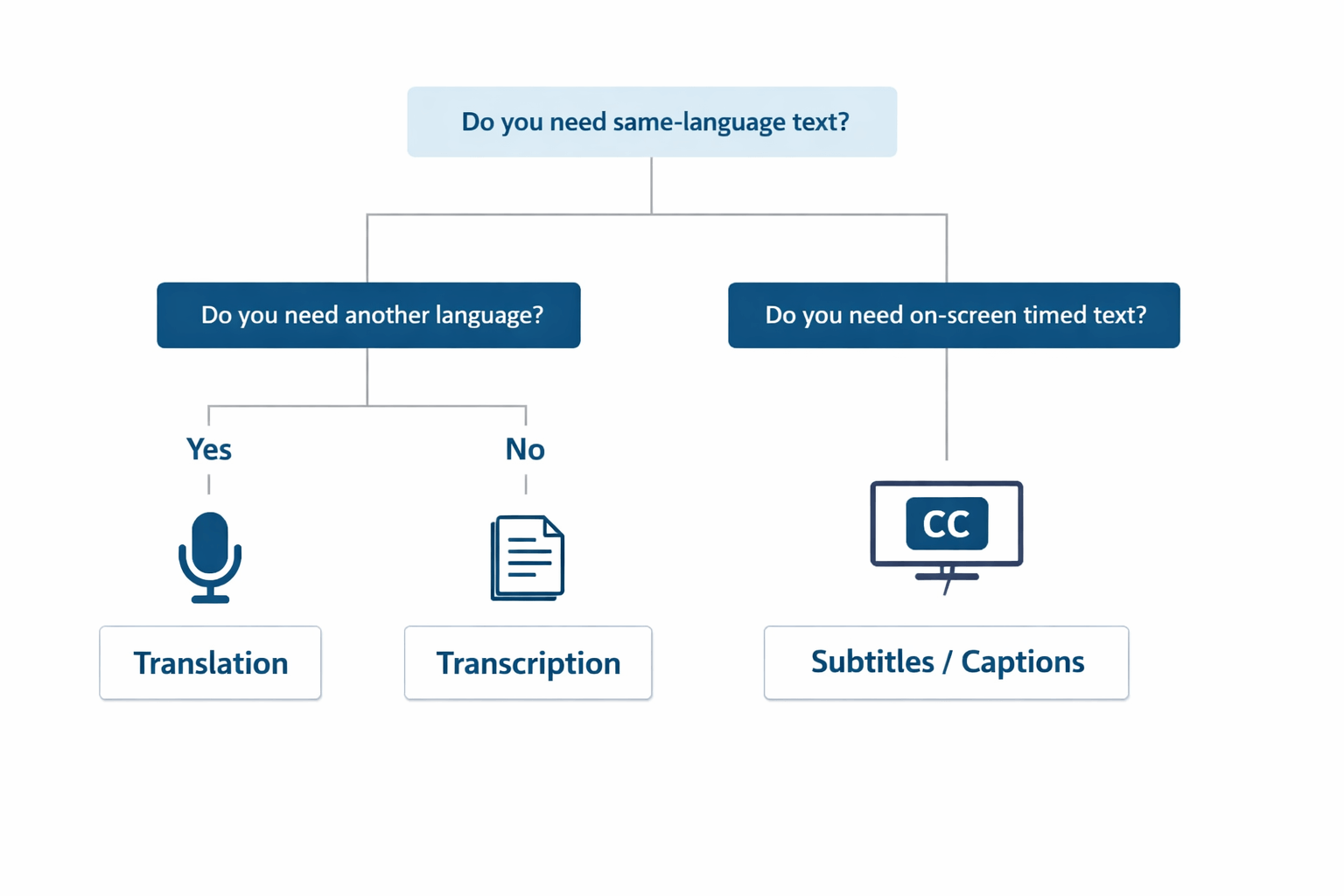
- Transcribing turns speech into text in the same language.
- Translating turns meaning into another language (from spoken or written content).
And then there’s the “third thing” many projects actually need: subtitling services, which convert spoken content into time-synced, readable lines on screen (often using both transcription and translation).
If you want a fast, accurate recommendation on what your project needs, you can share a sample clip or file for review via our Contact Us page.
A quick way to decide in 30 seconds
Ask these three questions:
- Do you need a written version of what was said (same language)?
You need transcription. - Do you need people who don’t speak the original language to understand it?
You need translation (and often transcription first). - Does it need to appear on screen in sync with a video?
You need subtitling services (timecodes + line breaks + readability rules).
When projects go wrong, it’s usually because the deliverable was labelled incorrectly (“translation” requested when what they needed was transcription, or “subtitles” requested when what they really needed was a full transcript plus translation).
Definitions that actually help (not dictionary fluff)
Transcription
A transcript is a written version of spoken content. Good transcription isn’t just typing. It usually includes:
- Speaker labels (when needed)
- Punctuation that reflects meaning
- Formatting for readability
- Optional timestamps (especially for research, legal, or media)
If you’re new to the process, this guide explains what a transcription service really delivers: What is a transcription service?
Translation
A translation expresses the same meaning in another language. It can start from:
- A written document
- A transcript
- Audio/video (usually transcribed first for accuracy and review)
Translation isn’t just “word swapping.” It considers tone, intent, terminology, and cultural nuance—especially in legal, medical, and research contexts.
Learn more about professional workflows and quality controls here: Translation services
Subtitling
Subtitling takes text and makes it watchable:
- Time-synced lines
- Character limits per line
- Comfortable reading speed
- Natural line breaks that don’t disrupt meaning
- File formats like SRT or WebVTT
If your end goal is video delivery, start here: Voiceover and subtitling services
The real differences between transcribing and translating
1) What changes: format vs language
- Transcription changes the format (audio → text) while keeping the language.
- Translation changes the language while preserving meaning (text or speech → another language).
2) What “accuracy” means
- In transcription, accuracy is about capturing what was said (including names, numbers, terms, and speaker changes).
- In translation, accuracy is about capturing what was meant (including tone, intent, and context).
3) Skills required
- Transcription relies heavily on listening, attention to detail, and formatting judgement.
- Translation relies heavily on language mastery, subject knowledge, and cultural fluency.
4) The typical end use
- Transcription is often used for records, analysis, accessibility, and repurposing content.
- Translation is used to communicate across languages for audiences, stakeholders, customers, courts, or regulators.
What you’ll receive: common deliverables (and what they’re for)
Typical transcription deliverables
- Clean transcript (readable, corrected, same meaning)
- Verbatim transcript (captures every utterance more closely)
- Speaker-labelled transcript
- Timestamped transcript (useful for navigation, research coding, evidence)
If you need a transcript style that’s structured for real-world use (timestamps, speaker labels, clean formatting), explore intelligent transcription and verbatim transcription.
Typical translation deliverables
- Bilingual document (source + target)
- Target-language only (final “ready to use” text)
- Certified formats (when required for official use)
Typical subtitling deliverables
- Subtitle-ready script
- SRT / VTT subtitle files
- Timecoded translation
- SDH-style captions (when accessibility is a requirement)
The “hidden” category: transcription, translation, subtitles, captions, interpreting (not interchangeable)
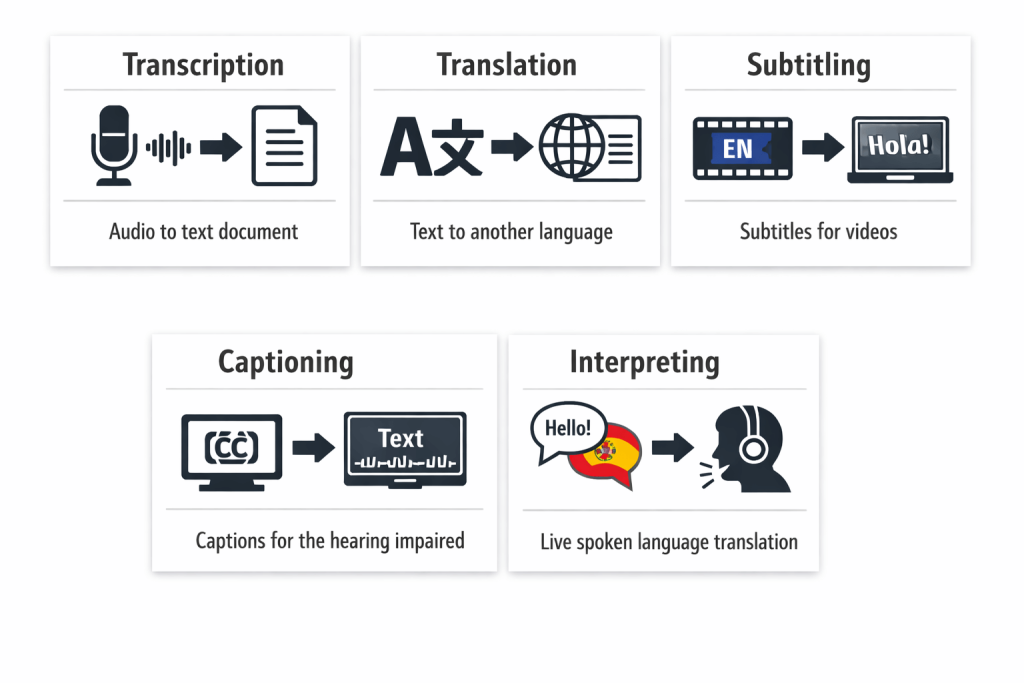
Use this quick comparison to avoid ordering the wrong service:
| Service | Input | Output | Same Language? | Best for |
| Transcription | Audio/Video | Text document | Yes | Meetings, interviews, evidence, analysis |
| Translation | Text or speech | Another language | No | Documents, multilingual comms |
| Subtitling | Video + text | Timecoded on-screen text | Either | Global video distribution |
| Captioning | Video + transcript | Timecoded + sound cues | Usually yes | Accessibility & compliance |
| Interpreting | Live speech | Live speech | No | Meetings, hearings, events |
If you’re doing anything live or real-time, you likely need interpreting, not transcription or translation. (And if you’re unsure, you can tell us the scenario and we’ll guide you: Contact Us.)
When you need transcription (and nothing else)
Choose transcription when:
- Your audience understands the language already
- You need a written record for reference or compliance
- You want searchable text for analysis, coding, or reporting
- You’re repurposing content (articles, summaries, training materials)
Common transcription use cases
- Legal: witness interviews, hearings, disclosure bundles
- Medical: consultations, notes, research interviews
- Market research: focus groups, depth interviews, usability tests
- Business: board meetings, internal comms, stakeholder calls
- Media: podcast scripts, documentary logs, rough cuts
If you’re UK-based or need local handling, you can review options here: UK transcription services.
When you need translation (and nothing else)
Choose translation when:
- You already have text (a document, script, or transcript)
- Your goal is to communicate the same message to another language audience
Translation-only examples
- A written report needs a second language version
- A product guide needs localisation for a new market
- A contract needs review-ready translation for stakeholders
If the starting point is only audio/video, translation-only rarely stays “translation-only” for long. Most teams end up needing a transcript first so the translation can be reviewed, edited, approved, and reused.
When you need both (the most common scenario)
Most real projects sit here.
Scenario A: You have a foreign-language recording and need an English document
This is a classic “transcribe + translate” workflow:
- Produce a reliable transcript from the recording
- Translate the transcript into the target language
- Deliver in the format your team can actually use (Word/PDF/bilingual)
Scenario B: You need multilingual subtitles
Subtitling services often involve:
- Transcription (source language)
- Timecoding (subtitle timing)
- Translation (target language subtitles)
- Subtitle QA (readability + timing + terminology consistency)
Scenario C: You need a transcript for analysis and a translated quote sheet for publication
This is common in research, media, and legal teams:
- Full transcript (for internal use)
- Selected quote translations (for reports or press)
If you want one team to manage the workflow end-to-end, explore our services or request a quote directly: Get in touch.
Arabic transcription: what makes it different (and how to avoid common mistakes)
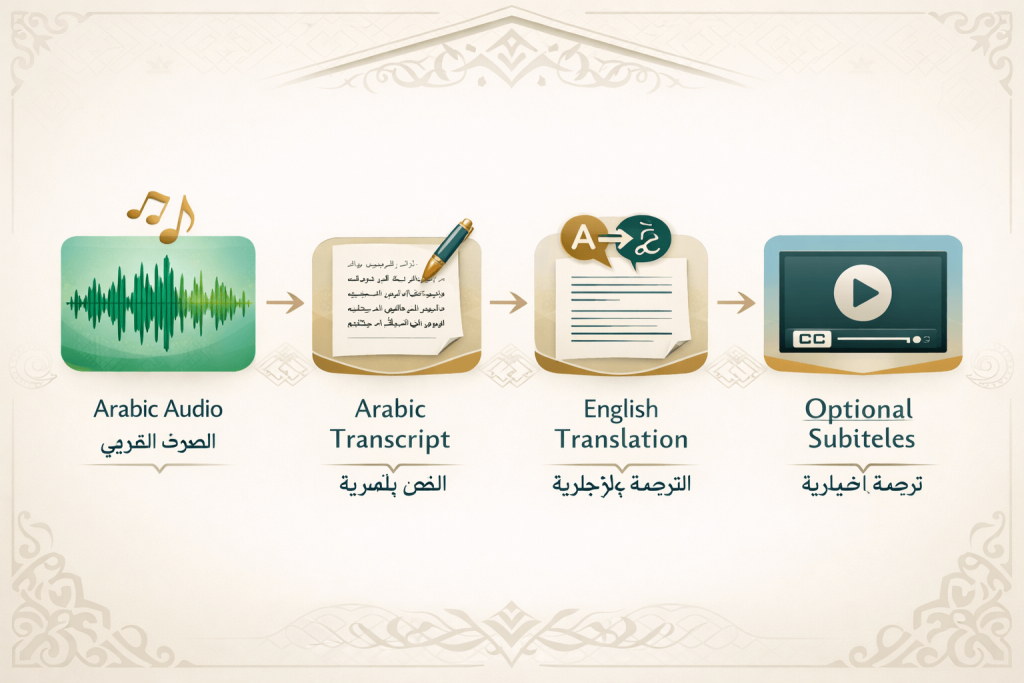
Arabic transcription is one of the most requested (and most misunderstood) services—because “Arabic” isn’t one uniform spoken form in real life. The right approach depends on what you need the transcript to do.
Decide what “Arabic transcription” means for your project
You might need:
- Arabic audio → Arabic text (same-language transcription)
- Arabic audio → English text (transcription + translation, sometimes called “translated transcription”)
- Arabic audio → Arabic transcript + English translation (best for review, audit trails, and publication)
What to clarify before you start
- Is the audio Modern Standard Arabic or a regional dialect?
- Do you need verbatim detail or clean readability?
- Should names be transliterated a specific way (passport spelling, legal spelling, internal glossary)?
- Do you need timestamps for review or evidence?
If you’re working specifically with Arabic-to-English outputs, this page covers common deliverables and use cases: Arabic ↔ English language support (including Arabic transcription).
Subtitling services: why “just translate it” usually fails
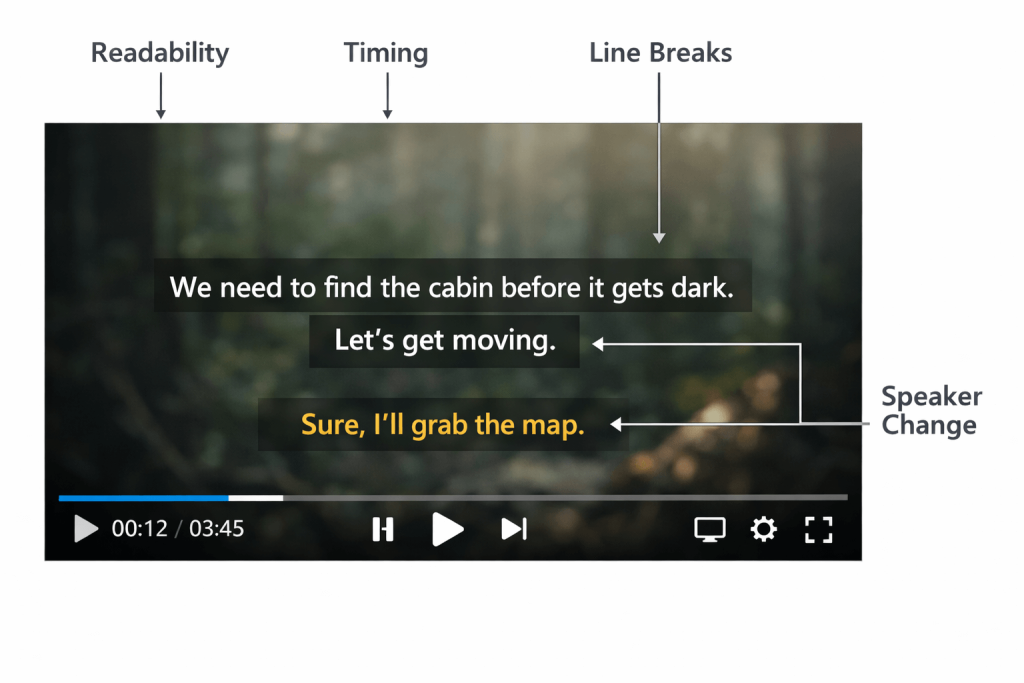
Subtitles are not paragraphs. They’re timed, compressed, and designed for reading while watching.
Even if your translation is perfect on paper, subtitles can still fail if:
- Lines are too long
- Timing is too fast
- Breaks split phrases unnaturally
- On-screen text competes with visuals
- Speaker changes aren’t clear
What professional subtitling includes
- Timing that matches speech naturally
- Line breaks that protect meaning
- Consistent terminology (especially for branded or technical content)
- Style rules for punctuation, numbers, sound cues, speaker labels
- Correct file formats for your platform
If your end goal is subtitles, start here: Voiceover and subtitling services.
The 7-question checklist that prevents expensive rework
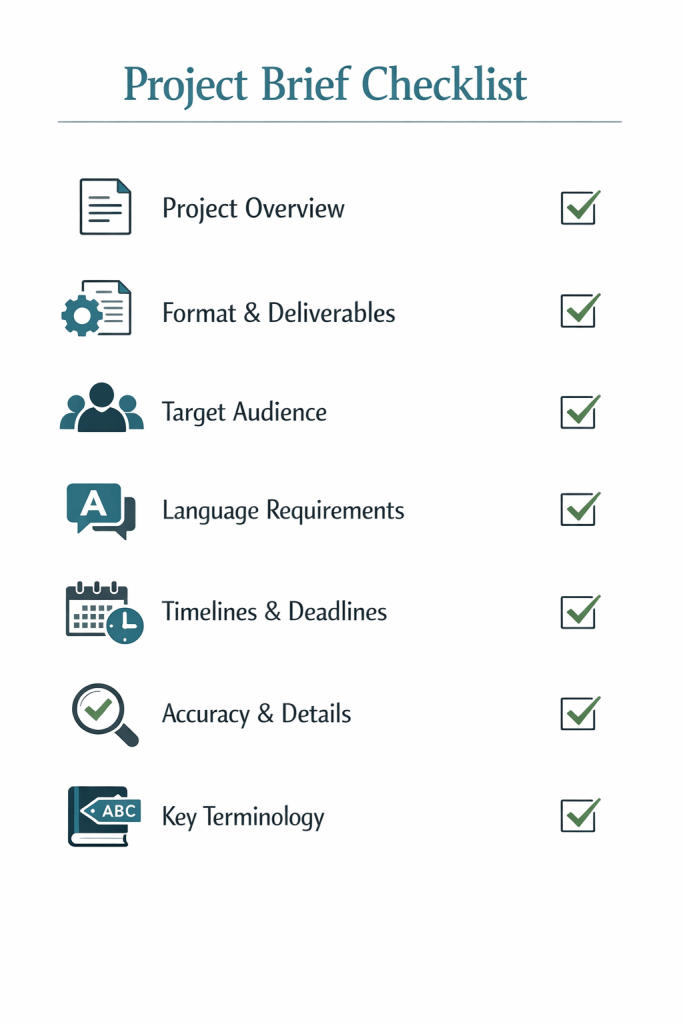
Before you order anything, answer these:
- What’s the input? (audio, video, text, mixed)
- What’s the output format? (Word, PDF, SRT, VTT, bilingual table)
- Who is the audience? (internal team, court, customers, public viewers)
- Do you need the same language or a new language?
- Do you need timestamps or speaker labels?
- How accurate does it need to be? (high-stakes vs internal notes)
- Is there specialist terminology? (medical, legal, technical, brand terms)
If you send these answers with your file, you’ll get faster quotes and far fewer “clarification” emails. You can share your file and requirements here: Upload your file and request a quote.
Quality: what “good” looks like (and how to spot shortcuts)
Whether you’re transcribing and translating for research, legal matters, or media release, quality shows up in the details:
For transcription, look for
- Correct names, organisations, and numbers
- Natural punctuation that reflects meaning
- Clear speaker changes
- Consistent formatting throughout
- A readable structure (paragraphing, headings where helpful)
For translation, look for
- Consistent terminology (glossary alignment)
- Natural target-language phrasing (not “translated-sounding” text)
- Correct tone for the context (formal, conversational, legal, clinical)
- Care with ambiguity (especially in spoken content)
For subtitling, look for
- Readable pace
- Natural line breaks
- Style consistency
- Accurate timing
If you’re working with sensitive recordings, it’s also worth asking how files are handled, who has access, and whether NDA arrangements are available.
A practical example: same clip, three different outcomes
Imagine a 45-minute recorded interview.
Output 1: Transcript (same language)
You get a clean document to:
- search for key moments
- pull quotes
- highlight themes
- share internally
Output 2: Translation (new language)
You get a readable version for:
- stakeholders in another region
- published reports
- multilingual documentation
Output 3: Subtitles (timecoded)
You get an on-screen deliverable for:
- video platforms
- training content
- webinars
- client deliverables
Same source file. Completely different value—depending on what you actually need.
How Transcribe Lingo supports transcribing and translating projects
If your project involves speech, text, or multilingual video, you’ll usually benefit from one managed workflow rather than stitching multiple suppliers together.
Explore:
- Transcription services (audio/video → structured text)
- Translation services (meaning → target language)
- Voiceover and subtitling services (timed text + multilingual media delivery)
- FAQs (common turnaround, formats, process questions)
If you want the quickest next step: send your file and get a free quote with your target language(s), deadline, and intended use.
3) FAQ Section
FAQs
1) What is the main difference between transcribing and translating?
Transcribing turns speech into text in the same language. Translating converts meaning into a different language. Many projects use both.
2) Do I need transcription before translation?
If your starting point is audio or video, yes—most of the time. A transcript makes translation reviewable, editable, and reusable (especially for subtitles and reporting).
3) Is Arabic transcription the same as Arabic-to-English translation?
Not necessarily. Arabic transcription can mean Arabic audio → Arabic text. If you need English output, that’s transcription plus translation (or a transcript + translation package).
4) What’s the difference between subtitles and transcription?
A transcript is a document. Subtitles are timecoded lines designed for on-screen reading. Subtitling services often include timing rules, line breaks, and subtitle file formats.
5) Can I get both transcription and translation in one service?
Yes. Many teams request a single managed workflow: transcript (source language) + translation (target language), with options for timestamps, speaker labels, and subtitle formats.
6) What should I send to get an accurate quote?
Send your file plus: language(s), approximate duration/word count, deadline, intended use (internal, legal, public, video), and any requirements (timestamps, speaker IDs, subtitling services).
