
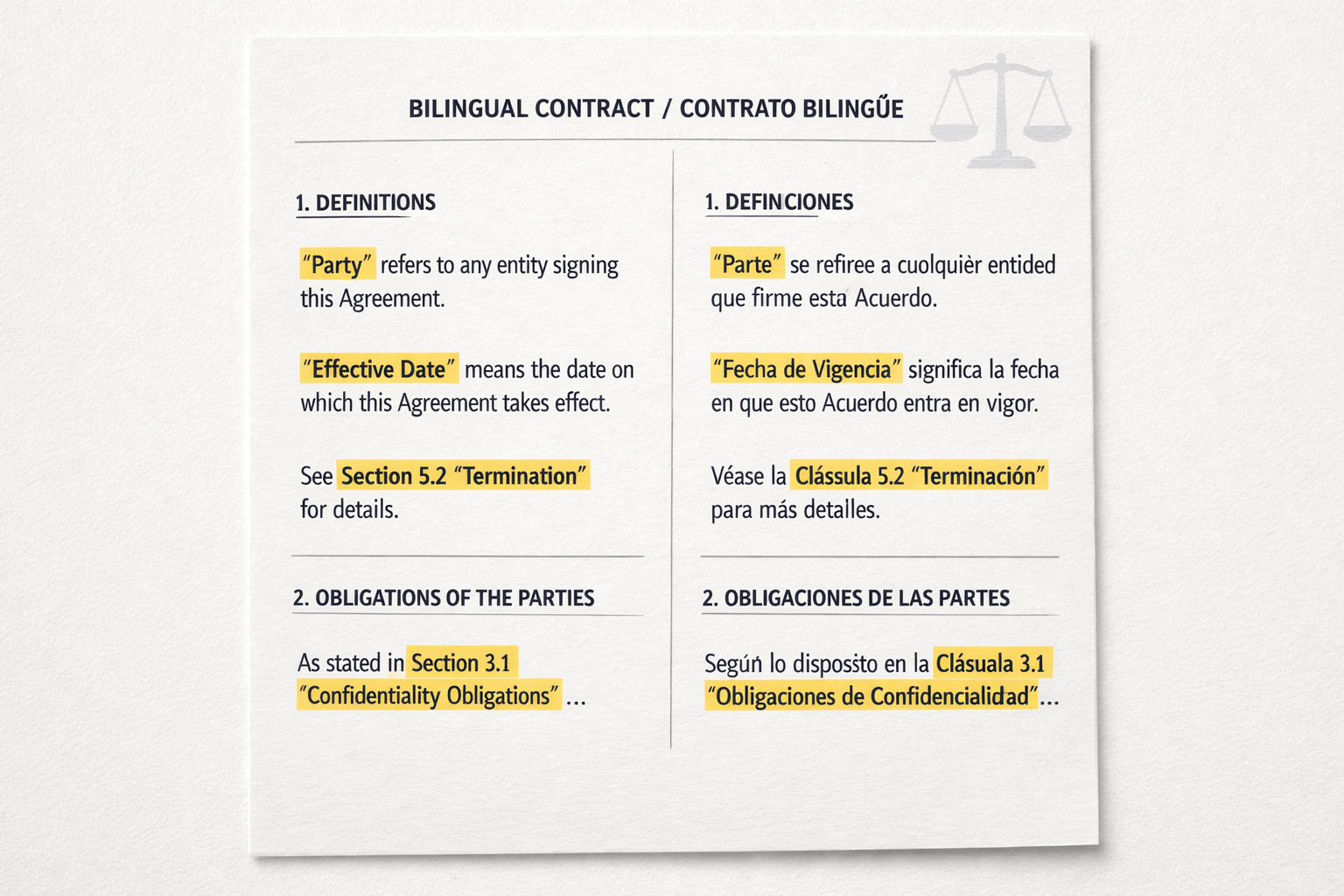
Legal translating is the translating of any text that has legal effect (or legal consequences), such as contracts, court documents, company filings, policies, affidavits, and regulatory materials.
Two quick distinctions matter:
- Legal translating = the specialist work of translating legal meaning and legal effect.
- Certified translating (when required) = a translating delivered with a certification statement, signatures, dates, and other details requested by the receiving authority.
If you’re submitting documents to a court, government office, embassy, or university, you usually need a professional workflow and the correct certification format. If you’re unsure what level you need, start with a specialist intake on a page likelegal document translating so you don’t lose time (or risk rejection) later.
Why Translating Law Is So Hard: 9 Reasons Regular Translating Rules Fail
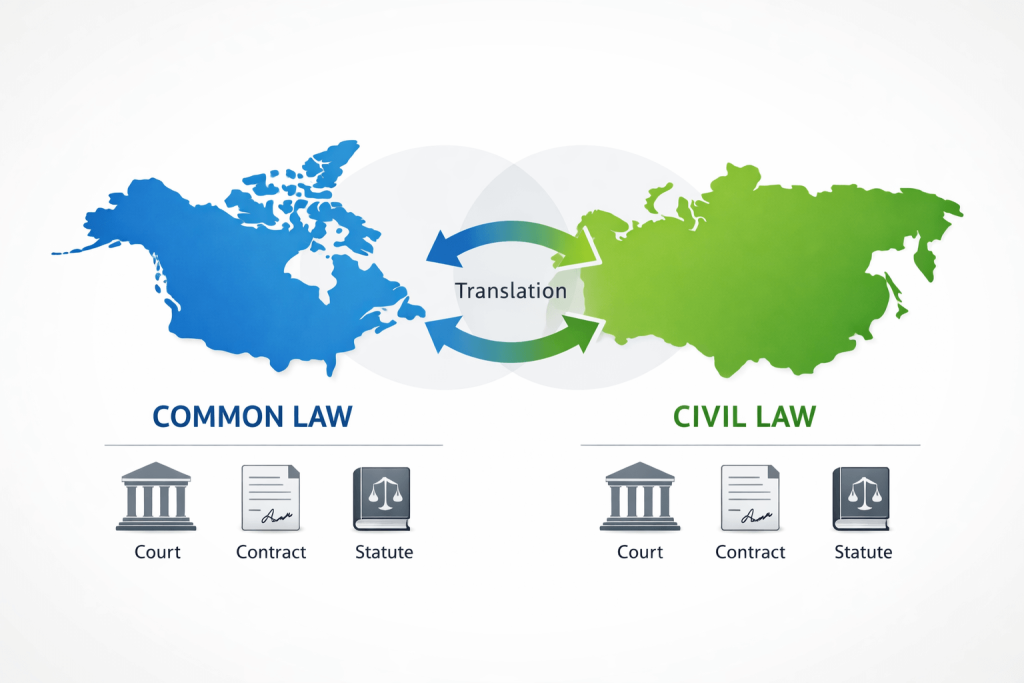
1) Law is tied to a system, not just a language
A word can be “correct” linguistically and still be wrong legally because the underlying concept doesn’t match across jurisdictions (common law vs civil law, local procedural rules, administrative structures, and more).
Example: A term like “consideration,” “equity,” or “injunction” may not map cleanly into another system without explanation or a carefully chosen functional equivalent.
2) Legal meaning is often defined inside the document
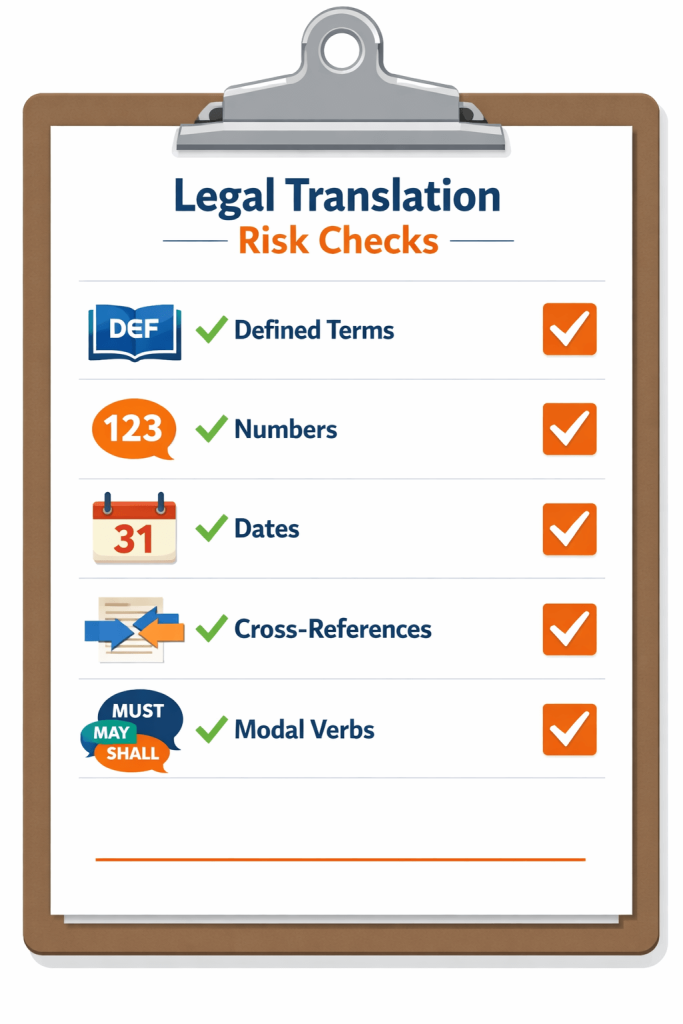
Contracts and statutes love “defined terms” (capitalized terms that mean something specific). If you translate them inconsistently, you create contradictions.
Pro habit: Treat defined terms like code. Same input, same output, every time.
3) Ambiguity can be intentional
Legal texts sometimes leave room for interpretation on purpose. A translator who “clarifies” can accidentally change the deal.
Working principle: Don’t improve the author’s drafting. Preserve meaning, structure, and interpretive room.
4) “Legalese” isn’t just style, it’s a risk-management tool
Long sentences, repetition, doublets (“null and void”), and formal phrasing often exist to prevent loopholes. A “simplified” version can become a different instrument.
This is where the idea of a legalese translator matters: it’s not about making text sound fancy, it’s about respecting the function behind legal phrasing.
5) One small word can change legal force
Modal verbs and qualifiers are high-risk: shall, must, may, should, unless, provided that, notwithstanding.
A single mistranslating can flip:
- permission ↔ obligation
- condition ↔ exception
- discretion ↔ duty
6) Cross-references, exhibits, and numbering must survive intact
Legal documents are interconnected: clauses point to schedules, exhibits, annexes, footnotes, and definitions. If you break references, the document becomes hard to use (or unusable).
7) Formatting can be a compliance requirement
Courts, authorities, and legal teams may require:
- identical pagination
- consistent headings and numbering
- mirrored tables
- bilingual layouts
- stamped certification pages
A translating can be “accurate” and still rejected if it doesn’t match expected format.
8) Names, dates, and numbers are surprisingly dangerous
Legal filings are full of identity data and deadlines. Translators must maintain:
- exact spelling (including accents, transliteration standards, and aliases)
- date formats suitable for the destination
- number formatting (1,000 vs 1.000; decimal separators)
- currency and units
9) Confidentiality and auditability are non-negotiable
Legal materials are sensitive. The workflow must be secure, controlled, and traceable—especially in litigation, M&A, compliance, and immigration.
If you’re handling high-stakes materials, work with a provider that can formalize NDAs and a controlled team process (see how a structured legal workflow is described on legal language services).
The 7 “Silent Killers” of Legal Translating (With Practical Fixes)
1) False friends and “near synonyms”
Legal language punishes “close enough.”
Fix: Use jurisdiction-aware glossaries, not general dictionaries.
2) Terms of art (words that mean something special in law)
“Service,” “execute,” “consideration,” “discovery,” “injury,” “charge” can be traps.
Fix: Identify terms of art early and lock them into a project termbase.
3) Defined terms drifting over time
A defined term appears 40+ times. If it changes twice, you’ve made three different contracts.
Fix: Automate consistency checks and run a final defined-term pass.
4) Negatives stacked on negatives
“Notwithstanding,” “unless,” “except as otherwise provided,” “no later than” create logic puzzles.
Fix: Preserve structure and verify logic with a clause-by-clause “meaning test.”
5) “Shall” problems (obligation vs future vs formality)
Some languages handle obligation differently; some legal cultures avoid “shall” entirely.
Fix: Translate the function (obligation, prohibition, permission) and keep tone consistent with the destination’s legal drafting norms.
6) Boilerplate that looks boring but carries big risk
Indemnities, limitations of liability, governing law, severability, force majeure—these are where disputes happen.
Fix: Use parallel texts and “known-good” clause libraries (where permitted) to avoid reinventing standard language.
7) Mixed documents (legal + financial + technical)
One file may include legal clauses, accounting tables, product specs, and annexes.
Fix: Split work by specialization and reunify with consistent terminology and formatting controls.
A Practical Example: One Clause, Three Ways It Goes Wrong translating law
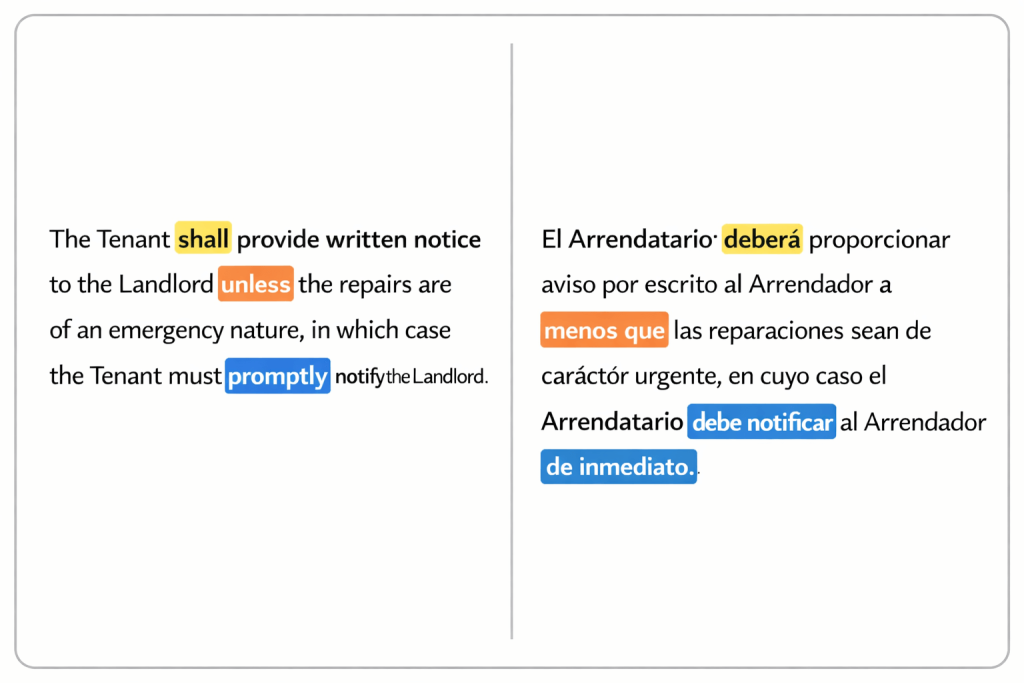
Source clause (English):
“The Supplier shall not disclose Confidential Information unless required by law, and shall notify the Customer promptly.”
Common failure modes:
- “shall” becomes a future tense (“will”), weakening the obligation
- “unless” becomes “except,” changing the exception logic
- “promptly” gets “cleaned up” into a fixed timeframe that wasn’t there
How pros handle it:
- identify obligations vs exceptions vs timing
- translate consistently with the destination system’s drafting norms
- preserve interpretive flexibility (don’t invent timelines)
- keep defined terms (“Confidential Information”) identical everywhere
If you need this level of control across a bundle (contracts, exhibits, court filings), start with a specialist intake and file review vialegal document translating.
How Professionals Translating Law: The Workflow That Prevents Costly Mistakes
Here’s what high-quality legal translating looks like in practice.
Step 1: Clarify purpose and “who decides”
Before translating a single word, pros ask:
- Where will this be used (court, authority, internal review, negotiations)?
- Does the destination require certification or notarisation?
- Is this an “informational” translating or an “operative/authentic” version?
Why it matters: The goal controls the degree of literalness, formatting, and certification.
Step 2: Map jurisdiction and legal system
Legal meaning depends on governing law and legal culture.
Pros identify:
- jurisdiction, governing law, and venue (if stated)
- document type (contract, power of attorney, judgment, policy, filing)
- whether concepts have direct equivalents or require functional rendering
Step 3: Build a terminology spine (before drafting)
Pros create a mini termbase including:
- defined terms
- party names, roles, and titles
- recurring legal terms and procedural phrases
- any mandated phrases for certification pages
This is where “law translate” stops being guesswork and becomes controlled work.
Step 4: Translate with “legal effect” in mind
Pros balance:
- accuracy (semantic meaning)
- legal function (what the clause does)
- conventions (how the target system usually expresses it)
They also preserve:
- numbering and cross-references
- defined-term capitalization
- annex and exhibit structures
Step 5: Review like it’s a legal instrument
A professional legal translating is not “translated and sent.” It is:
- bilingual revision (second linguist checks meaning)
- consistency checks (defined terms, numbers, names, references)
- formatting QA (tables, pagination, headings, footnotes)
- final verification against submission requirements
If your project is sensitive or time-critical, this is the difference between a clean submission and a costly delay.
Step 6: Deliver in the required format (and certify if needed)
Depending on the destination, you may need:
- certification statement page
- signatures and date
- translator or agency details
- notarisation or legalisation (apostille) coordination
For official submissions, a fast way to avoid back-and-forth is to use a service built around this end-to-end process, such ascertified translating services when certification is required.
When AI Can Help translating law (and When It Can Hurt)
AI tools can be useful for:
- early-stage triage (“What is this document about?”)
- generating a draft glossary
- spotting repeated phrases in large bundles
But AI is risky for legal translating because:
- it can produce plausible-but-wrong terms
- it may “normalize” ambiguity
- it can miss defined-term consistency
- it won’t reliably preserve legal drafting conventions
A safe approach is hybrid: use tech for speed and consistency checks, but rely on specialist human legal translators and review for anything that carries legal consequences.
If you need a legally safe workflow rather than a quick output, start with legal language services and a structured intake.
Certified, Notarised, Legalised: What People Mean (and What You Actually Need)
These labels vary by country, but a practical way to think about it:
- Certified translating: comes with a certification statement and is commonly required by authorities
- Notarised translating: certification witnessed by a notary/solicitor (often for overseas use)
- Legalised / apostille: authentication step so a document is accepted abroad
If your document crosses borders (immigration, overseas marriage, international litigation), it’s worth confirming destination requirements upfront. A specialist team can tell you the exact package needed during intake onlegal document translating.
Cost, Turnaround, and What Actually Drives Pricing
Legal translating pricing depends less on “how many pages” and more on:
- complexity (dense clauses, archaic language, multiple jurisdictions)
- formatting (tables, exhibits, bilingual layouts, scanned PDFs)
- urgency (same-day or multi-linguist teams)
- certification steps (certified/notarised/legalised handling)
- risk profile (contracts and filings need heavier review than general text)
If you want a clear quote quickly, the easiest next step is to upload the file and specify where it’s being submitted on thecontact page or start directly withcertified translating services.
A Real-World Patterntranslating law: What Happens When Legal + Financial + Formatting Collide
In high-pressure legal matters, the hardest jobs are often mixed: legal clauses plus financial tables plus strict formatting. That combination is where rushed or non-specialist translating fail.
The professional solution is almost always the same:
- split work by domain expertise
- use controlled terminology across the team
- reproduce tables and references precisely
- run a final unified QA pass
If you’re curious how that looks in practice, see a legal workflow example in this law firm case study.
A Quick Self-Check Before You Translate a Legal Document Translating Law
Use this checklist if you’re about to translate a contract, court document, or official file.
- Where will it be used? (court, government, employer, university, internal)
- Do you need certification or notarisation?
- What’s the jurisdiction/governing law?
- Does the document define terms?
- Are there exhibits, schedules, or cross-references?
- Are there tables, stamps, seals, handwritten notes, or scans?
- Is there a deadline tied to submission?
If you answer “yes” to any complexity points, skip generic tools and start with a specialist intake atlegal document translating. It’s the fastest way to avoid rework.
3) FAQ Section
What does “translating law” actually mean?
Translating law means translating text that carries legal consequences, not just meaning. The translator must preserve legal effect, defined terms, references, and drafting conventions so the document functions properly in the target language.
Is legal translating the same as using a legalese translator tool?
No. A “legalese translator” tool might rewrite or simplify legal language, but legal translating must preserve obligations, exceptions, and legal force. Simplification can change meaning and create risk.
Can AI safely handle legal translating or “law translate” tasks?
AI can help with triage and pattern spotting, but it can also generate plausible errors and inconsistent defined terms. For contracts, court documents, and official submissions, professional legal translating with review is the safer route.
When do I need a certified legal translating?
You typically need certified translating when submitting non-English documents to authorities (courts, immigration, embassies, universities, employers, regulators). Requirements vary, so confirm the destination rules before ordering.
Why is legal translating so expensive compared with general translating?
Legal translating is higher risk and often needs specialist translators, heavier review, strict formatting, and sometimes certification/notarisation/legalisation steps. The cost reflects the level of control required to prevent errors.
How do professionals prevent mistakes in legal translating?
They use a structured workflow: purpose + jurisdiction mapping, terminology control, careful drafting, bilingual revision, consistency checks, formatting QA, and (when required) correct certification formatting and secure delivery.
