
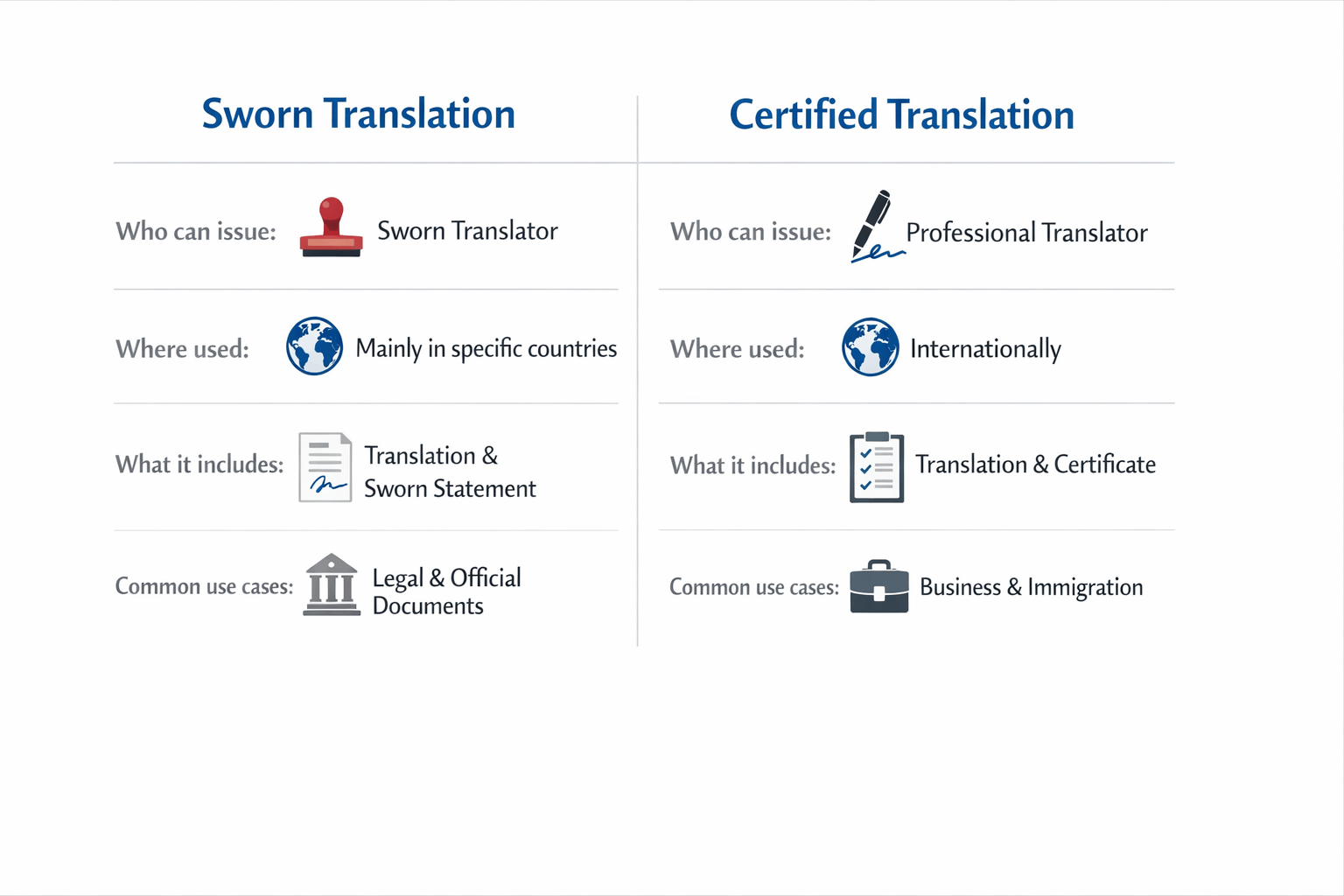
If you’ve been told you need a sworn translation (sometimes called an official translation), you’re not alone in feeling confused. The tricky part is that “sworn” and “certified” don’t mean the same thing everywhere — and in some countries, people use the words interchangeably even when the legal process is different.
Here’s the simplest way to think about it:
- A sworn translation is produced by a translator who has legal authority in that country (typically appointed, registered, or sworn in by a court or government body).
- A certified translation is a translation that includes a signed statement of accuracy from the translator or agency, in a format accepted by the receiving authority.
If you want the translation accepted first time, the real question is not “sworn or certified?” — it’s:
Which country and which authority will receive the document — and what do they accept?
If you’d like us to confirm the correct format in minutes, you can upload your document here: Certified translation services.
The meaning of sworn translation
A sworn translation is a translation that carries official legal weight in the country where it’s produced (or where it will be used), because the translator is recognised by an official body.
Depending on the jurisdiction, a sworn translation may be:
- prepared and stamped/signed by a court-authorised translator
- sworn in (or declared) before a court, notary, or competent authority
- issued in a bound format (translation + source document copy + certification page), sometimes with numbered pages and an official seal
What does sworn translation mean in practice?
It usually means the translator is not just translating — they are also acting as an official certifier of the translation’s fidelity to the original.
What is a sworn translation document?
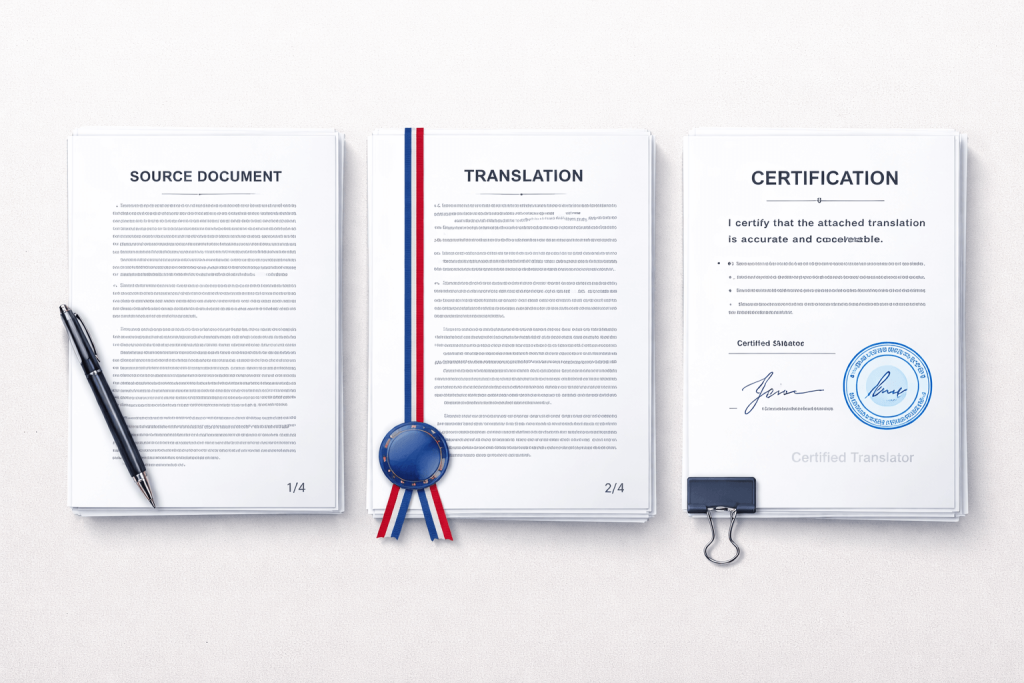
A sworn translation document commonly includes:
- the translated text (often mirroring the original layout)
- a certification statement (wording varies by country)
- the translator’s signature and official stamp/seal
- date and place of certification
- sometimes a registration number, court reference, or official ID
What is a sworn translator?
A sworn translator is a translator who is authorised by a court, ministry, or government-approved register to produce translations that are accepted as official in that jurisdiction.
How that authorisation works varies by country. Common models include:
- Court-sworn / court-appointed translators (often in civil-law systems)
- Ministry-accredited sworn translators (some countries centralise authorisation)
- Registered sworn translators listed in an official database
Because the status is jurisdiction-specific, a “sworn translator” in one country is not automatically “sworn” everywhere else.
What is a certified translation?
A certified translation is a translation that comes with a certificate of accuracy (sometimes called a “translator’s declaration” or “statement of truth”) signed by the translator or translation agency.
In many English-speaking contexts (including the UK and the US), certified translations are the standard format for:
- visa and immigration submissions
- academic admissions
- employment and professional registration
- courts (depending on the case and venue)
- embassies and consulates (varies)
A typical certified translation includes:
- confirmation it is a true and accurate translation
- translator’s name and signature
- date of translation
- contact details
- agency details (if applicable)
- sometimes a stamp (depending on the destination authority)
If you need a certified translation prepared in a commonly accepted format, start here: Certified translation services.
Sworn vs certified translation: the real differences
Below is a practical comparison that matches how these terms are used most often in real-world submissions.
| Feature | Sworn Translation | Certified Translation |
| Who produces it | Translator with legal authority (court/government/register) | Professional translator or agency providing a signed certification |
| What makes it “official” | Legal status of the translator + official seal/stamp and prescribed format | Signed certificate of accuracy attached to the translation |
| Where it’s common | Many civil-law countries (e.g., parts of Europe and Latin America) | UK, US, Canada, Australia and many international submissions |
| Typical use cases | Civil status docs, court filings, registrations, official legal procedures | Immigration, universities, employers, banks, many authorities |
| Verification focus | The translator’s official authorisation | The translator’s identity, accountability, and certification statement |
| Add-ons often requested | Legalisation / apostille; sometimes binding rules | Sometimes notarisation or apostille depending on destination |
The most important takeaway
The same document can require different formats depending on where it’s going. A birth certificate translation for a UK visa often needs certified translation formatting, while the same birth certificate used for a civil registration in another jurisdiction may require a sworn translator recognised there.
“Sworn”, “certified”, “notarised”, “legalised”: how they fit together
People often mix these up. Here’s a clear way to separate them:
- Certified translation: translator/agency signs a certificate of accuracy.
- Notarised translation: a notary (or sometimes solicitor) witnesses the translator’s signature or certifies the identity/signing process.
- Legalised / apostilled: a government office attaches an apostille (or legalisation certificate) to confirm a signature/seal is genuine for overseas use.
- Sworn translation: the translator is officially authorised (and the format follows that jurisdiction’s rules).
A common scenario in the UK is: Certified translation → Notarisation (if requested) → Apostille (if the destination country requires it).
If your instruction email says “we need a sworn translation”, in the UK they may actually mean “certified translation with notarisation”. When in doubt, tell us the destination country + receiving organisation and we’ll confirm the correct pathway via Legal document translation.
Which one do you need? Use this decision checklist
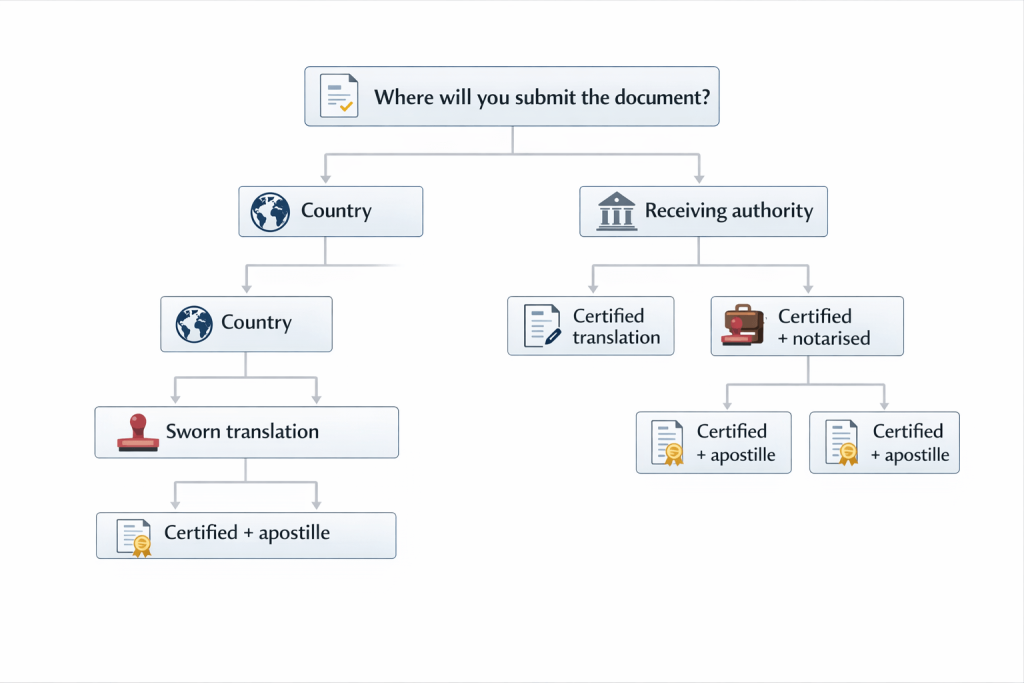
Step 1: Identify the receiving authority
Ask: Who will review this document?
Examples:
- immigration department
- court or tribunal
- registry office (birth/marriage/civil status)
- university admissions
- professional regulator
- embassy or consulate
Step 2: Identify the destination country (this is the “rule-set”)
Requirements are usually set by the destination authority, not by you — and not by the country the document came from.
Step 3: Look for the keyword that reveals the answer
When authorities publish requirements, the deciding words are often:
- “sworn translator”
- “court-appointed translator”
- “translator registered with…”
- “certified translation”
- “translation must be independently verifiable”
- “must include translator’s details and signature”
- “must be legalised / apostilled”
Step 4: Match the requirement to the right format
Use this quick rule:
- If the authority asks for a sworn/court-authorised translator → you likely need a sworn translation recognised in that jurisdiction.
- If the authority asks for a certificate of accuracy + translator details → you likely need a certified translation (with optional notarisation/apostille depending on destination).
- If you’re not sure, the fastest path is to send us the requirement text (a screenshot is fine) viaContact us and we’ll interpret it for you.
Country-by-country reality: why people get tripped up
Many articles oversimplify this topic. In practice:
- In some countries, an “official translation” is only official if it’s done by a sworn translator listed in a register.
- In others, “certified translation” means a statement of accuracy, and there’s no special legal status for the translator.
- In some jurisdictions, the word “certified” is used to describe what other countries call “sworn”.
So instead of trying to memorise definitions, remember one principle:
Official translations are jurisdiction-specific. Always follow the destination authority’s language.
How to get a sworn translation (step-by-step)
If you’ve been asked specifically for a sworn translation, here’s how to get it done smoothly.
- Confirm where it will be used
- Country + city (sometimes courts are regional)
- Name of the receiving body (registry office vs court can differ)
- Check whether the translator must be sworn locally
- Some authorities require the translator to be sworn in that country
- Others accept a sworn translation produced elsewhere if it meets legalisation rules
- Provide clear scans (and photos of stamps/seals)
- Include both sides of documents if there are stamps on the back
- Send full pages, not cropped screenshots
- Confirm whether you need a physical bound set
- Some sworn formats are delivered as a bound pack
- Others allow a secure PDF, especially for pre-checks
- Add notarisation/apostille if required
- If the destination authority wants legalisation, plan for extra handling time
- Order early if there’s a court or notary step
- Sworn processes can involve scheduling and prescribed formatting
For documents used in legal settings, we can advise and handle the correct pathway through Legal document translation.
How much does a sworn translation cost?
There isn’t a universal rate, because sworn translation is often priced around process, not just text length.
What typically affects cost:
- Language pair and document type (civil status documents vs multi-page contracts)
- Format rules (layout matching, court wording, binding requirements)
- Whether a court/notary step is needed
- Whether legalisation/apostille is required
- Urgency (same-day vs standard)
- Delivery method (digital only vs tracked post originals)
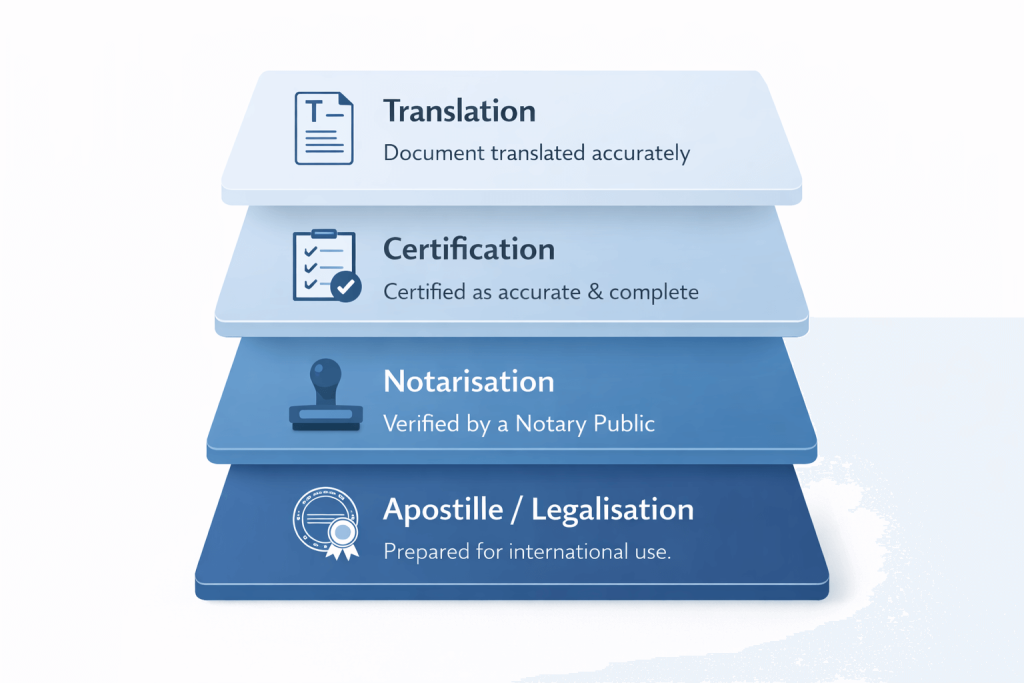
A practical way to budget
Think in layers:
- Translation (word/page-based)
- Certification layer (certified statement or sworn format)
- Verification layer (notary/solicitor if requested)
- Cross-border layer (apostille/legalisation if required)
If you want a fast, accurate quote, upload the document and tell us the destination country here: Certified translation services.
Common mistakes that lead to rejection
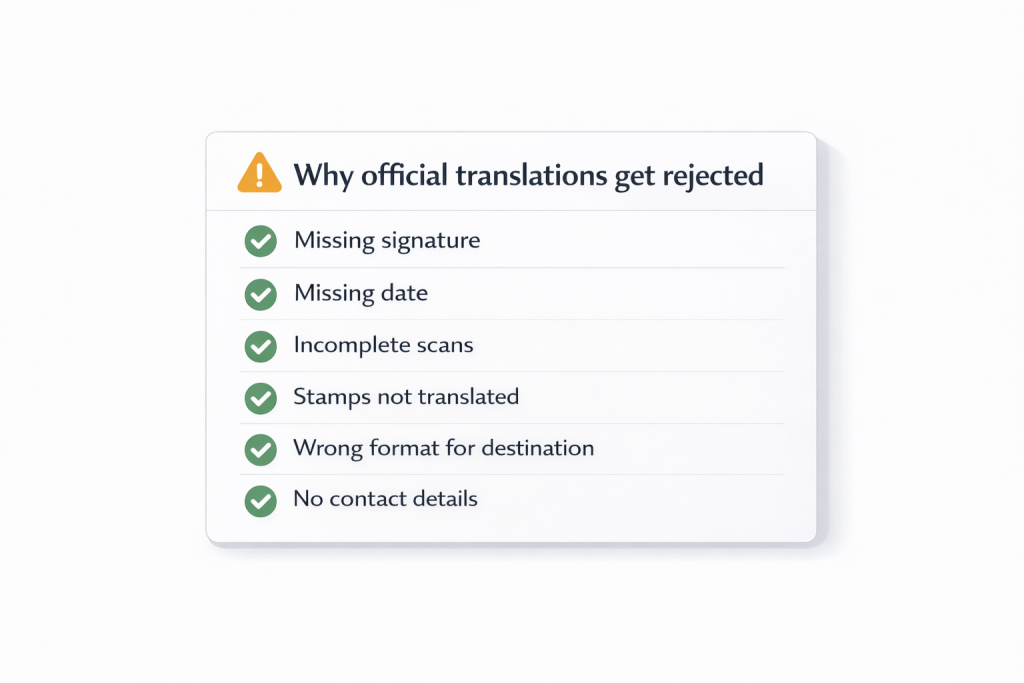
Authorities usually reject “official” translations for avoidable reasons. The most common ones:
- missing translator name, signature, date, or contact details
- certification statement is present but too vague (no accountability wording)
- source document is incomplete (missing stamps, reverse side, annexes)
- formatting that obscures meaning (tables/figures not reproduced clearly)
- document was “summarised” rather than fully translated
- the authority required a sworn translator in a specific register, but the translation was certified only
- apostille/legalisation was required but not provided
A good provider doesn’t just translate — they check the destination rules and deliver the format that matches them. That’s exactly what we do via Document certification support when notarisation or apostille is involved.
What you can expect from Transcribe Lingo for official translations
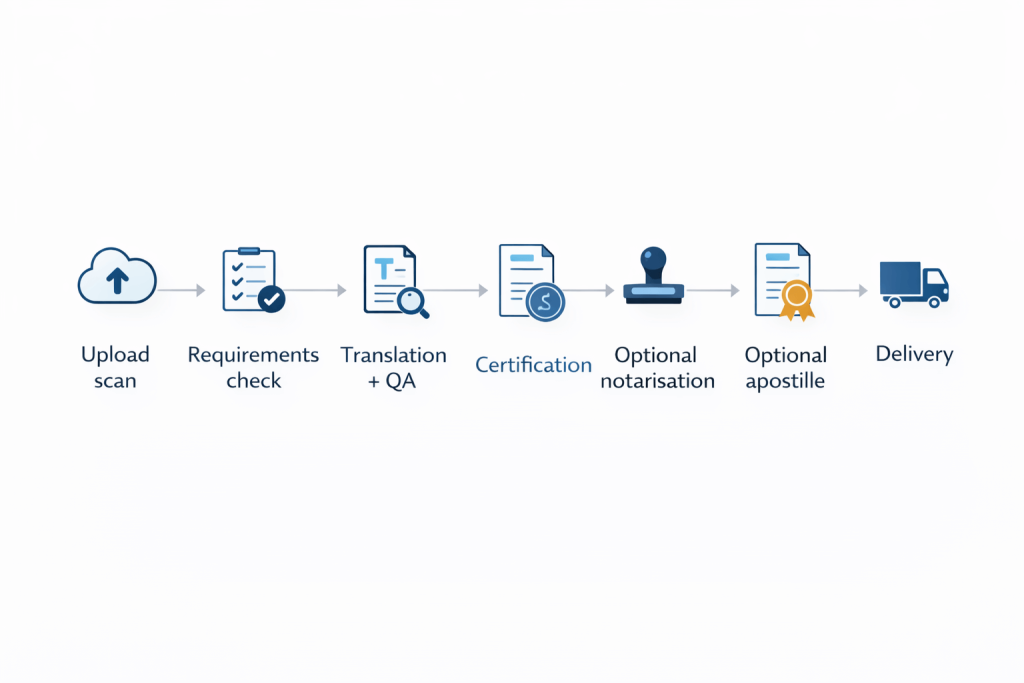
When people come to us asking for “sworn translation”, they’re usually in one of these situations:
- they genuinely need a court-sworn / officially registered translator for a specific country, or
- they need a certified translation in a format that the authority calls “sworn”, often with notarisation and sometimes an apostille
Our process is designed to remove guesswork:
- Requirement-first check: you tell us the destination authority and we confirm the correct format
- Professional certification: we provide certified translations in a widely accepted format through Certified translation services
- Legal pathway support: for court/registry submissions, we handle the appropriate format via Legal document translation
- Notary and apostille coordination: when needed, we coordinate notarisation and legalisation through Document certification near me
- Language coverage: access support across many language pairs via All languages
If you want the quickest outcome, send your document and the destination country. We’ll reply with the correct option and a clear price — no back-and-forth: Contact us.
FAQ
What is a sworn translation?
A sworn translation is an official translation produced by a translator who is legally authorised in a specific country (often via a court or government register) and issued in that jurisdiction’s prescribed format, typically with an official stamp and certification statement.
What is a sworn translator?
A sworn translator is a translator who has been authorised by a court, ministry, or official register to produce translations that carry official status in that jurisdiction. The title and approval process differ by country.
What is the difference between sworn and certified translation?
In most cases, sworn translation refers to a translation produced by a legally authorised translator (court/government/register). Certified translation usually refers to a translation accompanied by a signed certificate of accuracy from the translator or agency. Which one you need depends on the destination authority and country.
Do I need a sworn translation for a UK visa?
Usually, UK submissions require a certified translation that includes translator confirmation of accuracy, date, signature, and contact details. Some cases may require notarisation or legalisation depending on the receiving body and destination use of the document.
