

/If you’re wondering where to get documents translated and certified, you’re usually on a deadline: a visa application, a passport request, a university offer, a court matter, or a bank asking for “official translation”.
The problem is that “certified” can mean different things depending on where you’re submitting the document—and choosing the wrong option can cost you time, money, and a rejected application.
This guide shows you exactly where to go, what to ask for, and how to make sure your translation is accepted first time.
If you want a quick, compliant route now: start with Transcribe Lingo certified translation services and upload your file for a same-day or 24–48 hour turnaround where available.
The quick answer: the best places to get certified translations
For most people, the safest options are:
- A professional translation agency that provides certified translations (best all-round option for official use)
- A qualified professional translator who can certify their own work (works well if the authority accepts individual certifications)
- A sworn translator system (country-specific) (often required abroad; the UK typically uses certified/notarised formats instead)
- Certified + notarised translation (only when explicitly required) (usually for overseas legal/consular use)
If your document is for UK authorities, immigration, universities, lenders, or employers, a certified translation from a specialist provider is usually what you need.
To get started quickly for common personal documents, use:
First: “certified translation” vs “notarised” vs “apostille” (plain English)

People often overpay because these terms are mixed up. Here’s the clean distinction:
Certified translation
A translation with a signed statement confirming it’s a true and accurate translation of the original, plus key details (translator/agency name, date, signature, contact details).
Notarised (notarized) translation
A certified translation where the signature on the certification is witnessed by a notary. This is typically needed for overseas authorities that require notary involvement.
Learn more: Notarised translation & apostille
Apostille / legalisation
This does not certify the translation itself. It authenticates a notary’s signature/seal for international acceptance (often part of an overseas submission chain).
If your instruction letter doesn’t explicitly say notary or apostille, don’t guess—ask the receiving body or share the requirement with your translation provider so you only pay for what you actually need.
Where to get documents translated and certified (your options)
1) A specialist translation agency (recommended for most official uses)
This is the most straightforward route because the agency manages:
- the correct certification wording and format
- consistent layout and “like-for-like” reproduction of official fields
- quality checks (especially important for names, dates, reference numbers, stamps)
- delivery options (secure PDF and, if needed, posted hard copies)
If you want one provider who can handle certified, notarised, and legalised routes depending on your destination, start here:
Certified translation services
Best for: visa/immigration, passport submissions, universities, HM Land Registry-style paperwork, banks/lenders, employers, healthcare registration.
2) An individual qualified translator (works when permitted)
This can be a good option if the organisation accepts a translator’s certification directly.
Before you proceed, confirm:
- the translator will provide a signed certification statement
- they include full contact details for verification
- they are experienced in official-format translations (civil status docs, legal docs, academic records)
If you’re unsure what the authority expects, it’s usually simpler to use an agency route so the format is consistent.
3) Embassy/consulate-recommended translators (destination-specific)
Some consulates keep informal lists or provide guidance on what they accept. This route is useful when:
- the receiving body is outside the UK
- the authority has strict local rules (sometimes requiring a sworn translator)
This can be slower than using a dedicated agency—so if time matters, ask the consulate what they require and request an agency quote in parallel.
4) Notary public / solicitor route (only for witnessing, not translating)
Notaries and solicitors usually do not translate your documents. Their role is typically to:
- witness signatures (for notarisation chains)
- certify copies of originals (different from certified translation)
If your destination requires notarisation, a translation agency can coordinate the correct process end-to-end:
Notarised translation
The acceptance checklist: what a certified translation should include
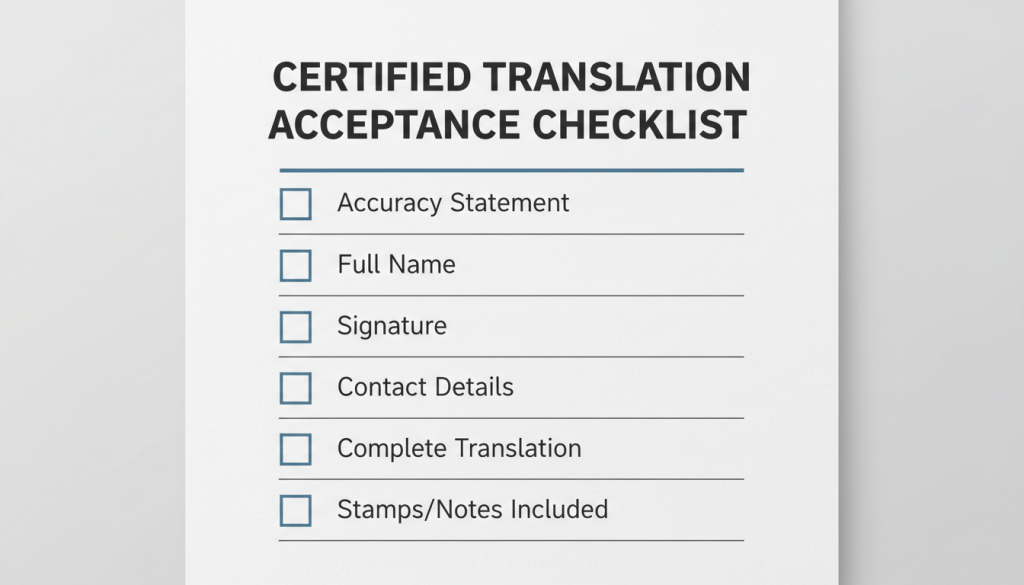
A reliable certified translation is usually accepted because it’s independently verifiable and complete.
Look for a certification that includes:
- confirmation it is an accurate translation of the original
- date of translation
- translator/agency full name and signature
- translator/agency contact details
- the translated document attached (complete, including stamps/notes where relevant)
If any of these are missing, you risk delays, requests for resubmission, or rejection.
If you want a provider that follows established UK certification conventions for official submissions, start with:
Transcribe Lingo certified translations
Common documents people need translated and certified
Personal documents
- Birth certificates
- Marriage certificates
- Divorce documents
- Death certificates
- Passports / ID pages (where required)
- Driving licences
- Police certificates / DBS-equivalent records
- Name change deeds / deed poll documents
For birth certificates specifically: Birth certificate translation service
Academic and professional documents
- Diplomas and degree certificates
- Transcripts
- Reference letters
- Professional registration letters
Legal and financial documents
- Court orders and judgments
- Contracts and affidavits
- Bank statements (when requested)
- Company documents (for overseas filing)
For court- and solicitor-facing work: Legal document translation
How to choose the right service (without overpaying)
Use this simple rule:
Choose the lightest option that meets the requirement.
Certified is often enough for UK submissions. Notarised/apostilled is typically for overseas authorities that explicitly ask for it.
When comparing providers, ask these five questions:
- Will the translation include a signed certification statement suitable for official use?
- Do you match formatting and official fields exactly (names, dates, numbers, stamps)?
- Can you deliver as a secure PDF and post a hard copy if required?
- What’s the turnaround time for my exact document and language pair?
- If the receiving body asks for notarisation/apostille, can you handle that too?
If you’d rather skip the back-and-forth:
Use the contact page or go straight to certified translation services and send your file with the purpose (visa, passport, university, court, etc.). You’ll get a clear quote and delivery plan.
What to avoid (these cause the most delays)
- Self-translation (even if you’re fluent, many authorities require independent verification)
- Machine translation output without professional review and proper certification
- Missing stamps/notes (official documents often include marginal notes, seals, registration details)
- Name inconsistencies (one letter difference can trigger follow-up checks)
- Vague “certified” claims with no signature/contact details/date
A good provider will proactively flag issues like unclear scans, missing pages, or conflicting spellings before they become a problem.
What the process looks like (done properly)
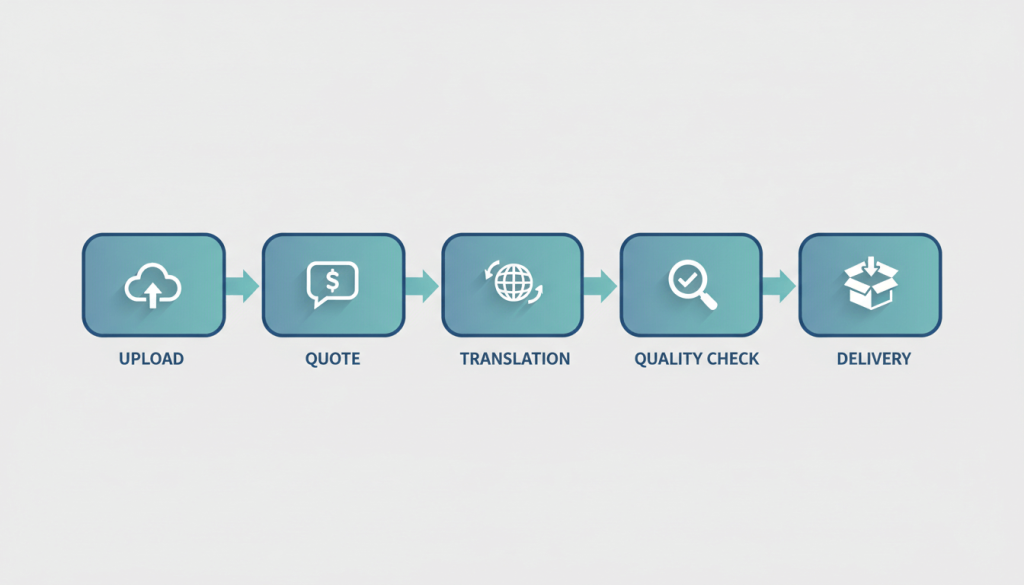
Here’s the standard workflow most people should expect:
- Send a clear scan/photo (all pages, including backs if there’s text/stamps)
- Receive a fixed quote and delivery timeline
- Translation by a specialist linguist (matched to document type and destination)
- Quality check for names, dates, numbers, formatting
- Certification added and delivery sent (secure PDF; optional posted hard copy)
Start the process here: Get a certified translation quote
“Super fast, and Home Office accepted it with no questions!” — Maria G.
FAQs
Where can I get documents translated and certified near me?
You can use a local translation agency or a qualified translator, but many people choose an online provider for faster turnaround. The key is ensuring the translation includes a proper certification statement and is independently verifiable.
Where to get documents translated and certified for immigration?
For immigration, use a provider experienced in official submissions who supplies a signed certification statement and matches names/dates exactly to the original. If you’re unsure what level you need, share the authority’s instructions and your provider should advise the minimal compliant route.
Do I need notarisation or is certified translation enough?
Certified translation is often enough for UK submissions and many institutions. Notarisation is usually only needed when the receiving body explicitly requires a notary (often for overseas filings). If your instruction letter mentions apostille/legalisation, notarisation is likely part of the process.
How long does a certified translation take?
Short personal documents are commonly completed within 24–48 hours, with urgent options sometimes available. Complex legal bundles and multi-document packs can take longer depending on volume and formatting.
What should a certified translation include?
A certified translation should include a signed statement confirming accuracy, the date, the translator/agency name and signature, and contact details—plus the complete translated document.
Can I translate my own documents and get them certified?
Usually no. Many organisations require an independent translator/agency so the translation can be verified. If you’re in doubt, assume self-translation risks rejection and use a professional provider.
