
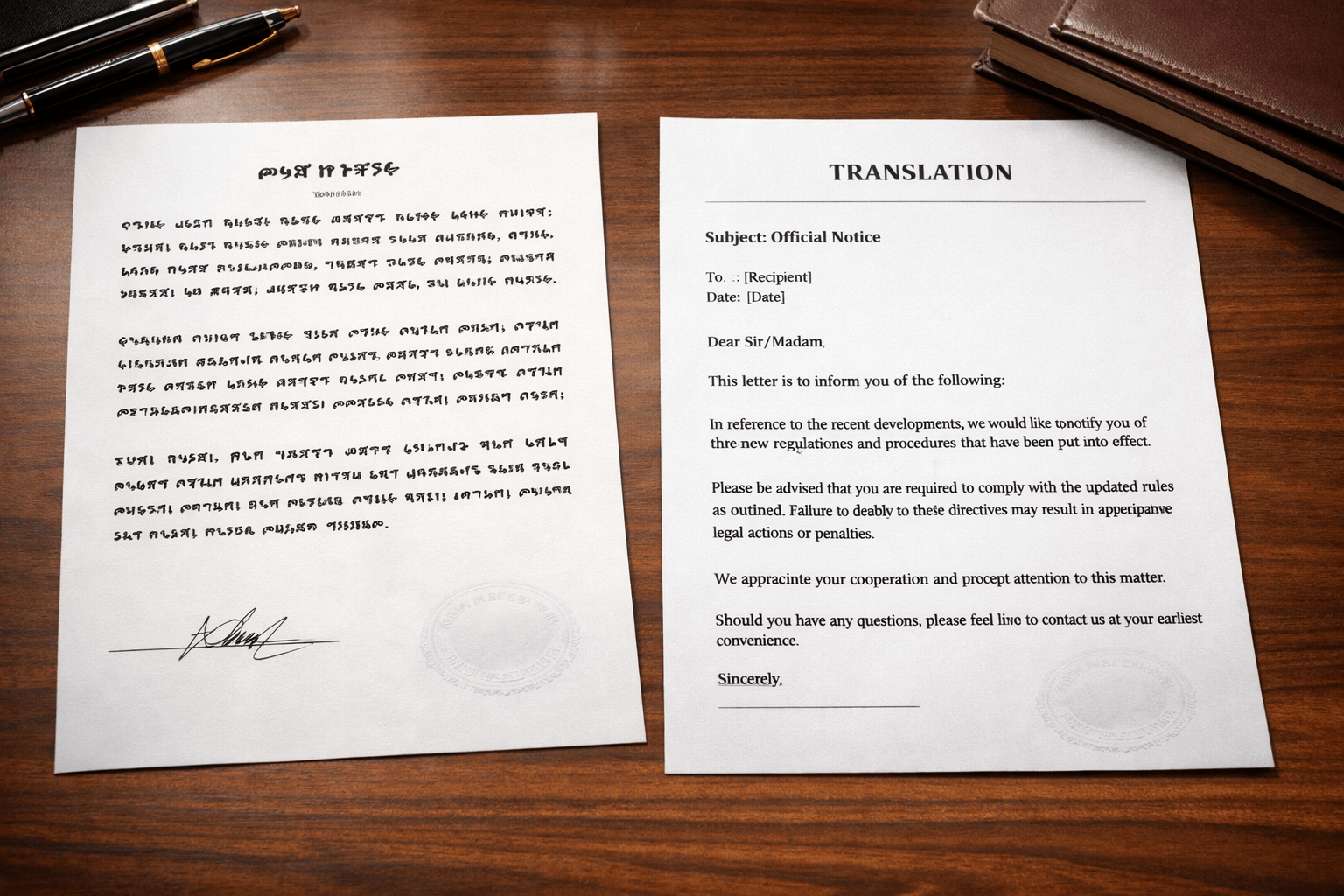
If you’ve searched “tigrigna translate to english”, you’ve probably noticed two things straight away: the language name is spelled in more than one way, and the results often focus on quick online tools rather than the real-world issues that cause rejections, delays, or misunderstandings.
This guide is for the situations where accuracy matters: passports and IDs, birth and marriage certificates, school records, legal paperwork, asylum evidence, medical letters, HR documents, and anything you may need to submit to an authority or institution.
You’ll learn how dialect differences can shift meaning, why Tigrinya names “multiply” when written in Latin letters, and how to format a Tigrinya translation in English so it reads cleanly and matches the original document.
When a quick translator is fine, and when it’s risky
Online tools can be useful for everyday messages. Problems start when you need consistency and traceability.
Use a quick tool when:
- It’s informal (texts, chats, short everyday messages)
- You’re only trying to get the gist
- There’s no consequence if a word choice is slightly off
Be cautious when:
- Names, places, or dates must match other records exactly
- The document includes stamps, seals, handwritten notes, or tables
- The content is legal, medical, financial, or immigration-related
- The receiving body can reject it if it’s incomplete or not verifiable
If you’re submitting documents, you typically need a translation that can be checked independently, with a clear certification statement and consistent formatting. For that, start with certified translation services or follow the step-by-step process in how to get a certified translation.
“Tigrigna” vs “Tigrinya”: what people mean (and why it affects your search)
You’ll see all of these:
- Tigrinya
- Tigrigna
- (sometimes) “Tigrinyan” or other variants
In practice, people usually mean the same language. The difference is romanisation preference and community usage, and it’s one reason the keyword tigrigna translate to english is so common: people type what they’ve seen on apps, community pages, or older spellings.
The important part is not what you call it, but what you’re translating:
- Which country/region the document comes from
- Whether the content is formal or conversational
- Whether the Latin-letter spelling must match an existing passport/BRP/visa file
Dialects: how Eritrean and Ethiopian usage can change the translation
Tigrinya is spoken across Eritrea and Ethiopia, and dialect differences can affect:
- Vocabulary choices (especially modern terms)
- How formal a phrase sounds
- Spelling preferences in Latin letters
- Idioms, greetings, and set phrases used in certificates or letters
A practical way to avoid dialect mistakes
Before translating, lock down three details:
- Origin of the document
Eritrea (often influenced by local administrative phrasing) vs Tigray region documents (often influenced by local Ethiopian administrative patterns). - Purpose of the translation
Home Office/UKVI, school admissions, court, medical, employer, embassy, banking, etc. - Name spelling reference
If the person already has a passport or visa record, your Latin spelling must follow that consistently, even if another spelling is “more accurate” linguistically.
If you’re unsure, upload your file for a quote and include a photo of the passport/ID page (if available) so the spelling can be aligned.
Spelling: why one name becomes five (and how to fix it)

The single biggest issue in tigrinya translate requests for official use is not the sentence translation. It’s names.
A single Tigrinya name can appear in Latin letters in multiple ways because:
- The script is syllabic, not alphabetic, so there isn’t always a one-to-one match
- Vowel rendering varies (a/e/ə-like sounds)
- Some consonants are represented differently (k/q, s/ṣ, h/ḥ, etc.)
- People inherit spellings from school records, older passports, or administrative habit
The “Name Consistency Rule” (use this every time)
For official documents, the best spelling is usually the one that already exists on:
- Passport / travel document
- BRP / visa vignette
- UKVI correspondence
- Previous official English records (bank, NHS, university)
If the source document spelling doesn’t match the passport spelling, don’t guess. A good translation will handle it transparently (for example, by keeping the passport spelling in the translation and noting variants where appropriate).
Create a simple “Name Spelling Map”
Use a mini table like this during translation (even if you don’t include it in the final output):
- Tigrinya script: (copy as shown)
- Passport/ID spelling: (the one that must be used)
- Other spellings found: (from certificates, school records)
- Decision: “Use passport spelling throughout”
This prevents the classic error where a birth certificate uses one spelling, a marriage certificate uses another, and the translation unintentionally introduces a third.
Script and typing: what makes Tigrinya tricky on screen
Tigrinya is written in the Ethiopic (Ge’ez) script. In digital documents, that can cause:
- Missing characters if the font isn’t embedded
- Copy/paste issues where characters change or spacing breaks
- Mixed-direction formatting problems when a document includes English, numbers, or Latin abbreviations
What to do if you’re copying Tigrinya text into a translation
- Work from a clear scan or native PDF whenever possible (screenshots often blur similar characters)
- Use Unicode-supporting fonts in your working file
- Keep the original script exactly as it appears for reference, even if the final output is English-only
- When a stamp or seal contains script that’s not fully legible, mark it as illegible rather than inventing content
For formal submissions, accuracy is not just “meaning”, it’s also completeness: stamps, seals, headers, handwritten notes, and marginal remarks can matter.
Formatting: how to present a Tigrinya translation in English so it’s accepted

Authorities usually expect the translation to mirror the original document’s structure. That means:
- Same order of sections
- Clear rendering of fields (names, dates, places, registration numbers)
- Stamps/seals described if not fully readable
- Signatures labelled (e.g., “Signature”)
- Handwritten notes either translated or marked “handwritten note (illegible)”
A clean formatting approach that works well
- Header: Document title (in English), plus a short descriptor like “Translation from Tigrinya”
- Body: Field-by-field translation in the same order
- Notes: Translator notes in square brackets where needed, for example:
- [Stamp: Ministry office seal, partially illegible]
- [Handwritten note: unreadable]
- Certification section: Statement of accuracy + translator details (when required)
If you need certified formatting, start here: certified translation services or contact the team directly via Contact Us.
Dates, numbers, and calendars: avoid silent conversion errors
Dates and numbers cause “quiet mistakes” because they look familiar.
Dates
Watch for:
- Day/month order differences
- Handwritten dates that can be misread (especially when ink is faint)
- Documents that refer to local administrative timing or non-Gregorian context
Best practice:
- Translate the date exactly as shown
- Use a clear English date format (e.g., 14 January 2026) to avoid ambiguity
- If the document uses a different calendar system or you’re uncertain, add a translator note rather than guessing
Numbers and IDs
- Keep ID numbers exactly as printed (including spacing or separators)
- Keep leading zeros
- If the number is partly unclear, mark it as partially illegible
Places and geographic names: pick one romanisation approach and stay consistent
Place names can be transliterated in more than one acceptable way. The risk is inconsistency within a bundle of documents.
A reliable approach is:
- Use the spelling found on the person’s existing English records when it exists
- Otherwise, choose one consistent romanisation method and apply it throughout
- Keep the original script for internal checking during translation
This matters most for:
- Birthplace
- Municipality/region
- Issuing authority names
- School names and institutions
A quick accuracy checklist (for translators and clients)
Before finalising any tigrinya translation in english, confirm:
- Names match the passport/ID spelling
- Dates are unambiguous and match the document
- All stamps, seals, signatures, and notes are addressed
- Numbers (IDs, registry, certificate numbers) match exactly
- Formatting mirrors the original document structure
- Any illegible parts are flagged clearly (not guessed)
Example: the most common real-world failure (and how to prevent it)
Scenario:
A client submits a translated birth certificate and school letter. The English spellings of the father’s name differ by one vowel across the two translations. The receiving body flags it as inconsistent identity evidence.
What fixes it:
- Use the passport/ID spelling as the “master spelling”
- Apply it across every document in the bundle
- Add a short translator note the first time it appears if the source spelling differs
- Run a final cross-document QA check specifically for names, dates, and reference numbers
This is exactly the kind of QA we build into document work such as legal document translation and certified submissions.
If you need it fast: what to prepare for a smoother turnaround
If you want the translation done quickly and correctly, send:
- Clear scans (not angled photos) of each page
- Any existing passport/ID spelling reference (photo is fine)
- The purpose (visa, court, school, employer, embassy)
- Your deadline and whether you need a certified statement
Then upload your document for a quote and you’ll receive a clear turnaround time and format recommendation.
If the request involves spoken content (voicemails, interviews, asylum testimonies), consider a combined workflow using transcription before translation to reduce interpretation errors.
FAQs
1) What does “tigrigna translate to english” usually mean?
It usually means translating Tigrinya (also commonly spelled Tigrigna) into English, often for documents, messages, or official use where spelling and formatting must be accurate.
2) Is “Tigrinya” different from “Tigrigna”?
They’re commonly used as alternative spellings for the same language. The key is using consistent spelling in English output, especially for names and places.
3) Why does my name have multiple spellings in a Tigrinya translation in English?
Because romanising from Ethiopic script to Latin letters isn’t one-to-one, and vowel/consonant rendering varies. For official use, the spelling should match your passport/ID whenever possible.
4) Can I use an online tool for tigrinya translate requests for UK submissions?
For informal understanding, yes. For submissions, you may need a translation that can be independently verified and includes the required certification details and consistent formatting.
5) How should stamps and seals be handled in a Tigrinya to English translation?
They should be translated or described clearly. If a stamp is partially unreadable, it should be marked as partially illegible rather than guessed.
6) Do dialect differences affect Tigrinya translation into English?
Yes. Dialects can influence word choice, tone, and set phrases. For best results, note the document origin and align names to official records.
